The African Cybercrime Economy
Remi Afon (Founder · Go Legit Africa)
Blacks in Cyber Village @ DEF CON 33 · Day 1 · Blacks in Cyber Village
Overview
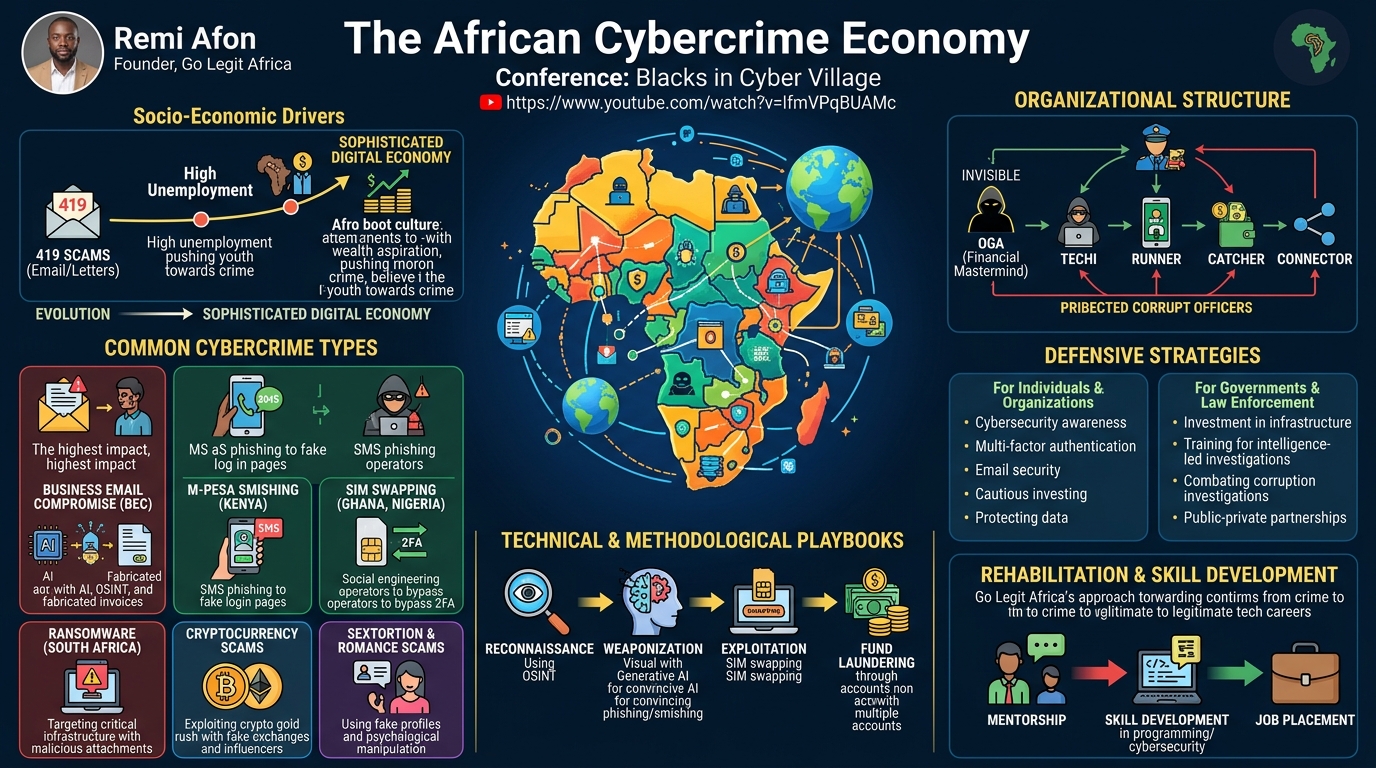
Remi Afon, founder of Go Legit Africa, delivers a compelling and in-depth analysis of the evolving African cybercrime landscape, moving beyond simplistic notions of "419 scams" to reveal a sophisticated, globally-connected digital underground. Titled "The African Cybercrime Economy: Inside the Playbooks of Digital Hustlers," this talk sheds light on the real-world tactics employed by cybercriminals, the socio-economic factors fueling their activities, and the critical need for innovative rehabilitation and upskilling initiatives. Afon's presentation not only dissects the intricate organizational structures and technical methodologies of these illicit operations but also offers a unique perspective from the front lines of efforts to redirect talent towards ethical pursuits.
Key moments
- 0:00 Speaker introduction and overview of African cybercrime talk
- 2:10 Key factors driving the rise of African cybercrime
- 4:00 Understanding the organized structure and roles of cybercriminals
- 6:00 The evolution of 419 scams and their sophistication
- 8:00 Recent 419 election fund scam using cryptocurrency
- 9:00 M-Pesa smishing fraud and SIM swapping in Kenya
The African Cybercrime Economy
Speakers: Remi Afon, Founder, Go Legit Africa
Conference: Blacks in Cyber Village
YouTube: https://www.youtube.com/watch?v=IfmVPqBUAMc
Overview
Remi Afon, founder of Go Legit Africa, delivers a compelling and in-depth analysis of the evolving African cybercrime landscape, moving beyond simplistic notions of "419 scams" to reveal a sophisticated, globally-connected digital underground. Titled "The African Cybercrime Economy: Inside the Playbooks of Digital Hustlers," this talk sheds light on the real-world tactics employed by cybercriminals, the socio-economic factors fueling their activities, and the critical need for innovative rehabilitation and upskilling initiatives. Afon's presentation not only dissects the intricate organizational structures and technical methodologies of these illicit operations but also offers a unique perspective from the front lines of efforts to redirect talent towards ethical pursuits.
The talk is particularly significant for its exploration of the human element behind cybercrime, emphasizing that while criminal acts must be addressed, understanding the root causes—such as high unemployment and limited opportunities for youth—is paramount. Afon, drawing on his experience with Go Legit Africa, advocates for a holistic approach that combines law enforcement with community transformation, mentorship, and skill development. This perspective is vital for cybersecurity professionals, policymakers, and community leaders seeking to understand and combat a growing global threat that leverages advanced social engineering, technical exploits, and a complex network of operatives.
Background
▶ Watch: Speaker introduction and overview of African cybercrime talk (0:00)
The perception of cybercrime in Africa has often been limited to the infamous 419 scam, a term derived from a section of the Nigerian criminal code pertaining to obtaining money by false pretenses. However, as Remi Afon elucidates, this landscape has evolved dramatically, transforming into a sophisticated, multi-faceted economy with specialized roles and increasingly technical attack vectors. The underlying drivers for this expansion are deeply rooted in socio-economic conditions, primarily high levels of unemployment among the continent's vast youth population. With limited legitimate opportunities, many young individuals are drawn to cybercrime as a perceived pathway to financial stability or quick wealth.
Compounding this issue is the influence of a "Afro boot culture," where musicians and public figures display immense wealth, fostering a desire for rapid accumulation of riches among impressionable youth. This aspiration, combined with a tendency to emulate successful peers, pushes individuals towards illicit activities when conventional avenues seem closed. The organizational structure of this evolving cybercrime ecosystem is remarkably well-defined and hierarchical. At the apex is the Oga (Yoruba for "master"), the financial backer and strategic mastermind who remains largely invisible to lower-level operatives, making apprehension challenging. Below the Oga are the Techi, responsible for technical execution, and the Runner, who directly executes scams, recruits new members, and interfaces with victims. The chain also includes the Catcher, functioning as a money mule, and the Connector, who acts as a dealer for various illicit services or information. Crucially, this intricate network is often protected by corrupt officers who are bribed to impede law enforcement efforts, further entrenching the criminal enterprises and making them difficult for agencies to penetrate.
Key Findings
▶ Watch: Understanding the organized structure and roles of cybercriminals (4:00)
Remi Afon's talk reveals several critical insights into the African cybercrime economy, highlighting its complexity, adaptability, and significant global impact.
Firstly, the sophistication and organization of African cybercrime have far outstripped the historical perception of simple 419 scams. This is no longer a collection of isolated opportunists but rather a highly structured, evolving economy with specialized roles, clear hierarchies, and robust collaboration mechanisms, often facilitated through platforms like Telegram.
Secondly, the talk identifies a diverse array of prominent cybercrime types, each tailored to specific regional contexts or victim profiles:
- 419 Scams: While still present, they have evolved from physical letters to sophisticated spear phishing, fabricated invoices, social engineering (leveraging platforms like LinkedIn), and fake websites. Recent examples include cryptocurrency payments, which paradoxically aided tracing due to KYC requirements.
- M-Pesa Smishing (Kenya): Exploiting the widespread mobile money platform, criminals use SMS phishing to direct users to fake login pages, stealing PINs and performing SIM swaps for account takeover.
- SIM Swapping (Ghana, Nigeria): Attackers social engineer mobile operators to block a victim's SIM, obtain a new one, bypass two-factor authentication (2FA), and gain access to banking and social media accounts. Nigeria has implemented biometric verification as a countermeasure.
- Business Email Compromise (BEC): Identified as the highest form of cybercrime in Africa, costing organizations significant sums. US and Western Europe are primary targets. Criminals use Open Source Intelligence (OSINT) to gather information, craft convincing emails (now aided by Generative AI like ChatGPT), impersonate executives or vendors, and request urgent fund transfers to fraudulent accounts.
- Ransomware: Prevalent in South Africa, targeting critical infrastructure like hospitals. Attacks typically begin with phishing emails containing malicious attachments, leading to encryption and Bitcoin ransom demands.
- Cryptocurrency Investment Scams: Exploiting the "crypto gold rush," these scams promise exorbitant returns (e.g., 100% in 90 days) through fake exchanges (e.g., CEX in Nigeria). They use aggressive marketing, including social media influencers, before disappearing with investor funds, leaving recruited local staff to face the consequences. Over $200 million was lost in the CEX scam alone.
- Sextortion: A rising and tragic trend, where criminals create fake social media profiles to chat with unsuspecting teenagers (17-24 years old), coerce them into sending nude images, and then blackmail them with threats of exposure to contacts and family, demanding payments. A 17-year-old in Michigan tragically committed suicide after being targeted.
- Romance Scams: Similar to sextortion in the use of fake profiles, but focused on building romantic relationships to solicit money.
Thirdly, the talk highlights the significant role of foreign nationals in orchestrating and funding these operations. These individuals often rent buildings, recruit unsuspecting local youth under the guise of legitimate employment, and provide the infrastructure and expertise for large-scale cybercrime, making up a substantial portion of arrested suspects (e.g., 193 out of 792 recent arrests were foreign nationals).
Finally, Afon underscores the formidable challenges in combating cybercrime in Africa. These include limited cybersecurity awareness, weak infrastructure with outdated systems, inadequate security measures, law enforcement agencies lacking capacity, resources, and expertise (often resorting to "crude methods" instead of intelligence-led approaches), and pervasive corruption that hampers investigations and prosecutions. The "Ogas" often hold reputable positions in society, further complicating detection and accountability.
Technical Deep Dive
▶ Watch: The evolution of 419 scams and their sophistication (6:00)
While the talk does not delve into specific exploit code or low-level vulnerabilities, it provides a detailed breakdown of the technical and methodological playbooks employed by African cybercriminals, illustrating a clear evolution in sophistication.
The foundational 419 scam, historically a simple confidence trick, has transformed into a multi-stage, digitally-driven operation. Early methods involving physical letters have given way to spear phishing campaigns, where attackers meticulously craft emails impersonating legitimate entities or individuals. This often involves social engineering to gather information from public sources like LinkedIn, allowing for the creation of believable narratives, such as requests for payment against fabricated invoices. Criminals also deploy fake websites that mimic legitimate businesses, tricking victims into making payments. The movement of funds has also evolved, with the use of cryptocurrency (e.g., Binance accounts) providing a perceived layer of anonymity, although this can sometimes lead to traceability through Know Your Customer (KYC) protocols, as seen in the $250,000 JD Vance/Trump campaign scam.
In Kenya, the widespread adoption of M-Pesa, a mobile money payment system, has led to prevalent smishing (SMS phishing) attacks. Users receive text messages containing malicious links. Clicking these links redirects them to fake M-Pesa login pages designed to harvest their PINs and other credentials. This stolen information is then used to hijack accounts, often facilitated by SIM swapping.
SIM swapping is a critical technique across Ghana and parts of Nigeria (though Nigeria has introduced biometric safeguards). Attackers first gather a victim's personal information through various means. They then use social engineering to contact the mobile operator, impersonating the victim and claiming to have lost their SIM card. By answering security questions, they convince the operator to block the original SIM and issue a new one. This new SIM allows them to bypass two-factor authentication (2FA) mechanisms linked to the phone number, granting access to banking apps, social media accounts, and other digital services, enabling widespread financial fraud and identity theft.
Business Email Compromise (BEC) is presented as the most financially damaging cybercrime originating from Africa. The technical process involves extensive Open Source Intelligence (OSINT) to identify high-value targets, such as company executives and individuals involved in financial processes. With the advent of Generative AI tools like ChatGPT, criminals can now draft highly convincing emails that perfectly mimic the language, tone, and context of the target organization or country, making them incredibly difficult to detect. These emails often contain urgent requests for large fund transfers, or they impersonate legitimate suppliers, claiming a change in bank account details. Attackers may also clone supplier websites to add legitimacy. The funds, once transferred, are rapidly moved through multiple accounts, a process known as fund laundering, making them difficult for law enforcement to trace. The BEC playbook typically follows these steps: Identify Targets (reconnaissance) -> Compromise Accounts (email blasts, gaining initial access) -> Impersonate Executive/Vendor (crafting credible fraud messages) -> Request Payment (urgent transfers) -> Launder Funds.
Ransomware attacks, particularly prominent in South Africa, typically begin with phishing emails carrying malicious attachments. Once executed, the ransomware encrypts the victim's data, and a ransom demand, usually in Bitcoin, is issued. This highlights the use of readily available, often "ransomware-as-a-service" kits, which lower the technical barrier for entry.
Cryptocurrency investment scams exploit the allure of high returns. Platforms like the fraudulent CEX in Nigeria promised 100% returns in 90 days. These platforms are often fake cryptocurrency exchanges or investment schemes, aggressively marketed through social media and influencers. The technical aspect here lies in creating convincing, albeit ultimately non-functional, investment interfaces that appear legitimate for long enough to attract substantial capital before the operators disappear.
Sextortion leverages social media platforms like Instagram. Criminals create fake accounts, often posing as attractive young females, to engage in conversations with unsuspecting teenagers (typically 17-24 years old). Through social engineering and psychological manipulation, they coerce victims into sending intimate images. Once obtained, these images become leverage for blackmail, with threats of public exposure to the victim's contacts or family unless a ransom (often in cryptocurrency) is paid.
The toolkits employed by these digital hustlers are a mix of freely available resources and dark web purchases. They include social engineering and reconnaissance tools for gathering information, phishing and credential harvesting tools to compromise accounts, and ransomware-as-a-service for executing encryption attacks. The use of AI-powered language models like ChatGPT is a game-changer, enabling criminals to generate grammatically correct, highly persuasive email templates that bypass traditional detection methods reliant on poor English or obvious grammatical errors.
Demo / Proof of Concept
▶ Watch: Recent 419 election fund scam using cryptocurrency (8:00)
The talk did not feature a live technical demonstration or proof of concept in the traditional sense of executing code or showcasing a specific exploit. Instead, Remi Afon provided numerous real-world examples and case studies from various African countries to illustrate the mechanics and impact of the cybercrime playbooks he described. These detailed accounts, such as the M-Pesa smishing in Kenya, the CEX crypto scam in Nigeria, and the tragic sextortion case in Michigan, served as compelling real-world demonstrations of the criminal tactics in action.
Defensive Implications
▶ Watch: M-Pesa smishing fraud and SIM swapping in Kenya (9:00)
Understanding the sophisticated and evolving nature of the African cybercrime economy, as detailed by Remi Afon, is crucial for developing effective defensive strategies. Defenders, including individuals, organizations, and governments, must implement multi-layered approaches to mitigate these threats.
For Individuals and Organizations:
- Enhance Cybersecurity Awareness: This is foundational. Users must be educated about common scam tactics, including spear phishing, smishing, fake websites, and the red flags of romance scams and cryptocurrency investment fraud. Training should emphasize verifying information through independent channels, especially for urgent financial requests.
- Implement Strong Authentication: Where possible, utilize biometric authentication (as Nigeria has for SIM changes) and robust multi-factor authentication (MFA) that is resistant to SIM swapping. While SMS-based 2FA is vulnerable, app-based or hardware token MFA offers greater security.
- Strengthen Email Security: Organizations should deploy advanced email security solutions, including DMARC, SPF, and DKIM, to detect and block spoofed emails. Employee training on identifying BEC attempts is paramount, emphasizing independent verification of payment requests, especially for large sums or changes in vendor banking details.
- Secure Mobile Payments: For regions heavily reliant on mobile money (like M-Pesa), users must be vigilant about SMS links and always access their accounts through official applications or verified URLs. Mobile operators should implement stronger identity verification for SIM replacement.
- Exercise Caution with Investments: Individuals should be highly skeptical of investment opportunities promising unrealistically high returns in short periods. Thorough due diligence is essential, and reliance on social media influencers for financial advice should be avoided.
- Protect Personal Information: Be mindful of the information shared online, particularly on social media, as it can be used for OSINT by criminals to craft more convincing social engineering attacks or to identify sextortion targets.
For Governments and Law Enforcement:
- Invest in Security Infrastructure: Governments must prioritize investment in modern, resilient cybersecurity infrastructure and implement adequate security measures to address systemic vulnerabilities that criminals exploit.
- Strengthen Law Enforcement Capacity: Law enforcement agencies require increased resources, specialized training in cyber forensics, and expertise to conduct intelligence-led investigations rather than relying on crude, often ineffective, methods. International collaboration is vital for tracing cross-border cybercrime and apprehending perpetrators like the Ogas and foreign nationals.
- Combat Corruption: Addressing corruption within law enforcement and judicial systems is critical to ensure that apprehended cybercriminals face prosecution and cannot bribe their way out of justice.
- Foster Public-Private Partnerships: Collaboration between government agencies, private cybersecurity firms, and non-profit organizations like Go Legit Africa is essential for sharing threat intelligence, developing joint strategies, and implementing rehabilitation programs.
Ultimately, a comprehensive defensive strategy must also acknowledge and address the underlying socio-economic drivers of cybercrime. Initiatives that provide education, skill development, and legitimate job opportunities—such as those championed by Go Legit Africa—are crucial for redirecting talent and preventing young individuals from turning to cybercrime in the first place.
Key Takeaways
- African cybercrime is highly sophisticated and organized: It has evolved far beyond simple 419 scams into a complex, multi-layered economy with specialized roles (Oga, Techi, Runner, Catcher, Connector) and often protected by corrupt officials.
- Socio-economic factors are key drivers: High unemployment, limited legitimate opportunities for youth, and a cultural drive for quick wealth contribute significantly to the proliferation of cybercrime across the continent.
- Diverse and evolving attack methods: Criminals employ a wide array of tactics, including advanced spear phishing, M-Pesa smishing, SIM swapping, financially devastating Business Email Compromise (BEC), ransomware, cryptocurrency investment scams, sextortion, and romance scams.
- Foreign nationals play a substantial role: External actors are increasingly involved in funding, organizing, and recruiting local youth into cybercrime operations, bringing in resources and infrastructure.
- Combating cybercrime requires a multi-faceted approach: Effective defense necessitates improved cybersecurity awareness, investment in robust infrastructure, enhanced law enforcement capacity, international collaboration, and concerted efforts to address corruption.
- Rehabilitation and skill development are crucial: Initiatives like Go Legit Africa demonstrate the importance of rehabilitating cybercriminals, providing skill development in areas like programming and cybersecurity, and facilitating job placement to offer legitimate alternatives and prevent recidivism.
About the Speaker(s)
Remi Afon is a highly experienced cybersecurity consultant with deep expertise spanning AI and ML security, cloud infrastructure, and DevSecOps. He is particularly recognized for his work in security-by-design initiatives and automation across the Software Development Life Cycle (SDLC). Throughout his career, Afon has led significant security efforts in fast-paced IT and financial environments. He is the founder of Go Legit Africa, an organization dedicated to rehabilitating cybercriminals and redirecting their talents towards ethical hacking and legitimate tech careers. Prior to this, Remi Afon served as the president of the cybersecurity power of Nigeria. His insights are drawn from extensive practical experience and a unique understanding of the digital underground economy.
Reviews
Dr. Zero (Offensive Security Researcher) — SOLID
A competent threat-intel/case-study hybrid that does something genuinely useful: reframes African cybercrime from a punchline into a structured criminal economy with identifiable roles, regional variants, and socioeconomic roots. The speaker's Go Legit Africa work gives him a ground-level vantage point most researchers lack, but the talk stays at survey altitude — breadth over depth — and never delivers the kind of insider data or original methodology that would push it into must-see territory.
Heather Calloway (CISO) — SOLID
Afon brings genuine field credibility and a needed corrective to shallow narratives about African cybercrime — the organizational taxonomy alone is worth the session. But the talk stays at the level of informed description, and the defensive guidance it produces is generic enough to apply to any threat actor on any continent.