Weaponized Deception: Lessons from Indonesia's Muslim Cyber Army
Black Hat Asia 2025 · Day 1 · Briefings
Overview
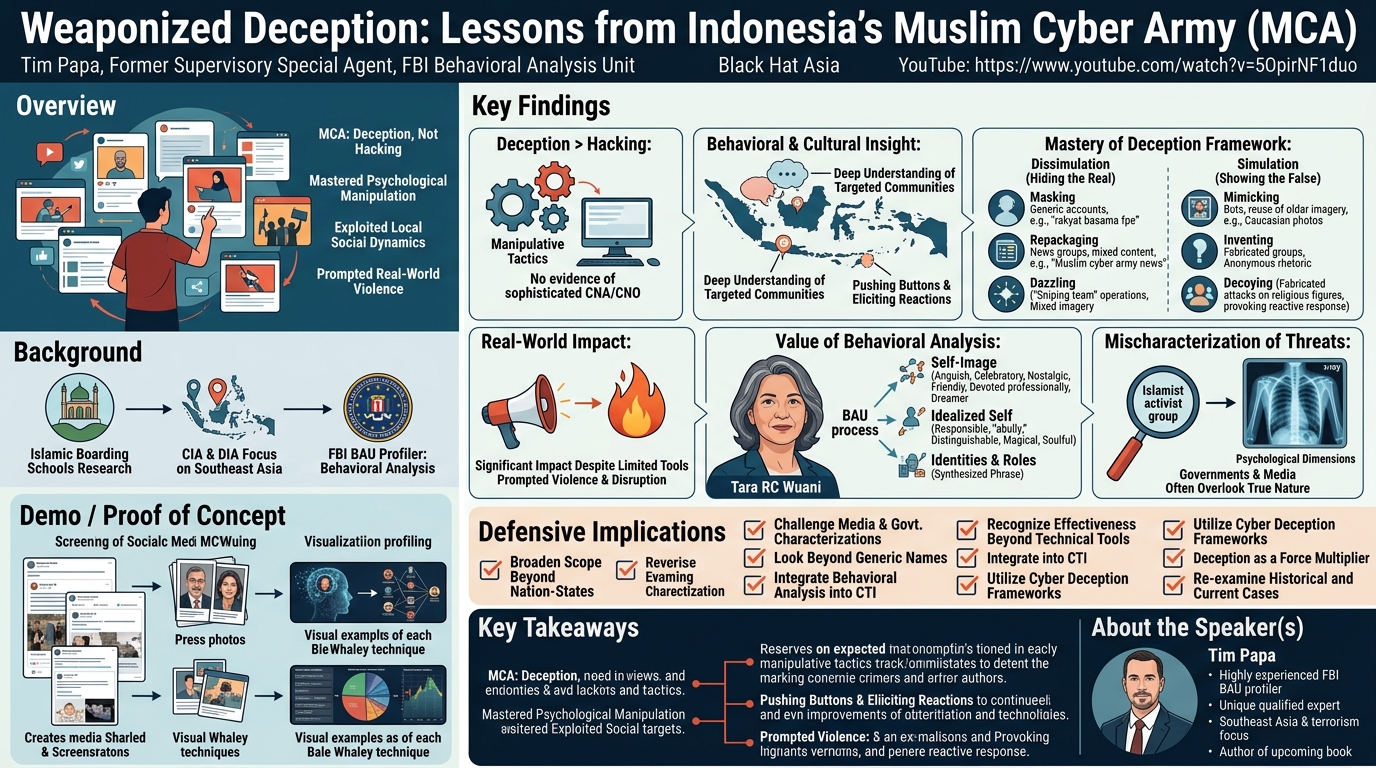
This compelling talk by Tim Papa, a former Supervisory Special Agent and profiler with the FBI's Behavioral Analysis Unit (BAU), re-examines the enigmatic case of Indonesia's Muslim Cyber Army (MCA). Far from being a group of sophisticated hackers, MCA's true danger lay in its masterful application of cyber deception, deeply rooted in a profound understanding of local social dynamics and human behavior. Papa challenges conventional threat intelligence paradigms that often overemphasize technical capabilities, arguing that governments and media frequently mischaracterize the true nature of such groups, leading to overlooked threats.
Key moments
- 0:00 Speaker's background and research focus
- 1:59 Presentation outline: MCA, profiling, deception framework
- 2:41 Muslim Cyber Army's core activities and impact
- 4:04 Re-examining MCA: local targeting and influence
- 5:50 MCA's core content themes and mimemetic nature
- 6:17 Debunking MCA's 'sniping team' and admin arrests
Weaponized Deception: Lessons from Indonesia's Muslim Cyber Army
Speakers: Tim Papa, Former Supervisory Special Agent, FBI Behavioral Analysis Unit
Conference: Black Hat Asia
YouTube: https://www.youtube.com/watch?v=5OpirNF1duo
Overview
This compelling talk by Tim Papa, a former Supervisory Special Agent and profiler with the FBI's Behavioral Analysis Unit (BAU), re-examines the enigmatic case of Indonesia's Muslim Cyber Army (MCA). Far from being a group of sophisticated hackers, MCA's true danger lay in its masterful application of cyber deception, deeply rooted in a profound understanding of local social dynamics and human behavior. Papa challenges conventional threat intelligence paradigms that often overemphasize technical capabilities, arguing that governments and media frequently mischaracterize the true nature of such groups, leading to overlooked threats.
The presentation provides a unique lens through which to analyze online influence operations, integrating principles of behavioral analysis with established deception frameworks. Papa demonstrates how MCA effectively manipulated religious and political sentiments within specific Indonesian communities, ultimately prompting real-world violence, despite their limited technical prowess. By dissecting the personality of a key MCA admin and mapping the group's tactics against the Bale Whaley deception framework, the talk offers critical insights for cyber threat intelligence (CTI) practitioners seeking to understand and counter non-technical, behaviorally-driven cyber threats.
This re-evaluation of MCA serves as a powerful reminder that the most impactful online operations are not always those with the most advanced tools, but rather those that expertly exploit human vulnerabilities and cultural nuances. Papa advocates for a more holistic approach to CTI, urging analysts to look beyond technical indicators and delve into the behavioral, social, and psychological dimensions of threat actors. The lessons drawn from MCA's weaponized deception are globally relevant, highlighting how easily groups can emerge and cause significant disruption by leveraging deeply ingrained community beliefs and emotional triggers.
Background
▶ Watch: Speaker's background and research focus (0:00)
Tim Papa's journey into understanding groups like the Muslim Cyber Army is deeply personal and professionally diverse. Nearly two decades ago, he lived in Islamic boarding schools, known as pasantran, in Indonesia, studying how religious leaders (KIE) communicated and built relationships within generational communities. This ethnographic research laid the groundwork for his later career, which included stints with the Central Intelligence Agency (CIA) and Defense Intelligence Agency (DIA), focusing on Southeast Asia and terrorism. When he joined the FBI, he eventually returned to cyber terrorism, spending his last six years as a profiler in the Behavioral Analysis Unit, where he periodically examined online threat actors from Indonesia and Southeast Asia. This unique background equipped him to apply behavioral analysis to complex cyber cases, including figures like Barun Naim, an individual with significant online influence despite being an unsophisticated hacker.
The Muslim Cyber Army first gained notoriety around 2018 in Indonesia, primarily for spreading "fake news" and "online hoaxes" that inflamed religious and political tensions. Their content often depicted religious leaders as persecuted, leveraging the "power of myth and folklore" by naturalizing historical events with strong emotions to make them "indisputable" to their audience. This led to widespread misinformation and disinformation, which Indonesian officials took very seriously, even labeling MCA members as "traitors" and conducting numerous arrests. However, after 2018, public discussion and research on MCA largely disappeared, with even an Indonesian police official dismissing them as "no longer a threat" in a recent conversation with Papa.
Papa challenges this conventional view, arguing that the true nature and threat of MCA were misunderstood. He highlights that MCA members grew up within and understood the very communities they targeted – the diverse and dynamic Islamic boarding school environments. This intimate knowledge allowed them to "push those buttons" and elicit strong reactions, much like how political discussions can become aggressive among friends and family during electoral seasons. While previous iterations of "Muslim Cyber Armies" existed globally with a mimetic quality (reflecting underlying beliefs and attitudes), the Indonesian MCA focused on themes of persecution and anti-LGBTQ content. Despite media portrayals of a sophisticated "sniping team" capable of computer network attacks (CNA) or computer network operations (CNO), Papa found no evidence of such advanced technical capabilities. Instead, their "organized functions" primarily involved creating and repurposing content, and orchestrating mass reporting campaigns to get accounts banned. The true origins of the Indonesian MCA also remain largely unknown, adding to the mystery surrounding the group.
Key Findings
▶ Watch: Muslim Cyber Army's core activities and impact (2:41)
Tim Papa's re-examination of the Muslim Cyber Army yielded several critical findings that challenge traditional understandings of cyber threats and underscore the importance of behavioral analysis:
- Deception, Not Hacking Prowess, Was MCA's Core Strength: Contrary to initial perceptions and media portrayals, MCA was not a group of skilled hackers engaging in computer network attacks. Papa found no evidence of sophisticated technical operations. Their "sniping team" primarily functioned by identifying target accounts, creating fake accounts to impersonate them, fabricating offensive content, or provoking hostile exchanges, then screenshotting and reporting these to social media platforms for bans. Their effectiveness derived from psychological manipulation rather than technical exploitation.
- Profound Behavioral and Cultural Understanding: MCA's most significant asset was its intimate knowledge of the communities it targeted, particularly the Indonesian Islamic boarding schools. Members lived in these neighborhoods, understanding the nuanced religious, political, and social dynamics. This deep behavioral insight enabled them to craft and disseminate content that resonated profoundly with local sentiments, effectively "pushing buttons" to inflame emotions and prompt specific reactions.
- Comprehensive Application of Deception Techniques: MCA demonstrated a sophisticated, albeit likely untaught, mastery of deception. Papa systematically mapped their activities against the established Bale Whaley deception framework, concluding that MCA employed nearly every technique within both dissimulation (hiding the real) and simulation (showing the false). This indicated a natural aptitude for strategic manipulation, even without formal training in military deception principles.
- Significant Real-World Impact Despite Limited Technical Tools: Despite using basic social media tools and lacking advanced cyber capabilities, MCA was highly effective and disruptive. Their deceptive campaigns successfully prompted misinformation, disinformation, and, crucially, real-world violence. This finding directly challenges the notion that only nation-state actors or highly skilled technical groups can achieve significant impact in the information environment.
- The Value of Behavioral Analysis in CTI: The case study of Tara RC Wuani, a leading MCA admin, highlighted the critical role of personality assessment in understanding threat actors. Wuani, a middle-aged, divorced single mother, defied the stereotypical image of an Islamist activist. By applying the FBI's Behavioral Analysis Unit (BAU) methodology, Papa revealed her complex personality traits (anguish, celebratory, nostalgic, friendly, devoted, dreamer, aspirational, distinguishable, magical, soulful) and potential vulnerabilities (self-actualization challenges, engagement in edgework). Understanding these personal dimensions provides invaluable insight into motivations and methods, which traditional technical analysis often misses.
- Mischaracterization of Threats: The MCA case serves as an example of how governments and news media can mischaracterize the true capabilities and threats posed by groups. By focusing solely on technical aspects or labeling them generically (e.g., "Islamist activist group" or "traitors"), the deeper, more dangerous behavioral and deceptive tactics are often overlooked, leading to an underestimation of their potential for disruption.
Technical Deep Dive
▶ Watch: Re-examining MCA: local targeting and influence (4:04)
The core of Tim Papa's technical deep dive revolves around the application of the Bale Whaley deception framework to analyze the Muslim Cyber Army's tactics. This framework, traditionally used in military deception, categorizes techniques into two main strategies: dissimulation (hiding the real) and simulation (showing the false), each with three specific techniques. Papa meticulously illustrates how MCA employed almost every one of these, demonstrating their inherent, if untrained, mastery of psychological manipulation.
Dissimulation: Hiding the Real
Dissimulation involves concealing genuine activities, identities, or intentions. MCA achieved this through:
- Masking (Hiding the real by making it invisible):
MCA admins created numerous social media accounts (primarily Facebook and Twitter at the time) and tags that were deliberately generic and common within Indonesian online discourse. For instance, phrases like "rakyat basama fpe" (meaning "the people stand with Islamic defenders front") were so ubiquitous that they blended seamlessly into the vast ocean of organic content. The purpose was to obscure their origin. These masked accounts would then be used to identify targets and orchestrate mass reporting campaigns, alleging violations of platform rules. Because the reporting accounts appeared innocuous and blended with legitimate users, social media platforms like Facebook and Twitter struggled to discern that MCA admins were systematically coordinating these actions. This technique effectively hid the true source of the coordinated attacks and allowed MCA to operate under the radar while causing significant disruption.
- Repackaging (Hiding the real by disguising):
MCA disguised its propaganda and influence operations within seemingly legitimate or broadly accepted online structures. A prime example was the creation of large Facebook news groups, such as "Muslim cyber army news," which amassed nearly 298,000 members. While the title itself wasn't inherently inflammatory, the sheer size of these groups provided an enormous distribution channel. Within these groups, MCA would mix overtly political or religiously charged content with seemingly innocuous posts. Papa showed examples of posts about the importance of integrity learned in pasantran (Islamic boarding schools) or featuring a politician they supported, presented in an uninflammatory manner. By blending their agenda with content that appeared benign or culturally resonant, MCA repackaged its true purpose, making it easier for their messages to be accepted and projected by a wide audience without immediate suspicion.
- Dazzling (Hiding the real by confusing or enticing):
This technique involves overwhelming or confusing the adversary with excessive or misleading information. MCA employed dazzling in several ways:
- "Sniping Team" Operations: Despite the lack of technical hacking, MCA's "sniping team" engaged in a form of dazzling. They would schedule specific times, often twice a day, to go online and identify accounts they wanted banned. To achieve this, they would create entirely new accounts designed to masquerade as their targets. They would then either fabricate offensive content under the target's "identity" or engage the target in conversations, provoke an offensive exchange, screenshot it, and then report it to Facebook and Twitter. This created a confusing trail, making it difficult for platforms to ascertain the true aggressor and the fabricated nature of the "violations."
- Mixed Imagery and Affiliations: MCA intentionally used a mix of imagery commonly associated with other activist groups, including symbols reminiscent of Anonymous (e.g., the Guy Fawkes mask) and other Islamist activist groups. While MCA admins reportedly denied direct involvement with Anonymous, this visual blending was a deliberate act of dazzling. It confused observers and investigators, making it difficult to pinpoint MCA's specific ideology, capabilities, or true affiliations. In a crowded landscape of online activist groups, this allowed MCA to blend in and potentially benefit from the perceived legitimacy or fear associated with other, more well-known entities.
- Distributed Content Spreading: The sheer volume and distributed nature of MCA-originated content on platforms like Twitter served as a form of dazzling. Papa presented a visualization of content branching out to "so many thousands of users" over a two-week period. This rapid, widespread dissemination made it incredibly challenging for investigators to trace the origin of the content, creating a confusing and overwhelming data landscape.
Simulation: Showing the False
Simulation involves presenting false information or creating a misleading appearance. MCA's techniques included:
- Mimicking (Showing the false by imitating):
MCA created bots and anonymized accounts to project their content, often imitating legitimate users or generic online personas. These accounts frequently featured photos of Caucasian people, despite the content being in Indonesian. This seemingly innocuous detail was part of a broader strategy to make the accounts appear less suspicious or tied to a specific local identity, making it harder for observers to discern the true source or intent. The group also re-used older imagery from previous "Muslim Cyber Army" iterations, creating a false sense of continuity and a larger, more established movement than might have existed for their specific iteration. Allegations of MCA members being linked to Sarris, an Indonesian criminal syndicate paid to smear politicians, further blurred the lines, contributing to a deliberate state of confusion and myth-making.
- Inventing (Showing the false by fabricating):
This technique involves creating entirely false information or scenarios. MCA engaged in inventing by:
- Fabricated Group Affiliations: MCA members would appear at protests and marches that had no direct affiliation with their group, carrying banners adorned with multiple MCA logos. This created a false impression of widespread support, numerous affiliated groups, and a larger organizational structure than actually existed. To an unfamiliar public, it suggested a formidable and broadly supported movement.
- Adopting Anonymous-like Rhetoric: Despite denying direct ties, MCA utilized language strikingly similar to Anonymous's "we are legion" ethos. Their posts included phrases like "we are Muslim, we are brother, and we are Muslim cyber army." This deliberate adoption of familiar activist rhetoric further invented a connection to a globally recognized movement, adding a layer of perceived power and legitimacy to their activities. This fed into a "political imagination" in Indonesia, where existing attitudes and beliefs made such fabrications easily digestible.
- Decoying (Showing the false by masquerading):
Decoying involves drawing attention to a false target or narrative to distract from the true intent or to provoke a specific reaction. MCA frequently used this to incite violence:
- Fabricated Attacks on Religious Figures: MCA would post fabricated content online about KIE (religious figures) being attacked outside mosques. While such incidents were rare, MCA claimed to have over 50 different posts on this topic. They would leverage real, isolated incidents where a KIE might have died from an attack, but then amplify and generalize these into a widespread pattern of persecution. This created a powerful, emotionally charged myth that naturalized real events with exaggerated emotion, leading people to believe these attacks were common and widespread. This highly effective decoying tactic was designed to provoke a strong, reactive response and, in some cases, directly prompted violence by leveraging deeply ingrained religious sentiments and fears of persecution within the communities.
Through these sophisticated yet non-technical deception techniques, the Muslim Cyber Army achieved a significant impact, demonstrating that a deep understanding of human behavior and social dynamics can be a more potent weapon than advanced cyber tools.
Demo / Proof of Concept
▶ Watch: MCA's core content themes and mimemetic nature (5:50)
While the talk did not feature a live technical demonstration or a software-based proof of concept in the traditional sense, Tim Papa provided a powerful demonstration of his analytical methodology. He meticulously walked the audience through the process of conducting a personality assessment on a key Muslim Cyber Army admin, Tara RC Wuani, applying the very techniques used by the FBI's Behavioral Analysis Unit (BAU).
This "demonstration" served to illustrate how behavioral analysis can be incorporated into cyber threat intelligence (CTI) practices. Papa outlined the BAU's four-bracket approach:
- Self-Image: Papa presented artifacts like a picture of Tara in anguish during a press conference, photos celebrating a wedding, nostalgic images from school reunions, and professional posts about her 30-year journey to becoming a professor. These were used to infer personality traits like being in anguish, celebratory, nostalgic, friendly, devoted professionally, and a dreamer. He also showed her continued commitment to a struggling business with her ex-husband, even as her life crumbled, highlighting her devotion.
- Idealized Self (Aspirational Self): This bracket focused on how Tara wished to be seen. Papa used her masked appearance at the press conference to suggest an aspirational desire for responsibility, even amidst her downfall. Pictures with her daughter and cheerful posts, despite impending divorce and arrest, pointed to an aspirational self as secure and "abully" (cheerful). Her attendance at a heavy metal band press conference suggested a desire to be seen as distinguishable or different. Finally, her choice of social media banners and posts about "good friends are like stars" and "soulmates" indicated a "magical" and "soulful" outlook, suggesting she might have viewed her involvement with MCA as "meant to be."
- Self-Actualization: This involved clinically imagining Tara's pathway of life goals and challenges. Papa noted her difficult move at 15, her adaptation, and open questions about her marital history (divorce, potential prior marriage, blended family with four children) which could have significantly shaped her vulnerabilities in a conservative community. He introduced the concept of edgework – voluntarily pursuing dangerous things when feeling a lack of control – as a possible motivator, suggesting she might have felt a heightened sense of self amidst personal turmoil.
- Identities and Roles: Here, Papa aimed to synthesize a single phrase capturing Tara's essence. While imagery related to Palestine was common in Indonesia, he concluded that her core identity was deeply tied to "relationships in her family," exemplified by her poignant post about keeping "great love... alive" amidst her life imploding.
This detailed profiling of Tara RC Wuani was a practical demonstration of how to extract behavioral insights from disparate artifacts (social media posts, press photos, public records) to construct a dynamic, holistic understanding of a threat actor. Following this, Papa presented numerous specific examples of MCA's online content (screenshots of Facebook groups, Twitter feeds, protest banners, fabricated news posts) to visually demonstrate how each of the six Bale Whaley deception techniques was applied in practice. This combined approach showcased both the analytical framework and its real-world application, proving the efficacy of behavioral analysis in dissecting complex cyber deception campaigns.
Defensive Implications
▶ Watch: Debunking MCA's 'sniping team' and admin arrests (6:17)
The insights gleaned from the Muslim Cyber Army case study offer crucial defensive implications for cyber threat intelligence (CTI) practitioners, law enforcement, and policymakers:
- Broaden the Scope Beyond Nation-States and Russia: Defenders must actively seek out and analyze examples of cyber threats from diverse geographic and political contexts, moving beyond an exclusive focus on well-resourced nation-state actors or specific regions like Russia. The MCA case highlights that significant impact can come from unexpected quarters, and assuming a threat is negligible because it doesn't fit a common mold is dangerous.
- Challenge Media and Government Characterizations: It is imperative to critically re-evaluate how governments and news media characterize the capabilities and threats of groups. Mischaracterizing a group as primarily a "hacker" collective when its true power lies in deception can lead to misallocation of resources and ineffective countermeasures. Defenders should look deeper than official narratives to understand the actual mechanisms of influence and harm.
- Look Beyond Generic Group Names: Generic or seemingly unsophisticated group names, like "Muslim Cyber Army," often mask deeper social attitudes, beliefs, and grievances within a community. CTI should investigate these underlying cultural and behavioral drivers, as they are often the "buttons" that threat actors leverage for maximal impact. Understanding these roots provides better predictive intelligence.
- Recognize Effectiveness Beyond Technical Tools: The MCA demonstrated that threat actor collectives can be incredibly effective and disruptive even with limited technical capabilities and tools. Their power was derived from behavioral exploitation and sophisticated deception. CTI frameworks must evolve to incorporate non-technical indicators of effectiveness, such as social engineering, influence operations, and behavioral manipulation, rather than solely focusing on malware, exploits, or infrastructure.
- Integrate Behavioral Analysis into CTI: Incorporating behavioral analysis and personality assessment into CTI practices is paramount. Understanding the interpersonal relationships, personal lives, and motivations of threat actors (as demonstrated with Tara RC Wuani) can provide invaluable insight into why individuals join these groups, what drives their actions, and how they choose their targets and methods. This adds a crucial human dimension to threat intelligence, moving beyond mere technical indicators.
- Utilize Cyber Deception Frameworks: Employing structured analytical frameworks like the Bale Whaley deception framework can reveal hidden techniques and strategies that are not tool-dependent. These frameworks help analysts systematically identify how adversaries are hiding the real (dissimulation) and showing the false (simulation), providing a more comprehensive understanding of their operational methodology and allowing for more targeted defensive strategies.
- Deception as a Force Multiplier: Defenders must acknowledge that cyber deception, particularly when behaviorally rich and culturally resonant, can act as a potent force multiplier, sometimes achieving impacts comparable to or even exceeding those of well-resourced nation-state operations. Its effectiveness is often independent of the actors' technical training or background.
- Re-examine Historical and Current Cases: Apply cyber deception frameworks to re-examine current and historical cases of online activism, cybercrime, and influence operations. This retrospective analysis can uncover previously overlooked insights into effective tactics and motivations, enriching the collective understanding of evolving threat landscapes.
By adopting these defensive implications, CTI professionals can develop a more robust, adaptive, and human-centric approach to understanding and countering the complex and evolving nature of online threats.
Key Takeaways
- Behavioral Analysis is Paramount: Understanding the human element, including motivations, personalities, and cultural nuances, is crucial for effective cyber threat intelligence, especially when dealing with non-technical deception.
- Deception is a Potent Force Multiplier: Non-technical cyber deception, when rooted in deep behavioral and cultural understanding, can be as impactful and dangerous as sophisticated technical attacks, even without advanced hacking skills.
- Challenge Conventional Threat Assessments: Do not solely rely on technical capabilities to assess a threat. Governments and media can mischaracterize groups, leading to an underestimation of their true disruptive potential if their behavioral and deceptive tactics are overlooked.
- Leverage Deception Frameworks: Analytical models like the Bale Whaley deception framework provide a structured way to identify and understand how adversaries hide the real and show the false, revealing non-tool-based techniques that are critical for defense.
- Interpersonal Dynamics Drive Motivation: Investigating the personal lives and interpersonal relationships of threat actors can offer invaluable insights into their motivations for joining groups and their targeting strategies, complementing technical analysis.
- Generic Names May Mask Deeper Issues: Groups with generic names often reflect deeper social attitudes and beliefs. A thorough investigation into these underlying dynamics is essential to understand the "buttons" being pushed in influence operations.
About the Speaker(s)
Tim Papa is a highly experienced and uniquely qualified expert in the field of behavioral analysis and cyber terrorism. He served as a Supervisory Special Agent and profiler with the Federal Bureau of Investigation's (FBI) Behavioral Analysis Unit (BAU), where he specialized in analyzing online threat actors.
Before his tenure at the FBI, Papa gained extensive international experience. He spent nearly two years living in Islamic boarding schools in Indonesia, conducting ethnographic research on communication and community building among religious leaders. His background also includes time with the Central Intelligence Agency (CIA) and the Defense Intelligence Agency (DIA), where his focus remained on Southeast Asia and terrorism.
Currently, Papa continues his research into the behavioral aspects of cyber threats in the industry, building on his extensive experience. He is also the author of an upcoming book, set to be released in August, which further explores the themes and research presented in this talk, applying behavioral analysis to complex case studies of online influence.
Reviews
Dr. Zero (Offensive Security Researcher) — MUST SEE
This talk is a masterclass in re-evaluating cyber threats through a behavioral lens, demonstrating how weaponized deception, not technical prowess, can yield devastating real-world impact. Papa, with his unmatched background, challenges the very foundation of traditional CTI by applying established military deception frameworks and FBI profiling methodologies to a misunderstood online influence operation. It's a critical recalibration for anyone serious about understanding modern information warfare, forcing a necessary shift from purely technical indicators to the human element.
Heather Calloway (CISO) — MUST SEE
Tim Papa's re-examination of the Muslim Cyber Army is a critical call to action for every CISO and security leader. It fundamentally challenges our often-myopic focus on technical capabilities, demonstrating how sophisticated deception rooted in behavioral and cultural understanding can achieve devastating real-world impact with minimal technical prowess. This talk isn't about exploits; it's about intelligence gaps, mischaracterization of threats, and the profound implications for governance and risk ownership when our threat models fail to account for the human element. It forces a necessary shift in how we approach cyber threat intelligence and executive decision-making.