Unveiling New Attack Vectors in Bluetooth Vulnerability Discovery through Protocol State Machine
Black Hat Asia 2025 · Day 1 · Briefings
Overview
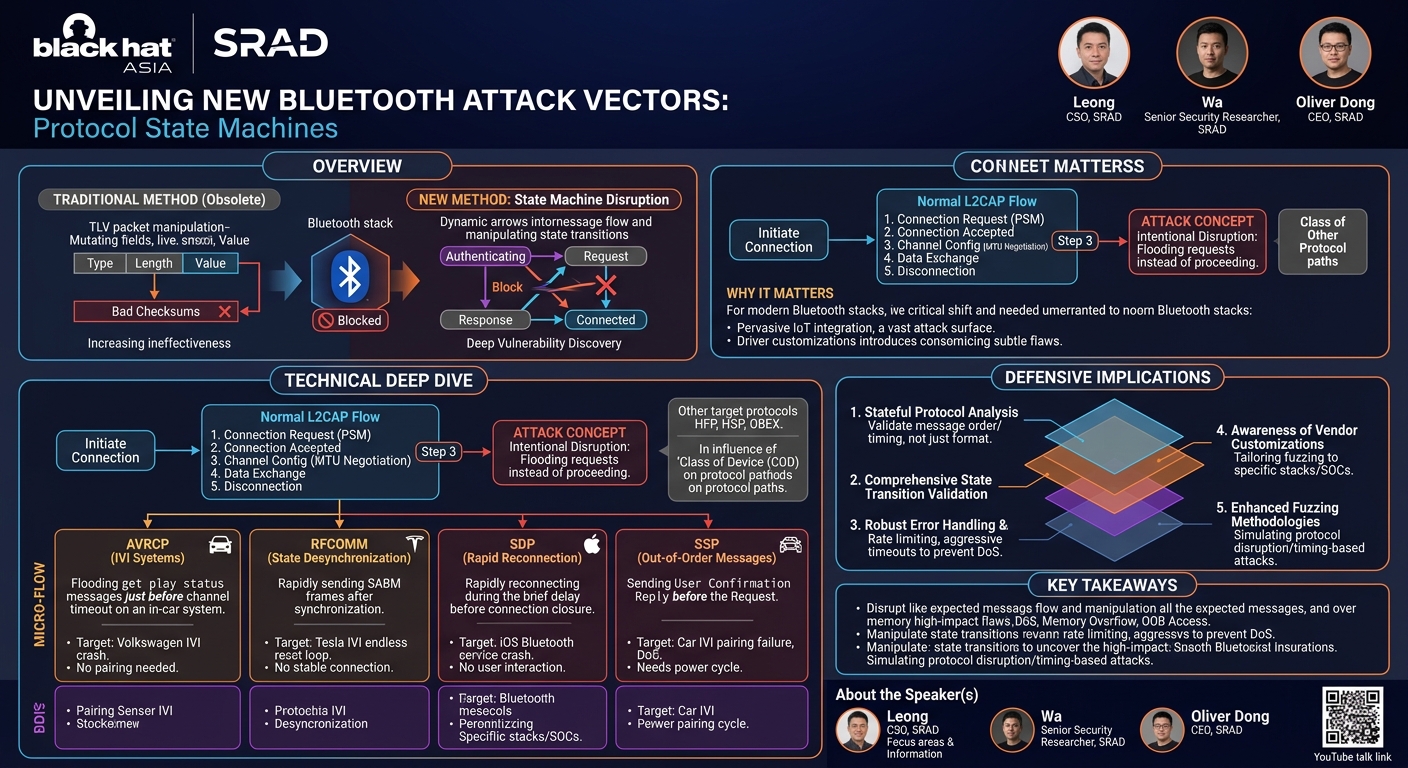
This talk, presented by Leong, Wa, and Oliver Dong from SRAD, introduces a groundbreaking methodology for discovering Bluetooth vulnerabilities by deconstructing and manipulating the underlying protocol state machines. Moving beyond the limitations of traditional fuzzing techniques, the researchers demonstrate how intentionally disrupting the expected flow of Bluetooth messages can uncover deep-seated, high-impact security flaws. The presentation highlights the critical shift in vulnerability discovery, emphasizing that modern Bluetooth stacks are resilient to simple packet mutations, necessitating a more sophisticated approach focused on state transitions and inter-protocol interactions.
Key moments
- 0:00 Introduction and talk agenda for vulnerability discovery
- 2:45 Overview of Bluetooth protocol stack and layers
- 4:00 Limitations of traditional fuzzing for Bluetooth vulnerabilities
- 6:00 Four key reasons traditional fuzzing fails
- 8:00 Evolution of Bluetooth bugs and new method introduction
- 10:00 Disrupting state machines to find new vulnerabilities
- 10:25 Identifying critical nodes in protocol interaction states
- 11:00 Walkthrough of an L2CAP connection establishment example
Unveiling New Attack Vectors in Bluetooth Vulnerability Discovery through Protocol State Machine
Speakers: Leong, CSO, SRAD; Wa, Senior Security Researcher, SRAD; Oliver Dong, CEO, SRAD
Conference: Black Hat Asia
YouTube: https://www.youtube.com/watch?v=3M9UT77VFIA
Overview
This talk, presented by Leong, Wa, and Oliver Dong from SRAD, introduces a groundbreaking methodology for discovering Bluetooth vulnerabilities by deconstructing and manipulating the underlying protocol state machines. Moving beyond the limitations of traditional fuzzing techniques, the researchers demonstrate how intentionally disrupting the expected flow of Bluetooth messages can uncover deep-seated, high-impact security flaws. The presentation highlights the critical shift in vulnerability discovery, emphasizing that modern Bluetooth stacks are resilient to simple packet mutations, necessitating a more sophisticated approach focused on state transitions and inter-protocol interactions.
The significance of this research stems from Bluetooth's pervasive integration into countless smart devices, from smartphones and automotive systems to IoT endpoints. As a wireless technology, Bluetooth presents a vast attack surface susceptible to remote exploitation, making robust security paramount. The speakers argue that continuous updates to Bluetooth standards and vendor-specific customizations in driver implementations often introduce subtle variations in state machine behavior, creating fertile ground for novel vulnerabilities that traditional methods fail to expose. This talk not only details their innovative methodology but also provides concrete examples of severe vulnerabilities found in commercial products, underscoring the urgency for a paradigm shift in Bluetooth security testing.
Background
▶ Watch: Introduction and talk agenda for vulnerability discovery (0:00)
Bluetooth technology, a cornerstone of modern connectivity, underpins a vast ecosystem of smart devices. Its architecture is complex, comprising numerous nested protocols, each with a specific function. Key protocols include L2CAP (Logical Link Control and Adaptation Protocol), SDP (Service Discovery Protocol), RFCOMM (Radio Frequency Communication), A2DP (Advanced Audio Distribution Profile), AVRCP (Audio/Video Remote Control Profile), OBEX (Object Exchange), HSP (Headset Profile), HFP (Hands-Free Profile), and BNE (Bluetooth Network Encapsulation). These protocols are often used in combination, with L2CAP and RFCOMM forming foundational layers for most application profiles. For instance, L2CAP utilizes PSM (Protocol/Service Multiplexer) values to establish logical channels, upon which RFCOMM builds virtual serial port connections, supporting higher-layer profiles like HSP and SDP.
Historically, the most common method for discovering Bluetooth vulnerabilities has been TLV (Type-Length-Value) based fuzzing. This technique involves mutating fields within Bluetooth messages—such as repeating or nesting tags, increasing string lengths, or setting values to maximum/minimum—to trigger unexpected behavior. While effective in the past, leading to discoveries like the BlueBorne vulnerabilities in 2017, this approach is increasingly ineffective against modern Bluetooth stacks. Contemporary drivers and firmware often incorporate rigorous input validation, dropping malformed packets before they can reach vulnerable logic. Furthermore, traditional fuzzing frequently generates a high volume of invalid or random packets, wasting testing resources and failing to achieve deep code coverage or trigger complex state-dependent vulnerabilities.
The speakers highlighted four key reasons for the decline of traditional fuzzing: the generation of many random, invalid packets; stringent driver checks that drop malformed data; a lack of comprehensive test cases; and, critically, a poor understanding of protocol intricacies and interdependencies, leading to low state machine coverage. As evidenced by more recent discoveries like BleedingTooth (2020) and BlueDuck (2023), vulnerabilities have evolved from simple packet format issues to more complex flaws residing in state changes and data fragmentation. This trend signifies that merely modifying message fields is no longer sufficient to uncover the sophisticated, high-impact bugs prevalent in today's Bluetooth implementations. The problem's persistence is exacerbated by the fact that Bluetooth protocol definitions are often broad, allowing vendors to implement customized drivers and SOC (System-on-Chip) chipsets that exhibit subtle variations in state execution, creating unique attack surfaces.
Key Findings
▶ Watch: Limitations of traditional fuzzing for Bluetooth vulnerabilities (4:00)
The central finding of this research is that traditional TLV-based fuzzing is largely obsolete for discovering new vulnerabilities in modern Bluetooth stacks. Instead, the most impactful vulnerabilities are now found by analyzing and manipulating the protocol state machine. The speakers demonstrated that by intentionally disrupting the expected message flow and state transitions, attackers can uncover deep, high-impact security flaws that lead to Denial of Service (DoS), memory overflow, and out-of-bounds (OOB) access.
A critical insight is that vendor customization of Bluetooth drivers and firmware introduces significant variations in how state machines behave across different platforms (e.g., Linux vs. Android, or different SOC chipsets). These platform-specific deviations create unique vulnerabilities that cannot be predicted by merely adhering to general protocol specifications. The researchers' method focuses on identifying and targeting "critical nodes" within protocol interactions, such as authentication steps, request and response exchanges, connection setup, and handshake behaviors. By focusing on these sensitive areas and intentionally sending out-of-order or excessively repeated messages, they were able to force devices into unexpected states, triggering resource exhaustion or protocol stack crashes.
The practical application of this methodology led to the discovery of several remote vulnerabilities across various core Bluetooth protocols, including L2CAP, AVRCP, RFCOMM, SDP, and SSP. Crucially, many of these exploits did not require any prior pairing or user interaction, allowing for silent, remote attacks. Specific examples included causing system-wide crashes on smartphones and automotive IVI (In-Vehicle Infotainment) systems, and forcing Bluetooth modules into endless reset loops. These findings underscore the urgent need for a shift in Bluetooth security testing, moving from static packet analysis to dynamic, state-aware manipulation to effectively identify and mitigate advanced threats.
Technical Deep Dive
▶ Watch: Evolution of Bluetooth bugs and new method introduction (8:00)
The core of SRAD's novel methodology lies in the intentional disruption and reconstruction of Bluetooth protocol state machines. The researchers emphasize identifying critical nodes in protocol interactions, such as authentication, request/response exchanges, connection setups, and handshakes. They also pay close attention to factors influencing state transitions, including protocol versions, driver-specific behaviors (e.g., Linux vs. Android Bluetooth stacks), and variations across different SOC chipsets. These variations arise because Bluetooth protocol definitions are often broad, allowing vendors to customize their implementations, which in turn leads to unique state machine behaviors.
Let's delve into specific examples across various Bluetooth protocols:
L2CAP Protocol Manipulation
The L2CAP (Logical Link Control and Adaptation Protocol) is fundamental, establishing logical channels via PSM (Protocol/Service Multiplexer) values. A typical L2CAP connection flow involves:
- Connection Request: Master sends a request with a PSM value and CIDs (Channel Identifiers).
- Connection Acceptance: Slave checks service availability and accepts, setting up an initial connection.
- Channel Configuration: Both devices negotiate settings like MTU (Maximum Transmission Unit) size and Quality of Service parameters.
- Data Exchange: Channel is fully established, ready for data.
- Disconnection: Master sends a request, slave confirms, channel closes.
The attack strategy involves initiating a normal configuration request and, upon receiving a valid response, intentionally not proceeding to the next step. Instead, the attacker rapidly sends many more configuration request messages, for instance, repeatedly negotiating MTU parameters. This technique aims to test for resource exhaustion or protocol stack crashes. The researchers successfully ran a proof of concept (PoC) on a smartphone, confirming that this device was vulnerable and triggered a crash at the driver level, leading to an entire system crash, not just the Bluetooth service. A key finding was that certain L2CAP sub-messages can be sent without pairing, or by modifying the BlueZ source code to bypass pairing checks, enabling silent, remote interaction.
AVRCP Protocol Exploitation
The AVRCP (Audio/Video Remote Control Profile) is primarily used for media playback control, including the AVRCP browsing channel. Before use, the target device must be queried via SDP (Service Discovery Protocol) to confirm browsing feature support. The browsing channel relies on underlying Bluetooth connections: an A2DP (Advanced Audio Distribution Profile) connection for audio streaming and an AVCTP (Audio/Video Control Transport Protocol) channel for basic control functions. These connections are regularly monitored, and if a channel remains idle for too long, the device might automatically close the browsing channel.
The attack capitalizes on this connection status monitoring. Just before the channel times out, the attacker floods it with a large number of get play status messages. By sending these requests at a high rate, especially near the timeout threshold, the goal is to exhaust system resources and overload the protocol stack. This high-frequency traffic at the edge of session expiration can trigger unexpected behavior. In a test case, this led to a system crash, successfully verified on a Volkswagen IVI system. The researchers demonstrated that, without any physical contact or user interaction, as long as the IVI had Bluetooth turned on, a carefully crafted payload could cause the entire in-car entertainment system to crash. Furthermore, by continuously sending the payload within Bluetooth range, the car's central control system could be rapidly crashed even while the car was running.
RFCOMM Protocol State Desynchronization
RFCOMM (Radio Frequency Communication) frames are carried within L2CAP packet payloads, meaning an L2CAP connection must precede an RFCOMM connection. RFCOMM uses a reserved PSM value of 0x0003. The core RFCOMM connection flow involves:
- SABM (Set Asynchronous Balanced Mode): Initiator sends this frame to start the connection.
- UA (Unnumbered Acknowledge): If the responder's RFCOMM is active, it enters balanced mode and replies with a UA frame.
- Signaling Channel: Once a connection with DLCI (Data Link Connection Identifier)
0is established, it becomes the RFCOMM signaling channel. - Data Channel: A second RFCOMM channel is then set up for user data transfer, potentially involving parameter negotiation.
- Control/Disconnect: User data includes modem status commands; a disconnect command terminates the multiplexer.
The attack involves entering the synchronized balanced mode (after SABM and UA) and then continuously sending SABM frames rapidly. This action forces the device to repeatedly re-enter the link setup phase, testing for resource exhaustion, state desynchronization, or other unexpected behaviors. This PoC was demonstrated on a Tesla IVI system, causing the Bluetooth module to enter an endless reset loop, rendering it impossible to maintain any stable Bluetooth connection.
SDP Protocol Rapid Reconnection
The SDP (Service Discovery Protocol) is one of the most common Bluetooth protocols, known for vulnerabilities like BlueFrag (related to fragmentation handling). A critical aspect of SDP vulnerabilities is that the protocol often does not require any pairing or user interaction, allowing for silent, remote interaction with a target device as long as Bluetooth is active. SDP runs on top of L2CAP using a fixed PSM value of 0x0001. The basic interaction flow:
- Connection: Initiator sends a connection request, responder accepts, creating an L2CAP channel.
- SDP Request: Master sends SDP request packets (e.g., for service UUID, attribute ID).
- Response: Responder reads data from its SDP database and returns results over the L2CAP channel; an error is returned if no match is found.
While SDP doesn't have a complex state machine for direct manipulation, the researchers exploited a lesser-known behavior: a brief delay before the connection fully closes after use. The attack involves sending a normal SDP request and then rapidly attempting to reconnect and send new requests during this short window before the previous connection completely terminates. This technique caused the target device to enter a timeout state, as the protocol failed to respond properly. This PoC was successfully tested on iOS, where the rapid repeated requests crashed the Bluetooth service, with potential for exploitation, again without any pairing or user interaction.
SSP Protocol Out-of-Order Messages
SSP (Secure Simple Pairing) handles secure Bluetooth pairing. Its flow involves several steps, including:
- Connection Request: Local device sends
Create Connection Request(with a DLCI). - IO Request: Remote device replies with an
IO Request Event. - IO Cap Reply: Local device responds with an
IO Cap Reply. - User Confirmation: Remote device sends a
User Confirmation Request. - Pairing Complete: Local device replies with
User Confirmation Replyand waits for aCommand Complete, finally receiving aPairing Complete Event.
The attack involves sending the User Confirmation Reply too soon, specifically before receiving the User Confirmation Request. This out-of-order message handling causes the remote device to misinterpret the state, leading to issues like denial of service or conditional state machine mismatches. A demo showed this vulnerability affecting a car IVI system, where the system failed to register pairing with a standard device and required a power cycle to restore functionality.
Class of Device (COD) Considerations
While not a direct attack vector, the COD (Class of Device) field, which indicates the type of Bluetooth device, can influence state machine paths at the profile level. For example, some Bluetooth systems might reject connections based on COD mismatches (e.g., a phone rejecting a non-phone device, or an in-car entertainment system only accepting connections from devices identified as phones). This highlights how even seemingly benign fields can affect protocol behavior and potential attack surfaces.
Demo / Proof of Concept
▶ Watch: Disrupting state machines to find new vulnerabilities (10:00)
The talk effectively integrated several compelling demonstrations and proofs of concept to illustrate the efficacy of their state machine manipulation methodology:
- L2CAP Configuration Request Flooding on Smartphone: The speakers demonstrated that by rapidly sending multiple L2CAP configuration requests after an initial valid response, they could trigger a driver-level crash on a smartphone. This resulted in a complete system crash, not just a restart of the Bluetooth service, highlighting the severity of resource exhaustion vulnerabilities. This attack was shown to be possible without pairing, or by modifying the BlueZ stack to bypass such checks.
- AVRCP
Get Play StatusFlooding on Volkswagen IVI: A critical demonstration involved targeting a Volkswagen in-car infotainment system. By flooding the AVRCP browsing channel withget play statusmessages just before its connection timeout, the researchers induced a system crash. This was particularly impactful as it occurred remotely, required no user interaction, and could continuously crash the central control system while the car was in operation, posing a significant safety risk.
- RFCOMM
SABMFlooding on Tesla IVI: The presentation included a demo against a Tesla IVI system. By continuously sendingSABMframes after the RFCOMM synchronized balanced mode was established, the researchers forced the Bluetooth module into an endless reset loop. This effectively rendered the Bluetooth functionality unusable, preventing any stable connection and requiring a system intervention to restore.
- SDP Rapid Reconnection on iOS: A PoC against an iOS device showed that by rapidly attempting to reconnect and send new SDP requests during the brief connection closure delay, the Bluetooth service on iOS could be crashed. This vulnerability was significant due to its potential for exploitation and the fact that it required no pairing or user interaction, allowing for silent, remote attacks against Apple devices.
- SSP Out-of-Order User Confirmation on Car IVI: Finally, a demo illustrated how sending an out-of-order
User Confirmation Replyduring the Secure Simple Pairing process could disrupt the pairing mechanism of a generic car IVI system. The system failed to complete pairing with a standard device and required a power cycle to regain functionality, demonstrating a denial of service at the pairing level.
These demonstrations collectively showcased the ability to achieve severe impacts, ranging from system crashes and infinite reset loops to pairing failures, all remotely and often without requiring any prior authentication or user interaction.
Defensive Implications
▶ Watch: Walkthrough of an L2CAP connection establishment example (11:00)
The findings presented in this talk necessitate a significant re-evaluation of Bluetooth security strategies for both developers and defenders. The shift from simple packet validation to stateful protocol analysis is paramount. Developers must move beyond merely checking the format of individual messages and instead implement robust validation mechanisms that account for the expected sequence and timing of messages within the context of the protocol's state machine.
Key defensive implications include:
- Comprehensive State Transition Validation: Bluetooth stacks must rigorously validate all state transitions. Unexpected or out-of-order messages, even if syntactically correct, should be handled gracefully, potentially by dropping the packet, logging the anomaly, or resetting the connection, rather than allowing them to corrupt the stack or exhaust resources.
- Robust Error Handling and Resource Management: Implementations need robust error handling for unexpected messages or protocol violations. Critical attention should be paid to preventing resource exhaustion attacks, where rapid, legitimate-looking requests (e.g., L2CAP configuration requests, AVRCP
get play statusmessages) can overwhelm system resources. This includes implementing rate limiting, connection quotas, and aggressive timeout mechanisms for idle or misbehaving connections. - Awareness of Vendor-Specific Behaviors: Given that vendor customizations and SOC-specific implementations introduce variations in state machine behavior, developers and security testers must understand how their specific Bluetooth stack deviates from generic specifications. Fuzzing and security testing should be tailored to these unique characteristics.
- Secure Protocols Without Pairing: Protocols like SDP, which often operate without requiring pairing or user interaction, represent a significant attack surface. These protocols must be secured with the same rigor as authenticated channels, implementing strict input validation and stateful checks to prevent silent, remote exploits.
- Enhanced Fuzzing Methodologies: Traditional TLV fuzzing is no longer sufficient. Security teams should adopt advanced fuzzing techniques that incorporate state machine manipulation, protocol flow disruption, and timing-based attacks. Tools that can dynamically adjust protocol sequences or inject faked timing signals are essential for discovering modern Bluetooth vulnerabilities.
- Proactive Cleanup and Timeout Mechanisms: Implementations should have strong mechanisms for cleaning up resources associated with incomplete or abandoned connection attempts and for gracefully handling timeouts. This prevents lingering states or resource leaks that could be exploited.
- Supply Chain Security: Given the reliance on SOC chipsets and third-party drivers, a comprehensive supply chain security strategy is vital to ensure that Bluetooth components are developed with security best practices in mind, including thorough state machine validation.
By adopting these defensive measures, organizations can significantly enhance the resilience of their Bluetooth-enabled devices against the sophisticated, state-aware attacks demonstrated in this talk.
Key Takeaways
- Traditional fuzzing is obsolete: Simple Type-Length-Value (TLV) mutation fuzzing is no longer effective against modern Bluetooth stacks, which employ robust packet validation.
- State machine manipulation is key: New attack vectors leverage intentional disruption of Bluetooth protocol state machines and out-of-order message flows to trigger vulnerabilities.
- Vendor customizations create unique flaws: Variations in Bluetooth driver implementations across different platforms and SOCs lead to platform-specific state machine vulnerabilities.
- Remote, unauthenticated attacks are prevalent: Many high-impact vulnerabilities can be exploited remotely without requiring prior pairing or user interaction, leading to system crashes, denial of service, and memory corruption.
- Critical protocols are vulnerable: Attacks were demonstrated across fundamental Bluetooth protocols including L2CAP, AVRCP, RFCOMM, SDP, and SSP, affecting devices from smartphones to automotive IVI systems.
- Defenders must adopt state-aware security: Security efforts must shift to comprehensive state transition validation, robust error handling, resource management, and advanced fuzzing techniques that mimic protocol flow disruption.
About the Speaker(s)
Leong is the CSO (Chief Security Officer) at SRAD. His primary research focus is on fuzzing technologies and the discovery of vulnerabilities in communication protocols.
Wa is a Senior Security Researcher at SRAD. His work primarily involves Bluetooth and Wi-Fi protocol vulnerabilities and their exploitation.
Oliver Dong is the CEO (Chief Executive Officer) at SRAD. His main interests lie in AI security and chip driver security. He led the technical deep dive section of the presentation.
Reviews
Dr. Zero (Offensive Security Researcher) — MUST SEE
This talk delivers a much-needed paradigm shift in Bluetooth vulnerability discovery, moving past the increasingly useless traditional fuzzing. The SRAD team has demonstrated a sophisticated, state-aware methodology that exploits protocol state machine disruptions, uncovering severe, often unauthenticated, remote vulnerabilities in critical devices from smartphones to automotive IVI systems. This is real research with high impact and requires genuine skill.
Heather Calloway (CISO) — STRONG ACCEPT
This research from SRAD delivers a critical message: the era of simple Bluetooth fuzzing is over. Modern vulnerabilities are found by manipulating protocol state machines, often leading to remote, unauthenticated attacks with severe business impact, particularly in critical systems like automotive IVI. It's a clear call for CISOs to re-evaluate product security testing, demanding a state-aware approach from their teams and vendors to address a pervasive, understated risk.