Closing Ceremony
Reed Loden
BSidesSF 2024 · Day 1
Overview
The "Closing Ceremony" at BSidesSF 2024, led by Reed Loden, served as a comprehensive retrospective on the conference's operational success, community engagement, and overall impact. Far from a mere farewell, this session provided a detailed statistical breakdown of participant numbers, volunteer efforts, technical infrastructure performance, and charitable contributions, highlighting the monumental undertaking of organizing a major security conference. The talk underscored the unique ethos of BSides events, where every individual is considered a participant rather than a passive attendee, actively contributing to knowledge sharing and community building.
Key moments
- 0:30 BSidesSF 2024 attendance: 2,682 participants, biggest ever.
- 1:40 Call for participation: almost 400 submissions, up 60% from last year.
- 2:30 Program statistics: lower acceptance rate for higher content quality.
- 4:10 Capture The Flag (CTF) stats: 1300 registered users, 850 teams, 48 challenges.
- 6:20 Network statistics: 1.4TB downloaded, 1250 unique Wi-Fi clients.
- 11:00 Volunteer effort: over 200 volunteers, 1,300+ human hours worked.
- 12:20 Financial realities: BSidesSF is the most expensive BSides globally, reliant on sponsors.
Closing Ceremony
Speakers: Reed Loden
Conference: BSidesSF 2024
YouTube: https://www.youtube.com/watch?v=LmgTVkKKP-k
Overview
The "Closing Ceremony" at BSidesSF 2024, led by Reed Loden, served as a comprehensive retrospective on the conference's operational success, community engagement, and overall impact. Far from a mere farewell, this session provided a detailed statistical breakdown of participant numbers, volunteer efforts, technical infrastructure performance, and charitable contributions, highlighting the monumental undertaking of organizing a major security conference. The talk underscored the unique ethos of BSides events, where every individual is considered a participant rather than a passive attendee, actively contributing to knowledge sharing and community building.
This presentation is particularly significant as it reveals the scale and growth of BSidesSF, which achieved its largest attendance ever in 2024, defying post-pandemic trends that have "decimated" many in-person conferences. Loden's insights offer a transparent look into the logistical complexities, the dedication of a 100% volunteer team, and the critical role of sponsors in making such a large-scale, community-focused event possible in one of the world's most expensive cities. The detailed metrics presented provide valuable benchmarks for other community-driven events and demonstrate the vibrant health of the cybersecurity community's commitment to in-person collaboration and learning.
Background
▶ Watch: BSidesSF 2024 attendance: 2,682 participants, biggest ever. (0:30)
BSides conferences originated from the desire to create more accessible, community-driven security events, often serving as an "unconference" alternative or complement to larger, more commercial conferences. The core philosophy emphasizes participation, knowledge sharing, and fostering a collaborative environment. BSidesSF, as one of the prominent chapters, embodies this spirit, striving to provide high-quality, community-curated content without the commercial pressures often seen elsewhere. The speaker, Reed Loden, highlighted this foundational principle by stating, "there are no attendees at a BSides event, everybody is a participant," emphasizing active engagement over passive consumption.
The context for BSidesSF 2024 was particularly challenging, given the lingering effects of the COVID-19 pandemic on in-person gatherings. Many conferences struggled with attendance and operational logistics in the preceding years. Against this backdrop, BSidesSF's record-breaking numbers represent a significant achievement, signaling a strong resurgence in community desire for physical interaction and learning. The event's commitment to being 100% volunteer-run, coupled with its location in San Francisco—described as the "most expensive BSides in the world" to run—further amplifies the organizational hurdles and the dedication required from its staff and community. This background sets the stage for understanding the impressive statistics and operational details shared during the closing ceremony.
Key Findings
▶ Watch: Program statistics: lower acceptance rate for higher content quality. (2:30)
BSidesSF 2024 proved to be a landmark event, setting new records across multiple metrics and demonstrating robust community engagement. The key findings presented by Reed Loden painted a picture of unprecedented growth and operational success:
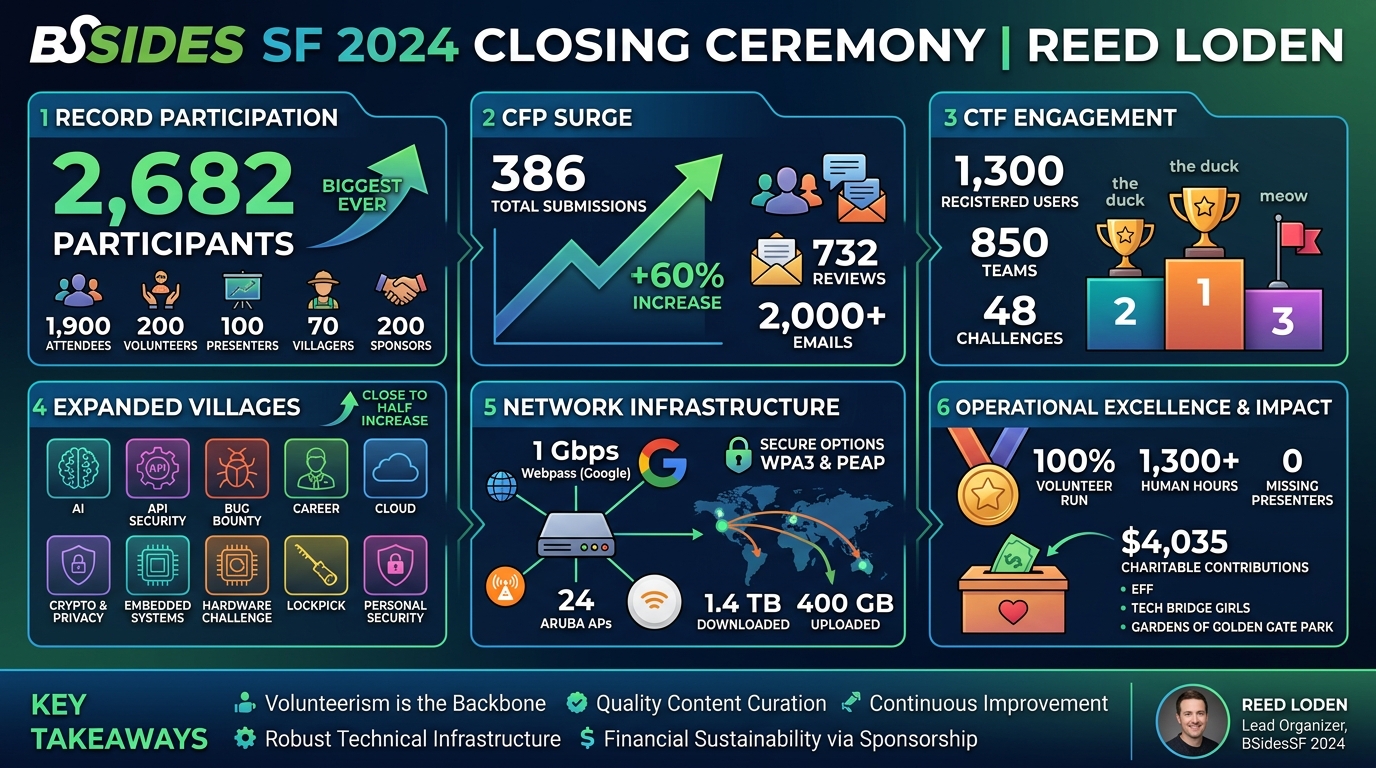
- Record Participation: The conference hosted a total of 2,682 participants, making it the "biggest BSidesSF ever." This figure included approximately 1,900 attendees, 100 presenters, 200 volunteers, 70 villagers, and nearly 200 sponsors. This record attendance was particularly notable given the post-COVID landscape, where many in-person conferences have seen reduced numbers.
- Surge in Call for Participation (CFP) Submissions: The event received almost 400 total submissions (386), a remarkable 60% increase from the previous year. These submissions spanned presentations, workshops, the new Birds of a Feather (BoF) track, panels, and villages. A dedicated program team of five people, supported by 12 reviewers, processed 732 different reviews and sent over 2,000 emails to manage the selection process. Despite the increased submissions, the acceptance rate decreased, allowing the organizers to be more selective and ensure higher quality content for the community.
- Expanded Villages: The number of Villages increased by "close to half" from the previous year, offering diverse hands-on experiences. The villages included AI, API Security, Bug Bounty, Career, Cloud, Crypto and Privacy, Embedded Systems, Hardware Challenge, Lockpick, and Personal Security Village. These interactive zones were highlighted as a core component of the BSides experience, extending beyond traditional talks.
- Record Capture The Flag (CTF) Engagement: The CTF saw 1,300 registered users, another record for the event. This translated to approximately 850 teams, with about 600 teams solving challenges. Notably, around 400 of these solving teams were on-site, while the CTF's global availability allowed for significant remote participation. The CTF featured 48 total challenges, meticulously crafted by a dedicated, independent team. On-site winners included "the duck" (1st), "meow" (2nd), and "Natty Kates" (3rd), with an honorable mention for the remote team "dcua."
- Significant Charitable Contributions: Through t-shirt sales, BSidesSF 2024 raised $4,035 for three chosen charities: Tech Bridge Girls, EFF (Electronic Frontier Foundation), and Gardens of Golden Gate Park. This demonstrated the conference's commitment to giving back to the broader community.
- Robust Network Infrastructure Usage: The conference network, powered by a 1 gig link from Webpass (Google), handled substantial traffic. Participants downloaded approximately 1.4 terabytes and uploaded 400 gigabytes. The network supported around 1,250 unique Wi-Fi clients across 24 Aruba Access Points (APs). An interesting metric was the split between PEAP and WPA3 usage, indicating that a significant portion of users opted for the more secure WPA3 network.
- Operational Excellence and Volunteer Dedication: The event achieved the rare feat of zero missing presenters, a testament to meticulous planning and coordination. The staff consumed over 10 pounds of jelly beans and collectively walked over 1 million steps (500+ miles). Over 200 volunteers worked more than 300 shifts, accumulating over 1,300 human hours across various roles, from setup and tear down to registration, moderation, and safety operations. Special challenge coins were awarded to volunteers who went "above and beyond."
- Sponsor Support: The conference acknowledged the critical role of nearly 200 sponsors, especially the five leading sponsors: Anthropic, Google, Microsoft, Secureframe, and Wiz. Their financial contributions are essential for running the "most expensive BSides in the world" in San Francisco, and their participation in the Career Village was vital for connecting participants with job opportunities.
These findings collectively highlight BSidesSF 2024 as a highly successful, well-attended, and meticulously organized event, driven by a passionate volunteer community and strong industry support.
Technical Deep Dive
▶ Watch: Capture The Flag (CTF) stats: 1300 registered users, 850 teams, 48 challenges. (4:10)
While the "Closing Ceremony" is not a traditional technical presentation on a specific vulnerability or tool, it provides valuable insights into the technical infrastructure and operational challenges of running a large-scale cybersecurity conference. The technical deep dive focuses on the network, CTF platform, live streaming capabilities, and electronic badges, all of which are critical for delivering a modern conference experience.
Network Infrastructure and Performance:
The backbone of any modern conference is its network, and BSidesSF 2024 deployed a robust setup to support its record number of participants. The conference utilized a 1 gigabit per second (Gbps) link provided by Webpass from Google. This high-bandwidth connection is crucial for accommodating the simultaneous internet access needs of thousands of security professionals, who often require significant bandwidth for research, tool downloads, and general connectivity.
The network distributed connectivity through 24 Aruba Access Points (APs) strategically placed throughout the venue. Aruba APs are enterprise-grade devices known for their reliability, performance, and advanced features like intelligent RF management and robust security protocols. These APs were responsible for serving approximately 1,250 unique Wi-Fi clients throughout the event. The sheer number of unique clients underscores the density of network usage and the need for a well-engineered wireless infrastructure to prevent congestion and ensure stable connections.
Traffic statistics revealed substantial usage: approximately 1.4 terabytes (TB) of data were downloaded and 400 gigabytes (GB) were uploaded over the course of the conference. This 3.5:1 download-to-upload ratio is typical for user-centric events, where participants primarily consume content (browsing, streaming, downloading tools) rather than generating large amounts of upload traffic. These figures demonstrate the critical need for a high-capacity internet link and a resilient internal network to handle such data volumes without performance degradation.
An interesting security-related metric was the split in Wi-Fi client connections between PEAP and WPA3. While the exact percentages were not explicitly stated, Loden noted that "a lot of people can just join in WPA," referring likely to WPA2-PSK or a less secure open network, but also highlighted "the people who went a step above for better security by getting on PEAP on the secure network." This implies that BSidesSF offered at least two distinct Wi-Fi networks: one potentially simpler to access (perhaps WPA2-PSK or even open with a captive portal) and another more secure, likely using WPA3-Enterprise with Protected Extensible Authentication Protocol (PEAP) for authentication. WPA3-Enterprise, combined with PEAP, provides stronger encryption and authentication mechanisms, often leveraging RADIUS servers for user or device authentication. The observation of users actively choosing the more secure option at a security conference is a positive indicator of the community's security awareness.
Capture The Flag (CTF) Platform:
The CTF is a cornerstone of many security conferences, providing hands-on challenges for participants. BSidesSF 2024's CTF was a significant technical undertaking, featuring 48 total challenges. While the specific platform or architecture was not detailed, the scale of participation—1,300 registered users forming 850 teams—suggests a robust and scalable infrastructure capable of handling concurrent user interactions, challenge deployment, and score tracking. The fact that the CTF was available "worldwide" and saw significant remote participation indicates a well-designed, internet-accessible platform, likely hosted on cloud infrastructure to ensure global reach and resilience. The independent CTF team's "countless hours" of work highlight the specialized technical expertise required to develop, deploy, and maintain such a complex system.
Live Streaming Capabilities:
To extend the reach of the conference beyond the physical venue, four different tracks were streamed live to YouTube. This required a dedicated NOC (Network Operations Center) team responsible for managing video encoding, streaming infrastructure, and ensuring stable connections. Live streaming involves significant technical challenges, including reliable internet egress, video capture and mixing, encoding for various platforms, and monitoring stream health. The NOC team, including individuals like Robin, BS, Ghost, Pep, Griffin, SeeV, Lrat, and Video Man, played a crucial role in making this possible, ensuring that remote participants could access the valuable content.
Electronic Badges:
A notable technical contribution was the development of electronic badges, specifically attributed to Joe Fitz. While no details were provided on the functionality or design of these badges, electronic badges at security conferences often incorporate microcontrollers, displays, and various sensors, sometimes allowing for interactive games, communication, or even custom programming. This adds a unique technical element to the attendee experience and often serves as a "hardware challenge" in itself.
In summary, the technical aspects of BSidesSF 2024, though not the primary focus of the closing ceremony, reveal a sophisticated and well-managed operational environment. The robust network, scalable CTF platform, professional live streaming, and innovative electronic badges collectively underscore the significant technical effort required to deliver a high-quality, engaging, and secure conference experience for thousands of participants, both on-site and remotely.
Demo / Proof of Concept
▶ Watch: Volunteer effort: over 200 volunteers, 1,300+ human hours worked. (11:00)
As the "Closing Ceremony" was a retrospective and statistical overview of the BSidesSF 2024 conference, it did not include any live technical demonstrations or proofs of concept. The presentation focused on summarizing the event's achievements, operational metrics, and community contributions rather than showcasing specific security tools, vulnerabilities, or research findings.
Defensive Implications
▶ Watch: Financial realities: BSidesSF is the most expensive BSides globally, reliant ... (12:20)
While the "Closing Ceremony" did not present traditional defensive security research, the operational insights shared by Reed Loden offer several "defensive implications" for conference organizers, participants, and the broader cybersecurity community. These implications relate to operational resilience, community building, and fostering a secure environment.
- Operational Resilience and Scalability: The record-breaking attendance (2,682 participants) and network usage (1.4 TB downloaded, 400 GB uploaded, 1,250 unique Wi-Fi clients) highlight the critical need for robust and scalable infrastructure. Conference organizers must "defend" against network congestion, service outages, and capacity limitations. The deployment of a 1 gigabit internet link and 24 Aruba APs demonstrates a proactive approach to ensuring network stability. For future events, continuous monitoring of network performance and planning for even higher capacities will be essential to maintain a positive participant experience.
- Secure Network Provisioning and User Education: The observation of a split between PEAP and WPA3 usage on the conference Wi-Fi is a key defensive metric. While offering a simpler, less secure option might be convenient, providing and promoting a more secure WPA3-Enterprise network (with PEAP authentication) is crucial, especially at a security conference. This "defends" participants against common Wi-Fi attacks like eavesdropping and rogue access points. Organizers should continue to educate participants on the benefits of using the more secure network and ensure its ease of access. The fact that many opted for the secure network indicates a baseline level of security awareness within the community that can be further leveraged.
- Community-Driven Content Curation as a Quality Defense: The significant increase in CFP submissions (up 60%) and the subsequent decrease in acceptance rate allowed the program team to be more selective. This acts as a "defense" against diluted content quality, ensuring that presentations, workshops, and panels are highly relevant and valuable to the community. A rigorous, multi-reviewer CFP process (732 reviews by 12 people) is a strong defensive measure against low-quality or commercially biased submissions, reinforcing the community-first ethos.
- Volunteer Engagement as a Force Multiplier: The reliance on over 200 volunteers contributing 1,300+ human hours is a testament to the power of community. This volunteer model "defends" against the prohibitive costs of paid staff, especially in an expensive city like San Francisco. Cultivating and recognizing this volunteer base (e.g., through challenge coins) is a defensive strategy for long-term sustainability and operational capacity.
- Financial Sustainability through Diverse Support: Running the "most expensive BSides in the world" requires substantial financial backing. The involvement of nearly 200 sponsors is a critical "defense" against financial instability. Diversifying sponsor relationships and demonstrating value (e.g., through the Career Village) ensures the event's continued viability. This also "defends" against potential single points of failure in funding.
- Feedback Mechanisms for Continuous Improvement: The emphasis on collecting feedback via
bsidessf.org/feedbackand directly through the Sched platform for individual sessions is a proactive "defensive" measure against stagnation and dissatisfaction. Actively listening to the community (e.g., improving coffee quality after years of feedback) ensures the conference evolves to meet participant needs, thereby "defending" its relevance and appeal. - Environmental Responsibility: The conscious decision to not over-order registration swag bags to avoid "a lot of waste at the end" is a "defensive" stance against environmental impact. While seemingly minor, this reflects a broader commitment to responsible event management, which can enhance the conference's reputation and appeal to environmentally conscious participants.
In essence, the "defensive implications" from the BSidesSF 2024 Closing Ceremony are less about cybersecurity vulnerabilities and more about the robust operational, community, and ethical strategies required to build, sustain, and grow a successful, secure, and impactful technical conference in a challenging environment.
Key Takeaways
- Record-Breaking Growth and Community Engagement: BSidesSF 2024 achieved its largest attendance ever with 2,682 participants, including a 60% increase in CFP submissions and record CTF engagement, demonstrating a strong resurgence in community interest for in-person events post-pandemic.
- Volunteerism is the Backbone: The conference operates entirely on a 100% volunteer model, with over 200 volunteers contributing more than 1,300 human hours, underscoring the critical role of community dedication in making such a large-scale event possible.
- Robust Technical Infrastructure is Essential: A 1 gigabit internet link, 24 Aruba APs, and a dedicated NOC team were crucial for supporting 1,250 unique Wi-Fi clients, handling 1.4 TB of downloads, and live-streaming four tracks, highlighting the significant technical demands of a modern security conference.
- Quality Content Curation through Rigorous Review: Despite a surge in submissions, a selective CFP process involving 12 reviewers and 732 reviews ensured a high-quality program, reinforcing the conference's commitment to valuable, community-driven content.
- Financial Sustainability Relies on Strong Sponsorship: As the "most expensive BSides in the world" to run, the event's viability is heavily dependent on the support of nearly 200 sponsors, whose contributions enable low ticket prices and facilitate career opportunities through initiatives like the Career Village.
- Continuous Improvement Driven by Participant Feedback: The organizers actively solicit and value participant feedback, using it to refine all aspects of the conference, from logistical details like coffee vendors to content quality, ensuring the event remains relevant and responsive to its community's needs.
About the Speaker(s)
Reed Loden served as the lead organizer for BSidesSF 2024. He has been deeply involved in organizing the conference since 2015, demonstrating a long-standing commitment to the BSides community. His role encompasses overseeing the myriad logistical, operational, and community-engagement aspects of the event, from managing volunteer teams and sponsor relations to ensuring the smooth execution of all conference tracks and activities. Loden's dedication, as highlighted in his closing remarks, is a key factor in the sustained growth and success of BSidesSF, an event that relies entirely on volunteer effort.
Reviews
Dr. Zero (Offensive Security Researcher) — WEAK
This 'session' is a logistical debrief of BSidesSF 2024, detailing attendance, submission statistics, volunteer efforts, and network usage. While providing transparency into the operational scale of a major community event, it offers minimal technical content, serving primarily as an organizational report rather than a research presentation.
Heather Calloway (CISO) — STRONG ACCEPT
This closing ceremony provides a transparent and comprehensive overview of BSidesSF 2024's operational success, highlighting the significant community engagement, volunteer dedication, and financial realities of hosting a large-scale cybersecurity conference. It underscores the critical role such events play in fostering talent, knowledge exchange, and industry resilience, offering valuable insights into the institutional effort required to sustain the cybersecurity ecosystem.