Where’s the Money-Defeating ATM Disk Encryption
Matt Burch
DEF CON 32 Main Stage · Day 1 · Main Stage
Overview
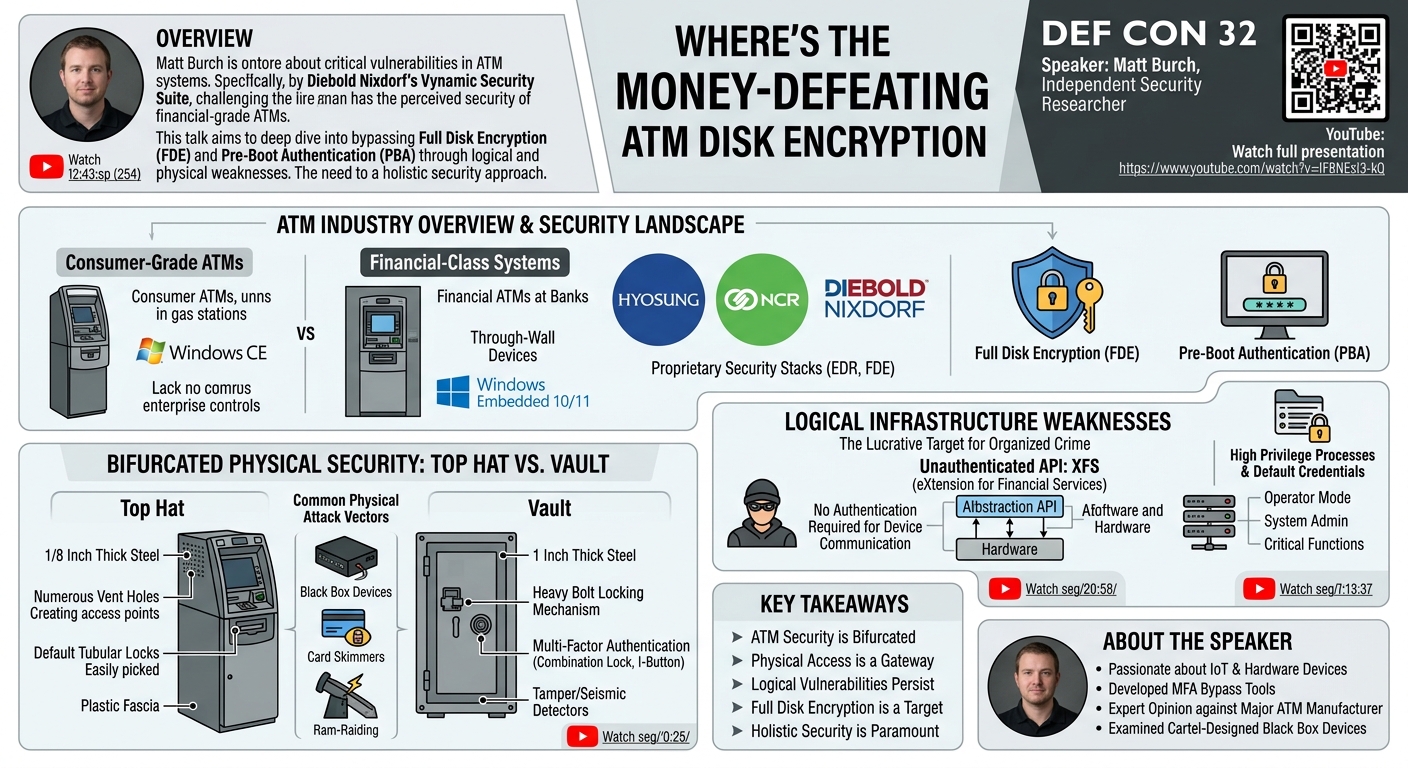
In his DEF CON 32 presentation, "Where’s the Money-Defeating ATM Disk Encryption," independent security researcher Matt Burch sheds light on critical vulnerabilities within the Automated Teller Machine (ATM) ecosystem, with a particular focus on Diebold Nixdorf's Vynamic Security Suite. Burch's talk, born from years of dedicated research into IoT and hardware devices, aims to publicly disclose findings that challenge the perceived security of financial-grade ATMs. While the provided transcript primarily establishes a comprehensive background on the ATM industry's security landscape, it sets the stage for what promises to be a deep dive into bypassing full disk encryption (FDE) through weaknesses in pre-boot authentication (PBA) mechanisms.
Key moments
- 0:00 Speaker introduction and talk agenda.
- 1:00 ATM market classes: consumer vs. financial systems.
- 2:00 Physical security disparity between ATM 'top hat' and 'vault'.
- 4:00 Common physical attack vectors: black box, skimmers, ram-raiding.
- 5:00 Logical infrastructure weaknesses: XFS, high privileges, default credentials.
Where’s the Money-Defeating ATM Disk Encryption
Speakers: Matt Burch, Independent Security Researcher
Conference: DEF CON 32
YouTube: https://www.youtube.com/watch?v=lF8NEsl3-kQ
Overview
In his DEF CON 32 presentation, "Where’s the Money-Defeating ATM Disk Encryption," independent security researcher Matt Burch sheds light on critical vulnerabilities within the Automated Teller Machine (ATM) ecosystem, with a particular focus on Diebold Nixdorf's Vynamic Security Suite. Burch's talk, born from years of dedicated research into IoT and hardware devices, aims to publicly disclose findings that challenge the perceived security of financial-grade ATMs. While the provided transcript primarily establishes a comprehensive background on the ATM industry's security landscape, it sets the stage for what promises to be a deep dive into bypassing full disk encryption (FDE) through weaknesses in pre-boot authentication (PBA) mechanisms.
The talk highlights the stark contrast between the robust physical security protecting the cash vault of an ATM and the comparatively weaker defenses surrounding its computational "top hat." This disparity, coupled with inherent logical vulnerabilities in ATM software architecture, creates a lucrative target for organized crime. Burch's work underscores the importance of a holistic security approach, where physical and logical controls are equally stringent, especially when dealing with high-value targets like ATMs that process billions in transactions daily. The intended core of his presentation—exposing specific flaws in Diebold Nixdorf's PBA—underscores the need for continuous vigilance and advanced security measures to protect financial infrastructure from sophisticated attacks.
Background
▶ Watch: Speaker introduction and talk agenda. (0:00)
The ATM market is broadly categorized into two distinct classes: consumer-grade platforms and financial-class systems. Consumer-grade ATMs, commonly found in gas stations or local grocers, typically run on Windows CE and often lack the sophisticated enterprise security controls prevalent in corporate environments. These standalone units, while convenient, are generally less secure. In contrast, financial-class systems are the robust, enterprise-grade ATMs located at banking institutions, appearing as larger standalone units or through-wall devices. These machines are equipped with more modern operating systems like Windows Embedded 10, with newer models transitioning to Windows Embedded 11. Crucially, each major manufacturer, including Hyosung, NCR, and Diebold Nixdorf (the three dominant players in the United States), implements its own proprietary security stack, featuring various endpoint detection and full disk encryption (FDE) solutions.
Despite the advanced software security measures in financial-class ATMs, their physical architecture presents a paradox of security. An ATM is essentially divided into two hemispheres: the "top hat" and the "vault." The top hat houses all the PC peripherals and computational components, while the vault contains the cash cassettes and currency. While these components are physically isolated, their security levels vary drastically. The vault is engineered for maximum protection, featuring approximately 1 inch thick steel, a heavy bolt locking mechanism, and often equipped with multi-factor authentication (MFA), typically involving a digital combination lock and an I button for authorization verification. Additionally, vaults may incorporate seismic detectors or tamper detection systems to alert against malicious entry attempts.
Conversely, the top hat suffers from significant physical security weaknesses. It is constructed with only about 1/8 inch thick steel and is riddled with numerous vent holes for PC ventilation, which inadvertently create access points. The locking mechanisms often rely on default tubular locks, which are easily acquired online and picked. The cantilever-style lock, activated by a cable connected to the cylinder, can be compromised through destructive entry or even by simply manipulating the mechanism with a coat hanger inserted through a PC speaker vent. The prevalence of plastic components on the ATM's front fascia further facilitates access to these vulnerable locking mechanisms.
These physical vulnerabilities pave the way for numerous attack vectors, almost all of which require some level of physical access. Common attacks include the deployment of black box devices, small units placed inside or outside the ATM to manipulate dispense requests and simulate the ATM's hosting network, effectively tricking the machine into dispensing cash. Card skimmers are another pervasive threat, designed to attach to the ATM's card reader to steal sensitive card data. More overt physical attacks range from ram-raiding, where vehicles are used to rip ATMs from their foundations, to using construction equipment to breach the machines. While less common in the United States due to paper currency's flammability (making explosive attacks counterproductive), explosive attacks are a significant concern internationally, particularly where plastic-based currency is common, leading to the development of "explosive-proof" ATMs.
Beyond physical access, the logical infrastructure of ATMs also presents significant weaknesses. The fundamental operation of an ATM relies on the eXtension for Financial Services (XFS), an unauthenticated API that acts as an abstraction layer between software and hardware. This design allows for vendor-agnostic cash cassettes but introduces a critical vulnerability by not requiring authentication for device communication. Furthermore, much of the software on these ATM platforms runs in the context of high privilege, and systems are often configured with layers of default credentials for accessing operator mode, system administration, and other critical functions. This combination of weak physical security, an unauthenticated API, high privilege processes, and easily guessable or default credentials makes ATMs an incredibly lucrative target for organized crime, highlighting the urgent need for a more robust and integrated security posture.
Key Findings
▶ Watch: ATM market classes: consumer vs. financial systems. (1:00)
Based on the talk's title, "Where’s the Money-Defeating ATM Disk Encryption," and the speaker's agenda, the core objective of Matt Burch's research was to identify and exploit vulnerabilities within the full disk encryption (FDE) mechanisms implemented in financial-class ATMs, specifically targeting Diebold Nixdorf's Vynamic Security Suite. The speaker explicitly listed diving deeper into the pre-boot authentication (PBA) process within this software as a key component of the talk.
However, it is critical to note that the provided transcript, despite its length and repetition of background information, does not contain the specific technical details of these key findings. The transcript extensively covers the general ATM security landscape, physical vulnerabilities, and logical weaknesses, laying a comprehensive foundation. It introduces Diebold Nixdorf as a major manufacturer and mentions its proprietary security stack, including FDE, but the actual exposition of how the disk encryption is defeated or what specific vulnerabilities in the Vynamic Security Suite's PBA process were discovered is not present in the provided text.
Therefore, while the talk's intent was clearly to disclose a method for bypassing or defeating ATM disk encryption, the details of the specific vulnerabilities, the attack methodology, or the resulting impact on Diebold Nixdorf's Vynamic Security Suite and its PBA are not available in this transcript. The "Key Findings" section would, in the full talk, undoubtedly detail the specific flaws found in the PBA implementation that allow an attacker to gain access to the encrypted disk, thereby compromising the logical integrity and data security of the ATM. Without these details, we can only infer the nature of the finding: a successful bypass of a critical security control designed to protect sensitive data on ATM hard drives.
Technical Deep Dive
▶ Watch: Physical security disparity between ATM 'top hat' and 'vault'. (2:00)
The technical deep dive of this talk, as indicated by the agenda, was intended to focus on the pre-boot authentication (PBA) process implemented within Diebold Nixdorf's Vynamic Security Suite. PBA is a crucial component of full disk encryption (FDE) solutions, designed to authenticate a user or system before the operating system even begins to load. Its primary purpose is to ensure that the encryption keys required to decrypt the hard drive are only released after a successful authentication, thus protecting the data at rest from unauthorized access, even if the physical drive is removed from the system.
Unfortunately, the provided transcript focuses entirely on the introductory and background segments of the presentation, extensively detailing the general ATM industry landscape, physical security disparities between the "top hat" and "vault," and broad logical vulnerabilities such as the unauthenticated XFS API and the widespread use of default credentials. The transcript mentions Diebold Nixdorf as one of the three major US ATM manufacturers and states that financial-class systems, including those from Diebold Nixdorf, come with proprietary security stacks offering endpoint detection and full disk encryption. However, the specific technical mechanics of Diebold Nixdorf's Vynamic Security Suite, the architecture of its PBA, the identified vulnerabilities, or the methods used to bypass it are not elaborated upon in the provided text.
Therefore, a detailed technical discussion of the attack vector, any specific code exploits, protocol weaknesses, or architectural flaws discovered in the Vynamic Security Suite's PBA cannot be provided based on the available transcript. The speaker's expertise in MFA bypass tools and examination of cartel-designed ATM black box devices suggests that the deep dive would likely involve sophisticated hardware or software manipulation techniques, potentially leveraging aspects of the ATM's physical access vulnerabilities (e.g., gaining access to internal components to interfere with the boot process or exploit a side channel) or software-level weaknesses in the PBA implementation itself. This could involve anything from cryptographic flaws, insecure key management, or weaknesses in the authentication flow that permit an attacker to bypass the pre-boot challenge and gain access to the decrypted operating system and its underlying data. Without the specific details, any further technical discussion would be speculative and would violate the instruction not to fabricate details.
Demo / Proof of Concept
▶ Watch: Common physical attack vectors: black box, skimmers, ram-raiding. (4:00)
The provided transcript does not contain any details regarding a demonstration or proof of concept (PoC) related to defeating ATM disk encryption. While a security conference talk of this nature, especially one focused on hardware and software vulnerabilities in financial systems, would typically feature a live demonstration or a video showcasing the exploit, the transcript concludes before reaching this stage of the presentation. The speaker's agenda mentioned a "cat and mouse" segment at the end, which often implies a discussion of attack and defense or a reveal of the exploit in action. However, the details of such a demonstration, including how it might have worked or what specific tools or techniques were employed to bypass Diebold Nixdorf's Vynamic Security Suite's pre-boot authentication, are not available in the provided material.
Defensive Implications
▶ Watch: Logical infrastructure weaknesses: XFS, high privileges, default credentials. (5:00)
While the specific technical details of the disk encryption bypass were not present in the provided transcript, Matt Burch's comprehensive background on ATM vulnerabilities offers crucial insights for defenders. The core message is clear: physical security cannot be divorced from logical security, especially in high-value targets like ATMs.
- Strengthen Physical Security of the "Top Hat": The most immediate implication is the urgent need to enhance the physical security of the ATM's top hat. The stark contrast between the vault's robust construction (1 inch thick steel, MFA, seismic detectors) and the top hat's flimsy defenses (1/8 inch thick steel, vent holes, easily pickable tubular locks) is a critical design flaw. Financial institutions must explore options for reinforcing the top hat, eliminating easily accessible vent holes, upgrading to more secure, tamper-resistant locking mechanisms, and protecting internal cabling that controls the locks. Regular physical security audits are essential to identify and mitigate these vulnerabilities.
- Harden Against Logical Attack Vectors:
- Secure the XFS API: The eXtension for Financial Services (XFS) being an unauthenticated API is a significant logical vulnerability. Defenders should investigate methods to introduce authentication or authorization layers for XFS commands, particularly those that control sensitive hardware functions like cash dispensing. Network segmentation and strict firewall rules should be implemented to limit access to XFS-related ports and services only to trusted internal components or authenticated processes.
- Eliminate Default Credentials: The widespread use of default credentials for operator mode, system administration, and other functions is an unacceptable security risk. All default passwords must be changed immediately upon deployment to strong, unique, and complex credentials. Implement robust password policies, multi-factor authentication for administrative access, and regular credential rotation.
- Principle of Least Privilege: ATM software, which often runs in high privilege contexts, should be re-evaluated. Implement the principle of least privilege for all applications and services, ensuring they only have the minimum necessary permissions to perform their functions. This reduces the blast radius if an application is compromised.
- Validate Full Disk Encryption (FDE) and Pre-Boot Authentication (PBA) Implementations: Even without the specific bypass details, the talk's title implies that FDE and PBA, while present, are not infallible. Defenders using Diebold Nixdorf's Vynamic Security Suite or other FDE solutions must:
- Regularly Audit PBA: Conduct independent security audits and penetration tests specifically targeting the PBA process. This includes examining the cryptographic implementation, key management, authentication flow, and resistance to physical tampering (e.g., cold boot attacks, direct memory access).
- Ensure Timely Updates and Patches: Promptly apply all security patches and firmware updates released by ATM manufacturers. Vulnerabilities in FDE/PBA solutions are often addressed through these updates.
- Monitor for Tampering: Implement advanced endpoint detection and response (EDR) solutions and security information and event management (SIEM) systems to monitor for unusual boot sequences, unauthorized software installations, or attempts to modify critical system files that could indicate a PBA bypass attempt.
- Employee Training and Awareness: Front-line staff and maintenance personnel must be trained on physical security best practices, recognizing suspicious activity around ATMs, and adhering to strict protocols for accessing the machines. The ease of bypassing physical locks with simple tools like coat hangers underscores the need for vigilance.
By addressing these physical and logical vulnerabilities comprehensively, financial institutions can significantly raise the bar for attackers, protecting both the cash within the vault and the sensitive data on the hard drives from sophisticated and opportunistic criminals.
Key Takeaways
- ATM Security is Bifurcated: There's a severe disparity between the robust physical security of an ATM's cash vault (1-inch steel, MFA) and the weak physical security of its computational "top hat" (1/8-inch steel, pickable locks).
- Physical Access is a Gateway: Most prevalent ATM attacks, including black box devices, skimmers, and even logical exploits, often require some form of physical access to the machine.
- Logical Vulnerabilities Persist: ATMs suffer from critical logical weaknesses, such as the unauthenticated XFS API for hardware communication and the widespread use of default credentials for administrative access.
- Full Disk Encryption is a Target: Despite the presence of full disk encryption (FDE) and pre-boot authentication (PBA) in financial-class ATMs (e.g., Diebold Nixdorf's Vynamic Security Suite), these controls can be vulnerable to bypass, as implied by the talk's core subject.
- Holistic Security is Paramount: Effective ATM security demands a unified approach that addresses both physical hardening and robust logical controls, including secure API implementations, strong access management, and resilient FDE/PBA mechanisms.
About the Speaker(s)
Matt Burch is an independent security researcher with a strong passion for IoT and hardware devices. His extensive experience includes developing several MFA bypass tools that have impacted various Mobile Device Management (MDM) solutions. Burch has also provided expert opinion against a major ATM manufacturer, indicating his deep understanding of the industry's security landscape. Furthermore, he has had the unique opportunity of examining cartel-designed ATM black box devices, providing him with firsthand insight into real-world criminal methodologies targeting these financial machines. His research and public disclosure efforts underscore his commitment to advancing security in critical infrastructure.
Reviews
Dr. Zero (Offensive Security Researcher) — WEAK
The talk presents a crucial problem space in ATM security, offering a comprehensive and well-structured background on physical and logical vulnerabilities. The speaker's credibility is evident through their deep understanding of the ATM ecosystem and real-world attack vectors. However, despite the talk's title and stated objective to detail a bypass for ATM disk encryption, the provided transcript explicitly lacks the specific technical findings, attack methodology, or proof of concept for defeating Diebold Nixdorf's Vynamic Security Suite's pre-boot authentication. This omission of the core technical contribution makes the presentation feel like an extended introduction without the…
Heather Calloway (CISO) — STRONG ACCEPT
This DEF CON presentation, "Where’s the Money-Defeating ATM Disk Encryption," addresses a profoundly critical vulnerability type within financial infrastructure. While the provided transcript excels at detailing the systemic physical and logical weaknesses of ATMs—laying bare significant governance and accountability failures—it unfortunately omits the crucial technical exposition of how Diebold Nixdorf's disk encryption is specifically bypassed. The talk's premise and extensive background are highly valuable for security leaders in understanding institutional risk, but the absence of the core exploit details prevents a full assessment of its novelty and direct operational impact for…