1 for All, All for WHAD: wireless shenanigans made easy
Romain Cayre, Damien Cauquil
DEF CON 32 Main Stage · Day 1 · Main Stage
Overview
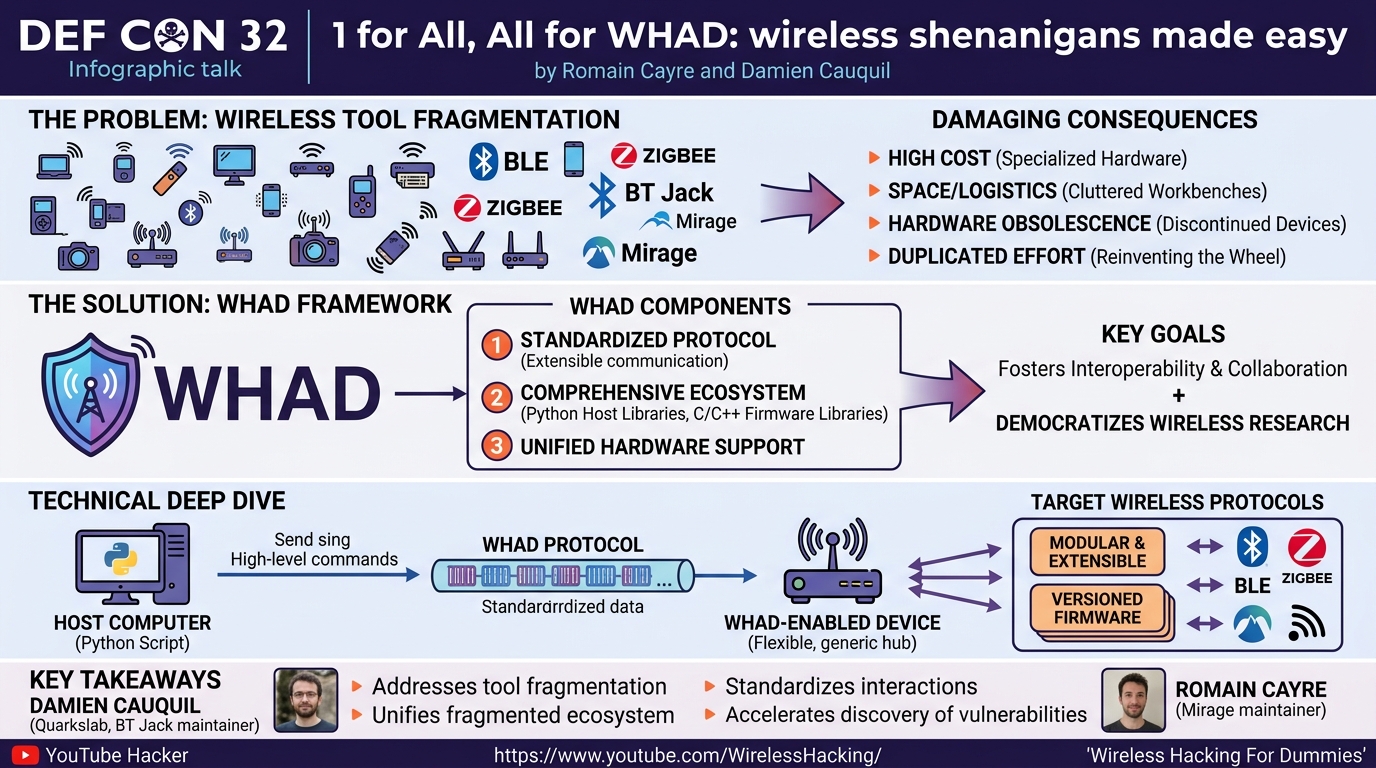
In the rapidly evolving landscape of wireless technology, security researchers and enthusiasts often face a significant hurdle: the fragmented ecosystem of tools and hardware required to analyze and exploit various wireless protocols. This talk, "1 for All, All for WHAD: wireless shenanigans made easy," presented by Damien Cauquil and Romain Cayre, addresses this pervasive problem head-on. They introduce WHAD, a novel framework designed to unify the disparate world of wireless protocol hacking by providing a standardized communication protocol, a comprehensive set of libraries, and an overarching ecosystem that fosters collaboration.
Key moments
- 0:00 Introduction to the talk and speakers
- 1:15 Problem: Fragmentation of wireless hacking tools and hardware
- 2:00 Consequences of fragmentation: cost, space, obsolescence, time waste
- 3:00 Three main ideas for solving wireless tool fragmentation
- 4:10 Introducing the WHAD protocol and its design principles
- 4:25 Key WHAD protocol features: standardized, modular, extensible, versioned
1 for All, All for WHAD: wireless shenanigans made easy
Speakers: Romain Cayre; Damien Cauquil
Conference: DEF CON 32
YouTube: https://www.youtube.com/watch?v=4xjRgr4dbzU
Overview
In the rapidly evolving landscape of wireless technology, security researchers and enthusiasts often face a significant hurdle: the fragmented ecosystem of tools and hardware required to analyze and exploit various wireless protocols. This talk, "1 for All, All for WHAD: wireless shenanigans made easy," presented by Damien Cauquil and Romain Cayre, addresses this pervasive problem head-on. They introduce WHAD, a novel framework designed to unify the disparate world of wireless protocol hacking by providing a standardized communication protocol, a comprehensive set of libraries, and an overarching ecosystem that fosters collaboration.
The core motivation behind WHAD stems from the observation that each wireless protocol (e.g., BLE, Zigbee) typically requires specialized hardware, unique firmware, and custom host-side tools. This leads to redundant development efforts, increased costs for researchers, and the frustrating reality of hardware obsolescence. Cauquil and Cayre, experienced researchers and maintainers of popular wireless security tools like BT Jack and Mirage, leverage their deep understanding of these challenges to propose a solution that streamlines the entire process, making advanced wireless security research more accessible and efficient for everyone.
This initiative is not merely about creating another tool; it's about establishing a foundational layer that enables future innovation and interoperability. By standardizing the interface between host computers and diverse wireless hardware, WHAD aims to eliminate the "reinventing the wheel" syndrome prevalent in the field. It promises to democratize wireless security research by lowering the barrier to entry, encouraging shared development, and ultimately, accelerating the discovery and remediation of vulnerabilities across a multitude of wireless technologies.
Background
▶ Watch: Introduction to the talk and speakers (0:00)
The genesis of WHAD lies in a critical problem plaguing the wireless security research community: severe fragmentation. As wireless protocols proliferate, each with its unique physical layer (PHY) and communication mechanisms, researchers have developed an array of highly specialized tools and hardware. For instance, in the realm of Bluetooth Low Energy (BLE), tools like BT Jack, Mirage, Gattacker, and Sniffle each offer distinct capabilities, often requiring specific hardware dongles or development boards. While effective in their niches, the cumulative effect is a chaotic environment where comprehensive testing requires an extensive collection of devices, custom firmware, and a deep understanding of multiple, often incompatible, software stacks.
The speakers highlight several detrimental consequences of this fragmentation. Firstly, the financial burden on researchers is significant. Acquiring a diverse set of hardware, each costing anywhere from tens to hundreds of dollars, quickly adds up. This includes specialized transceivers, development kits, and protocol-specific sniffers. Secondly, the sheer volume of hardware creates logistical challenges, consuming valuable workspace and requiring constant management. More critically, many of these specialized hardware components can be discontinued without warning, leaving researchers with unsupported or obsolete tools that are essential for specific attack vectors or protocol versions. The frustration of needing a "tiny hardware you didn't buy three years ago" that is now the only supported device for a particular hack is a common and debilitating experience.
Beyond hardware, the software landscape is equally fractured. Each researcher often develops bespoke firmware for their hardware, coupled with custom communication protocols to interface with a host computer. This "reinventing the wheel" approach leads to duplicated effort, inconsistent methodologies, and a steep learning curve for newcomers. Common issues encountered by one researcher are often re-solved by another, leading to a waste of time and resources that could otherwise be directed towards novel research. The lack of a unified framework inhibits collaboration, as integrating tools or sharing findings across different setups becomes an arduous task. This fragmentation ultimately stifles progress in a field where rapid adaptation and shared knowledge are paramount to staying ahead of emerging threats. The need for a cohesive, open-source solution that transcends these individual tool limitations became evident, motivating the development of WHAD.
Key Findings
▶ Watch: Consequences of fragmentation: cost, space, obsolescence, time waste (2:00)
The core contribution of Damien Cauquil and Romain Cayre's work is the WHAD framework itself, a multifaceted solution designed to address the aforementioned fragmentation in wireless security research. Their key findings and proposed solutions revolve around three main ideas that form the foundation of WHAD:
- A Standardized, Extensible Communication Protocol: The primary innovation is the design of a novel communication protocol that facilitates interaction between a host computer and diverse wireless hacking hardware. This protocol is conceived to be extensible, meaning it can support multiple wireless protocols and physical layers (PHYs) simultaneously, and easily adaptable to new ones. Crucially, it is open source and designed for straightforward extension by the community, ensuring its longevity and relevance. This standardized approach aims to eliminate the need for researchers to develop custom host-to-hardware communication layers for every new project or device.
- A Comprehensive Ecosystem of Libraries and Frameworks: Beyond the protocol, WHAD encompasses a complete ecosystem. This includes a set of ready-to-use libraries and a framework that caters to both the host-side software (e.g., Python libraries) and the embedded firmware (e.g., C/C++ libraries). These libraries abstract away the complexities of the underlying hardware and the WHAD protocol, providing researchers with high-level functions to interact with various wireless protocols. This significantly reduces development time and allows researchers to focus on the security logic rather than low-level hardware communication. The vision is to provide a unified development environment where common functionalities are readily available across different platforms.
- Fostering Interoperability and Collaboration: A fundamental principle guiding WHAD's development is the active encouragement of interoperability and collaboration within the research community. By providing standardized tools and an open-source framework, WHAD aims to break down the silos that currently exist. Researchers can contribute new protocol implementations, hardware support, or attack modules to a common platform, benefiting the entire community. This collaborative model ensures that solutions to common problems are shared and improved upon, rather than being repeatedly reinvented.
The speakers also clarified the naming convention, noting that WHAD originally stood for "Wireless Hacking Devices" due to its intent to support a wide array of hardware. However, after over a year of development and use, the alternative interpretation, "Wireless Hacking For Dummies," emerged as equally fitting, reflecting the framework's success in simplifying complex wireless security tasks and making them more accessible. This rebranding, even if informal, underscores the project's commitment to ease of use and broad appeal within the community.
Technical Deep Dive
▶ Watch: Three main ideas for solving wireless tool fragmentation (3:00)
The technical core of the WHAD project is its eponymous communication protocol, designed with several guiding principles to ensure its effectiveness and longevity. The speakers emphasize that WHAD is more than just a protocol; it's a holistic ecosystem comprising the protocol itself, host-side libraries, and firmware-side libraries, all working in concert.
The WHAD protocol is fundamentally a standardized protocol. This means its specifications are thoroughly defined, documented, and explained, ensuring clarity and consistency for implementers. This standardization is critical for achieving the framework's goal of interoperability across diverse hardware and software. It dictates how commands are structured, how data is exchanged, and how responses are formatted between the host machine (e.g., a laptop running a Python script) and the specialized wireless hardware (the WHAD-enabled device).
A key design feature is its genericity. The protocol is engineered to cover a broad spectrum of wireless capabilities already present in the existing ecosystem of hacking tools. This isn't limited to a single protocol like BLE or Zigbee but aims to abstract common functionalities such as packet sniffing, injection, device enumeration, and state manipulation across various wireless technologies. This generic approach allows a single hardware device, when equipped with appropriate firmware, to handle multiple wireless protocols, reducing the need for specialized, single-purpose hardware.
The protocol's modularity is another crucial aspect. It's structured in a way that allows support for multiple wireless protocols to be added or removed independently. This design ensures that the framework can evolve without requiring a complete overhaul for every new wireless standard. Furthermore, it is highly extensible. If a researcher needs to implement support for a completely new or niche wireless protocol, they can modify the WHAD protocol by adding new messages or command types as needed, while maintaining compatibility with the existing framework. The crucial point here is that all the complex transitions between these various messages and states are handled by the device's firmware, abstracting this complexity away from the host application. This means the host simply sends high-level commands, and the firmware translates them into the necessary low-level hardware operations.
WHAD also incorporates versioning. The protocol is designed to be backward compatible, meaning that a device running an older version of the WHAD protocol (e.g., version one) will still be supported by a host application that understands newer versions (e.g., version two). This ensures that researchers' existing WHAD-compatible hardware doesn't become obsolete with protocol updates, safeguarding their investments and promoting a stable development environment.
On the implementation side, the ecosystem provides libraries in popular languages like Python for host applications and C/C++ for embedded firmware. These libraries encapsulate the complexities of the WHAD protocol, allowing developers to interact with the hardware using high-level, easy-to-use APIs. For instance, a Python script on the host can send a command to "sniff BLE packets" without needing to know the intricate byte-level details of the WHAD protocol or the specific registers of the underlying transceiver chip. The C/C++ libraries for the firmware provide the necessary abstractions to receive these host commands, interpret them, and execute the corresponding low-level wireless operations on the hardware. This dual-language support ensures that both the application development on the host and the embedded programming on the device are streamlined, making wireless "shenanigans" genuinely easier.
Demo / Proof of Concept
▶ Watch: Introducing the WHAD protocol and its design principles (4:10)
The transcript for this talk regrettably concludes before the speakers delve into specific demonstrations or proof-of-concept implementations of the WHAD framework. The presenters state that they "are going to show that in multiple demos" and mention that "wireless hacking for them is also a great name because it's makes things easier," implying that practical demonstrations were planned to illustrate the ease of use and versatility of WHAD.
While the details of these demonstrations are not available in the provided segment, the intent was clearly to showcase how WHAD simplifies common wireless security tasks. This would likely involve using a single WHAD-enabled device to perform actions across different wireless protocols, such as sniffing BLE advertisements, injecting custom Zigbee packets, or performing replay attacks on other wireless technologies, all controlled from a unified host application. The absence of these specific examples in the transcript means we cannot detail the exact tools, commands, or results of any live demonstrations. However, the framework's design principles—genericity, modularity, and ease of use—strongly suggest that the planned demos would have highlighted its ability to streamline complex, multi-protocol wireless engagements.
Defensive Implications
▶ Watch: Key WHAD protocol features: standardized, modular, extensible, versioned (4:25)
While WHAD is presented as a framework for "wireless shenanigans," its underlying principles and capabilities hold significant defensive implications for organizations and security professionals. The very tools and techniques used to discover vulnerabilities can be repurposed to build more robust and secure systems.
Firstly, WHAD's standardized and extensible nature makes it an invaluable asset for comprehensive security testing. Security teams can leverage a single WHAD-compatible hardware platform, rather than an array of disparate devices, to perform penetration testing and vulnerability assessments across all wireless protocols used within an organization's infrastructure. This includes evaluating the security of BLE-enabled IoT devices, Zigbee smart home systems, proprietary industrial wireless sensors, and more. The unified framework allows for consistent testing methodologies, reducing the chance of overlooking vulnerabilities due to tool limitations or compatibility issues.
Secondly, the framework facilitates the development of defensive countermeasures. By providing an open-source ecosystem, WHAD enables security engineers to quickly prototype and test new detection mechanisms or mitigation strategies against known and emerging wireless threats. For example, a defender could use WHAD to simulate various attack scenarios (e.g., spoofing, jamming, replay attacks) to understand their impact and then develop or refine intrusion detection systems or secure communication protocols to counter them. The ability to programmatically control diverse wireless interactions from a single host makes this kind of rapid iteration far more efficient.
Thirdly, WHAD can contribute to security awareness and training. By simplifying access to complex wireless interactions, it allows developers and operations teams to gain a better understanding of how their wireless products and deployments might be attacked. This practical exposure can lead to more secure design choices from the outset, fostering a "security by design" culture. It empowers internal teams to conduct their own basic wireless security checks, catching potential issues before they reach external auditors or, worse, malicious actors.
Finally, the focus on interoperability and collaboration within the WHAD community means that defensive researchers can more easily share tools, techniques, and findings. This collective intelligence can accelerate the development of best practices and defensive strategies across the industry, helping to raise the overall bar for wireless security. In essence, by providing a powerful, unified platform for understanding and manipulating wireless protocols, WHAD equips defenders with a potent weapon to identify weaknesses and build stronger, more resilient wireless systems.
Key Takeaways
- Wireless Hacking Fragmentation is a Major Problem: The current landscape of wireless security research is plagued by a fragmented ecosystem of specialized, often incompatible, hardware and software tools, leading to high costs, wasted effort, and hardware obsolescence.
- WHAD Aims for Unification: The WHAD framework addresses this fragmentation by proposing a standardized, extensible communication protocol, a comprehensive ecosystem of libraries (Python, C/C++), and a collaborative development model.
- Standardized & Extensible Protocol: The core WHAD protocol is documented, generic, modular, and versioned for backward compatibility, allowing a single hardware device to support multiple wireless protocols and PHYs through adaptable firmware.
- Ecosystem Simplifies Development: WHAD provides ready-to-use libraries for both host applications and device firmware, abstracting complex low-level interactions and enabling researchers to focus on security logic rather than hardware specifics.
- Fosters Collaboration: By being open-source and standardized, WHAD encourages researchers to contribute, share, and build upon a common platform, accelerating innovation and knowledge exchange in wireless security.
- Significant Defensive Potential: Beyond offensive applications, WHAD can be a powerful tool for defensive security teams, enabling comprehensive vulnerability testing, rapid prototyping of countermeasures, and improved security training across diverse wireless technologies.
About the Speaker(s)
Damien Cauquil is a security researcher from Quarkslab and a key figure in the wireless security community. He is widely recognized as the maintainer of BT Jack (also known as Beetle Jack), a prominent BLE Swiss Army knife tool used for various Bluetooth Low Energy security tasks. His expertise extends to embedded systems, where he focuses on the security of low-level hardware and firmware. Damien's work highlights a passion for understanding and exploiting the intricacies of wireless protocols and embedded devices.
Romain Cayre is another notable security researcher and a contributor to the wireless hacking landscape. He is the maintainer of Mirage, another versatile BLE Swiss Army tool that also supports other protocols like Zigbee. Romain has a particular interest in cross-protocol attacks, exploring how vulnerabilities in one wireless standard can impact or be leveraged through others. His collaboration with Damien on WHAD underscores their shared vision for a more unified and accessible approach to wireless security research.
Reviews
Dr. Zero (Offensive Security Researcher) — MUST SEE
This talk introduces WHAD, a critical framework designed to unify the fragmented world of wireless security research. Developed by seasoned experts Damien Cauquil and Romain Cayre, WHAD proposes a standardized, extensible communication protocol and a comprehensive ecosystem of libraries to streamline the analysis and exploitation of various wireless technologies. This initiative promises to significantly lower the barrier to entry, reduce costs, and accelerate innovation by fostering collaboration and eliminating redundant development efforts across the community. It's a foundational shift in how wireless security research will be conducted.
Heather Calloway (CISO) — STRONG ACCEPT
The WHAD framework addresses a critical pain point in wireless security research by unifying disparate tools and hardware into a standardized, extensible ecosystem. This initiative promises to significantly reduce the cost and complexity of comprehensive wireless security testing, making it an invaluable asset for security programs to assess and mitigate risks across a multitude of wireless protocols. While the talk focuses on a technical solution, its implications for operational efficiency, resource allocation, and the overall robustness of an organization's wireless security posture are profound and directly actionable for security leaders.