Troll Trapping Through TAS Tools Exposing Speedrunning Cheaters
Allan Cecil
DEF CON 32 Main Stage · Day 1 · Main Stage
Overview
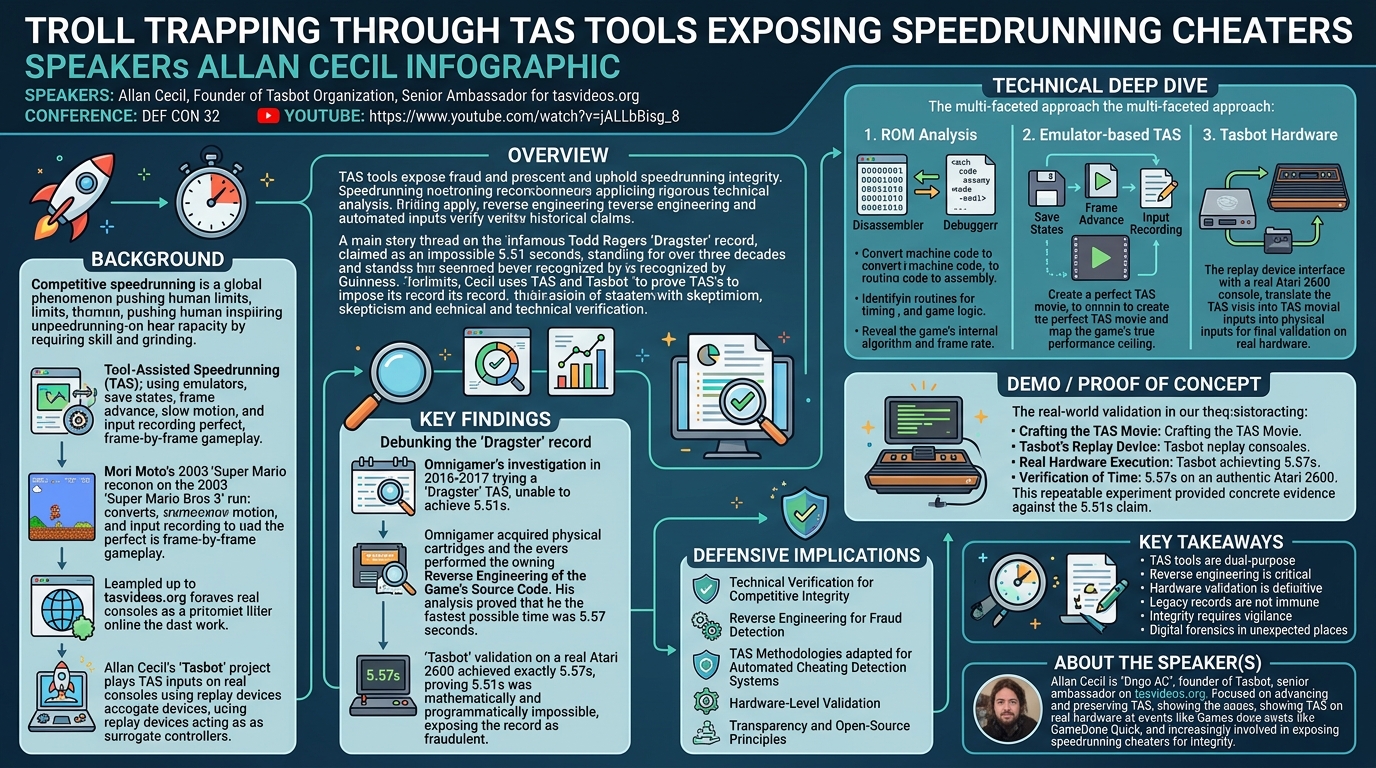
In "Troll Trapping Through TAS Tools Exposing Speedrunning Cheaters," Allan Cecil, known as Dngo AC and the founder of the Tasbot organization, delves into the fascinating intersection of competitive gaming, digital forensics, and the meticulous world of Tool-Assisted Speedruns (TAS). Cecil's talk at DEF CON 32 highlights how the very techniques and tools designed to push video game performance to superhuman limits can be repurposed to expose long-standing frauds and uphold the integrity of speedrunning communities. This presentation is a compelling case study in applying rigorous technical analysis to a domain often perceived as recreational, demonstrating the power of reverse engineering and automated input systems in verifying historical claims.
Key moments
- 0:00 Introduction, TASbot, and talk's cheating investigation focus
- 1:30 Todd Rogers's Dragster cheating case introduced
- 3:30 Understanding Tool-Assisted Speedruns (TAS) and their tools
- 5:00 Omnigamer's TAS attempt exposes impossible Dragster record
- 6:00 TASbot verifies Dragster's fastest possible time (5.57s)
Troll Trapping Through TAS Tools Exposing Speedrunning Cheaters
Speakers: Allan Cecil, Founder of Tasbot Organization, Senior Ambassador for tasvideos.org
Conference: DEF CON 32
YouTube: https://www.youtube.com/watch?v=jALLbBisg_8
Overview
In "Troll Trapping Through TAS Tools Exposing Speedrunning Cheaters," Allan Cecil, known as Dngo AC and the founder of the Tasbot organization, delves into the fascinating intersection of competitive gaming, digital forensics, and the meticulous world of Tool-Assisted Speedruns (TAS). Cecil's talk at DEF CON 32 highlights how the very techniques and tools designed to push video game performance to superhuman limits can be repurposed to expose long-standing frauds and uphold the integrity of speedrunning communities. This presentation is a compelling case study in applying rigorous technical analysis to a domain often perceived as recreational, demonstrating the power of reverse engineering and automated input systems in verifying historical claims.
The core narrative revolves around the infamous Todd Rogers Dragster record, a claim of completing the Atari 2600 game in an impossible 5.51 seconds, a record that stood for over three decades and was even recognized by Guinness World Records. Cecil, through his involvement with the TAS community and the Tasbot project, illustrates how a detailed examination of game code, combined with the precise execution capabilities of TAS tools, conclusively proved the impossibility of this record. This talk is not merely about debunking a video game record; it's a testament to the importance of skepticism, technical verification, and the unexpected applications of specialized tools in uncovering digital deception, offering valuable lessons for any field reliant on verifiable performance metrics.
Background
▶ Watch: Introduction, TASbot, and talk's cheating investigation focus (0:00)
Competitive video gaming, particularly speedrunning, is a global phenomenon where players strive to complete games or specific segments as quickly as possible. This pursuit demands immense skill, reflexes, memory, and often, a degree of luck. The community thrives on the challenge of pushing human limits, with top performances often requiring thousands of hours of practice, known as "grinding." However, an intriguing offshoot emerged that removed human limitations entirely: Tool-Assisted Speedrunning (TAS).
TAS involves using specialized software (emulators) and tools to achieve perfect, frame-by-frame gameplay. Key tools include save states, allowing players to instantly rewind and retry sections; frame advance, enabling progression one video frame at a time for pixel-perfect timing; slow motion; and input recording, which captures every button press to create a "movie" of the optimal run. One of the most famous early examples was Mori Moto's Super Mario Bros 3 time attack run from 2003, which showcased seemingly impossible feats, sparking controversy due to its lack of initial labeling as a TAS. This led to the development of platforms like NES videos (later tasvideos.org) to host and contextualize these runs.
Allan Cecil's Tasbot project takes TAS a step further by playing these perfectly crafted input sequences back on actual, physical game consoles. Founded in 2013, the Tasbot community developed "replay devices" that act as surrogate controllers, inputting commands with superhuman precision directly into original hardware. This capability is crucial for validating TAS runs under real-world conditions, removing any potential discrepancies that might arise from emulator inaccuracies.
The central case study for Cecil's talk is the legendary Dragster record set by Todd Rogers for the Atari 2600 game in the 1980s. Rogers claimed a completion time of 5.51 seconds, a record that was prominently displayed on Twin Galaxies, a prominent speedrunning leaderboard, and was even recognized by the Guinness Book of World Records for over 30 years. This record stood as an untouchable benchmark, revered by many in the retro gaming community. The stage was set for a confrontation between a decades-old, seemingly impossible record and the rigorous, objective analysis offered by the modern TAS community.
Key Findings
▶ Watch: Todd Rogers's Dragster cheating case introduced (1:30)
The core of Allan Cecil's presentation, and the driving force behind the "troll trapping," lies in the definitive debunking of Todd Rogers' Dragster record. The investigation began around 2016-2017 when Omnigamer, a prolific tool-assisted speedrun author and tasvideos.org member, attempted to create a TAS run for Dragster. Despite employing superhuman precision and leveraging all available TAS tools within an emulator, Omnigamer encountered a critical problem: he was unable to achieve Rogers' claimed time of 5.51 seconds. This immediate discrepancy raised significant questions about the validity of the long-standing record.
To resolve this, Omnigamer undertook a meticulous technical deep dive. He acquired physical Dragster cartridges, used a ROM reader to extract their contents, and then proceeded to reverse engineer the game's source code. This forensic analysis of the game's internal algorithms was paramount. By examining how the game calculated and displayed elapsed time, Omnigamer conclusively determined that, across all known versions of Dragster (including prototypes and release versions), the game's code simply did not allow for a completion time of 5.51 seconds. The absolute fastest theoretical time achievable within the game's engine, even with perfect, frame-by-frame input, was 5.57 seconds.
This finding was then independently validated and cemented by Allan Cecil and the Tasbot organization. Utilizing their specialized hardware, Tasbot was configured to play Dragster on a real Atari 2600 console, executing a TAS run designed to achieve the theoretical maximum speed. The result was unequivocal: Tasbot achieved precisely 5.57 seconds, mirroring Omnigamer's emulator-based findings and the ROM analysis. This real-hardware validation provided irrefutable proof that Todd Rogers' 5.51-second record was mathematically and programmatically impossible. The discrepancy of 0.06 seconds, seemingly minor, represented a fundamental violation of the game's underlying physics and timing mechanisms, exposing the record as fraudulent.
Technical Deep Dive
▶ Watch: Understanding Tool-Assisted Speedruns (TAS) and their tools (3:30)
The technical foundation for debunking the Dragster record rests on a combination of ROM analysis, emulator-based tool-assisted speedrunning, and hardware-level replay systems. This multi-faceted approach provided a robust and verifiable methodology.
The initial and perhaps most critical step was the **reverse engineering of the Dragster ROM. Omnigamer's process involved physically extracting the game's code from various Atari 2600 cartridges. This required using a specialized reader to pull the raw binary data, effectively creating a digital copy of the game's executable. Once the ROM was acquired, disassemblers and debuggers would have been used to convert the machine code back into a more human-readable assembly language. The focus was on identifying and understanding the specific routines responsible for game logic, particularly the timing mechanism and the conditions for game completion. The Atari 2600's rudimentary hardware and direct memory mapping made it possible to trace how player inputs affected game state and how the internal timer incremented. This analysis revealed the game's internal algorithm** for calculating speed and elapsed time, confirming that certain sequences of events or input combinations simply could not lead to a time faster than 5.57 seconds. This involves understanding the game's frame rate, how many cycles each instruction takes, and the minimum number of frames required to execute the necessary actions (e.g., shifting gears, accelerating, crossing the finish line).
Emulator-based TAS tools played a pivotal role in establishing the theoretical maximum performance. Emulators like Stella (for Atari 2600) provide an environment where gameplay can be manipulated with extreme precision. Tools such as save states allow a player to experiment with different input sequences at any point, instantly rewinding if a suboptimal choice is made. Frame advance is crucial for achieving pixel-perfect and frame-perfect inputs, ensuring that actions are executed at the earliest possible moment or with optimal timing relative to game events. By recording these precise button presses, a TAS movie is generated, representing the absolute best possible human (or rather, superhuman) performance. Omnigamer's inability to achieve 5.51s even with these tools was the first strong indicator of fraud. The TAS process itself acts as an exhaustive search for optimal strategies, effectively mapping the game's true performance ceiling.
Finally, the Tasbot hardware provided the ultimate validation on real hardware. The Tasbot system, developed by a community including individuals like True and Micro 500, consists of a "replay device" that interfaces directly with vintage game consoles. This device functions as a highly accurate, automated controller. It takes the recorded input sequences (the TAS movie) generated by an emulator and translates them into physical button presses or joystick movements that the actual Atari 2600 console interprets. This eliminates any potential arguments about emulator inaccuracies or differences between emulated and real hardware behavior. By running the 5.57-second TAS movie on an authentic Atari 2600 console, Tasbot definitively demonstrated that the game itself, when played with perfect inputs, could not yield a faster time. This hardware-level proof is critical in competitive gaming communities where the authenticity of records is paramount and often debated.
Demo / Proof of Concept
▶ Watch: Omnigamer's TAS attempt exposes impossible Dragster record (5:00)
While the talk itself at DEF CON 32 might not have featured a live, real-time demonstration of Tasbot playing Dragster (though the speaker mentions having Tasbot present), the entire investigation and its findings are built upon a powerful proof of concept that was executed by Allan Cecil's team. The central demonstration was Tasbot's successful execution of a **Tool-Assisted Speedrun (TAS) of Dragster on a physical Atari 2600 console, achieving a time of 5.57 seconds.**
This demonstration served as the undeniable, real-world validation of the theoretical findings derived from the ROM analysis and emulator-based TAS efforts. The process involved:
- Crafting the TAS movie: Omnigamer's initial work, refined by the TAS community, created an input sequence (a "movie") that represented the absolute fastest way to complete Dragster based on the game's code, yielding 5.57 seconds.
- Tasbot's Replay Device: The Tasbot hardware, acting as a sophisticated, automated controller, took this digital input sequence.
- Real Hardware Execution: The replay device connected to an actual Atari 2600 console, simulating perfect, frame-accurate button presses and joystick movements as dictated by the TAS movie.
- Verification of Time: The console, running the original game cartridge, then produced the 5.57-second completion time, which was recorded and observed.
This systematic approach directly countered the 5.51-second claim. By showing that even "superhuman input" on the original hardware could not break the 5.57-second barrier, the Tasbot demonstration provided concrete evidence that the alleged 5.51-second record was fundamentally impossible within the constraints of the game's programming. It was a tangible, repeatable experiment that closed the door on any further debate regarding the Dragster record's legitimacy.
Defensive Implications
▶ Watch: TASbot verifies Dragster's fastest possible time (5.57s) (6:00)
The case of Todd Rogers' Dragster record, and the methodology used to debunk it, offers profound defensive implications not just for speedrunning communities, but for any domain where performance claims and data integrity are critical.
Firstly, it underscores the importance of technical verification for competitive integrity. In any competitive environment, whether it's esports, scientific research, or financial markets, claims of exceptional performance must be verifiable. The Dragster case demonstrates that relying solely on anecdotal evidence, reputation, or even long-standing records without rigorous technical scrutiny can lead to entrenched fraud. Defenders (in this case, the speedrunning community) should establish clear protocols for technical review of outlier performances, especially those that push beyond theoretical limits.
Secondly, reverse engineering and code analysis emerge as powerful tools for fraud detection. By pulling the ROM, disassembling the code, and understanding the game's internal logic, Omnigamer identified the hard limits imposed by the software itself. This approach can be generalized: in any system where performance is governed by code, analyzing that code can reveal impossible states or behaviors. For software developers, this implies the potential for internal auditing tools that can analyze game or application logic to detect potential exploits or impossible outcomes that could be indicative of cheating.
Thirdly, Tool-Assisted Speedrun (TAS) methodologies can be adapted into sophisticated automated cheating detection systems. The same precise input generation and analysis capabilities used to create TAS runs can be employed to scrutinize suspicious human runs. By comparing a human's gameplay data against a "perfect" TAS run (derived from code analysis), anomalies that defy the game's physics or known exploits can be flagged. This could involve comparing input timings, movement trajectories, or resource management to an optimal path. While a direct TAS comparison might be too strict for human play, the underlying principles of frame-perfect analysis and state manipulation are highly valuable.
Fourthly, the use of hardware-level validation via tools like Tasbot provides an unassailable layer of proof. Arguments about emulator differences or software quirks are negated when the test is performed on original, unmodified hardware. This highlights the need for hardware-based security measures in competitive settings, or at least the ability to conduct independent hardware verification when high stakes are involved. For modern esports, this could translate to standardized hardware setups, secure boot environments, and tamper-detection mechanisms.
Finally, the incident highlights the value of transparency and open-source principles in establishing trust. While Dragster's code wasn't open source, the community's ability to reverse engineer and publicly share their findings was crucial. In modern competitive platforms, fostering an environment where technical experts can openly scrutinize game mechanics and anti-cheat systems, perhaps through bug bounty programs or sanctioned research, can strengthen the overall security posture and deter cheaters. The pursuit of "troll trapping" ultimately leads to a more robust and trustworthy ecosystem for all participants.
Key Takeaways
- TAS tools are dual-purpose: While designed to achieve superhuman performance, they are equally powerful for forensic analysis and debunking fraudulent claims in competitive gaming.
- Reverse engineering is critical: Deep technical analysis of game ROMs and internal code provides objective, mathematical proof of a game's inherent limitations and possibilities.
- Hardware validation is definitive: Playing TAS runs on original, physical hardware (via systems like Tasbot) provides undeniable, real-world proof that complements emulator-based analysis.
- Legacy records are not immune: Even long-standing, officially recognized records can be exposed as fraudulent decades later through rigorous modern technical scrutiny.
- Integrity requires vigilance: Maintaining trust and fairness in competitive environments necessitates continuous technical verification and a willingness to challenge seemingly impossible achievements.
- Digital forensics in unexpected places: The principles of digital forensics and incident response apply broadly, extending even to the seemingly niche world of retro video game speedrunning.
About the Speaker(s)
Allan Cecil, known in the speedrunning community as Dngo AC, is a prominent figure dedicated to advancing and preserving the art of tool-assisted speedrunning. He serves as a senior ambassador on site staff for tasvideos.org, a primary repository for TAS content and knowledge. Cecil is also the founder of the Tasbot organization, a pioneering initiative focused on playing tool-assisted speedruns on real hardware, often showcased at major charity events like Games Done Quick. His work with Tasbot has been instrumental in bridging the gap between theoretical TAS achievements and their tangible realization on original consoles. Over the years, Cecil has increasingly become involved in investigations to expose cheaters in speedrunning, a role he acknowledges as unexpected but vital for maintaining the integrity of the competitive gaming landscape.
Reviews
Dr. Zero (Offensive Security Researcher) — STRONG ACCEPT
Allan Cecil's presentation meticulously details the use of Tool-Assisted Speedrun (TAS) methodologies, reverse engineering, and custom hardware (Tasbot) to definitively debunk a decades-old, seemingly impossible speedrunning record. This talk showcases the power of deep technical analysis and hardware-level validation in exposing long-standing digital fraud, offering critical lessons in integrity verification that extend far beyond competitive gaming.
Heather Calloway (CISO) — STRONG ACCEPT
This talk, while delving into the niche world of video game speedrunning, presents a compelling and rigorously evidenced case study in digital forensics and the critical importance of technical verification for maintaining integrity. It expertly demonstrates how deep technical analysis, reverse engineering, and hardware-level validation can expose long-standing fraud, forcing accountability and upholding trust in any system reliant on verifiable performance metrics. The underlying principles apply universally, offering valuable lessons for CISOs and leaders grappling with data integrity, fraud detection, and the need for irrefutable evidence in executive decision-making.