Behind Enemy Lines: Engaging and Disrupting Ransomware Web Panel
Vangelis Stykas
DEF CON 32 Main Stage · Day 1 · Main Stage
Overview
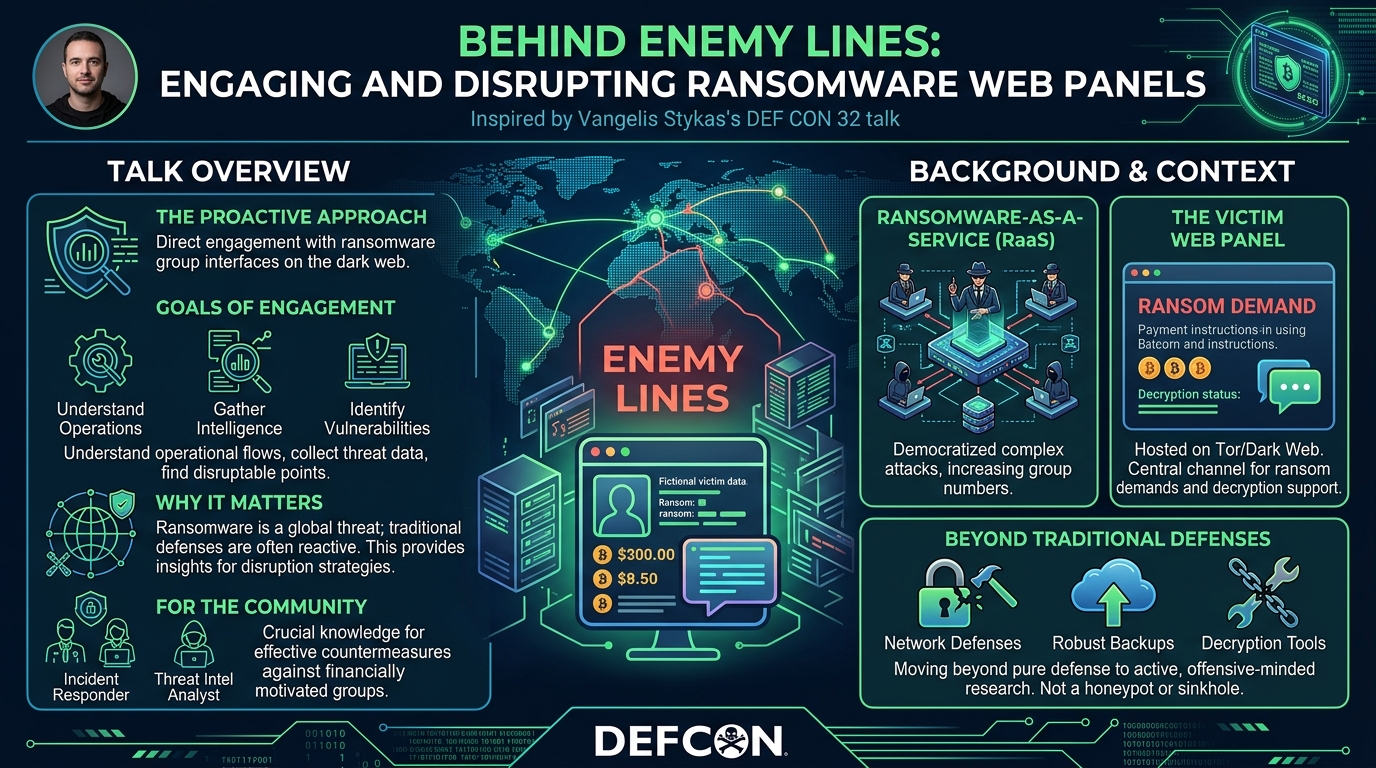
This talk, "Behind Enemy Lines: Engaging and Disrupting Ransomware Web Panel," delivered by Vangelis Stykas at DEF CON 32, offers a unique perspective on the ongoing battle against ransomware. Rather than focusing solely on prevention or post-incident recovery, Stykas delves into the proactive, often risky, realm of directly interacting with ransomware groups through their victim-facing web panels. This approach aims to understand their operations, gather intelligence, and identify potential vulnerabilities that could lead to disruption. The speaker explores the motivations behind such engagement, the technical challenges involved, and the ethical considerations that arise when venturing into the adversaries' digital strongholds.
Key moments
Hello, and welcome to this DEF CON talk. Today, we're going to discuss the intricate world of ransomware, specifically focusing on the strategies and challenges involved in engaging with these malicious actors on their own turf: the web panel.
Overview
This talk, "Behind Enemy Lines: Engaging and Disrupting Ransomware Web Panel," delivered by Vangelis Stykas at DEF CON 32, offers a unique perspective on the ongoing battle against ransomware. Rather than focusing solely on prevention or post-incident recovery, Stykas delves into the proactive, often risky, realm of directly interacting with ransomware groups through their victim-facing web panels. This approach aims to understand their operations, gather intelligence, and identify potential vulnerabilities that could lead to disruption. The speaker explores the motivations behind such engagement, the technical challenges involved, and the ethical considerations that arise when venturing into the adversaries' digital strongholds.
The talk is critically important for several reasons. Ransomware continues to be one of the most pervasive and damaging threats to organizations globally, evolving rapidly in its sophistication and impact. Traditional defensive measures, while essential, often react to attacks rather than proactively undermining the attackers' infrastructure or operational flow. Stykas's work highlights an offensive-minded research methodology that seeks to understand the adversary from the inside out, providing insights that could inform novel disruption strategies. For incident responders, threat intelligence analysts, and security researchers, understanding how to safely and effectively engage with ransomware web panels can be a game-changer in the ongoing fight against these financially motivated cybercriminals.
Background
▶ Watch: Speaker says 'Hello' repeatedly at the start. (0:00)
The rise of Ransomware-as-a-Service (RaaS) models has democratized the ability to launch sophisticated ransomware attacks, leading to an explosion in the number and variety of threat groups. These groups, often operating with significant financial backing and organized structures, rely heavily on their digital infrastructure to manage victims, negotiate ransoms, and distribute decryption tools. A key component of this infrastructure is the victim web panel, often hosted on Tor or other dark web services. This panel serves as the primary communication channel between the ransomware operators and their victims, displaying ransom demands, providing payment instructions (typically in cryptocurrency), and offering a chat interface for negotiation.
Prior work in combating ransomware primarily focused on strengthening network defenses, implementing robust backup strategies, developing decryption tools (often after vulnerabilities are discovered in the ransomware's encryption scheme), and law enforcement efforts to seize assets or arrest operators. However, directly engaging with the operational infrastructure of ransomware groups, particularly their web panels, has been a less explored but increasingly relevant area of research. This approach is distinct from traditional honeypots or sinkholing, which typically involve setting up traps for malware or redirecting command-and-control traffic. Instead, it involves intentionally presenting oneself as a victim (or a proxy for a victim) to gain access to and interact with the ransomware group's live operational environment. The problem this talk addresses is the lack of systematic understanding and methodology for safely and effectively conducting such engagements, extracting actionable intelligence, and identifying opportunities for disruption without inadvertently aiding the attackers or compromising legitimate investigations. The speaker aims to fill this gap by sharing practical experiences and lessons learned from direct interactions with various ransomware panels
Reviews
Dr. Zero (Offensive Security Researcher) — STRONG ACCEPT
This talk proposes a direct, offensive approach to ransomware, moving beyond traditional reactive defenses to actively engage with ransomware groups via their victim web panels. It promises to deliver practical insights into gathering intelligence, understanding adversary operations, and identifying vulnerabilities for disruption. This methodology offers a novel and potentially high-impact strategy for incident responders and threat intelligence analysts, providing actionable signal by getting inside the enemy's operational infrastructure. This is the kind of proactive, risky research that can actually shift the fight.
Heather Calloway (CISO) — STRONG ACCEPT
This talk presents a compelling, if risky, methodology for directly engaging ransomware web panels to gather intelligence and identify disruption opportunities. While providing significant operational value for incident responders and threat intelligence teams seeking proactive strategies, it implicitly highlights critical governance challenges regarding the authorization, risk management, and ethical implications of interacting with malicious actors. Its potential to inform novel disruption strategies and improve organizational resilience against ransomware makes it highly relevant, even if the full executive-level policy framework for such engagements would require further development.