Secret Life of Rogue Device: Lost IT Assets on the Public Marketplace
Matthew Bryant
DEF CON 32 Main Stage · Day 1 · Main Stage
Overview
In the contemporary digital landscape, the lifecycle management of IT assets extends beyond initial deployment and internal use, often overlooking the critical security implications of their eventual disposal or loss. Matthew Bryant's DEF CON 32 talk, "Secret Life of Rogue Device: Lost IT Assets on the Public Marketplace," delves into the startling phenomenon of sensitive corporate hardware—ranging from employee laptops and early-stage prototypes to specialized factory equipment and backup drives—finding its way onto second-hand online electronics markets. Bryant, a seasoned security researcher known for projects like XSS Hunter and Cursed Chrome, and the Red Team Lead at Snap, unveils the methodologies for detecting and analyzing these "rogue devices" at scale, highlighting the profound security risks they pose to intellectual property, corporate data, and operational integrity.
Secret Life of Rogue Device: Lost IT Assets on the Public Marketplace
Speakers: Matthew Bryant
Conference: DEF CON 32
YouTube: https://www.youtube.com/watch?v=QgeEHdAmJDg
Overview
In the contemporary digital landscape, the lifecycle management of IT assets extends beyond initial deployment and internal use, often overlooking the critical security implications of their eventual disposal or loss. Matthew Bryant's DEF CON 32 talk, "Secret Life of Rogue Device: Lost IT Assets on the Public Marketplace," delves into the startling phenomenon of sensitive corporate hardware—ranging from employee laptops and early-stage prototypes to specialized factory equipment and backup drives—finding its way onto second-hand online electronics markets. Bryant, a seasoned security researcher known for projects like XSS Hunter and Cursed Chrome, and the Red Team Lead at Snap, unveils the methodologies for detecting and analyzing these "rogue devices" at scale, highlighting the profound security risks they pose to intellectual property, corporate data, and operational integrity.
The core of Bryant's research addresses fundamental questions: how frequently does this occur, what is the true security impact, and what types of devices are most commonly encountered? The talk meticulously details the technical challenges involved in monitoring vast online marketplaces, particularly the sophisticated anti-bot measures employed by platforms like eBay and China's Xianyu. By demystifying the process of identifying these covert listings—often hidden in plain sight within images rather than text descriptions—Bryant underscores a pervasive and often overlooked vector for corporate espionage, data breaches, and competitive intelligence gathering. This presentation is a crucial wake-up call for organizations to reassess their asset management and disposal policies in an era where digital forensics extends far beyond the corporate perimeter.
Background
The problem of rogue hardware appearing on public marketplaces is a direct consequence of inadequate or non-existent secure asset disposal policies, alongside instances of theft, loss, or unauthorized resale by employees. These devices, which should ideally be securely wiped, decommissioned, or destroyed, instead become accessible to the general public, often at bargain prices. The motivations for selling such items vary from genuine ignorance on the part of the seller regarding the device's true nature or origin, to deliberate attempts to monetize stolen or found corporate property. Regardless of intent, the presence of these devices outside a company's control represents a significant security vulnerability.
Matthew Bryant's research focuses on two primary types of online marketplaces: eBay for Western markets and Xianyu for Eastern markets, particularly in China, where a significant portion of global electronics manufacturing and assembly takes place. The choice of these platforms is strategic, as they facilitate transactions that can scale beyond local pick-up arrangements, allowing for shipping and thus broader geographic reach for rogue devices. Prior work in this area has often been anecdotal or focused on individual incidents, but Bryant's approach aims for a systematic, scalable methodology to quantify the problem.
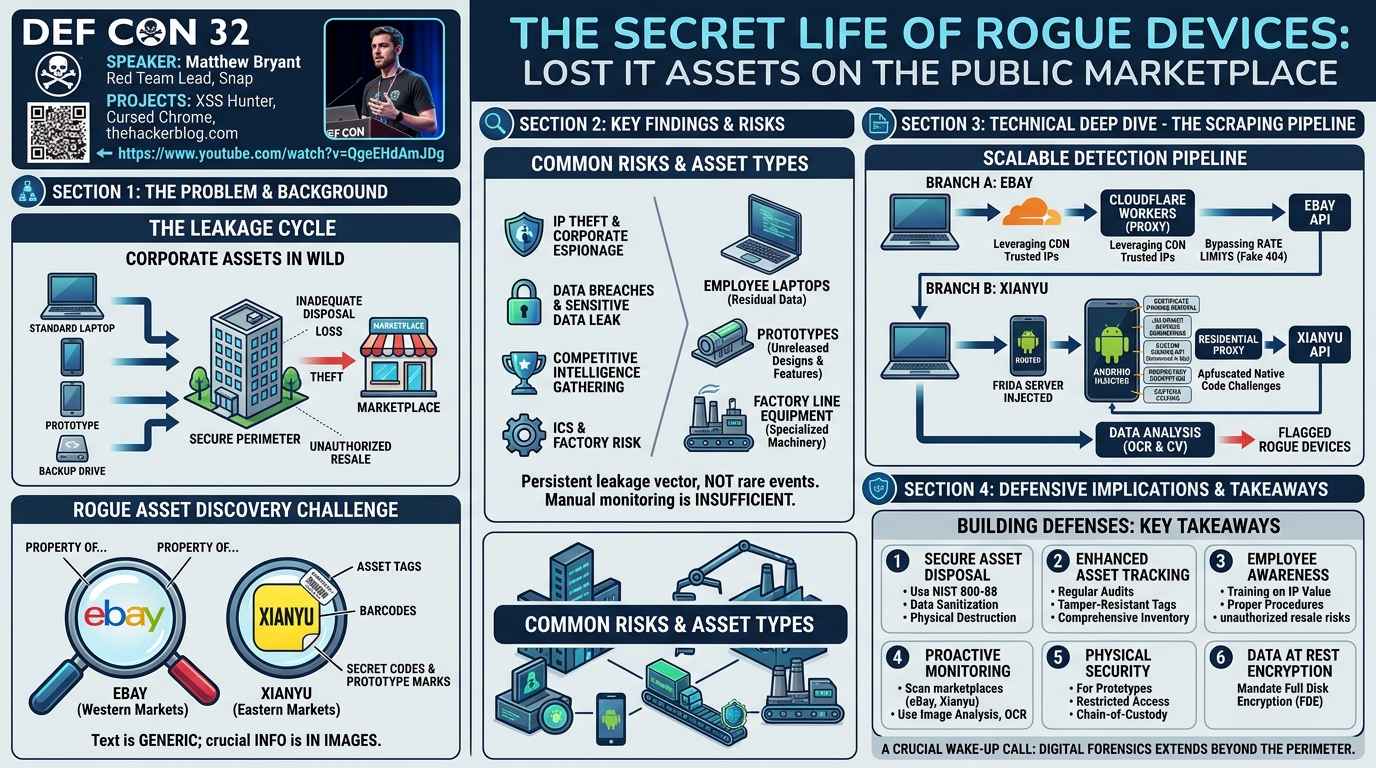
The inherent challenges in identifying these rogue devices are multifaceted. Firstly, sellers rarely explicitly advertise items as "secret prototypes" or "company property." Listings are typically generic, describing the item as a used laptop, phone, or electronic component. This necessitates a more sophisticated detection mechanism that looks beyond descriptive text. Bryant highlights that much of the crucial identifying information is embedded within the images accompanying the listings. This could be anything from a "Property of [Company Name]" sticker, an asset tag, a unique barcode format, or even secret code words and labeling conventions specific to prototypes or internal development versions of products. The sheer volume of listings across these global platforms, coupled with the obfuscated nature of the identifying information, underscores the need for an automated, scalable solution capable of deep image analysis and robust anti-bot circumvention.
Key Findings
While the talk primarily focuses on the sophisticated methodology for detecting rogue hardware rather than presenting specific quantitative results of discovered items, Matthew Bryant's research unequivocally establishes the existence and accessibility of corporate IT assets on public marketplaces as a significant and overlooked security threat. The key findings are therefore centered around the demonstrated capability to uncover these devices and the types of sensitive information they commonly expose.
Firstly, the research confirms that corporate assets, including employee laptops, sensitive prototypes, and factory equipment, are indeed being regularly listed and sold on second-hand markets like eBay and Xianyu. This isn't a rare occurrence but a persistent leakage vector, suggesting systemic failures in asset management and disposal across various industries. The talk emphasizes that the sheer volume of listings necessitates an automated approach, implying that manual monitoring is insufficient to grasp the scale of the problem.
Secondly, a critical finding is that valuable identifying information is predominantly found within images rather than listing descriptions. Sellers, often unaware of the item's sensitive nature, inadvertently expose company asset tags, proprietary labels, internal serial numbers, and even development-stage markings on prototypes. This necessitates the use of Optical Character Recognition (OCR) and image analysis techniques to extract and interpret this hidden data, making it feasible to link seemingly innocuous listings back to specific organizations or projects.
Thirdly, the research highlights the diverse range of sensitive devices that end up on these markets. Beyond standard employee laptops—which often contain residual user data despite attempted wipes—Bryant points to the presence of early development prototypes of consumer electronics. These prototypes carry immense intellectual property value, revealing future product designs, unreleased features, and proprietary hardware configurations, offering a direct competitive advantage to anyone who acquires them. The mention of factory line equipment also indicates a risk to industrial control systems (ICS) or specialized manufacturing processes.
Finally, the underlying finding is the demonstrated feasibility of building a scalable pipeline to continuously monitor these markets. By successfully navigating the complex technical barriers of scraping and data extraction from both Western and Eastern platforms, Bryant proves that proactive identification of rogue devices is achievable. This capability, though presented as a research endeavor, serves as a proof-of-concept for organizations to implement their own monitoring systems, turning a previously amorphous threat into a detectable and potentially actionable security concern. The implication is that without such monitoring, companies remain blind to a consistent outflow of valuable assets and sensitive information.
Technical Deep Dive
The technical core of Matthew Bryant's research revolves around building a robust, scalable pipeline to scrape and analyze listings from major online marketplaces, specifically eBay and Xianyu. The methodologies employed illustrate a sophisticated understanding of web scraping, anti-bot circumvention, and mobile application reverse engineering.
Scraping eBay: Leveraging Cloudflare Workers
For eBay, the scraping process initially appears straightforward: perform keyword searches (e.g., "laptop," "phone"), extract listing data, and download associated images for analysis. However, like any major platform, eBay implements rate limiting to deter automated scraping. Bryant describes how exceeding request thresholds triggers a fake 404 page, designed to mislead scrapers into believing the page doesn't exist.
The ingenious circumvention strategy for eBay leverages Cloudflare Workers. Cloudflare, a widely used Content Delivery Network (CDN), often has an allow list of its IP ranges that are exempt from rate limiting on client sites. This is because CDN traffic is generally trusted to accelerate legitimate user requests. Bryant exploited this by deploying a custom Cloudflare Worker—a serverless function that runs on Cloudflare's edge network—to act as a proxy. By routing scraping requests through this Cloudflare Worker, which originates from Cloudflare's own IP space, he effectively bypassed eBay's rate limiting, allowing for "unlimited requests" without being blocked. This method highlights a clever use of infrastructure-level trust relationships to achieve scraping at scale.
Scraping Xianyu: Advanced Mobile App Reverse Engineering
Scraping Xianyu, China's dominant second-hand marketplace, presented a far more significant technical challenge. Unlike eBay, Xianyu primarily operates as a mobile application with a minimal web presence, forcing researchers to interact with its API directly. This necessitated a deep dive into Android reverse engineering:
- App-Only Interface: The initial hurdle was the lack of a browsable website, requiring interaction with the mobile app.
- Certificate Pinning Removal: Xianyu employs certificate pinning, a security mechanism that prevents Man-in-the-Middle (MITM) attacks by ensuring the app only communicates with specific, pre-defined server certificates. To intercept and analyze network traffic, Bryant had to remove certificate pinning from the app. This typically involves patching the application binary or using dynamic instrumentation tools.
- Custom Signing API: Upon inspecting the app's network requests, Bryant discovered a "total custom signing API." This means every outgoing request is signed with cryptographic material generated by the app, and the server validates these signatures. Requests must be "byte perfect" and signed correctly, or they are rejected. Reimplementing this complex signing logic from scratch without full knowledge of the proprietary algorithms and keys is incredibly difficult.
- Proprietary Encrypted Fields: Even if a request was successfully signed and sent, the responses from Xianyu's servers contained "fields actually encrypted in their proprietary format." This required additional effort to reverse engineer the decryption mechanism to access the actual data.
- Custom CAPTCHA System: Xianyu implements its own CAPTCHA system, which spawns when a high volume of requests is detected or a user is not logged in. This often involves interactive puzzles (like "thumb capture sliding things") that are difficult for automated systems to solve.
- Obfuscated JNI Binary: The most challenging aspect was that much of this anti-bot logic—the signing algorithm, encryption/decryption routines, and CAPTCHA handling—was not implemented in easily reversible Java code. Instead, it was "done deep inside the obfuscated JNI binary," meaning the critical code was written in native languages (C/C++) and compiled into an obfuscated shared library, requiring assembly-level reverse engineering to understand.
To overcome these formidable obstacles, Bryant adopted a practical approach, combining automation with dynamic instrumentation using Frida. Recognizing the futility of constantly reversing and reimplementing the signing logic with every app update, he developed a system that:
- Automated App Interaction: A custom tool was built to launch the Xianyu app on a rooted phone, click through initial prompts, and even solve the interactive CAPTCHA automatically.
- Frida Server Injection: Once the app was in a functional state, a Frida server was injected. Frida is a dynamic instrumentation toolkit that allows developers and researchers to inject scripts into running processes, hook functions, and inspect runtime behavior.
- Signing Proxy: Bryant's setup essentially turned the rooted phone into a "signing proxy." External HTTP requests intended for Xianyu's API were sent to the Frida-instrumented app. The Frida script would then hook the app's internal signing functions, allow the app itself to generate the correct cryptographic signature, and return the fully signed request.
- Residential Proxies: The signed requests were then sent to Xianyu's API via residential proxies to avoid IP-based blocking.
This elegant solution for Xianyu effectively outsourced the complex, proprietary cryptographic operations back to the legitimate application itself, bypassing the need for extensive, continuous reverse engineering of obfuscated native code. This method is a testament to the "skill issue" mindset, where advanced tools and creative problem-solving overcome seemingly insurmountable anti-bot measures.
Image Analysis for Identification
Once listings and their images were scraped from both platforms, the final technical step involved image analysis. As discussed, crucial identifying information (asset tags, company logos, prototype markings, secret codes) is often embedded directly into the images. This requires Optical Character Recognition (OCR) to extract text from images and potentially computer vision techniques to identify specific logos, barcode formats, or unique device features. The extracted text and visual cues are then cross-referenced against known corporate identifiers or prototype characteristics to flag rogue hardware.
Demo / Proof of Concept
Matthew Bryant's talk featured a clear demonstration of the operational pipeline for scraping and processing data from Xianyu, illustrating the practical application of his sophisticated reverse engineering and automation techniques. While not a live exploit demonstration, the proof of concept showcased the fully realized scraping infrastructure.
The core of the demo involved a rooted Android phone configured with a Frida server. This phone served as the critical component for bypassing Xianyu's stringent anti-bot measures. Bryant described how his custom automation system would first interact with the Xianyu app on this rooted device, handling initial prompts and solving the complex "thumb capture sliding" CAPTCHA automatically.
Once the app was in a stable, interactive state, the Frida server would be active, allowing external processes to inject commands and hook into the app's internal functions. The demonstration highlighted how an HTTP request, intended for Xianyu's API, would be sent to this rooted phone. The Frida script, operating within the app's context, would then intercept the request and utilize the app's legitimate, internal custom signing API to generate the necessary cryptographic signature. This signed request would then be returned to the scraper's control system.
Finally, this properly signed request would be dispatched to Xianyu's servers, not directly from the scraping infrastructure, but via a residential proxy. This layered approach ensured that the requests appeared legitimate (signed correctly by the official app) and originated from diverse, non-datacenter IP addresses, further evading detection. Bryant even briefly showed the physical setup, mentioning that while his initial cable management was "much uglier," the functional result was a seamless, automated process for acquiring data from Xianyu at scale. This PoC effectively validated the feasibility and robustness of his multi-layered approach to overcoming advanced mobile app anti-bot defenses.
Defensive Implications
The findings from Matthew Bryant's research carry significant defensive implications for organizations of all sizes, urging a re-evaluation of current IT asset management and security practices. The ease with which sensitive corporate assets end up on public marketplaces underscores several critical vulnerabilities that defenders must address.
- Robust Asset Disposal Policies: The most immediate implication is the need for comprehensive and strictly enforced secure asset disposal policies. Simply deleting files or performing a quick format is insufficient. All data storage devices (hard drives, SSDs, USB drives, phones, tablets) must undergo data sanitization using methods that meet or exceed industry standards (e.g., NIST SP 800-88 guidelines for media sanitization). For highly sensitive data, physical destruction (shredding, degaussing) should be mandated. Companies must also have clear processes for decommissioning and physically destroying prototypes and specialized equipment.
- Enhanced Asset Tracking and Inventory Management: Organizations need highly accurate and up-to-date asset tracking systems. Every piece of corporate hardware, from laptops to network devices and prototypes, should be tagged, cataloged, and accounted for throughout its entire lifecycle. This includes tracking when assets are deployed, transferred, repaired, and finally disposed of. Asset tags should be tamper-resistant and clearly indicate company ownership. Regular audits are essential to identify discrepancies.
- Employee Awareness and Training: Employees often represent a weak link in the asset disposal chain. Comprehensive training is crucial to educate staff about the importance of safeguarding company property, the risks associated with unauthorized resale or improper disposal, and the correct procedures for returning or disposing of company-issued devices. This includes emphasizing the value of intellectual property embedded in prototypes or development hardware.
- Proactive Market Monitoring: Inspired by Bryant's methodology, organizations should consider implementing their own proactive monitoring programs to scan major online marketplaces for listings that match their asset profiles. This could involve using image analysis, OCR, and keyword searches to detect company logos, unique serial numbers, asset tag formats, or prototype identifiers. Early detection can allow companies to purchase back their rogue devices, mitigate data exposure, or pursue legal action.
- Physical Security for Prototypes and Sensitive Equipment: Prototypes, by their nature, are high-value targets. Strict physical security measures must be in place for their storage, transportation, and handling. This includes secure labs, restricted access, chain-of-custody protocols, and potentially GPS tracking for high-value items. Unique, non-removable identifiers should be integrated into prototypes from the earliest stages of development.
- Data at Rest Encryption: While not a direct solution to rogue hardware, ensuring full disk encryption (FDE) on all corporate laptops and mobile devices significantly reduces the risk of data compromise if a device is lost or stolen before proper sanitization. This provides a layer of protection even if the device ends up on a second-hand market.
- Vendor Management and Supply Chain Security: Companies should scrutinize their contracts with third-party vendors responsible for IT asset disposal. Ensure these vendors adhere to stringent security standards and provide proof of secure destruction or sanitization. Conduct regular audits of vendor practices.
By addressing these defensive implications, organizations can significantly reduce their exposure to intellectual property theft, data breaches, and reputational damage stemming from lost or improperly disposed IT assets.
Key Takeaways
- Rogue hardware on public marketplaces is a pervasive and underestimated threat: Corporate laptops, prototypes, and specialized equipment frequently appear on platforms like eBay and Xianyu, posing significant risks to intellectual property and sensitive data.
- Critical identifying information often resides in images, not text: Sellers inadvertently expose asset tags, proprietary labels, and prototype markings through photos, necessitating advanced image analysis and OCR for detection.
- Bypassing sophisticated anti-bot measures is essential for scalable monitoring: Platforms like eBay (Cloudflare Workers) and Xianyu (Android app reverse engineering, custom signing APIs, JNI, Frida) employ advanced defenses that require creative and technical solutions to overcome.
- Secure asset disposal policies are non-negotiable: Organizations must implement robust, auditable processes for data sanitization and physical destruction of all IT assets at end-of-life to prevent leakage.
- Proactive monitoring of second-hand markets is a vital defensive strategy: Companies can leverage techniques demonstrated in this research to actively scan for and identify their own rogue devices, enabling early intervention and risk mitigation.
- Employee awareness and robust asset tracking are fundamental: Educating staff on proper asset handling and maintaining accurate, comprehensive asset inventories are crucial first lines of defense against lost or unauthorized resale of corporate property.
About the Speaker(s)
Matthew Bryant, known to his friends as "Mandatory," is a distinguished figure in the cybersecurity community with a rich background in security research and red teaming. He is currently the Red Team Lead at Snap, where he spearheads efforts to identify and exploit vulnerabilities within the company's systems and infrastructure.
Beyond his professional role, Bryant is a prolific security researcher and developer. He is widely recognized for creating impactful security projects such as XSS Hunter, a popular tool for detecting Cross-Site Scripting (XSS) vulnerabilities, and Cursed Chrome, a project focused on browser security. His research and insights are regularly published on his security blog, thehackerblog.com. Matthew Bryant's work consistently demonstrates a deep technical understanding of various attack surfaces, from web applications to mobile platforms, making him a highly credible and insightful speaker on topics related to offensive security and threat intelligence.
Reviews
Dr. Zero (Offensive Security Researcher) — MUST SEE
Matthew Bryant's talk on detecting rogue IT assets on public marketplaces presents a critical, often overlooked security vector. The research provides a highly technical and scalable methodology to identify sensitive corporate hardware, from prototypes to employee laptops, being sold online. His deep dive into circumventing advanced anti-bot measures on platforms like Xianyu using sophisticated mobile app reverse engineering and Frida is particularly noteworthy, offering actionable intelligence and a clear call to action for organizations to overhaul their asset management and disposal policies.
Heather Calloway (CISO) — STRONG ACCEPT
Matthew Bryant's talk on "Secret Life of Rogue Device" is a vital wake-up call for security leaders, systematically exposing a pervasive and high-impact governance failure: the leakage of sensitive corporate hardware onto public marketplaces. While the technical deep dive into scraping and anti-bot circumvention is impressive, its core value lies in demonstrating the scale of this problem and, more importantly, the feasibility of proactive detection. This research moves beyond anecdotal evidence to present a clear mandate for CISOs to reassess asset lifecycle management, secure disposal policies, and consider external market monitoring as a critical component of their defensive strategy…