What’s Really in the Box? The Case for Hardware Provenance and HBOMs
Allan Friedman (US government)
DEF CON 33 · Day 1 · Main Stage
Overview
In this DEF CON talk, Allan Friedman, a prominent figure in the Software Bill of Materials (SBOM) movement during his decade as a US government lead for supply chain security, shifts focus to the burgeoning and complex challenge of Hardware Bills of Materials (HBOMs). Friedman argues that understanding the provenance and composition of hardware components, particularly semiconductors, is the next critical frontier in supply chain security. The talk dissects the multifaceted risks inherent in modern hardware supply chains, from pervasive counterfeiting and exploitable vulnerabilities to active tampering and geopolitical pressures.
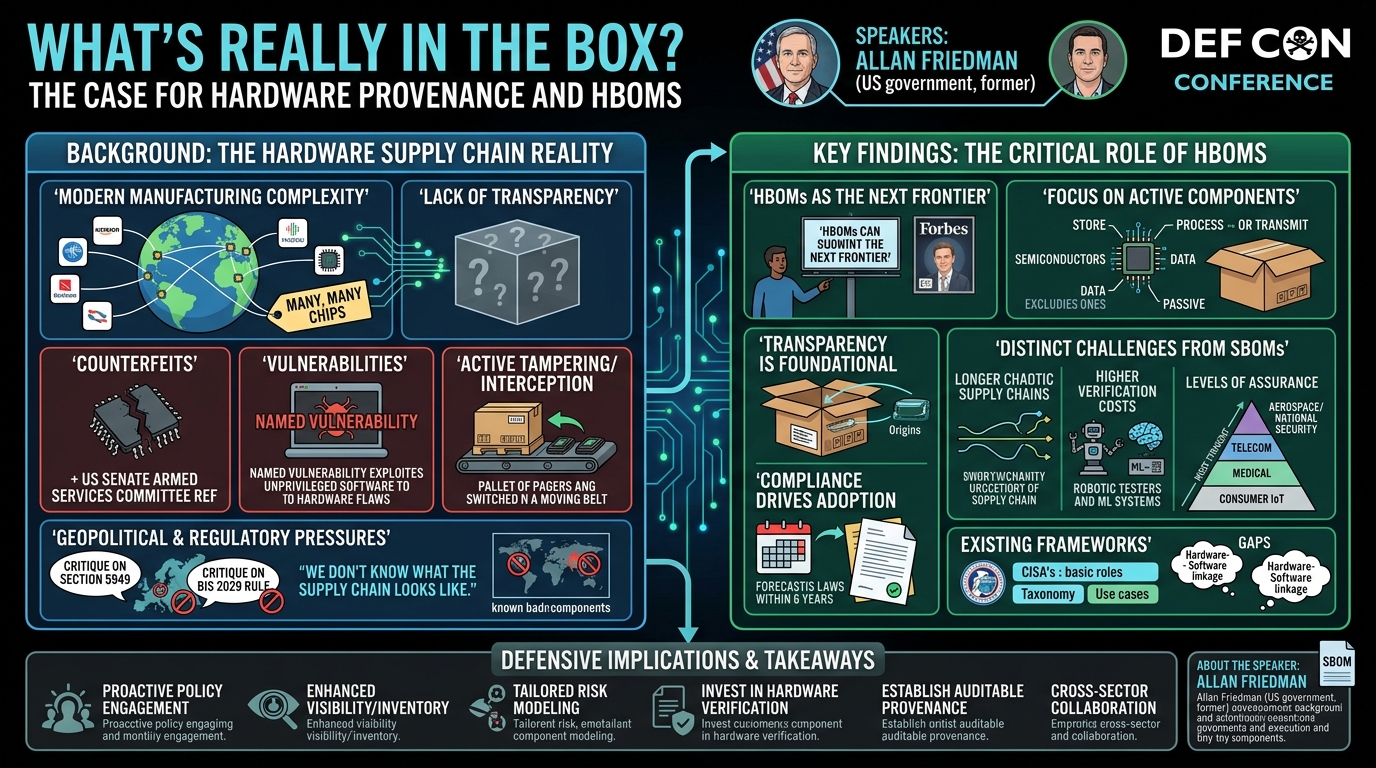
Key moments
- 0:00 Introduction to hardware supply chain and HBOMs
- 2:00 The intricate reality of modern chip supply chains
- 4:00 Key risks: counterfeits, vulnerabilities, and active tampering
- 6:30 Government regulations and their problematic impact on supply chain
- 8:15 HBOMs' core goal: enhanced visibility and transparency
What’s Really in the Box? The Case for Hardware Provenance and HBOMs
Speakers: Allan Friedman, US government (former)
Conference: DEF CON
YouTube: https://www.youtube.com/watch?v=QARwgoJ-IbA
Overview
In this DEF CON talk, Allan Friedman, a prominent figure in the Software Bill of Materials (SBOM) movement during his decade as a US government lead for supply chain security, shifts focus to the burgeoning and complex challenge of Hardware Bills of Materials (HBOMs). Friedman argues that understanding the provenance and composition of hardware components, particularly semiconductors, is the next critical frontier in supply chain security. The talk dissects the multifaceted risks inherent in modern hardware supply chains, from pervasive counterfeiting and exploitable vulnerabilities to active tampering and geopolitical pressures.
Friedman emphasizes that the increasing globalized nature of manufacturing, coupled with a lack of granular visibility into component origins, creates a fertile ground for both malicious actors and unintended compliance pitfalls. The presentation serves as a clarion call for a standardized, transparent approach to hardware supply chain data, drawing parallels with the success and lessons learned from the SBOM initiative. He posits that government regulation is an inevitable driver for HBOM adoption, urging the security community to proactively shape these policies to ensure they are both effective and practical.
The talk highlights the necessity of a modular, flexible data layer that can inform diverse risk management strategies, acknowledging that HBOMs will present unique challenges compared to their software counterparts, such as higher verification costs and the need for varying levels of assurance. Friedman's vision is not merely about identifying components but about establishing a verifiable chain of custody for active hardware, crucial for national security, critical infrastructure, and a host of other sectors grappling with the integrity of their physical assets.
Background
▶ Watch: Introduction to hardware supply chain and HBOMs (0:00)
The modern manufacturing landscape, while highly efficient, has introduced unprecedented complexity and opacity into the supply chain. Allan Friedman points out that while the concept of a "Bill of Materials" has existed for decades—pioneered by figures like W. Edwards Deming in the 1940s to optimize manufacturing processes—the focus has historically been on logistical tracking rather than security-relevant provenance. Today, a single product can contain "many, many chips" sourced from a vast network of organizations, many of which engage in non-trivial contract manufacturing, obscuring the true origin and handling of components.
This intricate global web opens the door to significant security risks:
- Counterfeits: Friedman cites the US Senate Armed Services Committee, which dedicated a year to investigating the pervasive issue of counterfeit components in the DoD defense national security supply chain. These are not just intellectual property violations but can introduce critical failures or backdoors.
- Vulnerabilities: Hardware-software interactions are a particularly "dangerous attack vector," enabling unprivileged software to exploit underlying hardware flaws. The talk alludes to known, named vulnerabilities that impact large portions of the supply chain.
- Active Tampering and Interception: Instances where "one thing is shipped and something else got to the final destination" highlight the risk of malicious modification during transit. Friedman recounts a personal "existential moment" involving a pallet of pagers intercepted before reaching southern Lebanon, underscoring the real-world implications beyond semiconductors. While acknowledging that some attacks might be overstated, he stresses that "we're going to have to start paying a lot more attention."
Beyond direct security threats, geopolitical factors and regulatory pressures are increasingly shaping the need for hardware provenance. Friedman, no longer constrained by government affiliation, critiques existing governmental policies, such as Section 5949 rules impacting the telecommunications sector and the Bureau of Industry and Security's (BIS) 2029 rule prohibiting Chinese components in US-sold cars. He deems these policies "bad" because they are impractical to implement given the current lack of supply chain visibility. The core problem, as Congressman Seth Moulton articulated, is that "we don't know what the supply chain looks like."
The philosophical foundation for HBOMs, much like SBOMs, is to create a data layer that can map "known badness" to specific components. The SBOM movement, Friedman explains, demonstrated the value of knowing what software components are in critical infrastructure and national security systems, allowing organizations to map known vulnerabilities (e.g., CVEs) or problematic open-source projects to their assets. This approach, separating the data from risk management, allows for flexibility and resilience, making it adaptable to diverse risk postures and evolving threats.
Key Findings
▶ Watch: The intricate reality of modern chip supply chains (2:00)
The central finding of Allan Friedman's talk is the undeniable and urgent necessity for Hardware Bills of Materials (HBOMs) to bring critical transparency and security to the global hardware supply chain. This is not merely an academic exercise but a practical imperative driven by escalating security risks, complex manufacturing realities, and impending governmental regulations.
Key findings and contributions include:
- HBOMs as the Next Frontier: Friedman, having spearheaded the SBOM movement, unequivocally identifies HBOMs as the next major challenge in supply chain security, stressing that "we are going to be seeing this a lot more." He highlights widespread recognition of this problem, citing Forbes cover stories and other media attention.
- Focus on Active Components: To manage the immense scope of "all hardware," the HBOM effort must primarily focus on "active components," specifically semiconductors and chips. These are defined by their ability to store, process, or transmit data, impacting confidentiality, integrity, and availability. This pragmatic narrowing excludes passive components like capacitors or batteries unless they actively handle data.
- Transparency as Foundational: Transparency is presented as the "sine qua non" for any effective security measure in the hardware domain. The goal of HBOMs is to provide this visibility from the customer's or downstream perspective, enabling a better understanding of component origins and their journey through the supply chain.
- Compliance as a Primary Driver: Unlike SBOMs, which initially gained traction through security benefits, Friedman predicts that "compliance is going to be the primary driver" for HBOM adoption. He strongly believes that major governments will enact laws regarding country of origin for physical supply chains within the next six years, making proactive community engagement crucial to shape effective policies.
- Distinct Challenges from SBOMs: While sharing a foundational philosophy with SBOMs (separating data from risk, modularity), HBOMs face unique complexities:
- Longer, More Chaotic Supply Chains: The physical movement of goods across continents introduces more opportunities for interception and tampering.
- Higher Verification Costs: Proving the integrity and provenance of physical hardware is significantly more expensive and complex than software, requiring specialized tools, robotics, and learning systems. This represents a nascent market opportunity for tech startups.
- Need for Levels of Assurance: A "one-size-fits-all" approach won't work. HBOMs will require different levels of assurance based on the criticality of the device and sector—ranging from consumer-grade IoT to medical devices, telecom infrastructure, automotive, aerospace, and national security systems.
- Existing Frameworks as a Starting Point: Friedman acknowledges foundational work, such as the CISA framework published in 2023, which provides a useful starting point with basic roles, taxonomy, and defined use cases (compliance, security, availability). However, he notes significant gaps remain.
- Integration with Broader Supply Chain Issues: HBOMs are not isolated but must integrate with existing supply chain concerns, including human rights and sustainability, and ultimately contribute to a holistic understanding of overall organizational exposure and risk.
In essence, Friedman's key finding is that the journey toward secure hardware begins with comprehensive, auditable, and context-aware transparency, driven by a blend of security imperative and regulatory inevitability.
Technical Deep Dive
▶ Watch: Key risks: counterfeits, vulnerabilities, and active tampering (4:00)
The technical underpinning of the HBOM concept, as articulated by Allan Friedman, revolves around creating a robust data layer for hardware provenance that is both specific enough to be actionable and flexible enough to adapt to diverse use cases and evolving threats.
At its core, an HBOM is envisioned as a structured list of components, but with critical distinctions from its software counterpart. The primary focus is on active components, which are defined by their capacity to store, process, or transmit data. This definition strategically narrows the scope to items directly relevant to security concerns (confidentiality, integrity, availability), allowing for the exclusion of passive components like basic resistors or capacitors unless they actively participate in data handling. This pragmatism is essential given the sheer volume and diversity of hardware parts.
Friedman emphasizes a modular philosophical approach, mirroring the SBOM model:
- Data Layer Separation: The HBOM itself serves as a neutral data layer, distinct from the risk management layer. This means the HBOM provides factual information about components, while an organization's specific risk appetite and threat model determine how that data is interpreted and acted upon. This modularity ensures flexibility, preventing either side from being "locked in" by the other.
- Mapping "Known Badness": The HBOM enables organizations to map identified risks (e.g., known vulnerabilities in a specific chip, components from a sanctioned entity, or those handled by untrusted third parties) to the actual hardware they possess.
The requirements for this transparency layer are stringent:
- Common Approaches and Interoperability: Given the global nature of hardware manufacturing, HBOM data must be generated and consumed using common, interoperable approaches. The focus, initially, is on defining these approaches rather than rushing to premature technical standards that might miss critical use cases or take too long to develop.
- Tracking Physical Control ("Who Touched Things"): A significant technical challenge unique to hardware is proving integrity. Unlike software, where cryptographic hashes can verify a file's immutability, "it's very hard to take a hash of a dim" (memory module) to prove it hasn't been tampered with. Therefore, HBOMs must incorporate robust mechanisms for tracking the chain of custody – "who had control of the physical stuff" – throughout the supply chain. This is crucial for detecting physical tampering or interference during the movement of goods.
The differences between HBOMs and SBOMs necessitate distinct technical considerations:
- Compliance-Driven Data: HBOMs are expected to be heavily driven by regulatory compliance, meaning the data collected will need to directly support auditing and attestation requirements for specific regulations (e.g., country of origin, restricted components).
- Levels of Assurance: A critical technical departure is the need for levels of assurance. Friedman explicitly states that "we're definitely going to need to do that," unlike SBOMs where a single standard was initially pursued. This means the granularity, reliability, and cost of HBOM data will vary based on the criticality of the asset. For example:
- Consumer-grade IoT might require basic assertions.
- Medical devices (safety-critical) and telecom infrastructure (safety-critical and target of foreign adversaries) will demand higher levels of data and attestation support.
- Aerospace and national security systems will require the most stringent data collection and verification processes. This implies different data schemas, verification methodologies, and audit trails for different contexts.
Current efforts, such as the CISA framework published in 2023, represent a starting point. This framework, built on the SBOM model, provides a basic taxonomy and defines roles within the HBOM ecosystem. It also outlines key use cases: compliance, security (vulnerabilities and active attacks), loss of control due to jurisdiction, and availability (understanding supply chain exposure and dependencies).
However, significant technical gaps remain:
- Hardware-Software Linkage: A "known hard problem" is how to effectively link hardware components to the software that runs on them, especially in complex systems.
- Provenance and Auditing: Developing robust, auditable methods for tracking and verifying provenance across a fragmented global supply chain is still an open challenge.
- Standard Fragmentation: Friedman notes that "no one standard is equipped to solve this problem today and almost certainly won't be." The diversity of data types and stakeholders will require an aggregation or integration of multiple standards.
- Role of AI: Friedman speculates that in the future, Large Language Models (LLMs) could play a role in bridging disparate "data universes" related to hardware and software, automating the complex linking and analysis that humans currently struggle with.
Ultimately, the technical deep dive into HBOMs reveals a highly complex, multi-faceted problem requiring innovative solutions in data modeling, chain of custody verification, and cross-sector collaboration to establish verifiable trust in the physical components that underpin our digital world.
Demo / Proof of Concept
▶ Watch: Government regulations and their problematic impact on supply chain (6:30)
The talk by Allan Friedman, "What’s Really in the Box? The Case for Hardware Provenance and HBOMs," focuses on outlining the problem, its implications, and the strategic path forward for developing and implementing Hardware Bills of Materials. As such, the presentation does not include a live demonstration or a proof of concept of an HBOM system or a hardware verification tool. The speaker emphasizes the foundational work required to establish frameworks and standards before such systems can be widely developed and showcased.
Defensive Implications
▶ Watch: HBOMs' core goal: enhanced visibility and transparency (8:15)
The push for Hardware Bills of Materials (HBOMs) carries profound implications for cybersecurity defenders, necessitating a significant shift in their approach to asset management, risk assessment, and supply chain security. Friedman's talk highlights several key areas where defenders must adapt and act:
- Proactive Policy Engagement: Defenders cannot afford to be passive recipients of government regulation. Friedman explicitly warns that "bad policies already" exist due to a lack of understanding of the supply chain's realities. The community, especially security professionals, must actively engage with policymakers to define meaningful, efficient, and implementable HBOM regulations. This involves educating legislators on technical feasibility, economic impact, and the nuances of global manufacturing to prevent mandates that are either impossible to meet or counterproductive.
- Enhanced Visibility and Inventory Management: The foundational defensive step is to gain granular visibility into the active components within an organization's hardware. This means moving beyond simple asset inventories to understanding the specific semiconductors and chips that "store, process, or transmit data" in critical systems. Knowing "where our chips come from" is paramount for identifying potential points of compromise or geopolitical risk.
- Tailored Risk Modeling and Assurance Levels: Defenders must move away from a one-size-fits-all security posture. HBOM data will enable the development of more sophisticated, context-aware risk models that incorporate the provenance and characteristics of hardware components. Crucially, organizations will need to define and implement varying levels of assurance for HBOMs based on the criticality of the hardware. A consumer IoT device will warrant different verification and auditing processes than a medical device, telecommunications infrastructure, or a national security system. This allows for optimized resource allocation and appropriate defensive controls.
- Investment in Hardware Verification Capabilities: The talk explicitly identifies hardware verification as a burgeoning market. Defenders, particularly in critical sectors, should consider investing in or advocating for the development of advanced verification technologies, including those leveraging robotics and machine learning. These capabilities will be essential for validating the authenticity and integrity of components, especially given the "more expensive" nature of physical verification compared to software.
- Establishing Auditable Provenance and Attestation: Given the difficulty of cryptographically hashing physical components, defenders need to establish robust systems for tracking the chain of custody for hardware. This includes processes for reliable, auditable attestations of who "touched things along the way." Friedman suggests this can be achieved without necessarily making sensitive supplier data public, perhaps through trusted third-party audits or data escrow mechanisms that only reveal information when proof is required.
- Cross-Sector Collaboration and International Standards: Hardware supply chains are inherently global and cross-sector. Defenders must engage in collaborative efforts across industries (defense, critical infrastructure, telecom, automotive, medical device, IT) and internationally to develop common HBOM approaches and standards. Unilateral national policies are likely to fail or create friction, making international cooperation vital for effective defense.
- Addressing Data Gaps and Leveraging Emerging Technologies: Defenders need to acknowledge and actively work on filling existing gaps, such as effectively linking hardware and software information, and improving auditing processes. Friedman's mention of AI, specifically Large Language Models, suggests a future where automated tools could help integrate disparate data sources to provide a more holistic security picture, reducing the manual burden on defenders.
In essence, the defensive implications of HBOMs call for a proactive, intelligence-driven, and collaborative approach to secure the physical backbone of our digital world, moving beyond traditional software-centric security models to embrace the complexities of hardware provenance and integrity.
Key Takeaways
- HBOMs are the Next Critical Supply Chain Frontier: Following the SBOM movement, Hardware Bills of Materials (HBOMs) are the inevitable and essential next step for securing complex global supply chains, driven by escalating risks and impending government regulations.
- Focus on Active Components and Data Flow: HBOM efforts should pragmatically focus on "active components" (e.g., semiconductors, chips) that store, process, or transmit data, as these are the primary vectors for security vulnerabilities impacting confidentiality, integrity, and availability.
- Distinct Challenges and Requirements from SBOMs: Unlike SBOMs, HBOMs face unique complexities including longer, more chaotic supply chains, significantly higher verification costs for physical components, and the critical need for multiple levels of assurance tailored to the criticality of the hardware and its operating environment.
- Transparency, Provenance, and Auditable Attestations are Key: Effective HBOMs demand granular transparency into component origins and a verifiable chain of custody ("who touched things") to mitigate risks like counterfeits, vulnerabilities, and active tampering, requiring auditable attestations rather than solely relying on traditional integrity checks.
- Proactive Engagement with Policymakers is Crucial: Given that compliance will be a primary driver for HBOM adoption, the security community must actively engage with governments to shape practical, effective, and internationally interoperable policies, preventing the implementation of "bad policies" due to a lack of industry understanding.
- Significant Gaps and Opportunities Remain: Key challenges include linking hardware and software data, establishing robust auditing mechanisms, and the absence of a single, comprehensive standard. However, this also presents opportunities for innovation in hardware verification technologies and the potential application of AI/LLMs to integrate disparate data sources.
About the Speaker(s)
Allan Friedman is a highly influential figure in the realm of supply chain security. For a decade, he served as one of the US government's leading experts on the topic, playing a pivotal role in the development and widespread adoption of Software Bills of Materials (SBOMs). Having recently concluded his tenure with the US government, Friedman is now directing his expertise and advocacy towards tackling the next major challenge: Hardware Bills of Materials (HBOMs). His experience at the intersection of government policy, industry collaboration, and technical standards development positions him as a key thought leader in this critical area of cybersecurity.
Reviews
Dr. Zero (Offensive Security Researcher) — SOLID
Friedman is the right person to give this talk — he built the SBOM playbook and knows exactly where the bodies are buried in supply chain policy. But this is a framing and advocacy talk, not a research drop: it maps the problem space, argues for community engagement, and draws SBOM analogies. Useful, competent, not groundbreaking.
Heather Calloway (CISO) — SOLID
Allan Friedman knows this terrain better than almost anyone, and the HBOM framing is legitimate and timely. But the talk delivers a well-structured problem statement where a more mature audience needs an operational path — it's more agenda-setting than actionable.