Veilid la revoluçion : Your data is yours to own
Katelyn Bowden, Paul Miller
DEF CON 33 · Day 1 · Main Stage
Overview
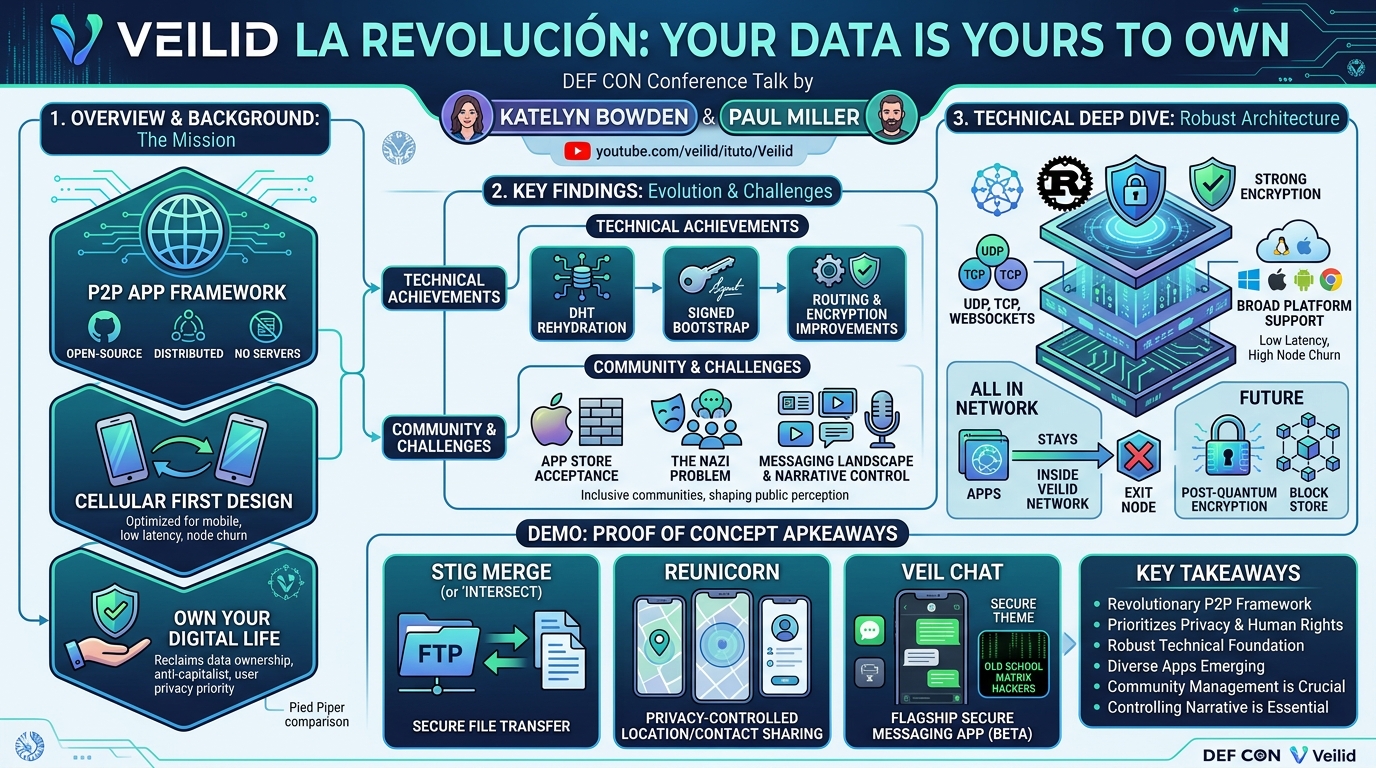
In an era where personal data is increasingly commodified and centralized platforms dominate digital communication, Katelyn Bowden and Paul Miller presented "Veilid la revolución: Your data is yours to own" at DEF CON, introducing Veilid – an ambitious, open-source, peer-to-peer (P2P) application framework. Veilid is designed from the ground up to prioritize user privacy and autonomy, aiming to dismantle the existing architecture where tech giants control personal data. The talk highlighted not only the technical advancements of the Veilid framework but also the critical lessons learned in building a community-driven, anti-capitalist project focused on defending human rights through privacy.
Key moments
- 0:54 Veilid's mission: privacy-focused, distributed, open-source framework
- 2:12 Technical overview: Rust, mobile-first, resilient, distributed network
- 3:57 The 'People's Cloud': mobile-first design philosophy
- 4:30 Key design goal: no exit nodes, apps stay within Veilid
- 5:22 Anti-capitalist model: no monetization, driven by passion
- 6:50 Developers can monetize, but Veilid Foundation remains non-profit
- 7:40 Recent improvements: DHT rehydration and new features
Veilid la revolución: Your data is yours to own
Speakers: Katelyn Bowden; Paul Miller
Conference: DEF CON
YouTube: https://www.youtube.com/watch?v=C8F5kvm2B5s
Overview
In an era where personal data is increasingly commodified and centralized platforms dominate digital communication, Katelyn Bowden and Paul Miller presented "Veilid la revolución: Your data is yours to own" at DEF CON, introducing Veilid – an ambitious, open-source, peer-to-peer (P2P) application framework. Veilid is designed from the ground up to prioritize user privacy and autonomy, aiming to dismantle the existing architecture where tech giants control personal data. The talk highlighted not only the technical advancements of the Veilid framework but also the critical lessons learned in building a community-driven, anti-capitalist project focused on defending human rights through privacy.
The core mission of Veilid is to develop, distribute, and maintain a privacy-focused communication platform and protocol, making true privacy accessible to everyone, not just technical elites. This vision translates into a completely distributed app framework that operates without traditional servers, blockchain, or any inherent monetization model. By eliminating perverse incentives to collect and sell user data, Veilid seeks to empower both developers to build privacy-preserving applications and users to reclaim ownership of their digital lives. The speakers emphasized that this project is a labor of love, driven by volunteers who believe in a more equitable and private internet.
This presentation served as a two-year update on Veilid's progress, detailing its architectural evolution, the diverse applications being built on its framework, and the challenges inherent in fostering a community around such a revolutionary concept. Bowden and Miller shared insights into navigating the complexities of public perception, managing community dynamics, and the philosophical stance required to build technology that genuinely serves human rights rather than corporate interests. Their candid discussion about the "Nazi problem" and the shifting narrative around encryption underscored the real-world implications and responsibilities of creating truly private communication tools.
Background
▶ Watch: Veilid's mission: privacy-focused, distributed, open-source framework (0:54)
The genesis of Veilid stems from a profound dissatisfaction with the current state of digital privacy and data ownership. The speakers articulate a vision where individuals, not corporations, control their digital identities and communications. Conceptually, Veilid draws parallels with existing distributed technologies like IPFS (InterPlanetary File System) and Tor (The Onion Router), but it differentiates itself through a fundamental design philosophy. While IPFS focuses on decentralized storage and Tor on anonymous routing, Veilid aims to provide a comprehensive, P2P application framework that is faster, more resilient, and specifically designed for "all in network" services, meaning applications running on Veilid primarily communicate within the Veilid network itself, without reliance on external exit nodes.
A crucial design decision for Veilid was its "cellular first" approach. Recognizing that the majority of the global population accesses the internet primarily through mobile devices, Veilid has been optimized for low latency and high node churn, capable of seamlessly handling network changes like switching between cellular and Wi-Fi mid-communication. This contrasts with many traditional internet services and even some privacy tools that were initially designed for wired connections and desktop environments. The goal is to make advanced privacy accessible and practical for users worldwide, turning the "supercomputers in our pockets" into nodes of a collective, decentralized "people's cloud" rather than mere conduits for corporate data collection.
The project explicitly positions itself as an anti-capitalist endeavor, drawing a direct comparison to the fictional "Pied Piper" project from the TV show Silicon Valley. The speakers acknowledge the technical ambition but highlight that Pied Piper's downfall was ultimately due to the pressures of monetization and catering to a board of directors. Veilid, in contrast, operates through small donations and volunteer efforts, intentionally avoiding the "perverse incentive to monetize" user data. This commitment extends to developers building on Veilid, who are not compelled to integrate advertising or data-selling models. While monetization is not forbidden for third-party applications built on Veilid (e.g., a patient portal for hospitals), the core framework and its flagship applications are designed to exist outside of a profit-driven model, ensuring that privacy remains the paramount objective. This philosophical stance directly addresses why the problem exists: the current internet infrastructure is largely built on models that incentivize data collection, creating a fundamental conflict with user privacy.
Key Findings
▶ Watch: The 'People's Cloud': mobile-first design philosophy (3:57)
Over the past two years, Veilid has achieved significant technical and community milestones, solidifying its position as a robust framework for privacy-centric applications. One of the primary findings highlighted is the continuous improvement in the framework's core capabilities. Key enhancements include DHT rehydration, a mechanism that allows the distributed hash table to take existing data from a local node and efficiently rehydrate it across the network as it ages out, ensuring data persistence and availability within the distributed system. This directly contributes to the resilience and self-healing nature of the network.
Security and privacy handling have also seen substantial improvements. The routing mechanisms and encryption protocols within Veilid have been refined, leading to a more secure and private communication environment. A significant security addition is signed bootstrap, which introduces a layer of authentication when nodes initially connect to the network. This mitigates certain attack vectors at the entry point. Despite this, the speakers proudly noted that the only centralized piece of infrastructure remains a single text record on a DNS server, underscoring the project's commitment to decentralization. The distributed nature extends to the inability to accurately count the number of active nodes, a deliberate design choice that prevents external parties, including the Veilid Foundation itself, from gaining visibility into network usage patterns, thereby enhancing user privacy.
Beyond technical advancements, the talk underscored critical findings regarding community building and management in the context of a public, privacy-focused project. The Veilid community, numbering "several hundred active people" on Discord, is not just technical; it includes marketing specialists and lawyers eager to contribute. A particularly striking finding was the challenge of explaining a "we don't retain data" privacy policy to app stores, an "alien concept" that highlights the entrenched data-collection norms of the industry. Furthermore, the speakers candidly discussed the "Nazi problem"—the inevitable reality that providing universal privacy means also enabling communication for individuals whose ideologies are antithetical to the project's values. The finding here is not a solution to prevent such individuals from using the network entirely, but rather a strategy to mitigate their influence within the community by fostering an inclusive environment that actively excludes those who seek to disrupt it. This includes proactive marketing to target desired user groups and strict moderation within community spaces.
Lastly, the talk identified the rapidly changing messaging landscape and public perception of encryption as a critical challenge. Drawing parallels with Tor's "dark web" stigma and recent negative media portrayals of Signal, the speakers found that maintaining control of the narrative around privacy tools is paramount. Their strategy involves learning from these prior experiences to proactively shape public understanding of Veilid, ensuring it is perceived as a tool for empowerment and human rights, not illicit activities. These findings collectively demonstrate Veilid's evolution as both a sophisticated technical platform and a socially conscious movement.
Technical Deep Dive
▶ Watch: Key design goal: no exit nodes, apps stay within Veilid (4:30)
Veilid's architectural foundation is built on Rust, a programming language known for its performance, memory safety, and concurrency, making it an ideal choice for a robust and secure networking framework. The core of Veilid's privacy guarantees lies in its use of strong encryption from the ground up, ensuring that communications are protected at every layer. The framework is designed for broad compatibility, with nodes capable of running on a wide array of operating systems, including Linux, Mac, Windows, Android, and iOS. Remarkably, the design even supports running a Veilid node within a browser session (demonstrated by projects like V-ne), significantly lowering the barrier to entry for users and developers by minimizing hardware requirements.
The network protocol is highly flexible, operating over UDP, TCP, WebSockets, and Secure WebSockets. This multi-protocol support enhances resilience against various network conditions and censorship attempts, allowing Veilid to adapt to different environments. A key technical optimization is the focus on low latency and high node churn. This means the network is engineered to handle situations where nodes frequently join and leave, or where network conditions are unstable (e.g., mobile connections switching between cellular and Wi-Fi), without interrupting ongoing communications. This resilience is a direct result of its "cellular first" design philosophy, prioritizing the typical mobile user experience.
Unlike many anonymizing networks, Veilid employs an "all in network" routing model. This means that applications built on Veilid are primarily designed to communicate within the Veilid network, without relying on external exit nodes similar to Tor. This design choice makes it "much harder for someone to be able to filter traffic leaving the network" and inherently integrates IP privacy by preventing direct exposure of user IP addresses to external services. While developers could theoretically build an application that acts as an exit node, the framework's design discourages this as it would likely break the privacy model Veilid promotes.
Recent technical improvements further solidify Veilid's robust architecture. DHT rehydration ensures that the distributed hash table, which is crucial for node discovery and data routing, remains consistent and up-to-date even as data ages out locally, by efficiently re-propagating it across the network. The implementation of signed bootstrap adds a layer of cryptographic authentication to the initial connection process for new nodes, enhancing network integrity and preventing unauthorized entry. Despite these advancements, the network maintains an impressive level of decentralization, with the speakers noting that "the only centralized piece of infrastructure is still one text record... on a DNS server."
Looking to the future, Veilid is actively integrating HTTPS web transport support, working with "major vendors" to ensure seamless integration and address potential perceived issues with web applications built on the framework. A significant upcoming development is post-quantum encryption support. The Veilid encryption suite is designed to be upgradeable, allowing for rapid adoption of quantum-resistant algorithms as they mature. The project is an active participant in the Post-Quantum Cryptography Alliance, demonstrating its forward-thinking approach to cryptographic security. Furthermore, a block store for distributed storage is under development, expected to provide capabilities for storing media files and other data directly across the Veilid network, adding a crucial component for truly decentralized applications. These technical details collectively paint a picture of a sophisticated, resilient, and future-proof privacy framework.
Demo / Proof of Concept
▶ Watch: Developers can monetize, but Veilid Foundation remains non-profit (6:50)
While the talk did not feature a live demonstration of the Veilid framework itself, the speakers provided compelling evidence of its capabilities by showcasing several applications already built upon it, acting as powerful proofs of concept. These applications highlight the versatility and practical utility of Veilid's distributed, privacy-focused architecture.
One of the standout applications is Stig Merge (or potentially Intersect, as the speakers briefly confused the names, but the description points to Stig Merge as the command-line version or Intersect as the web app). This tool is described as "super secure and private FTP" that also functions "kind of like a BitTorrent" due to Veilid's routing protocol. It enables users to exchange files, including large ones, with tens of gigabytes reportedly transferred across the network at "pretty peppy speed." A particularly intriguing, though vaguely described, feature of Intersect.blog (the web app version) is its ability to "escape sandboxes," allowing for copy-pasting of content out of environments that typically restrict such actions – a discovery the speakers called "interesting" and "an exploit most people aren't aware of," hinting at its potential for bypassing security controls in specific contexts.
Another innovative application is Reunicorn, a location and contact sharing app available for iPhone and Android. Reunicorn implements "circles of trust," allowing users granular control over which data they share and with whom. This feature directly addresses the speakers' early vision for a social media platform that gives users more control over their privacy, enabling them to replace "abusive apps" that track location data without user consent. Reunicorn demonstrates how Veilid can empower users to manage sensitive personal information with explicit consent and controlled sharing.
The talk also mentioned VROP (without further detail) and V-ne, a project that strips down the framework to its essentials, allowing a Veilid node to run directly within a browser session. This capability significantly lowers the barrier to entry, as users don't need to install dedicated software or have specialized hardware to participate in the Veilid network. It showcases the framework's lightweight nature and adaptability to common web environments.
Finally, the flagship application, Veil Chat, is currently in beta and serves as Veilid's primary secure messaging app. While acknowledging Signal's excellence in security, the speakers highlighted Veil Chat's distinct advantages, particularly its lack of reliance on a "six-figure overhead and zero funding" model that Signal faces. Veil Chat aims to offer a fun and user-friendly experience, with features like "away messages," custom backgrounds, and different color themes (including an "old school Matrix hackers theme"). The goal is to make it appealing enough for everyday users and family members to migrate off platforms like Facebook Messenger, proving that a secure, private messaging app can also be engaging and accessible. These applications collectively demonstrate Veilid's capacity to host a diverse ecosystem of privacy-preserving tools.
Defensive Implications
▶ Watch: Recent improvements: DHT rehydration and new features (7:40)
The Veilid project presents several crucial defensive implications for both individual users and the broader cybersecurity community. Primarily, it offers a tangible solution for resisting the pervasive data surveillance and monetization models that define much of the modern internet. For individual users, Veilid-based applications like Veil Chat and Reunicorn provide alternatives to mainstream platforms, allowing them to communicate and share data without their information being collected, analyzed, or sold by third parties. This empowers individuals to reclaim their digital sovereignty and mitigate risks associated with data breaches, targeted advertising, and potential government surveillance.
For developers and organizations, Veilid offers a robust framework to build privacy-preserving applications from the ground up. By providing a secure, distributed, and open-source foundation, it removes the pressure to monetize user data, which is a significant defensive posture against business models that inherently compromise privacy. Developers can leverage Veilid to create tools for sensitive communications, secure file transfer (e.g., Stig Merge), or even patient portals for hospitals, where data integrity and confidentiality are paramount, without having to build complex privacy-enhancing technologies from scratch. This democratizes the ability to create secure applications, allowing focus to shift from infrastructure to user experience and specific features.
The talk also highlighted critical lessons in community management that have defensive implications. The "Nazi problem" serves as a stark reminder that any truly open and private communication platform will inevitably be used by individuals with malicious or hateful intentions. Defenders building similar projects must be prepared for this eventuality. The Veilid team's approach of proactively shaping the community's narrative, targeting inclusive user groups, and enforcing community standards within their controlled spaces (like Discord) provides a blueprint. While the Veilid network itself is neutral, the community surrounding its development and adoption can and should actively defend its values against those who seek to subvert them. This involves deputizing trusted individuals for community management and being prepared to address poor behavior swiftly.
Furthermore, the discussion around the changing perception of encryption (e.g., Tor being labeled "dark web," Signal facing negative press) underscores the need for proactive narrative control as a defensive strategy. When building privacy tools, it is no longer sufficient to merely focus on technical security; projects must also invest in clear communication and public education to counter misinformation and prevent their tools from being demonized. Veilid's commitment to learning from the mistakes of past projects in this regard is a critical defensive lesson: shaping public understanding is as vital as cryptographic strength in ensuring the long-term viability and adoption of privacy-enhancing technologies. By building resilient, censorship-resistant communication channels and actively managing their public image, projects like Veilid offer a powerful defense against the erosion of privacy in the digital age.
Key Takeaways
- Veilid is a Revolutionary P2P Framework: It's an open-source, peer-to-peer, mobile-first application framework written in Rust, designed to provide privacy-focused communication and data ownership without centralized servers or inherent monetization.
- Prioritizes Privacy and Human Rights: The project's core mission is to defend human rights by making privacy accessible to everyone, operating on an anti-capitalist model to remove perverse incentives for data collection.
- Robust Technical Foundation: Veilid features strong encryption, multi-protocol support (UDP, TCP, WebSockets), is optimized for low latency and high node churn, and supports various platforms including browser sessions. Key advancements include DHT rehydration and signed bootstrap.
- Diverse Applications Emerging: Several practical applications are already built on Veilid, such as Stig Merge (secure file transfer), Reunicorn (privacy-controlled location/contact sharing), and Veil Chat (the flagship secure messaging app, aiming for user-friendliness).
- Community Management is Crucial: Building an open privacy project requires proactive community management, including addressing the "Nazi problem" by fostering an inclusive environment that excludes those who seek to disrupt it, and deputizing trusted individuals for moderation.
- Controlling the Narrative is Essential: Learning from past experiences of projects like Tor and Signal, Veilid emphasizes the importance of actively shaping public perception to counter misinformation and ensure encryption is understood as a tool for empowerment, not illicit activity.
About the Speaker(s)
Katelyn Bowden (also known as Medusa Bowen) is a member of the Cult of the Dead Cow, a renowned hacker collective. She describes herself as "just a lady who makes weird Furbies," showcasing a creative and unconventional approach. Katelyn is a passionate advocate for privacy and human rights, dedicating her time to the Veilid project as a volunteer, driven by the belief that everyone deserves access to privacy. Her contributions extend beyond technical aspects, playing a significant role in community building and managing the project's public narrative.
Paul Miller (also known as Gibson) is an active member of the hacker community, known for running the Hackerstown Mastodon instance. He has collaborated on various projects with organizations like the EFF. Paul is a key developer and architect behind the Veilid framework, contributing his technical expertise to its Rust-based implementation and protocol design. Like Katelyn, he is a volunteer for Veilid, committing his skills to building a decentralized and privacy-centric internet without financial compensation, reflecting the project's anti-capitalist ethos.
Reviews
Dr. Zero (Offensive Security Researcher) — SOLID
Veilid is a legitimately interesting open-source P2P framework with real technical substance — Rust core, all-in-network routing, DHT rehydration, post-quantum roadmap — and cDc lineage gives it credibility. But this talk is more project update and community manifesto than technical deep-dive, and the write-up leans harder on philosophy and narrative management than on the engineering that actually makes Veilid worth paying attention to.
Heather Calloway (CISO) — WEAK
Veilid is a technically earnest, ideologically coherent project with real engineering behind it. But this talk is aimed squarely at the DEF CON faithful — developers and privacy advocates who already believe — and it never crosses into the territory that would matter to a security leader, a policymaker, or an enterprise defender.