Leveraging the Little Known Features of Artifact Hub - Matt Farina, SUSE
Matt Farina, SUSE
KubeCon + CloudNativeCon Europe 2025 · Session
Overview
In this insightful KubeCon EU talk, Matt Farina, a Staff Software Engineer at SUSE and a long-time Helm maintainer, delved into the powerful, yet often underutilized, capabilities of ArtifactHub. As a CNCF incubating project, ArtifactHub serves as a centralized registry for discovering and distributing cloud-native artifacts from across the internet, ranging from Helm charts and OCI images to Tekton pipelines and, most recently, bootable containers. While many users are familiar with its basic search functionalities, Farina's presentation illuminated a suite of advanced features designed to enhance artifact discoverability, ensure software supply chain security, and enable robust automation.
Key moments
- 0:00 Introduction to Artifact Hub and its purpose
- 1:25 Announcing Bootable Containers as a new artifact type
- 2:00 Reference to previous talk for basics; this talk goes deeper
- 3:15 Enhancing artifact discoverability with more details
- 4:00 Key metadata types to improve artifact discovery
- 5:15 Specifying metadata: annotations vs. artifacthub-package.yml
- 6:00 Using alternative names for better searchability
- 6:50 Leveraging change logs for software updates
Leveraging the Little Known Features of Artifact Hub
Speakers: Matt Farina, Staff Software Engineer, SUSE
Conference: KubeCon EU
YouTube: https://www.youtube.com/watch?v=HEhnch8Wpj8
Overview
In this insightful KubeCon EU talk, Matt Farina, a Staff Software Engineer at SUSE and a long-time Helm maintainer, delved into the powerful, yet often underutilized, capabilities of ArtifactHub. As a CNCF incubating project, ArtifactHub serves as a centralized registry for discovering and distributing cloud-native artifacts from across the internet, ranging from Helm charts and OCI images to Tekton pipelines and, most recently, bootable containers. While many users are familiar with its basic search functionalities, Farina's presentation illuminated a suite of advanced features designed to enhance artifact discoverability, ensure software supply chain security, and enable robust automation.
The core premise of the talk was to move beyond the surface-level interaction with ArtifactHub, empowering users and organizations to maximize its potential. Farina meticulously explored how richer metadata can improve searchability and user experience, the critical role of artifact signing in maintaining trust and integrity, and the various mechanisms for integration and automation, including webhooks and a dedicated CLI. For anyone publishing, consuming, or managing cloud-native artifacts, understanding these advanced features is crucial for building more secure, efficient, and discoverable software ecosystems.
Background
▶ Watch: Introduction to Artifact Hub and its purpose (0:00)
ArtifactHub emerged from a need to consolidate and centralize the discovery of diverse cloud-native artifacts. Its origins can be traced back to projects like Helmhub, which focused specifically on Helm charts. As the cloud-native landscape expanded and more artifact types gained prominence, these individual "hubs" converged to form the comprehensive ArtifactHub we know today. Matt Farina played a pivotal role in this evolution, having been involved with Helmhub and then ArtifactHub since its inception, leveraging his extensive experience as a Helm maintainer.
The primary problem ArtifactHub solves is the fragmentation of artifact distribution. Before its existence, finding specific Helm charts, OCI images, or other cloud-native components often required searching multiple, disparate repositories. ArtifactHub provides a single, unified interface for discovery, acting as an intelligent index across numerous distributed sources. While the public, centralized instance (artifacthub.io) is the most widely known, Farina highlighted that ArtifactHub can also be self-hosted, allowing organizations to create their own internal registries for proprietary or internal-only artifacts, enhancing internal discoverability and control. A recent addition to its supported artifact types is bootable containers, which joined the CNCF last fall, further expanding ArtifactHub's scope. This talk specifically aimed to go "a little deeper" than previous introductory sessions, focusing on nuanced features that often go unnoticed but offer significant value.
Key Findings
▶ Watch: Reference to previous talk for basics; this talk goes deeper (2:00)
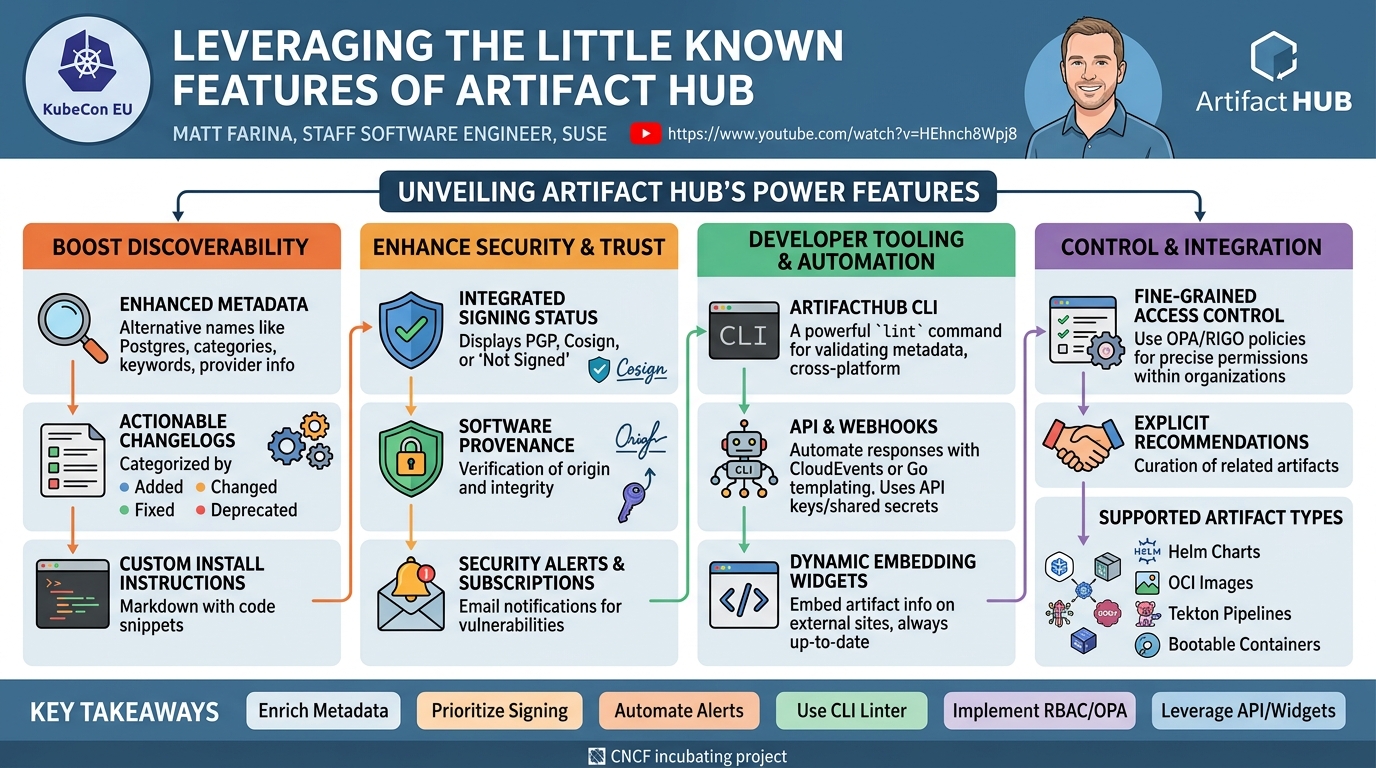
Farina's presentation revealed several key features of ArtifactHub that significantly elevate its utility beyond basic artifact discovery. These findings, while existing capabilities, are often "little known" and represent powerful opportunities for publishers and consumers alike:
- Enhanced Metadata for Discoverability: ArtifactHub supports extensive metadata beyond basic name and description. This includes alternative names (e.g., "PostgreSQL" and "Postgres"), categories, keywords (e.g., "security tool," "backup tool"), and explicit provider information. This rich metadata is crucial for improving search relevance and helping users quickly identify suitable artifacts.
- Actionable Changelogs: Publishers can embed detailed changelogs directly within their artifact metadata, categorized by type (e.g.,
added,changed,deprecated). These changelogs are displayed prominently in the ArtifactHub UI and are even consumed by external tools like Update CLI, demonstrating their value beyond mere display. - Customizable Install Instructions: For artifacts with complex installation procedures, ArtifactHub allows for the inclusion of custom install instructions written in Markdown, complete with code snippets and copy buttons, significantly improving the first-time user experience.
- Explicit Artifact Recommendations: Publishers can explicitly recommend related artifacts, creating curated bundles or suggesting complementary tools. These explicit recommendations are prioritized in the UI over automatically generated "related" items.
- Integrated Software Signing Status: ArtifactHub automatically detects and displays the signing status of artifacts, supporting both traditional PGP (for Helm charts) and modern cosign signatures (for newer artifact types like qborton policies). This provides crucial software provenance and integrity information directly within the discovery interface.
- Developer-Focused CLI for Linting: The ArtifactHub CLI provides a powerful
lintcommand that validates artifact metadata against best practices and schema, helping developers ensure their published artifacts are well-formed and discoverable. - Dynamic Embedding Widgets: ArtifactHub offers embeddable widgets for individual artifacts or filtered search results, allowing external websites to dynamically display up-to-date artifact information without manual synchronization.
- Robust Automation via Webhooks and API: For programmatic integration, ArtifactHub supports webhooks (using CloudEvents or custom Go templating payloads, secured with shared secrets) and a comprehensive API (protected by API keys), enabling automation of responses to artifact updates or security alerts.
- Email Subscriptions for Notifications: Users can subscribe to email notifications for new releases or, critically, security alerts for specific artifacts, providing a simple yet effective way to stay informed.
- Fine-Grained Access Control with OPA/RIGO: Organizations within ArtifactHub can implement sophisticated, fine-grained access control using OPA/RIGO policies, moving beyond simple owner roles to define precise permissions for different members.
These features collectively transform ArtifactHub from a mere search engine into a powerful platform for managing, securing, and promoting cloud-native artifacts throughout their lifecycle.
Technical Deep Dive
▶ Watch: Key metadata types to improve artifact discovery (4:00)
The technical depth of ArtifactHub's advanced features lies in its flexible metadata handling, integration points, and security mechanisms. Publishers can augment their artifact definitions in two primary ways: through annotations within existing manifest files (like a Helm chart's chart.yaml) or by creating a dedicated artifacthub-package.yaml file for artifact types without native metadata support.
For enhanced discoverability, several metadata fields are crucial. The name and description are standard, but the alternativeName field allows for common aliases, like "PostgreSQL" and "Postgres," ensuring broader search hits. Categories (e.g., "security," "backup") and keywords provide semantic tags, while the provider field explicitly attributes the artifact to an organization, building trust and brand recognition. These fields are processed by ArtifactHub's indexing engine to improve search results and enrich the UI display.
Changelogs offer a structured way to communicate updates. Within the artifacthub-package.yaml or as annotations, publishers can define a changes array, where each entry specifies a category (e.g., added, changed, deprecated, fixed, removed), a description of the change, and an optional url for more details. This structured approach allows ArtifactHub to display a clear, version-controlled change history in the sidebar of an artifact's page, making it easy for users to evaluate updates. Notably, external tools like Update CLI, an open-source project similar to dependabot or renovate bot but for broader artifact types, are beginning to leverage these change log annotations, demonstrating the interoperability of ArtifactHub's metadata.
Custom install instructions address the challenge of diverse artifact installation methods. For artifacts like qborton policies, which are WebAssembly modules, simple helm install commands are insufficient. Publishers can embed Markdown content, including code snippets, directly into the metadata. ArtifactHub renders this Markdown beautifully in the UI, providing copyable code blocks and clear guidance, significantly improving the onboarding experience for complex artifacts. The speaker emphasized the goal of enabling users to "have fun in five minutes" by making installation straightforward.
Artifact recommendations allow for explicit curation. By adding a recommendations annotation or field, publishers can list other ArtifactHub packages that complement their own. This creates a "Recommended for you" section at the top of an artifact's page, distinct from ArtifactHub's algorithmically generated "related" items, giving publishers direct control over suggested integrations.
A critical security feature highlighted is artifact signing. This addresses software provenance, authenticity, and integrity – ensuring an artifact originates from its claimed source and has not been tampered with. For older artifact types like Helm charts, signing is often done using PGP. Helm charts include a .prov file alongside the .tgz package, containing the PGP signature. ArtifactHub relies on an annotation for the PGP fingerprint and key location to validate these signatures. For newer cloud-native projects, cosign has become the de facto standard for signing. Artifacts like qborton policies leverage cosign, and ArtifactHub can detect and display these signatures, indicating whether an artifact is signed, by whom (e.g., GitLab), and with which method. If an artifact type doesn't support a known signature method, ArtifactHub transparently communicates this, preventing false assurances.
For developers, the ArtifactHub CLI is an invaluable tool. Available via Brew for Mac, Scoop for Windows, and as a binary for Linux, its primary command is lint. This command scans artifact configurations (e.g., chart.yaml or artifacthub-package.yaml) and provides feedback on missing or incorrectly structured metadata. It's type-aware, meaning it understands the schema for different artifact kinds (Helm charts, qborton policies, etc.) and can lint entire directories, offering a comprehensive overview of metadata compliance and completeness. This helps publishers ensure their artifacts are optimally discoverable and well-documented.
To extend ArtifactHub's reach, embedding widgets allow for dynamic content sharing. From the UI, users can generate HTML snippets for individual artifacts or filtered search results. These widgets, when embedded on external websites, automatically stay up-to-date with new versions, language changes, or search result alterations, providing a live view of ArtifactHub content on third-party sites.
For automation and integration, webhooks and a comprehensive API are available. Webhooks, configured in the user's control panel, can be triggered by events like new releases or security alerts for selected artifacts. They can send payloads in the CloudEvents format or highly customizable formats using Go templating, allowing for integration with diverse systems. A crucial security measure is the inclusion of a shared secret to authenticate webhook requests. The ArtifactHub API mirrors most of the website's functionality, allowing programmatic access to artifact metadata, search, and more. Access to the API requires API keys, also managed in the control panel, to prevent abuse and enable rate limiting.
Finally, fine-grained access control addresses the complexities of organizational management. While default settings might treat all organization members as owners, ArtifactHub supports advanced authorization using OPA/RIGO policies. This allows organizations to define custom rules for what specific members can do (e.g., read-only access, publish specific artifact types), ensuring adherence to least privilege principles and providing flexibility far beyond typical role-based access control systems. These policies can be selected from out-of-the-box options or custom-written, offering powerful control over an organization's presence on ArtifactHub.
Demo / Proof of Concept
▶ Watch: Specifying metadata: annotations vs. artifacthub-package.yml (5:15)
While the talk didn't feature a live, interactive coding demo in the traditional sense, Matt Farina effectively demonstrated the "little known features" through a series of UI walk-throughs and CLI command executions. These served as practical proofs of concept for each discussed capability.
For metadata enhancement, Farina showed screenshots of artifacthub-package.yaml and Helm chart annotations (chart.yaml) illustrating how alternativeName, changes, provider, and recommendations are defined. He then contrasted this with how these details visually manifest in the ArtifactHub UI, highlighting the dedicated sections for changelogs, provider information, and explicit recommendations. The visual presentation of changelogs, showing previous versions and their updates, particularly underscored the user experience benefits.
The demonstration of custom install instructions featured a qborton policy artifact. Farina displayed the Markdown syntax used to define the instructions, which included code snippets and specific commands. He then showed how this rendered in the ArtifactHub UI, complete with copyable code blocks, emphasizing how it simplifies complex installations for end-users.
The critical aspect of artifact signing was demonstrated by showing the GitLab Helm chart, which is PGP signed, and a qborton artifact signed with cosign. The ArtifactHub UI clearly indicated the signing status and method, or, in contrast, noted when an artifact type did not support known signatures. This visual validation is key for users assessing software supply chain security.
The ArtifactHub CLI was a focal point for demonstrating developer tooling. Farina created a dummy Helm chart using helm create and then executed artifacthub lint against it. The output, though small on the slide, showed a detailed list of detected and missing metadata fields, indicating how developers can use the CLI to ensure their artifacts are properly configured and discoverable. He also showed an example of linting a qborton policy, illustrating the CLI's type-awareness.
Finally, the talk demonstrated the setup of embedding widgets, webhooks, email subscriptions, API key generation, and fine-grained access control through guided tours of the ArtifactHub control panel and settings pages. For webhooks, he detailed the options for payload types (CloudEvents vs. custom Go templating) and the importance of a shared secret. For access control, he pointed to the documentation explaining OPA/RIGO policies and the UI toggle to enable them for an organization. These demonstrations effectively illustrated the practical application and configuration of each feature.
Defensive Implications
▶ Watch: Leveraging change logs for software updates (6:50)
The advanced features of ArtifactHub, particularly those less commonly known, offer significant defensive advantages for organizations managing and consuming cloud-native software. Integrating these capabilities into security workflows can bolster software supply chain security, improve incident response, and enhance overall operational resilience.
The most direct defensive implication comes from artifact signing. By clearly indicating whether an artifact is signed (using PGP or cosign) and by whom, ArtifactHub provides critical authenticity and integrity checks. Defenders should prioritize consuming signed artifacts and integrate signature verification into their CI/CD pipelines. This helps prevent the deployment of tampered or malicious software, a growing concern in software supply chain attacks. Security teams can leverage the displayed signing information to validate the source and trustworthiness of components before they enter their environments.
The availability of webhooks and email subscriptions for security alerts is a powerful defensive mechanism. By subscribing to security notifications for critical artifacts, organizations can receive immediate alerts about vulnerabilities or fixes. Integrating webhooks into security automation platforms allows for automated scanning, patching, or isolation actions in response to new security advisories. This proactive approach significantly reduces the window of exposure to known vulnerabilities.
Fine-grained access control for organizations within ArtifactHub itself is crucial for internal security. By implementing OPA/RIGO policies, organizations can enforce least privilege principles, ensuring that only authorized personnel can publish, update, or manage specific artifacts. This prevents unauthorized modifications to official artifact repositories, reducing the risk of internal compromise or accidental misconfigurations that could impact downstream consumers.
Furthermore, the detailed changelogs and provider information contribute to a stronger defensive posture. Changelogs allow security teams to quickly understand what changes have been introduced in new versions, aiding in impact analysis for vulnerabilities or assessing the risk of new features. Provider information helps verify the legitimate source of an artifact, which is foundational for trust decisions. The ArtifactHub CLI's linting capabilities also play a role by ensuring that published artifacts adhere to metadata standards, which can indirectly improve security by making it easier to track and manage components.
In essence, leveraging these ArtifactHub features allows defenders to shift from a reactive to a more proactive security stance, enabling better vigilance over the software supply chain, faster response to threats, and more robust internal controls.
Key Takeaways
- Enrich Artifact Metadata for Superior Discoverability: Utilize
artifacthub-package.yamlor annotations in artifact manifests to addalternativeName,categories,keywords,provider, and structuredchangelogsto significantly improve searchability and provide crucial context for users. - Prioritize and Verify Artifact Signing: ArtifactHub prominently displays signing status (PGP for Helm, Cosign for others), which is vital for software provenance, authenticity, and integrity. Defenders should favor signed artifacts and incorporate verification into their security pipelines.
- Automate Security & Updates with Webhooks and Subscriptions: Configure webhooks (with CloudEvents or custom Go templating payloads and shared secrets) and email subscriptions to receive immediate notifications for new releases or, critically, security alerts, enabling automated responses and proactive vulnerability management.
- Leverage the ArtifactHub CLI for Quality Assurance: Integrate the ArtifactHub CLI's
lintcommand into CI/CD pipelines to validate artifact metadata against schemas and best practices, ensuring high-quality, well-documented, and discoverable artifacts. - Implement Fine-Grained Access Control for Organizational Security: For organizations, move beyond default roles by implementing OPA/RIGO policies to enforce least privilege and precisely control who can manage and publish artifacts within ArtifactHub.
- Extend Reach and Information with Embedding and API: Use ArtifactHub's embedding widgets to dynamically display artifact information or search results on external websites, and leverage the comprehensive API (with API keys) for deep integration and custom tooling.
About the Speaker(s)
Matt Farina is a Staff Software Engineer at SUSE, where he primarily works on the Rancher platform. He has a long and distinguished history within the cloud-native ecosystem, particularly with artifact management. Farina has been involved with ArtifactHub since its conceptualization, predating its official creation, having worked on its precursor, Helmhub, and other similar initiatives that eventually merged. He is also a dedicated Helm maintainer, contributing significantly to the widely used Kubernetes package manager. During his talk, Matt Farina acknowledged the invaluable contributions of Sergio and Cynthia, who are responsible for the majority of the day-to-day development and maintenance work on ArtifactHub, ensuring its continuous improvement and robust functionality.
Reviews
Dr. Zero (Offensive Security Researcher) — STRONG ACCEPT
Matt Farina, a true expert in the cloud-native artifact space, delivers a no-nonsense deep dive into ArtifactHub's often overlooked but critical advanced features. This isn't a surface-level overview; it's a practical guide to leveraging the platform for enhanced software supply chain security, improved discoverability, and robust automation. For anyone serious about managing cloud-native components, this talk provides actionable insights that go far beyond basic usage, focusing on the features that actually matter for building secure and efficient systems.
Heather Calloway (CISO) — STRONG ACCEPT
This KubeCon talk by Matt Farina meticulously details the advanced, often underutilized, capabilities of ArtifactHub. While a deep dive into a specific CNCF project, it provides critical insights and actionable features directly impacting software supply chain security, artifact integrity, and organizational governance. The focus on artifact signing, webhooks for security alerts, and fine-grained access control with OPA/RIGO offers tangible value for CISOs and security leaders seeking to reduce business risk and improve institutional accountability within cloud-native environments.