"Izzy Saves the Birthday" - A Story-Driven Live Demo Exploring the Ma... Lin Sun & Faseela Kundattil
A Story-Driven Live Demo Exploring the Ma... Lin Sun, Faseela Kundattil
KubeCon + CloudNativeCon Europe 2025 · Session
Overview
In an engaging and highly accessible presentation at KubeCon EU, Lin Sun and Faseela Kundattil unveiled "Izzy Saves the Birthday," a unique talk that blended storytelling with a live technical demonstration. The core objective was to demystify complex Istio service mesh concepts, particularly the emergent ambient mesh data plane mode, for a broad audience ranging from newcomers to seasoned cloud-native practitioners. Through the narrative of Izzy the dolphin, a character from the popular Fippy and Friends series, they illustrated fundamental service mesh capabilities like zero-trust security, observability, and traffic management in a relatable context.
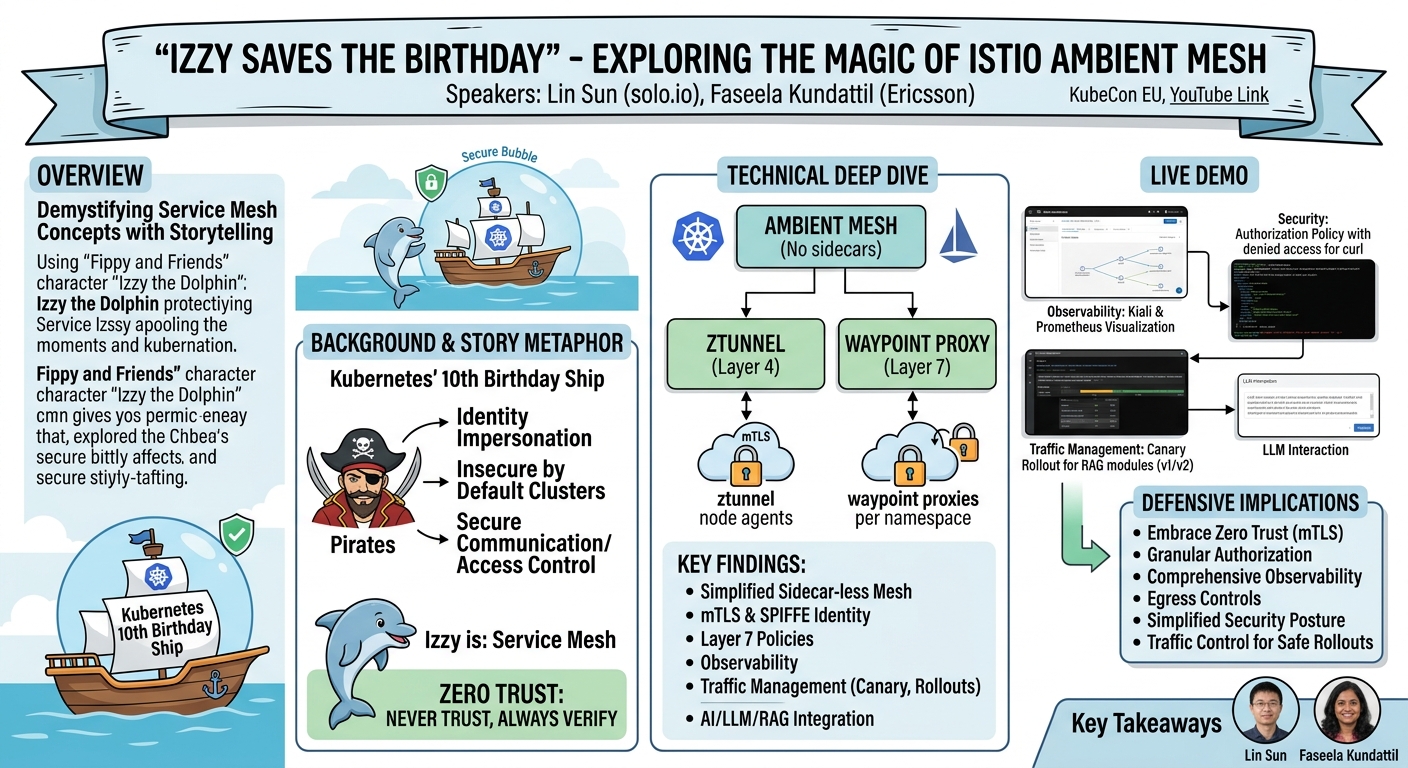
"Izzy Saves the Birthday" - A Story-Driven Live Demo Exploring the Magic of Istio Ambient Mesh
Speakers: Lin Sun, Head of Open Source, solo.io; Faseela Kundattil, CNCF TOC Member & Cloud Native Developer, Ericsson
Conference: KubeCon EU
YouTube: https://www.youtube.com/watch?v=mtqUtbMaSDw
Overview
In an engaging and highly accessible presentation at KubeCon EU, Lin Sun and Faseela Kundattil unveiled "Izzy Saves the Birthday," a unique talk that blended storytelling with a live technical demonstration. The core objective was to demystify complex Istio service mesh concepts, particularly the emergent ambient mesh data plane mode, for a broad audience ranging from newcomers to seasoned cloud-native practitioners. Through the narrative of Izzy the dolphin, a character from the popular Fippy and Friends series, they illustrated fundamental service mesh capabilities like zero-trust security, observability, and traffic management in a relatable context.
The talk addressed a critical challenge in the cloud-native ecosystem: the inherent complexity of distributed systems and the often steep learning curve associated with powerful tools like Istio. By framing these concepts within a children's story about pirates attempting to disrupt Kubernetes' 10th birthday celebration, the speakers made abstract security and networking principles tangible and easy to grasp. This approach not only served as an excellent educational tool but also highlighted the practical benefits and simplified operational model of Istio's ambient mesh.
The significance of this presentation lies in its innovative pedagogical method and its timely focus on Istio ambient mesh. As cloud-native adoption continues to grow, there's an increasing need for solutions that simplify management while enhancing security. Izzy's adventure effectively showcased how ambient mesh addresses these needs by offering a sidecar-less approach to service mesh, thereby reducing operational overhead and accelerating the implementation of robust security policies and traffic controls in Kubernetes environments.
Background
The foundation of this talk lies in the Fippy and Friends initiative, a family of illustrated characters originally designed by Microsoft and later contributed to the CNCF. The primary purpose of Fippy and Friends is to simplify and illustrate complex Kubernetes concepts, making them accessible to a wider audience, especially those new to the cloud-native community. In early 2024, a new Fippy character named Izzy, a dolphin, was introduced to represent the service mesh, specifically Istio. The "Izzy Saves the Birthday" book, co-authored by Faseela Kundattil, was first released at KubeCon SLC, telling a story designed to explain Istio features through an engaging narrative.
The story revolves around Kubernetes' 10th birthday celebration aboard a ship, which faces a threat from pirates attempting to steal valuable gifts. This scenario cleverly maps to common security challenges in a cloud-native environment:
- Stolen invitation cards represent the risk of identity impersonation when unattended credentials or configurations are compromised.
- The ship having "many entrances and not secure by default" directly parallels Kubernetes clusters, which often require explicit security configurations beyond their default state.
- The pirates' attempts to overhear conversations or access restricted areas illustrate the need for secure communication and access controls.
This narrative serves as a metaphor for a service mesh, which manages communication between microservices in a distributed architecture. Just as Izzy helps Captain Cube secure the birthday ship, a service mesh like Istio provides the necessary mechanisms to moderate and secure inter-application communication. A central tenet introduced through Izzy's wisdom is the zero-trust architecture concept: the principle of "never trust, always verify." Izzy educates Captain Cube that identities must be verified before any communication, as malicious entities may not be who they pretend to be. This forms the bedrock of modern cloud security, where every interaction, whether internal or external, is authenticated and authorized. The talk then transitions from these foundational concepts to demonstrate how Istio's features directly implement these zero-trust principles in a live Kubernetes environment.
Key Findings
The talk's primary contribution is demonstrating how Istio ambient mesh simplifies and enhances cloud-native security and traffic management, presented through a compelling story and practical live demo. The key findings and contributions are:
- Simplified Service Mesh Adoption with Istio Ambient Mesh: The presentation effectively showcases that Istio ambient mesh provides full service mesh capabilities—mutual TLS, authorization policies, observability, and advanced traffic management—without the operational overhead of sidecar proxies. This "sidecar-less" approach significantly lowers the barrier to entry for adopting a service mesh, making it easier for organizations to secure and manage their microservices.
- Practical Implementation of Zero Trust Principles: The demo explicitly illustrates how Istio implements core zero-trust architecture tenets. Through identity verification (enabled by SPIFFE and mutual TLS) and granular authorization policies, the system ensures that only verified and authorized applications can communicate, even when external or internal threats are present. This directly maps to Izzy's efforts to verify guest identities and restrict pirate access.
- Enhanced Observability for Proactive Security: Istio's out-of-the-box observability features, integrated with tools like Kiali and Prometheus, are highlighted as crucial for maintaining a secure environment. The ability to visualize traffic flows and monitor metrics allows defenders to detect unusual activities (like pirates accessing restricted rooms) in real-time and take immediate action, proving that continuous monitoring is vital for security.
- Flexible and Robust Traffic Management: The talk demonstrates how Istio, leveraging the Kubernetes Gateway API, enables dynamic and precise traffic management. This includes capabilities like weighted routing for canary deployments and header-based routing for controlled rollouts, which are essential for safely deploying new application versions or features while mitigating risks.
- Integration with Modern AI Workloads: The demo's use of a Large Language Model (LLM) via Ollama and Retrieval Augmented Generation (RAG) modules within the mesh context underscores Istio's relevance in securing and managing emerging AI-driven applications. It shows how mesh policies can protect sensitive AI endpoints and control access to external AI services.
- Effective Pedagogical Approach: Beyond the technical findings, the talk itself serves as a "finding" in demonstrating the efficacy of a story-driven approach to teaching complex technical concepts. The "Izzy Saves the Birthday" narrative proved highly effective in making abstract service mesh functionalities relatable and memorable for a diverse audience.
Technical Deep Dive
The technical core of the presentation centered on Istio ambient mesh, a revolutionary data plane mode designed to simplify service mesh operations by eliminating the need for sidecar proxies. Unlike traditional Istio deployments where an Envoy proxy is injected as a sidecar container into every application pod, ambient mesh operates on a node-level or namespace-level basis, significantly reducing resource consumption and operational complexity.
The ambient mesh architecture consists of two main components:
- Zero Trust Tunnel (ztunnel): This component operates at Layer 4 (TCP/IP) and runs as a node agent. Its primary responsibilities include establishing mutual TLS (mTLS) for all TCP traffic within the mesh and enforcing basic Layer 4 authorization policies per node. This means that all inter-service communication automatically benefits from strong identity-based encryption and authentication, without any application-level changes or sidecar injection. The ztunnel ensures that only authenticated identities (verified through SPIFFE, the Secure Production Identity Framework for Everyone) can communicate, embodying the "never trust, always verify" principle.
- Waypoint Proxies: For Layer 7 (HTTP/gRPC) capabilities, Istio ambient mesh utilizes waypoint proxies. These are dedicated Envoy proxies deployed as separate deployments, typically scoped to a specific tenant, such as a Kubernetes namespace. Instead of being co-located with every application pod, a waypoint proxy acts as a gateway for all traffic within its defined scope, applying advanced Layer 7 policies. This includes sophisticated authorization policies (e.g., path-based or header-based access controls), traffic management rules (e.g., weighted routing, retries, timeouts), and rich observability features. In the demo, a waypoint proxy was deployed for the
defaultnamespace and another for theegressnamespace, controlling outgoing traffic to external services. The use of waypoint proxies allows for granular Layer 7 control without the overhead of sidecars, as application pods can offload their Layer 7 traffic to these shared proxies.
The demo environment itself was a standard Kubernetes cluster, with Istio ambient mode installed. The application was built using Python and Streamlit, interacting with a Large Language Model (LLM) powered by Ollama running locally outside the cluster. Kiali provided visualization of the service mesh topology and traffic flow, while Prometheus collected metrics, powering Kiali's dashboards.
Key technical configurations showcased included:
- Namespace Labeling: Enabling ambient mesh for a namespace simply requires labeling it with
istio.io/dataplane-mode: ambientand specifying the associated waypoint proxy. This highlights the ease of adoption. - Kubernetes Gateway API: This modern API was central to configuring routing. An HTTPRoute resource was used to define how incoming traffic to the Istio ingress gateway (on port 80) should be forwarded to the backend
demoservice. Later, it was used for advanced traffic management to the RAG modules. - Authorization Policy: To enforce security, an
AuthorizationPolicywas deployed. This policy demonstrated how to restrict access to the external Ollama LLM. Specifically, it allowed only thedemoandragapplication principals to access Ollama freely, while other sources (like acurlclient) were restricted to only the/getpath, denying access to sensitive API endpoints. This illustrates the power of Istio's identity-aware access controls. - Service Entry: To allow the Kubernetes cluster to communicate with the external Ollama instance, a
ServiceEntrywas configured. This Istio resource defines external services that are not part of the mesh but need to be accessed by mesh workloads, enabling the egress waypoint proxy to manage this communication. - Traffic Management with HTTPRoute: For canary deployments and A/B testing, an
HTTPRoutewas used to control traffic distribution to two versions of the RAG module. Initially, traffic was split 75% to version one and 25% to version two. Crucially, a header-based rule was added: if theX-Rollout-Canaryheader was present, 100% of the traffic would be routed to version two. This capability allows developers to test new versions with a select group of users or for specific test cases before a full rollout, demonstrating fine-grained control over application updates.
These technical elements collectively demonstrated how Istio ambient mesh delivers robust security, comprehensive observability, and flexible traffic management in a streamlined, sidecar-less manner, addressing the challenges of microservices in a zero-trust paradigm.
Demo / Proof of Concept
The live demo, spearheaded by Lin Sun, vividly brought the theoretical concepts of Izzy's story to life, showcasing Istio ambient mesh in action. The setup involved a Kubernetes cluster running with Istio ambient mode enabled, alongside Kiali for visualization and Prometheus for metrics collection. A custom Python Streamlit application served as the client, interacting with a Large Language Model (LLM) powered by Ollama, which was running locally on the presenter's machine outside the Kubernetes cluster.
The demo unfolded in several key phases:
- Environment Overview and Initial Application Interaction:
- Lin began by showing the Kubernetes cluster, where namespaces were labeled
istio.io/dataplane-mode: ambientto enable the sidecar-less mesh. - Waypoint proxies were deployed for the
defaultandegressnamespaces, with the egress waypoint specifically managing traffic to the external Ollama LLM. - A Kubernetes Gateway API
HTTPRoutewas configured to route incoming traffic from the Istio ingress gateway to thedemoservice. - The Streamlit application was accessed, and an initial query ("What are the top five things to do in London?") was sent to the Ollama LLM. This demonstrated basic application functionality and external communication through the mesh. The LLM's initial lack of understanding regarding "ambient mesh" was also highlighted, setting the stage for the RAG module demonstration.
- Observability in Action:
- To illustrate Izzy's continuous monitoring, the Kiali dashboard was shown. It visually represented the traffic flow: from the
istio-ingressgatewayto thedemoapplication, then through theegresswaypoint proxy, and finally to theexternal-ollamaservice. - Kiali displayed both TCP and HTTP traffic metrics, showcasing Istio's out-of-the-box metric collection without any application instrumentation. This provided clear visibility into the system's runtime behavior, allowing for real-time anomaly detection, much like Izzy observing pirates.
- Enforcing Security with Authorization Policies:
- The demo then shifted to security, addressing the scenario where unauthorized clients (like pirates) might try to access sensitive resources.
- Lin demonstrated that a simple
curlcommand, acting as an unauthorized client, could initially query the Ollama LLM directly from within the cluster. - An Istio
AuthorizationPolicywas then applied. This policy was designed to restrict access to the external Ollama service. It specified that only thedemoandragapplication principals (identities established by Istio via SPIFFE) were allowed full access to Ollama. Any other client, including thecurlcommand, was permitted only to access the/getpath and denied all other access (e.g., to list models). - After applying the policy, repeating the
curlcommand to a restricted path resulted in a "deny access" response, whilecurlto the allowed/getpath still worked. Crucially, the main Streamlit application, being an authorized principal, continued to function normally, demonstrating granular and identity-aware access control.
- Dynamic Traffic Management for Controlled Rollouts:
- The final segment focused on traffic management, using the scenario of two Retrieval Augmented Generation (RAG) modules. RAG v1 understood only PDF files, while RAG v2 understood both PDF and TXT files. The goal was to ensure TXT files were always processed by v2.
- Initially, without specific routing, the application exhibited inconsistent behavior when uploading TXT files due to Kubernetes' default round-robin load balancing between the two RAG services.
- An Istio
HTTPRouteobject was deployed. ThisHTTPRoutewas configured to route 75% of traffic to RAG v1 and 25% to RAG v2. More importantly, it included a header-based rule: if theX-Rollout-Canaryheader was present in the request, 100% of the traffic would be directed to RAG v2. - This allowed for a "dark launch" or canary test, where specific requests (e.g., from developers with the header) could reliably hit the new version (v2).
- Finally, the
HTTPRoutewas updated to send 100% of the traffic to RAG v2, demonstrating a full rollout and ensuring consistent processing of TXT files. The Streamlit application successfully uploaded and processed aambient_mesh.txtfile, extracting the correct definition of ambient mesh.
The demo effectively demonstrated how Istio ambient mesh provides comprehensive security, observability, and traffic management capabilities with a simplified operational model, directly validating the principles illustrated in the "Izzy Saves the Birthday" narrative.
Defensive Implications
The "Izzy Saves the Birthday" talk and its accompanying demo provide several critical defensive implications for organizations operating in cloud-native environments:
- Embrace Zero Trust by Default: The core message from Izzy – "don't trust anyone by default" – is paramount. Defenders should implement mutual TLS (mTLS) for all service-to-service communication within the cluster. Istio ambient mesh's ztunnel provides this at Layer 4 automatically, ensuring that all traffic is encrypted and authenticated based on verifiable identities (SPIFFE). This prevents identity impersonation and secures communication channels from eavesdropping, much like Captain Cube verifying every guest's identity.
- Implement Granular, Identity-Aware Authorization Policies: Beyond mTLS, defenders must establish strict authorization policies. As demonstrated, these policies can control not only which services can talk to each other but also specify allowed HTTP paths, methods, and headers. This prevents unauthorized access to sensitive APIs or data, even if an attacker manages to compromise a legitimate service. Organizations should map their application's communication patterns and define least-privilege access rules, leveraging waypoint proxies for Layer 7 policy enforcement.
- Prioritize and Leverage Comprehensive Observability: The ability to "monitor everything all the time live" is a critical defensive tool. Defenders should integrate tools like Kiali and Prometheus to gain deep insights into traffic flow, service dependencies, and performance metrics. This enables the rapid detection of anomalies, unauthorized access attempts, or unusual traffic patterns that could indicate a security breach. Proactive monitoring allows for immediate action, turning potential threats into contained incidents.
- Secure External Communications with Egress Controls: As shown with the Ollama LLM, applications often need to communicate with external services. Defenders must secure these egress pathways. Istio's egress gateway and associated authorization policies can restrict outgoing traffic to only approved external endpoints and specific protocols or paths. This prevents data exfiltration and limits the blast radius if an internal service is compromised.
- Adopt Istio Ambient Mesh for Simplified Security Posture: For organizations struggling with the complexity of traditional sidecar-based service meshes, ambient mesh offers a compelling solution. By removing sidecars, it reduces the operational overhead, simplifies upgrades, and minimizes the attack surface associated with managing numerous proxies. This allows security teams to implement robust security controls more easily and at scale, without requiring significant changes to application code or deployment patterns.
- Utilize Traffic Management for Secure Rollouts and Incident Response: Istio's advanced traffic management capabilities, configured via the Kubernetes Gateway API, are not just for feature rollouts but also for security. Defenders can use weighted routing and header-based routing for canary deployments to safely introduce security patches or new policies, gradually exposing them to production traffic. In a crisis, traffic shifting can be used to quickly isolate compromised services or redirect traffic to known good versions, minimizing downtime and mitigating ongoing attacks.
By adopting these defensive strategies, organizations can build a more resilient and secure cloud-native infrastructure, effectively safeguarding their applications and data against modern threats, much like Izzy protected Kubernetes' birthday celebration.
Key Takeaways
- Istio Ambient Mesh Simplifies Service Mesh Adoption: The sidecar-less architecture of Istio ambient mesh, utilizing ztunnel for Layer 4 mTLS and waypoint proxies for Layer 7 policies, significantly reduces operational overhead and simplifies the implementation of service mesh capabilities in Kubernetes.
- Zero Trust is Fundamental for Cloud-Native Security: Implementing a zero-trust architecture with strong identity verification (SPIFFE, mTLS) and granular authorization policies is crucial to securing microservices, ensuring that all communication is authenticated and authorized.
- Comprehensive Observability is Key to Proactive Defense: Istio provides out-of-the-box observability through tools like Kiali and Prometheus, enabling real-time monitoring of traffic flows and detection of anomalies, which is vital for identifying and responding to security threats promptly.
- Dynamic Traffic Management Ensures Safe Operations: Advanced traffic management features, leveraging the Kubernetes Gateway API for weighted routing, canary deployments, and header-based routing, allow for controlled rollouts of new features or security patches, minimizing risks during application updates.
- Contextual Storytelling Enhances Learning: The "Izzy Saves the Birthday" narrative demonstrates an effective pedagogical approach to demystifying complex technical concepts, making them accessible and understandable for a wider audience.
- Secure Integration with AI Workloads is Possible: The demo showcased how Istio ambient mesh can secure and manage interactions with external Large Language Models (LLMs) and Retrieval Augmented Generation (RAG) modules, highlighting its relevance for emerging AI-driven applications.
About the Speaker(s)
Lin Sun is the Head of Open Source at solo.io. She travels from Cary, North Carolina, and is a prominent figure in the cloud-native community. Her company, solo.io, is recognized as one of the top 10 largest contributors to all CNCF projects, underscoring her deep involvement and expertise in open-source cloud technologies.
Faseela Kundattil is a distinguished member of the CNCF Technical Oversight Committee (TOC) and works as a Cloud Native Developer at Ericsson. She is also a CNCF Ambassador and an LFX Mentor, actively contributing to the community's growth and education. Faseela is the co-author of the "Izzy Saves the Birthday" book, which was central to the talk's narrative.
Reviews
Dr. Zero (Offensive Security Researcher) — STRONG ACCEPT
This talk delivered a surprisingly effective and deeply technical explanation of Istio Ambient Mesh, a critical defensive innovation for cloud-native security. By leveraging a novel, story-driven live demo, the speakers demystified complex concepts like zero-trust, mTLS, granular authorization, and advanced traffic management without resorting to marketing fluff. It provided concrete, actionable insights into simplifying service mesh adoption and enhancing security posture, making it highly valuable for practitioners and architects alike.
Heather Calloway (CISO) — STRONG ACCEPT
This presentation effectively translates complex service mesh concepts, particularly Istio's ambient mesh, into clear, actionable security and operational benefits. While presented through a narrative, the core message is a compelling demonstration of how to implement zero-trust principles, enhance observability, and manage traffic with significantly reduced operational overhead. It provides a credible path for security leaders and their teams to simplify and strengthen their cloud-native security posture, making it a valuable resource for anyone grappling with the inherent complexities of distributed systems security.