Project Lightning Talk: Sailing Multi-Host Inference with LWS - Kante Yin, Maintainer
Kante Yin, Maintainer
KubeCon + CloudNativeCon Europe 2025 · Project Lightning Talk
Overview
The rapid ascent of large language models (LLMs) has introduced a significant operational challenge: their sheer size often exceeds the capacity of a single computational node, necessitating sophisticated orchestration for multi-host inference. Kante Yin, a software engineer at Dark Cloud and maintainer of Little Work Set (LWS), addressed this critical issue in his KubeCon EU lightning talk. He introduced LWS as an innovative open-source project designed to streamline the deployment and management of LLM inference services across a distributed cluster.
Key moments
- 0:00 Introduction and the multi-host LLM inference problem
- 1:07 Little Work Set (LWS) architecture: Super Pods explained
- 2:00 Key capacities and features of LWS architecture
- 3:55 LWS adopters and project integrations (Limas, SG, VM)
- 4:20 New LWS release, website, contributors, and future roadmap
- 4:50 How to contribute and get involved with LWS
Project Lightning Talk: Sailing Multi-Host Inference with LWS - Kante Yin, Maintainer
Speakers: Kante Yin, Maintainer
Conference: KubeCon EU
YouTube: https://www.youtube.com/watch?v=PJ8qgKEwDyM
Overview
The rapid ascent of large language models (LLMs) has introduced a significant operational challenge: their sheer size often exceeds the capacity of a single computational node, necessitating sophisticated orchestration for multi-host inference. Kante Yin, a software engineer at Dark Cloud and maintainer of Little Work Set (LWS), addressed this critical issue in his KubeCon EU lightning talk. He introduced LWS as an innovative open-source project designed to streamline the deployment and management of LLM inference services across a distributed cluster.
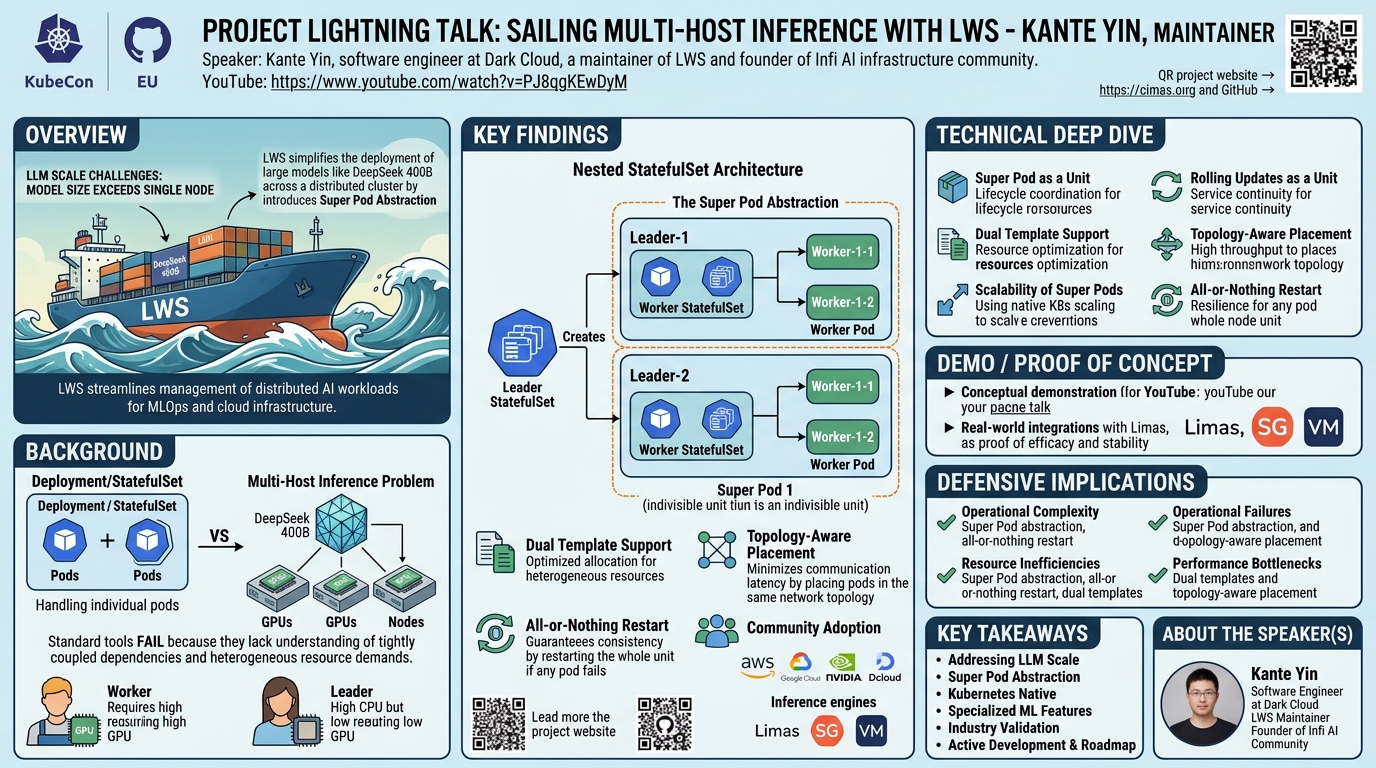
Little Work Set tackles the complexities inherent in deploying models like DeepSeek 400B and 5B, which are simply too large to fit on a single GPU or server. By building upon Kubernetes' foundational primitives, LWS introduces a novel abstraction called the Super Pod. This abstraction allows operators to manage groups of interdependent pods—comprising a leader and multiple workers—as a single, cohesive unit, thereby simplifying lifecycle management, scaling, and updates for distributed AI workloads.
This talk is particularly pertinent for anyone involved in MLOps, cloud infrastructure, or large-scale AI deployment. LWS offers a robust and opinionated solution to the burgeoning problem of distributed LLM inference, providing features like topology-aware placement, dual pod templates for heterogeneous resource allocation, and all-or-nothing restarts to ensure system integrity. Its growing adoption by major cloud providers and integration with prominent inference engines underscore its potential as a foundational component for next-generation AI infrastructure.
Background
▶ Watch: Introduction and the multi-host LLM inference problem (0:00)
The evolution of artificial intelligence, particularly in the realm of large language models, has been nothing short of revolutionary. However, this advancement has brought with it a substantial operational hurdle: the increasing scale of these models. As models like DeepSeek 400B and DeepSeek R1 v3 push the boundaries of parameter counts, they inevitably surpass the memory and computational limits of a single server or even a single high-end GPU. This necessitates a shift from single-host to multi-host inference, where the model is sharded or distributed across multiple nodes to leverage aggregated resources.
Traditional Kubernetes primitives, while powerful for general-purpose container orchestration, often fall short when addressing the highly specific requirements of distributed machine learning inference. A standard Deployment or StatefulSet manages individual pods or replicas, but it doesn't intrinsically understand the tightly coupled, interdependent nature of a sharded model inference service. For instance, if a large model is split across several GPUs on different nodes, these components must communicate efficiently, share a consistent state, and often require coordinated lifecycle management. A partial failure in such a system can render the entire inference service unusable, making individual pod restarts ineffective.
Furthermore, distributed inference often involves heterogeneous resource demands. A "leader" component might act as an API gateway, load balancer, or orchestrator, requiring substantial CPU but little to no GPU. Conversely, "worker" components are typically responsible for the actual model computation, demanding significant GPU resources. Managing these distinct resource profiles within a unified orchestration framework, while ensuring optimal placement for inter-component communication, presents a complex challenge that existing tools struggled to address natively. It was this gap—the need for a specialized handler to orchestrate and manage complex, multi-node inference services—that spurred the development of Little Work Set.
Key Findings
▶ Watch: Key capacities and features of LWS architecture (2:00)
The core contribution and key finding of the Little Work Set project is the successful abstraction and orchestration of multi-host inference for large language models within a Kubernetes environment. Kante Yin's presentation highlighted several critical discoveries and solutions embodied by LWS:
- The Super Pod Abstraction: LWS introduces the concept of a Super Pod, which is not a native Kubernetes object but a logical grouping of one leader pod and multiple worker pods that operate as a single, indivisible unit. This innovative abstraction fundamentally simplifies the management of complex, interdependent inference services, treating them as atomic entities rather than disparate containers. This concept is crucial for maintaining the integrity and consistency of distributed model serving.
- Nested StatefulSet Architecture: The underlying architectural pattern of LWS, built on top of Kubernetes StatefulSets, demonstrates an effective way to achieve this Super Pod abstraction. By creating a
Leader StatefulSetwhich in turn dynamically provisionsWorker StatefulSetsfor each leader pod, LWS provides robust, identity-stable, and ordered deployment guarantees for both leader and worker components. This hierarchical structure is a key enabler for the Super Pod's shared lifecycle and unified management.
- Specialized Capabilities for Distributed ML: LWS's design directly addresses several critical pain points in distributed ML inference:
- Dual Template Support: Acknowledging the heterogeneous nature of inference workloads, LWS allows for distinct pod templates for leaders (e.g., CPU-only proxy) and workers (e.g., GPU-intensive compute), optimizing resource allocation and cost efficiency.
- Topology-Aware Placement: Recognizing the performance impact of inter-node communication for sharded models, LWS supports placing leader and worker pods within the same network topology. This minimizes latency and maximizes throughput, which are critical for real-time inference.
- All-or-Nothing Restart: For tightly coupled distributed models, a partial failure can render the entire service inoperable. LWS's "all-or-nothing restart" policy ensures that if any part of a Super Pod fails, the entire unit is restarted, guaranteeing a consistent and functional state.
- Community Adoption and Integration: The rapid adoption of LWS by major cloud providers such as AWS, Dcloud, Google Cloud, and Nvidia, along with its integration into prominent inference platforms like Limas and inference engines like SG and VM, serves as a powerful validation of its design and utility. This widespread acceptance underscores LWS's practical effectiveness in solving real-world challenges faced by organizations deploying large-scale AI. The recent release of version 0.6.0, coupled with the growth to nine new contributors, further highlights the project's increasing maturity and community engagement.
Technical Deep Dive
▶ Watch: LWS adopters and project integrations (Limas, SG, VM) (3:55)
At its core, Little Work Set (LWS) is an opinionated Kubernetes controller designed to orchestrate complex, multi-host inference workloads, particularly for large language models. It achieves this by introducing a higher-level abstraction, the Super Pod, which bundles a leader pod and its associated worker pods into a single, manageable unit. This design leverages existing Kubernetes primitives, primarily the StatefulSet, but layers a sophisticated control plane on top to provide the specialized features required for distributed ML inference.
The architecture of LWS can be visualized as a two-tiered, nested StatefulSet structure. When an LWS resource is created, it first provisions a Leader StatefulSet. This Leader StatefulSet is responsible for creating a set of Leader Pods, much like a standard StatefulSet manages its replicas. For example, if the Leader StatefulSet is configured with four replicas, it will create four distinct Leader Pods.
The innovation arises in the next step: each of these Leader Pods is then responsible for orchestrating its own Worker StatefulSet. This means that within each Leader Pod's scope, LWS creates a dedicated Worker StatefulSet. This Worker StatefulSet then manages the deployment of multiple Worker Pods that are tightly coupled to that specific leader. In the example provided in the talk, each Leader Pod creates a Worker StatefulSet with two replicas, resulting in two Worker Pods per leader. The combination of a Leader Pod and its two Worker Pods constitutes a Super Pod. Thus, with four leader replicas and two worker replicas per leader, the system would comprise four independent Super Pods, each capable of handling a segment of the distributed inference task.
This architectural pattern enables several critical capacities:
- Super Pod as a Unit: All pods belonging to a Super Pod share the same lifecycle. This is crucial for distributed inference, where components are interdependent. If one part of a sharded model fails, the entire inference unit becomes non-functional. Managing them as a unit ensures coordinated startup, shutdown, and scaling, preventing inconsistent states.
- Dual Template Support: Distributed inference often involves heterogeneous resource requirements. The
Leader Podmight serve as a proxy, API endpoint, or orchestrator, requiring significant CPU resources but no GPU. Conversely, theWorker Podsperform the actual model computation, demanding substantial GPU capacity. LWS addresses this by allowing distinct pod templates for leader and worker components. This enables fine-grained resource allocation, optimizing costs and performance by ensuring that each component receives precisely the resources it needs without waste.
- Scalability of Super Pods: LWS integrates seamlessly with Kubernetes' native scaling mechanisms. Operators can scale the number of Super Pods in the same way they would scale a standard
DeploymentorStatefulSet. This allows for elastic scaling of the entire distributed inference service based on demand, without needing to manage individual pod groups manually.
- Rolling Updates as a Unit: Similar to scaling, LWS supports rolling updates for Super Pods as a cohesive unit. This ensures that updates to the inference service are performed in a coordinated manner, minimizing downtime and maintaining service availability. Updates are applied to entire Super Pods sequentially, guaranteeing that a functional unit is always available during the upgrade process.
- Topology-Aware Placement: The performance of sharded LLMs heavily relies on efficient inter-node communication between leader and worker components. LWS offers topology-aware placement, ensuring that the
Leader Podand its correspondingWorker Podsare placed within the same network topology (e.g., on nodes within the same rack or availability zone). This minimizes network latency and maximizes bandwidth, which are critical factors for achieving high-throughput, low-latency inference.
- All-or-Nothing Restart: In complex distributed systems, a partial failure can be more problematic than a complete one, as it can lead to inconsistent states or difficult-to-diagnose errors. LWS implements an all-or-nothing restart policy for Super Pods. If any pod within a Super Pod fails, the entire Super Pod is restarted. This ensures that the inference unit always comes up in a clean, consistent state, simplifying recovery and improving overall system reliability.
LWS recently released version 0.6.0, introducing a new website for comprehensive documentation and welcoming nine new contributors to the project. The roadmap for future features includes disaggregated serving, which would allow for even more flexible resource allocation, in-place rolling updates for further optimization of update processes, and gang scheduling support to ensure that all components of a Super Pod are scheduled simultaneously, preventing deadlocks or resource starvation. These features underscore LWS's commitment to evolving with the demands of cutting-edge AI infrastructure.
Demo / Proof of Concept
▶ Watch: New LWS release, website, contributors, and future roadmap (4:20)
While the lightning talk format at KubeCon EU did not permit a live, interactive demonstration of Little Work Set in action, Kante Yin effectively conveyed its operational capabilities and architectural principles through a clear diagram and descriptive examples. The visual overview presented on the left side of the slide served as a conceptual demonstration, illustrating how LWS constructs Super Pods from nested StatefulSets. This diagram effectively communicated the hierarchical relationship between leader and worker pods and how they collectively form a cohesive unit for distributed inference.
Further validating LWS's efficacy and serving as a robust proof of concept are its widespread adoption and integration within the industry. Kante Yin explicitly mentioned several key adopters and integrations:
- Cloud Providers: AWS, Dcloud, Google Cloud, and Nvidia are actively using or integrating LWS. This signifies a strong industry endorsement, as these major players recognize LWS's value in managing their own large-scale AI infrastructure.
- Inference Platforms: Limas, an inference platform, utilizes LWS as its underlying workload orchestrator. This demonstrates LWS's capability to serve as a foundational layer for broader AI serving solutions, supporting both single-host and cross-host scenarios.
- Inference Engines: Official integrations exist with SG and VM, two well-known inference engines in the community. These integrations confirm that LWS is compatible with and enhances the operational characteristics of popular model serving backends, enabling them to run efficiently in distributed, multi-host environments.
These real-world deployments and integrations, though not a live demo in the traditional sense, provide concrete evidence of LWS's functionality, stability, and ability to meet the demanding requirements of enterprise-grade distributed LLM inference. The project's active development, including the recent release of version 0.6.0 and the growth in its contributor base, further underscores its practical utility and ongoing evolution.
Defensive Implications
▶ Watch: How to contribute and get involved with LWS (4:50)
While Little Work Set (LWS) is not a security tool designed to defend against malicious attacks, its contributions have significant "defensive implications" for the reliability, resilience, and operational efficiency of large-scale distributed AI inference systems. In the context of MLOps and cloud infrastructure, "defending" often means safeguarding against operational failures, performance bottlenecks, resource inefficiencies, and the inherent complexities of managing distributed workloads. LWS provides a robust framework for such defense.
- Defense Against Operational Complexity: The primary "defense" offered by LWS is against the overwhelming complexity of manually orchestrating multi-host LLM inference. By abstracting away the intricacies of coordinating numerous pods, distinct resource requirements, and intricate communication patterns into the Super Pod unit, LWS significantly reduces the cognitive load on operators. This simplification minimizes human error, which is a common vector for operational incidents.
- Enhanced Reliability and Resilience:
- All-or-Nothing Restart: This feature is a direct defense against partial system failures. In a tightly coupled distributed inference service, a single failing component can destabilize the entire system. By restarting the entire Super Pod, LWS ensures that the inference unit always returns to a known good state, preventing cascading failures and ensuring data consistency across the sharded model. This significantly improves the system's ability to recover autonomously from transient issues.
- Shared Lifecycle: Managing the Super Pod as a single unit with a shared lifecycle protects against desynchronized states during scaling, updates, or failures. It ensures that all interdependent components of an inference service are always in a consistent operational phase, preventing potential deadlocks or resource contention that can arise from uncoordinated actions.
- Optimized Resource Utilization and Performance:
- Dual Template Support: This feature defends against inefficient resource allocation. By allowing separate pod templates for CPU-intensive leader components and GPU-intensive worker components, LWS ensures that resources are provisioned precisely where needed. This prevents over-provisioning of expensive GPUs for CPU-bound tasks or vice versa, leading to significant cost savings and better overall resource utilization.
- Topology-Aware Placement: This is a crucial defense against performance degradation due to network latency. For sharded LLMs, inter-pod communication is critical. LWS's ability to place leaders and workers within the same network topology (e.g., same rack or availability zone) minimizes network hops and latency, directly translating to higher inference throughput and lower response times. This protects the service from becoming a bottleneck due to suboptimal infrastructure layout.
- Streamlined Maintenance and Updates:
- Unit-based Rolling Updates: LWS defends against service disruption during maintenance windows. By performing rolling updates on Super Pods as atomic units, it ensures a controlled and graceful transition to new versions. This minimizes downtime and reduces the risk of introducing inconsistencies that could impact ongoing inference tasks.
In essence, LWS acts as a robust operational shield, allowing MLOps teams to deploy and manage large-scale distributed LLM inference with greater confidence, efficiency, and stability. It shifts the focus from managing individual containers to orchestrating intelligent, resilient inference units, thereby defending against the inherent complexities and potential pitfalls of modern AI infrastructure.
Key Takeaways
- Addressing LLM Scale: Little Work Set (LWS) provides a critical solution for orchestrating distributed inference of large language models (LLMs) that exceed single-node capacity.
- Super Pod Abstraction: The core innovation is the Super Pod, a logical unit comprising a leader pod and its worker pods, enabling simplified management of interdependent inference components.
- Kubernetes Native: LWS is built on and extends Kubernetes' StatefulSet primitive, offering a robust and familiar operational model for MLOps teams.
- Specialized ML Features: It offers unique capabilities like dual pod templates for heterogeneous resource allocation, topology-aware placement for performance, and all-or-nothing restarts for enhanced reliability.
- Industry Validation: LWS has seen significant adoption by major cloud providers (AWS, Google Cloud, Nvidia) and integration with prominent inference platforms (Limas) and engines (SG, VM), validating its practical utility.
- Active Development & Roadmap: The project is actively maintained, with a recent version 0.6.0 release and a clear roadmap for future enhancements like disaggregated serving and gang scheduling.
About the Speaker(s)
Kante Yin is a software engineer at Dark Cloud, a role that positions him at the forefront of developing scalable and robust cloud infrastructure solutions. Beyond his corporate contributions, Kante is a dedicated open-source maintainer for the Little Work Set (LWS) project, demonstrating his commitment to the broader technical community. Furthermore, he is the founder of Infi, an open-source community specifically focused on building advanced AI infrastructure, underscoring his expertise and passion for driving innovation in the machine learning operations (MLOps) space.
Reviews
Dr. Zero (Offensive Security Researcher) — MUST SEE
Kante Yin's lightning talk on Little Work Set (LWS) introduces a critically important open-source solution for orchestrating multi-host inference of massive Large Language Models within Kubernetes. The "Super Pod" abstraction, built on nested StatefulSets, provides a novel and robust approach to managing the lifecycle, scaling, and heterogeneous resource demands of distributed AI workloads. This project demonstrates significant technical depth and offers immediate, actionable value for MLOps practitioners grappling with the complexities of deploying LLMs at scale, evidenced by its rapid adoption across major cloud providers and inference platforms.
Heather Calloway (CISO) — STRONG ACCEPT
Kante Yin's lightning talk on Little Work Set (LWS) presents a compelling solution for the operational complexities of deploying large language models across distributed infrastructure. While not a direct cybersecurity tool, LWS fundamentally addresses the resilience and reliability of critical AI workloads, which are paramount CISO concerns for institutional accountability and business continuity. Its Super Pod abstraction and specialized features provide a robust framework that reduces operational risk and ensures consistent performance for enterprises leveraging advanced AI.