Hot Takes: Kubernetes Paintainers Bring the Heat
KubeCon + CloudNativeCon Europe 2025 · Session
Overview
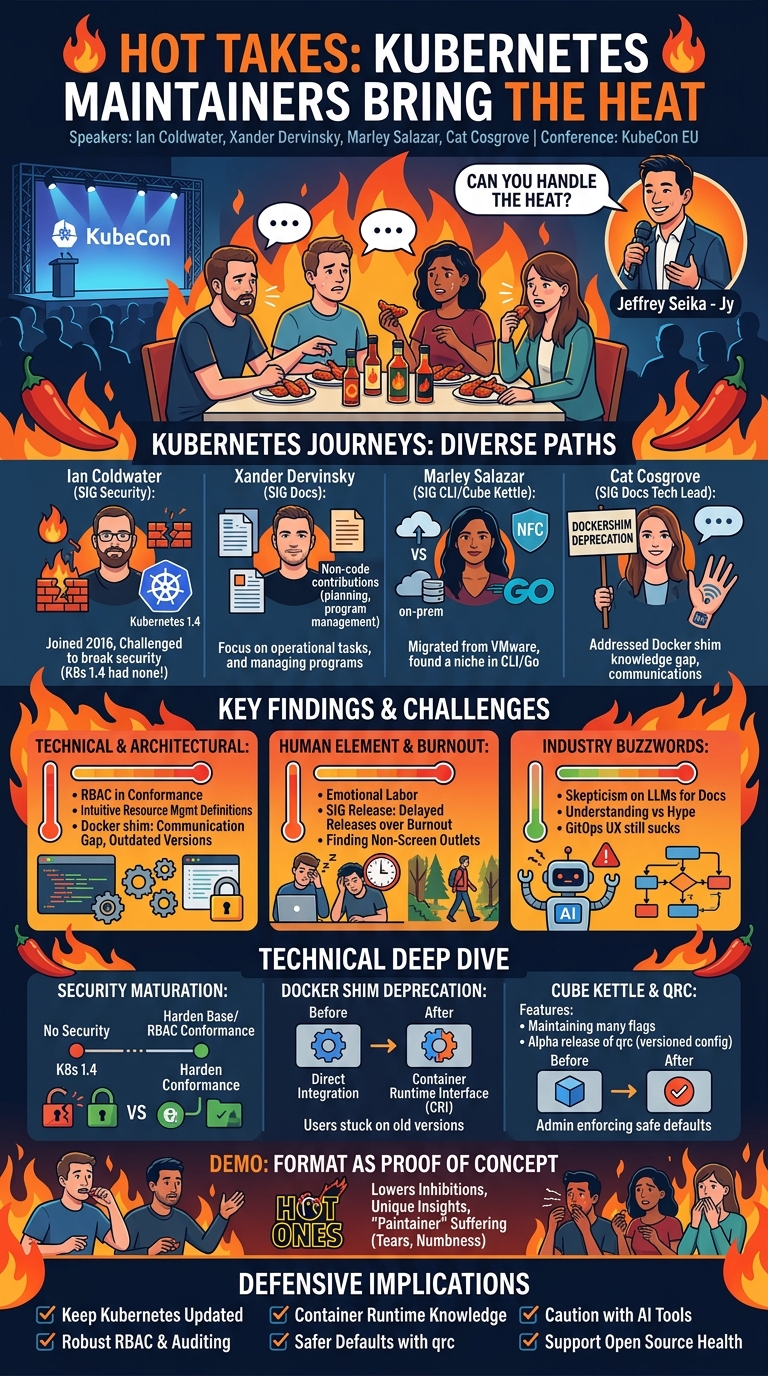
The KubeCon EU session "Hot Takes: Kubernetes Paintainers Bring the Heat" delivered a unique and highly engaging format, transforming a traditional panel discussion into a "Hot Ones"-style interview. Hosted by Jeffrey Seika (Jy), the panel featured prominent Kubernetes maintainers – Ian Coldwater, Xander Dervinsky, Marley Salazar, and Cat Cosgrove – progressively consuming hotter sauces while answering candid questions about their experiences, the evolution of Kubernetes, and the challenges of open-source project leadership. This innovative approach allowed for a raw and unfiltered exploration of the technical, emotional, and community-driven aspects of maintaining one of the world's most critical open-source projects.
Key moments
- 0:00 Introduction to Hot Takes and the challenge
- 1:00 Meet the panelists: Ian, Xander, Marley, Cat
- 2:20 First hot question: How did you join Kubernetes?
- 2:50 Ian Coldwater's journey breaking Kubernetes security
- 6:15 Cat Cosgrove's impact on Docker shim deprecation
- 7:20 Cat Cosgrove discusses her NFC chip implants
Hot Takes: Kubernetes Paintainers Bring the Heat
Speakers: Ian Coldwater, Co-chair Kubernetes SIG Security; Xander Dervinsky, Tech Lead SIG Docs; Marley Salazar, SIG CLI (Cube Kettle); Cat Cosgrove, SIG Docs Technical Lead & Release Team Sub-project Owner
Conference: KubeCon EU
YouTube: https://www.youtube.com/watch?v=syV-QGZDmWU
Overview
The KubeCon EU session "Hot Takes: Kubernetes Paintainers Bring the Heat" delivered a unique and highly engaging format, transforming a traditional panel discussion into a "Hot Ones"-style interview. Hosted by Jeffrey Seika (Jy), the panel featured prominent Kubernetes maintainers – Ian Coldwater, Xander Dervinsky, Marley Salazar, and Cat Cosgrove – progressively consuming hotter sauces while answering candid questions about their experiences, the evolution of Kubernetes, and the challenges of open-source project leadership. This innovative approach allowed for a raw and unfiltered exploration of the technical, emotional, and community-driven aspects of maintaining one of the world's most critical open-source projects.
This talk is significant because it peels back the layers of technical complexity to reveal the human element behind Kubernetes' success and ongoing development. Beyond the buzzwords and architectural diagrams, it highlights the dedication, struggles, and personal insights of the individuals who shape the cloud-native landscape. For anyone involved in or aspiring to contribute to open source, particularly in the Kubernetes ecosystem, this session offers invaluable perspectives on community dynamics, the realities of project maintenance, and the delicate balance between technical innovation and human well-being. It underscores that while Kubernetes is a technical marvel, its sustained growth and stability are deeply intertwined with the health and resilience of its diverse maintainer community.
Background
▶ Watch: Introduction to Hot Takes and the challenge (0:00)
The Kubernetes project, since its inception, has grown into a cornerstone of modern cloud-native infrastructure, driven by a sprawling global community of contributors. The panelists' journeys into this community reflect the project's diverse entry points and its rapid evolution. Ian Coldwater, for instance, entered the scene in 2016, drawn by an interest in automation and a challenge to "break" Kubernetes 1.4, which she noted "had basically no security to speak of." This early exposure to the project's nascent security posture became foundational to her role as a co-chair of Kubernetes SIG Security, highlighting the critical need for security expertise from the very beginning.
Xander Dervinsky's path began with SIG Release, emphasizing that Kubernetes' scale allows for significant non-code contributions, such as program management and operational tasks. This point is crucial for understanding the breadth of roles required to sustain such a large project. Marley Salazar transitioned from on-premise VMware-based systems to cloud-native, finding a niche in SIG CLI on Cube Kettle, a component she found more approachable than areas like Node or Networking. Her experience highlights the cultural shift from traditional IT, where vendors like VMware don't accept pull requests, to the collaborative open-source model. Cat Cosgrove's entry was catalyzed by the controversial Docker shim deprecation, where a significant knowledge gap emerged between the project's understanding and the average user's grasp of container runtimes. Her work in filling this gap through documentation and FAQs led her to SIG Docs and eventually to becoming a Release Team sub-project owner, demonstrating how critical communication and user education are to major project transitions.
Collectively, the panelists' backgrounds illustrate several key aspects of Kubernetes' history and its community: the initial security vulnerabilities, the evolution of its ecosystem to support diverse contributions, the challenges of migrating from legacy systems, and the significant impact of major architectural shifts like the Docker shim deprecation. These experiences form the contextual bedrock for understanding the technical and human challenges discussed throughout the "Hot Takes" session, underscoring the project's journey from a nascent technology to a mature, highly complex, and community-driven platform.
Key Findings
▶ Watch: First hot question: How did you join Kubernetes? (2:20)
The panel discussion, fueled by progressively spicier hot sauces, brought to light several critical findings about the Kubernetes ecosystem, its technical intricacies, and the human factors that drive its development.
One significant area of discussion revolved around Kubernetes security and architecture. Ian Coldwater's early experience with Kubernetes 1.4 highlighted its initial lack of robust security, underscoring the project's journey towards a more secure posture. Her desire for Role-Based Access Control (RBAC) to be included in conformance tests points to ongoing areas for improvement in standardizing and enforcing fundamental security mechanisms. Marley Salazar echoed architectural concerns, expressing a wish for more intuitive, scalable, manageable, and customizable resource management definitions. This suggests that while Kubernetes offers immense flexibility, its underlying resource models can still be a source of complexity and friction for users and maintainers alike. Cat Cosgrove's reflections on the Docker shim deprecation also served as a key finding: the project "grossly overestimated what the average user understood about the relationship between Kubernetes and Docker," leading to significant "drama that took a lot of time and energy and effort" and potentially causing users to "staying on an outdated version of Kubernetes much longer than they should have." This reveals a critical lesson in user empathy and communication during major technical transitions.
Beyond technical specifics, the session underscored the profound human element and emotional labor involved in maintaining a project of Kubernetes' scale. The pervasive issue of burnout among maintainers was a recurring theme, with several panelists openly admitting to experiencing it. Xander Dervinsky's insight into using artistic critique (from pottery) to foster productive community interactions—focusing on helping others achieve their goals rather than enforcing one's own agenda—offers a valuable model for managing diverse opinions. Cat Cosgrove detailed how SIG Release proactively combats burnout by being chartered to delay a release rather than making the team work nights or weekends, a policy that significantly improves maintainer well-being, a stark contrast to past practices. Ian Coldwater emphasized the importance of finding non-screen-related activities to manage burnout, such as chasing the northern lights, highlighting the need for personal boundaries and disconnection.
Finally, the panel offered "hot takes" on industry buzzwords and trends. Both Ian Coldwater and Cat Cosgrove expressed skepticism about Large Language Models (LLMs), particularly their misapplication. Coldwater stressed the importance of understanding how a technology works to discern genuine use cases from hype. Cosgrove shared a concrete example from SIG Docs where a paid LLM tool, purporting to automate documentation, failed to comply with their style guide and was rejected as a "free marketing opportunity," reinforcing the idea that "sometimes a person has to do that work." Xander Dervinsky candidly stated that the User Experience (UX) for most GitOps implementations "still sucks," citing the difficulty for developers to grasp the "invisible lines" and interconnectedness of GitOps workflows. These findings collectively paint a picture of a project constantly grappling with technical debt, architectural complexity, community well-being, and the challenge of navigating an ever-evolving technological landscape filled with both innovation and hype.
Technical Deep Dive
▶ Watch: Ian Coldwater's journey breaking Kubernetes security (2:50)
The "Hot Takes" panel provided several crucial technical insights and historical perspectives on Kubernetes, focusing on core components, design decisions, and future directions.
One of the most significant historical technical points raised was by Ian Coldwater, who described Kubernetes 1.4 (released in late 2016) as having "basically no security to speak of." Her early role involved actively attempting to "break it," a challenge she accepted and successfully met, leading to her deep involvement in Kubernetes SIG Security. This anecdote highlights the rapid maturation of Kubernetes' security posture and the continuous effort required to harden a complex distributed system. The current state, while vastly improved, still presents challenges, as evidenced by Coldwater's desire for RBAC (Role-Based Access Control) to be included in Kubernetes conformance tests. Conformance ensures that different Kubernetes distributions behave consistently, and including RBAC here would standardize and enforce critical security configurations across the ecosystem, preventing common misconfigurations and strengthening the security baseline.
The Docker shim deprecation was a pivotal moment in Kubernetes' technical history, extensively discussed by Cat Cosgrove. This event, which involved removing the direct integration with Docker Engine and standardizing on Container Runtime Interface (CRI) implementations like containerd or CRI-O, generated immense user confusion. Cosgrove noted that the project "grossly overestimated what the average user understood about the relationship between Kubernetes and Docker" and "grossly misunderstood what a container runtime is." This technical shift, while necessary for architectural clarity and flexibility, led to significant "drama," consuming "a lot of time and energy and effort" from the project's maintainers. A critical consequence was that user reluctance to migrate off the legacy Docker runtime likely "led to a lot of people staying on an outdated version of Kubernetes much longer than they should have," exposing them to unpatched vulnerabilities and missing out on new features. Cosgrove wished they had not designed the original Docker integration "that way in the first place," highlighting the long-term impact of early architectural decisions on user experience and security.
Marley Salazar, from SIG CLI, elaborated on challenges within Cube Kettle, the primary command-line tool for interacting with Kubernetes clusters. She described the burden of maintaining "so many flags" and the difficulty of introducing new features or changing default behaviors due to stringent backward compatibility requirements. A key example given was the inability to make interactive deletes the default behavior, which would prevent accidental cluster deletions. Changing defaults could "break like 50 to 60% of CIS in the world." However, Salazar shared a positive development: the alpha release of qrc. This new feature provides a versioned RC-like config for Cube Kettle, allowing administrators and IT teams to enforce default flags and behaviors for their users without breaking existing deployments. This innovation directly addresses the tension between improving usability/safety and maintaining backward compatibility, enabling a more secure and user-friendly experience for future Kubernetes interactions.
The discussion also touched upon the broader architectural and operational complexities. Marley Salazar expressed a desire to redesign resource management definitions to be "a lot more intuitive and scalable, manageable, customizable." This reflects a common sentiment among practitioners that while Kubernetes is powerful, its configuration surface can be overwhelming and sometimes rigid. Xander Dervinsky's "hot take" on GitOps UX—that it "still sucks"—underscored the difficulty for developers to fully grasp the "invisible lines" and interconnectedness of GitOps workflows, implying a need for better tooling and abstraction to simplify this increasingly popular deployment methodology.
Lastly, the skepticism towards Large Language Models (LLMs) in the context of open-source documentation, articulated by Cat Cosgrove, offered a practical technical critique. She detailed how a paid LLM tool, claiming to automate documentation tasks for the Kubernetes project, failed to comply with the project's style guide and made changes to generated files that humans wouldn't modify. This concrete example demonstrates the limitations of current LLM applications in nuanced technical domains, particularly where adherence to specific project standards and understanding of context are paramount. It serves as a cautionary tale against uncritically adopting hyped technologies without thorough technical validation.
These discussions collectively provide a deep technical understanding of Kubernetes' past challenges, ongoing architectural considerations, and the innovative solutions being developed to improve its usability, security, and maintainability for its vast global user base.
Demo / Proof of Concept
▶ Watch: Cat Cosgrove's impact on Docker shim deprecation (6:15)
While the "Hot Takes" session did not feature a traditional technical demonstration of software or a new Kubernetes feature, the entire presentation format served as an innovative proof of concept for engaging and extracting candid insights from technical leaders. The "Hot Ones"-style interview, where panelists consumed progressively spicier hot sauces, acted as a unique mechanism to lower inhibitions and encourage authentic, unscripted responses.
The "demo" was, therefore, of the format's effectiveness. By introducing physical discomfort and a playful atmosphere, the panel successfully demonstrated that a non-traditional setting can facilitate more personal and often more profound discussions about complex technical and community issues than a standard panel. This approach allowed the audience to witness the human side of Kubernetes maintainers, their struggles with burnout, their passionate opinions on architectural decisions, and their humorous takes on industry trends. The escalating heat of the sauces visibly impacted the panelists, from tears to numb hands and swelling lips, underscoring the "suffering" they endured for the audience's entertainment and, crucially, for the candid insights they provided. This unique "demonstration" proved that breaking from conventional conference formats can yield richer, more memorable, and more impactful content.
Defensive Implications
▶ Watch: Cat Cosgrove discusses her NFC chip implants (7:20)
The insights shared during the "Hot Takes" panel carry significant defensive implications for organizations operating or planning to adopt Kubernetes. Understanding these points can help security professionals and platform engineers build more resilient and secure cloud-native environments.
Firstly, Ian Coldwater's recount of Kubernetes 1.4's nascent security highlights the continuous need for vigilance. Organizations must prioritize keeping Kubernetes clusters updated to the latest stable versions. Running outdated versions, as some users did to avoid the Docker shim migration, significantly increases exposure to known vulnerabilities. Furthermore, her call for RBAC (Role-Based Access Control) to be in conformance tests underscores the importance of robust access control. Defenders should ensure their RBAC policies are meticulously crafted, regularly audited, and follow the principle of least privilege. The current state implies that while RBAC is available, its consistent implementation and verification might vary, necessitating extra diligence from security teams.
Cat Cosgrove's experience with the Docker shim deprecation offers a crucial lesson in container runtime management. Defenders must deeply understand their chosen container runtime (e.g., containerd, CRI-O) and its security implications. Relying on legacy or unsupported runtimes, or misunderstanding the underlying container ecosystem, introduces significant attack surfaces. Organizations should plan for and execute migrations well in advance, providing ample education and resources to their teams to prevent operational disruption and security lapses.
Marley Salazar's discussion of Cube Kettle's challenges and the introduction of qrc has direct defensive benefits. The ability to enforce default flags and behaviors via a versioned configuration (qrc) allows platform teams to implement safer defaults for their developers. For instance, enforcing interactive delete flags can prevent accidental deletion of critical resources. Defenders should advocate for and implement such configuration mechanisms to reduce human error, a common cause of security incidents and outages. This moves towards a "secure by default" posture, even if the project's backward compatibility constraints prevent it from being the universal default.
The collective skepticism towards Large Language Models (LLMs), particularly in sensitive areas like documentation, serves as a critical warning. Defenders should exercise extreme caution when evaluating AI-driven tools, especially those that claim to automate tasks without transparent mechanisms or open-source availability. Cat Cosgrove's example of a paid LLM tool failing to meet documentation standards and being a "free marketing opportunity" highlights the risk of supply chain attacks or the introduction of incorrect/malicious information. Any integration of LLMs into development or operational workflows, especially for security-relevant tasks (e.g., code generation, vulnerability scanning), must undergo rigorous validation and auditing to ensure accuracy, security, and compliance.
Finally, the pervasive theme of maintainer burnout has indirect but significant defensive implications. A burned-out maintainer community is less effective at identifying and patching vulnerabilities, reviewing code, or responding to incidents. Organizations that consume open-source software, particularly critical infrastructure like Kubernetes, have a vested interest in the health of its maintainers. While not a direct technical defense, supporting open-source maintainers, contributing back to projects, and advocating for sustainable development practices (like SIG Release's policy of delaying releases over burning out the team) contribute to the long-term security and stability of the software they rely on. A healthy community is a more secure community.
Key Takeaways
- Kubernetes' Security Evolution: Early versions of Kubernetes (e.g., 1.4) had significant security gaps, highlighting the project's continuous journey to harden its security posture and the ongoing need for robust mechanisms like RBAC conformance.
- The Power of Non-Code Contributions: Kubernetes thrives not only on code but also on vital operational, documentation, and program management contributions, offering diverse entry points for community involvement.
- Balancing Backward Compatibility and Progress: Major architectural shifts, like the Docker shim deprecation, underscore the immense challenge of introducing necessary technical changes while managing user expectations, avoiding widespread breakage, and preventing users from staying on outdated, less secure versions.
- Combating Maintainer Burnout: Open-source maintainership involves significant emotional labor. Strategies like prioritizing release delays over contributor overtime (as in SIG Release) and encouraging non-screen-based activities are crucial for long-term project sustainability and maintainer well-being.
- Skepticism Towards Hype: Critical evaluation of new technologies, such as LLMs, is essential. Their purported benefits must be weighed against actual technical utility, adherence to project standards, and potential risks, rather than being adopted based solely on industry buzz.
- Improving User Experience and Safety: Innovations like Cube Kettle's
qrcfeature demonstrate efforts to enhance user experience and safety (e.g., interactive deletes) within the constraints of backward compatibility, allowing administrators to enforce safer defaults.
About the Speaker(s)
The "Hot Takes" panel featured a distinguished group of Kubernetes maintainers, each bringing unique expertise and a deep commitment to the open-source community:
- Ian Coldwater is an independent security researcher and co-chair of Kubernetes SIG Security. Known for their candid and humorous approach to security, Ian gained early recognition for their ability to "break" Kubernetes 1.4. They are a vocal advocate for improving Kubernetes security and fostering a more welcoming environment within the security community. At the time of the talk, Ian was looking for work.
- Xander Dervinsky serves as a technical lead for SIG Docs and has been actively involved with SIG Release and SIG Contrib. Their background includes experience at major tech companies like Microsoft, Twitter, and Apple. Xander emphasizes the importance of non-code contributions to open-source projects and draws parallels between the patience and creativity required in pottery and shaping open-source communities. Xander was also looking for work at the time of the talk.
- Marley Salazar primarily works with SIG CLI, focusing on Cube Kettle. With a background in on-premise legacy systems, Marley transitioned to cloud-native, learning Go along the way. They bring a valuable perspective on migrating traditional applications to Kubernetes and the challenges of improving the user experience for command-line tools.
- Cat Cosgrove is a technical lead for SIG Docs and a sub-project owner for the Kubernetes Release Team. Her first significant contribution to Kubernetes involved addressing the widespread confusion surrounding the Docker shim deprecation. Cat is known for her proactive approach to managing maintainer burnout within SIG Release and for her unique perspective as a "literal cyborg," having NFC/RFID chips implanted in her hand. Cat was also seeking employment at the time of the talk, specifically a role that would sponsor a European visa.
Reviews
Dr. Zero (Offensive Security Researcher) — MUST SEE
This KubeCon session, while not a kernel exploit deep-dive, was a masterclass in extracting raw, unvarnished truth from the core Kubernetes maintainers. The 'Hot Ones' format was a clever mechanism to bypass corporate-speak and get genuine, candid insights. From the project's early security blunders to the ongoing struggle with burnout and a realistic critique of LLMs, this talk delivered rare, actionable signal that anyone building or defending K8s needs to hear. It's a prime example of how to get real value out of a panel.
Heather Calloway (CISO) — STRONG ACCEPT
This session, while unconventional in format, delivered a candid and vital examination of the human, operational, and governance realities behind Kubernetes. It stripped away technical jargon to expose the core challenges of maintaining critical open-source infrastructure, offering clear insights into business risk, institutional accountability, and the often-overlooked cost of human capital. The discussion provided concrete lessons for any leader navigating complex technical ecosystems, directly addressing the kind of systemic issues that demand executive attention.