A Practical Guide To Cloud Native Solutions: Demonstrating ROI and... Danielle Cook & Simon Forster
Danielle Cook, Simon Forster
KubeCon + CloudNativeCon Europe 2025 · Session
Overview
In this KubeCon EU session, Danielle Cook and Simon Forster, both CNCF Ambassadors and co-leads of the Cartographist Working Group, addressed a critical challenge facing technologists today: effectively demonstrating the business value and Return on Investment (ROI) of cloud-native solutions. Far too often, technical investments are made without a clear line of sight to their impact on the organization's bottom line, leading to skepticism from business leaders and an inability to secure future funding. The talk aimed to bridge this gap, urging technical professionals to adopt a business-centric mindset.
Key moments
- 0:00 Introduction and Cloud Native Investment Dilemma
- 0:40 Financial, timeline, and over-engineering challenges
- 2:38 Overview of practical ROI demonstration examples
- 3:30 Case study: Addressing rising customer churn rate
- 4:50 Technical solution: Lightweight platform to accelerate releases
- 5:50 Demonstrating ROI: Revenue at risk vs. investment
A Practical Guide To Cloud Native Solutions: Demonstrating ROI and Business Impact
Speakers: Danielle Cook, Simon Forster
Conference: KubeCon EU
YouTube: https://www.youtube.com/watch?v=OLrN7D84o4g
Overview
In this KubeCon EU session, Danielle Cook and Simon Forster, both CNCF Ambassadors and co-leads of the Cartographist Working Group, addressed a critical challenge facing technologists today: effectively demonstrating the business value and Return on Investment (ROI) of cloud-native solutions. Far too often, technical investments are made without a clear line of sight to their impact on the organization's bottom line, leading to skepticism from business leaders and an inability to secure future funding. The talk aimed to bridge this gap, urging technical professionals to adopt a business-centric mindset.
The speakers provided a practical framework for quantifying the benefits of cloud-native adoption, moving beyond mere technical specifications to tangible outcomes such as reduced churn, enhanced service reliability, and optimized capital expenditure. They presented three distinct, data-driven examples to illustrate how technical decisions can be directly translated into compelling business justifications. This approach is vital for anyone looking to champion cloud-native initiatives within their organization, ensuring that these transformative technologies are not just adopted, but strategically integrated for maximum business impact.
Background
▶ Watch: Introduction and Cloud Native Investment Dilemma (0:00)
The journey to cloud-native adoption is often fraught with what the speakers termed the "cloud-native investment dilemma." Organizations frequently encounter financial uncertainty, questioning whether these investments will ultimately save money or increase costs. This often leads to a "messy middle" phase, where initial expenses rise before significant cost reductions or efficiency gains materialize, making ROI difficult to demonstrate immediately. Another significant hurdle is the transition shift of budget from CAPEX (Capital Expenditure), where physical assets like data centers and servers are purchased and depreciated over time, to OPEX (Operational Expenditure), which involves recurring monthly expenses for cloud services. Explaining this fundamental shift to traditional finance departments can be a complex undertaking.
Furthermore, ROI isn't immediate with cloud-native transformations, requiring a longer-term perspective and a clear strategy for demonstrating value over time. There's also the risk of over-engineering, where complex solutions are built when simpler, off-the-shelf services like AWS EKS or Azure AKS might suffice. The Cartographist Working Group, co-founded by the speakers, developed the Cloud Native Maturity Model (CNM2) to address these challenges, focusing on business, technical, and people/culture outcomes necessary for achieving cloud-native maturity. This talk built upon that foundation, providing concrete methods for articulating the business case for such technical transformations.
Key Findings
▶ Watch: Overview of practical ROI demonstration examples (2:38)
The central finding and overarching message of this talk is that technical professionals must fundamentally shift their perspective to become business-minded technologists. The speakers emphasized that every technical investment, particularly in cloud-native solutions, must be justified by its direct contribution to the organization's strategic goals and financial health. The talk's core contribution lies in providing a practical methodology for this justification, moving away from abstract technical benefits towards quantifiable business impact.
The key findings can be summarized through the three primary examples presented:
- Development Efficiency Directly Impacts Revenue Retention: By linking faster feature delivery to reduced customer churn, the talk demonstrated how technical agility can prevent significant revenue loss and foster growth.
- Service Reliability is a Financial Imperative: The examples of major outages (Delta, TSB) clearly illustrated that downtime is not just a technical issue, but a direct cause of massive financial losses, reputational damage, and regulatory fines. Investing in resilient infrastructure is therefore a critical risk mitigation strategy with a clear ROI.
- Infrastructure Modernization Drives Financial Agility and Future Growth: Shifting from CAPEX to OPEX not only frees up capital but also provides the scalability and flexibility essential for long-term business growth and responsiveness to market demands, moving beyond the limitations of depreciating physical assets.
Ultimately, the talk provided a compelling argument that understanding and articulating the "why" behind cloud-native adoption, in terms of direct business outcomes, is paramount for securing investment and demonstrating the strategic value of technical teams.
Technical Deep Dive
▶ Watch: Case study: Addressing rising customer churn rate (3:30)
The speakers presented three distinct scenarios to illustrate how cloud-native investments can be justified from a business perspective, each with specific technical solutions and quantifiable financial impacts.
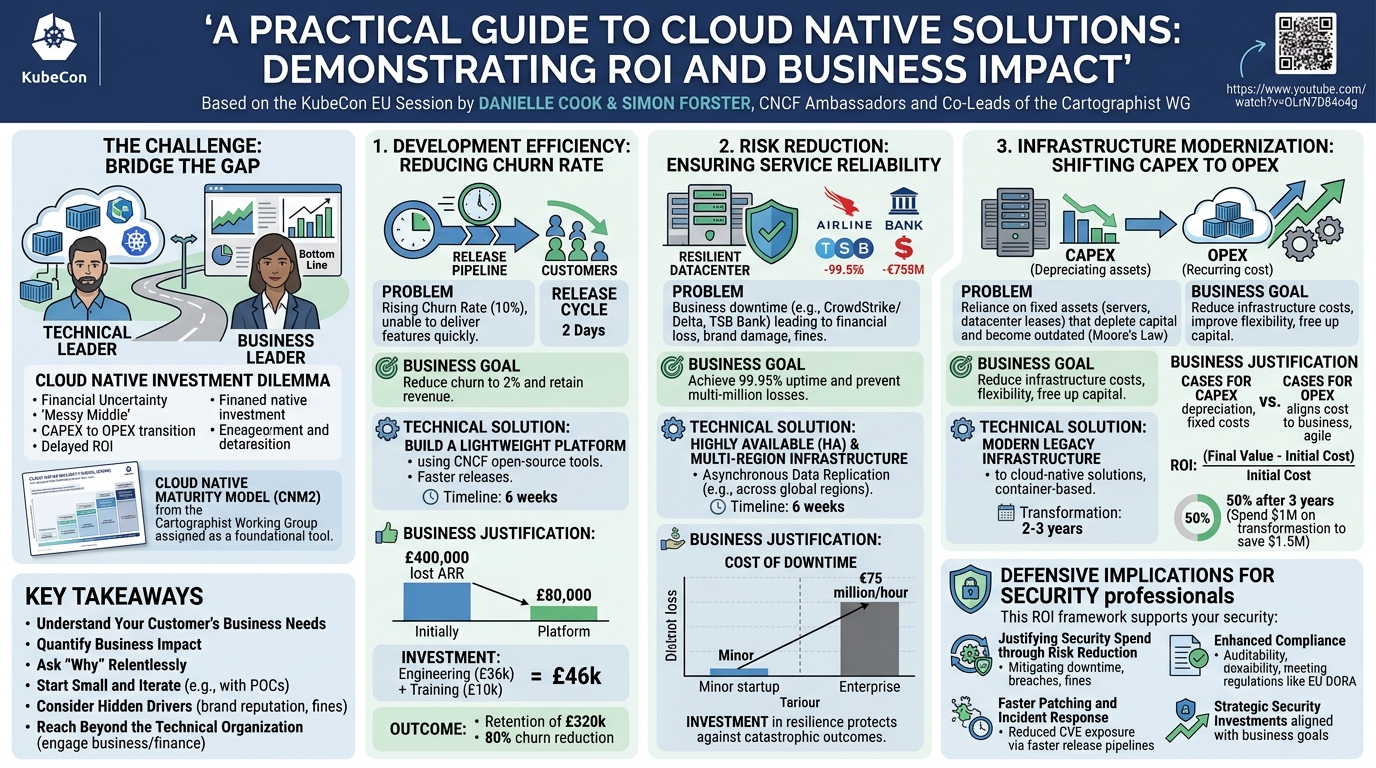
1. Development Efficiency: Reducing Churn Rate
Problem: An organization faces a rising customer churn rate (defined as losing customers who have already been acquired), currently at 10%. This is directly attributed to the inability to deliver new features as quickly as competitors, impacting sales, customer success, and ultimately board-level reporting. The current release cycle is two days.
Business Goal: Reduce the churn rate from 10% to less than 5%, specifically targeting a 2% churn rate. This requires accelerating feature delivery to remain competitive.
Technical Solution: The proposed solution is to build a lightweight platform utilizing various Cloud Native Computing Foundation (CNCF) open-source tools. This platform is designed to cut release times from two days to one day. The implementation timeline is aggressive, projected at six weeks, which includes enabling teams and setting up ongoing support.
Business Justification & ROI Calculation:
- Revenue at Risk: With 2,000 customers generating £2,000 each, the Annual Recurring Revenue (ARR) is £4 million. A 10% churn rate means losing £400,000 ARR annually. The goal is to reduce this to 5%, meaning only £200,000 lost, or ideally to 2% (only £80,000 lost).
- Investment Cost:
- Engineering: Two engineers, paid at £600 per day, working for 30 days each, total £36,000. The speakers noted that these engineers are expected to be proficient with the cloud-native ecosystem.
- Training & Enablement: An estimated £10,000 for training other teams to use the new platform.
- Total Initial Investment: Approximately £46,000.
- Outcome: By investing £46,000 and achieving the platform in six weeks, the organization reduces its churn rate to 2%. This means only £80,000 ARR is lost, an 80% reduction in churn compared to the initial 10% rate. The platform not only retains revenue but also sets the stage for future expansion and growth. This direct correlation between a relatively small technical investment and significant revenue retention (preventing £320,000 in losses annually) provides a clear and compelling ROI.
2. Risk Reduction: Ensuring Service Reliability
Problem: Business downtime leads to severe consequences, including reputational damage, lost revenue, and regulatory fines. The speakers cited real-world examples:
- CrowdStrike Update Impacting Delta: A faulty update caused significant outages, leading to Delta forecasting $380 million in losses. CrowdStrike also suffered reputational damage.
- TSB Bank Outage (UK): A system migration failure left customers unable to access funds for days, resulting in lost revenue and a nearly £50 million regulatory fine.
Business Goal: Achieve 99.95% uptime and avoid millions in lost revenue, upholding brand trust and ensuring service availability when customers need it.
Technical Solution: Implement a highly available (HA) and multi-region infrastructure leveraging cloud service providers. This involves asynchronous data replication between geographically diverse regions (e.g., UK, Germany, Finland, Madrid) to ensure resilience against regional failures. The implementation timeline is again aggressive, targeting six weeks for initial setup and enablement.
Business Justification & ROI Calculation:
- Cost of Downtime: The potential financial impact of downtime is immense.
- For a small startup, application downtime might cost €7/hour.
- For a mid-market institution, €30/hour.
- For an enterprise with a €100,000/month application hosting cost, this translates to roughly €40/hour.
- However, the lost income and revenue for an enterprise due to an hour of downtime can be as high as €75 million.
- Investment Justification: Compared to potential losses of tens or hundreds of millions from even short outages, the cost of building a resilient, multi-region cloud-native infrastructure becomes highly justifiable. The investment not only protects revenue but also mitigates brand damage and avoids regulatory fines, which can be substantial (e.g., TSB's ~£50 million fine). The ROI here is primarily in risk mitigation and loss prevention.
3. Infrastructure Modernization: Shifting from CAPEX to OPEX
Problem: Traditional on-premise infrastructure relies on CAPEX, where assets like servers and networking equipment are purchased, become fixed assets, and are depreciated over 3-5 years. This ties up capital, and due to Moore's Law, these assets often become outdated long before their depreciation cycle ends, failing to meet modern application requirements. There might also be upcoming deadlines, such as data center lease expirations, that necessitate a change.
Business Goal: Reduce infrastructure costs, accelerate application delivery, free up capital, and improve financial agility by shifting to OPEX.
Technical Solution: Modernize legacy infrastructure by adopting cloud-native, container-based solutions. This involves migrating applications to public cloud environments, leveraging the on-demand scalability and managed services offered by cloud providers. The transformation is typically a multi-year effort, estimated at 2-3 years.
Business Justification & ROI Calculation:
- CAPEX vs. OPEX:
- CAPEX: Large upfront investment in physical assets, depreciated over time. Turns cash into "tin."
- OPEX: Monthly expense for services, aligning costs directly with business operations. Improves cash flow and accounting flexibility.
- Basic ROI Calculation: The speakers proposed a simple ROI formula:
(Final Value of Investment - Initial Cost of Investment) / Initial Cost of Investment. - Example: If the initial infrastructure cost (or platform operating cost) is $3 million, and modernization reduces it to $2.5 million, but the transformation itself costs $1 million, the ROI can be calculated.
- After a couple of years, the organization might break even. After three years, a 50% ROI could be achieved (e.g., saving $1.5 million from the original $3 million cost, after spending $1 million on transformation).
- Outcome: Modernized infrastructure supports future growth and scalability, as additional resources can be requested on demand from cloud providers without the need for physical racking. This shift also eliminates the burden of managing depreciating hardware and allows the business to be more agile.
- Other Drivers:
- Upcoming Deadlines: Avoiding costly data center lease renewals (e.g., $10 million).
- Application Milestones: Aligning with vendors who are themselves moving to cloud-native, providing container images and Helm charts for deployment.
- Regulatory Changes: Compliance with regulations like the EU Digital Operational Resilience Act (DORA) can necessitate cloud migration to meet new resilience standards.
- Reduced Risk: Simply wanting to "sleep at night" knowing the infrastructure is robust and compliant.
The speakers consistently emphasized that these calculations, while simplified for the presentation, provide a concrete framework for technologists to start thinking about and quantifying the business impact of their decisions.
Demo / Proof of Concept
▶ Watch: Technical solution: Lightweight platform to accelerate releases (4:50)
This session was structured as a conceptual and strategic guide rather than a live technical demonstration. The speakers did not present a live demo or a specific proof-of-concept implementation during the talk. Instead, they focused on providing illustrative examples and financial models to demonstrate how ROI can be calculated and presented for various cloud-native initiatives.
Defensive Implications
▶ Watch: Demonstrating ROI: Revenue at risk vs. investment (5:50)
While the talk primarily focused on business justification for cloud-native adoption, the defensive implications for security professionals and organizations are substantial and multifaceted. A robust understanding of ROI, as articulated in this session, empowers defenders to make stronger cases for security investments.
- Justifying Security Spend through Risk Reduction: The "Risk Reduction" example directly translates to cybersecurity. Downtime, data breaches, and non-compliance are significant business risks. By quantifying the potential financial impact of these security incidents (lost revenue, fines, reputational damage), security teams can justify investments in cloud-native security tools, secure architecture design, and proactive threat detection. For instance, a multi-region, highly available architecture, while primarily for operational resilience, also enhances security by distributing risk and providing redundancy in case of a targeted attack on a specific region.
- Faster Patching and Incident Response: The "Development Efficiency" example, advocating for faster release cycles, has direct security benefits. A platform that enables releases in one day instead of two days means security patches for newly discovered vulnerabilities (e.g., CVEs) can be deployed much more rapidly. This reduces the window of exposure to threats. Furthermore, a highly automated, cloud-native pipeline can integrate security testing earlier (shifting left), allowing for quicker identification and remediation of vulnerabilities before they reach production.
- Enhanced Compliance and Regulatory Adherence: The mention of regulations like the EU DORA highlights the increasing pressure on organizations to demonstrate operational resilience and robust security controls. Cloud-native platforms, when implemented with security best practices, can offer superior auditability, immutable infrastructure, and automated compliance checks, making it easier to meet stringent regulatory requirements and avoid costly fines. The shift to OPEX can also allow for more flexible budgeting for security services and compliance tools.
- Strategic Security Investments: By understanding the business metrics (churn, ARR, lost revenue), security leaders can align their initiatives with top-level organizational goals. Instead of merely presenting security as a cost center, they can frame it as a critical enabler of business continuity, customer trust, and competitive advantage. This approach helps in prioritizing security investments that have the most significant impact on preventing business loss and protecting brand value.
In essence, the talk provides a powerful framework for security professionals to articulate the "why" behind their recommendations, moving beyond technical jargon to speak the language of business risk and financial returns.
Key Takeaways
- Understand Your Customer's Business Needs: Technologists must look beyond their technical domain to grasp the needs, goals, and key metrics of their internal and external customers. Connect technical solutions directly to business drivers like churn rates, customer acquisition costs, or profit and loss statements.
- Quantify Business Impact: Translate cloud-native investments into tangible business outcomes. Use clear financial metrics such as revenue saved, losses avoided, or capital freed up, rather than just technical benefits.
- Ask "Why" Relentlessly: Continuously question the purpose of technical initiatives to ensure they align with overarching business objectives. This helps in avoiding over-engineering and focusing on solutions that deliver real value.
- Start Small and Iterate: Begin with smaller projects or Proofs of Concept (POCs) to demonstrate value quickly. Leverage existing frameworks like the Cloud Native Maturity Model (CNM2) or the Platform Engineering Maturity Model to guide iterative growth and scale.
- Consider Hidden Drivers: Look beyond direct costs to include factors like brand reputation, regulatory fines (e.g., TSB's ~£50 million fine), competitive advantage, and the long-term benefits of shifting from CAPEX to OPEX.
- Reach Beyond the Technical Organization: Actively engage with business stakeholders, finance teams, and other departments to gain a holistic understanding of the organization's challenges and opportunities, fostering a shared vision for cloud-native adoption.
About the Speaker(s)
Danielle Cook and Simon Forster are both CNCF Ambassadors, actively contributing to the cloud-native community. They jointly lead the Cartographist Working Group within the CNCF, which is dedicated to developing the Cloud Native Maturity Model. This model helps organizations understand and achieve cloud-native maturity by focusing on business, technical, and people/culture outcomes. Simon Forster is also a technical architect, primarily contracting in financial services in the City of London, bringing real-world industry experience to his insights on cloud-native adoption.
Reviews
Dr. Zero (Offensive Security Researcher) — STRONG ACCEPT
This talk, while not a kernel exploit deep-dive, is a critical piece for any technologist struggling to justify cloud-native investments. Cook and Forster, clearly grounded in real-world experience, provide a brutally honest and practical framework for quantifying business value. They cut through the marketing fluff to deliver concrete ROI calculations for scenarios like churn reduction, risk mitigation, and CAPEX to OPEX shifts. This isn't just 'awareness'; it's a playbook for speaking the language of the business, making it highly actionable and essential for anyone looking to secure funding and demonstrate the strategic impact of their work.
Heather Calloway (CISO) — MUST SEE
This session by Cook and Forster is precisely the conversation we need more of. It provides a clear, practical framework for technologists to translate cloud-native investments into tangible business outcomes, addressing a critical governance gap. By demonstrating how to quantify impact on revenue, risk, and financial agility, it equips leaders, particularly CISOs, with the necessary lexicon to justify strategic programs and demonstrate accountability to the executive suite and the board.