Expanding the Contributor Pipeline Through Inclusion
KubeCon + CloudNativeCon Europe 2025 · Session
Overview
The KubeCon EU session, "Expanding the Contributor Pipeline Through Inclusion," delivered a compelling panel discussion on the critical role of diversity, equity, and inclusion (DEI) in fostering sustainable growth within the open-source ecosystem, particularly for the Cloud Native Computing Foundation (CNCF). Moderated by Josh Burkus, co-chair of TAG Contributor Strategy, the panel featured a diverse group of contributors and community leaders who shared their personal experiences and practical insights into building more welcoming and accessible open-source communities.
Key moments
- 0:00 Introduction and panelist introductions
- 3:55 Why expand contributor pipeline for sustainability?
- 4:09 Nancy: Fresh perspectives drive project growth
- 4:47 Stefanas: Diversity, innovation, and accessibility statistics
- 6:21 Sand's personal story on feeling included
- 7:44 Kaa: Responsiveness helps new contributors get involved
- 8:48 Role of maintainers in fostering inclusion
Expanding the Contributor Pipeline Through Inclusion
Speakers: Josh Burkus (Co-chair, TAG Contributor Strategy), Nancy (Co-chair, TAG Environmental Sustainability Advocacy; CNF Ambassador; Founder, Women in Cloud Native), Stefanas (CNCF Ambassador; Contributor, CNCF Glossary and BVI Initiative), Sand (Lead Software Engineer, Jen; Co-chair, CNCF Deaf and Hard of Hearing Working Group; Member, TAG Contributor Experience and TAG Contributor Strategy), Caa Taylor (Observability Engineer & Consultant, Eon Digital Technology; Co-organizer, KCD Accra; Member, BIPOC)
Conference: KubeCon EU
YouTube: https://www.youtube.com/watch?v=RgzyEc8pPa8
Overview
The KubeCon EU session, "Expanding the Contributor Pipeline Through Inclusion," delivered a compelling panel discussion on the critical role of diversity, equity, and inclusion (DEI) in fostering sustainable growth within the open-source ecosystem, particularly for the Cloud Native Computing Foundation (CNCF). Moderated by Josh Burkus, co-chair of TAG Contributor Strategy, the panel featured a diverse group of contributors and community leaders who shared their personal experiences and practical insights into building more welcoming and accessible open-source communities.
This talk underscored that expanding the contributor pipeline is not merely a matter of social justice but a strategic imperative for the long-term health and innovation of open-source projects. By actively cultivating inclusive environments, projects can attract a broader spectrum of talent, leading to richer ideas, more robust solutions, and greater resilience against contributor turnover. The panelists articulated that even small, consistent efforts by project maintainers and community members can create significant pathways for underrepresented groups, ultimately strengthening the entire cloud-native landscape.
The discussion delved into various facets of inclusion, from the importance of accessible documentation and meeting practices to the transformative power of mentorship and allyship. It highlighted successful initiatives already underway within the CNCF and offered concrete recommendations for individuals and organizations seeking to make a tangible difference. Far from being an abstract concept, the panel demonstrated that inclusion, when thoughtfully implemented, directly translates into a more vibrant, innovative, and sustainable future for open-source development.
Background
▶ Watch: Introduction and panelist introductions (0:00)
The rapid evolution and widespread adoption of cloud-native technologies have propelled the CNCF ecosystem to the forefront of modern software development. However, the sustained success and innovation of these projects are fundamentally reliant on a continuous influx of diverse contributions. Historically, open-source communities, like many tech sectors, have struggled with issues of underrepresentation, creating barriers that limit participation from various demographic groups. This panel addressed the core challenge of why expanding the contributor pipeline through inclusive practices is not just beneficial, but essential for the long-term sustainability of cloud-native projects.
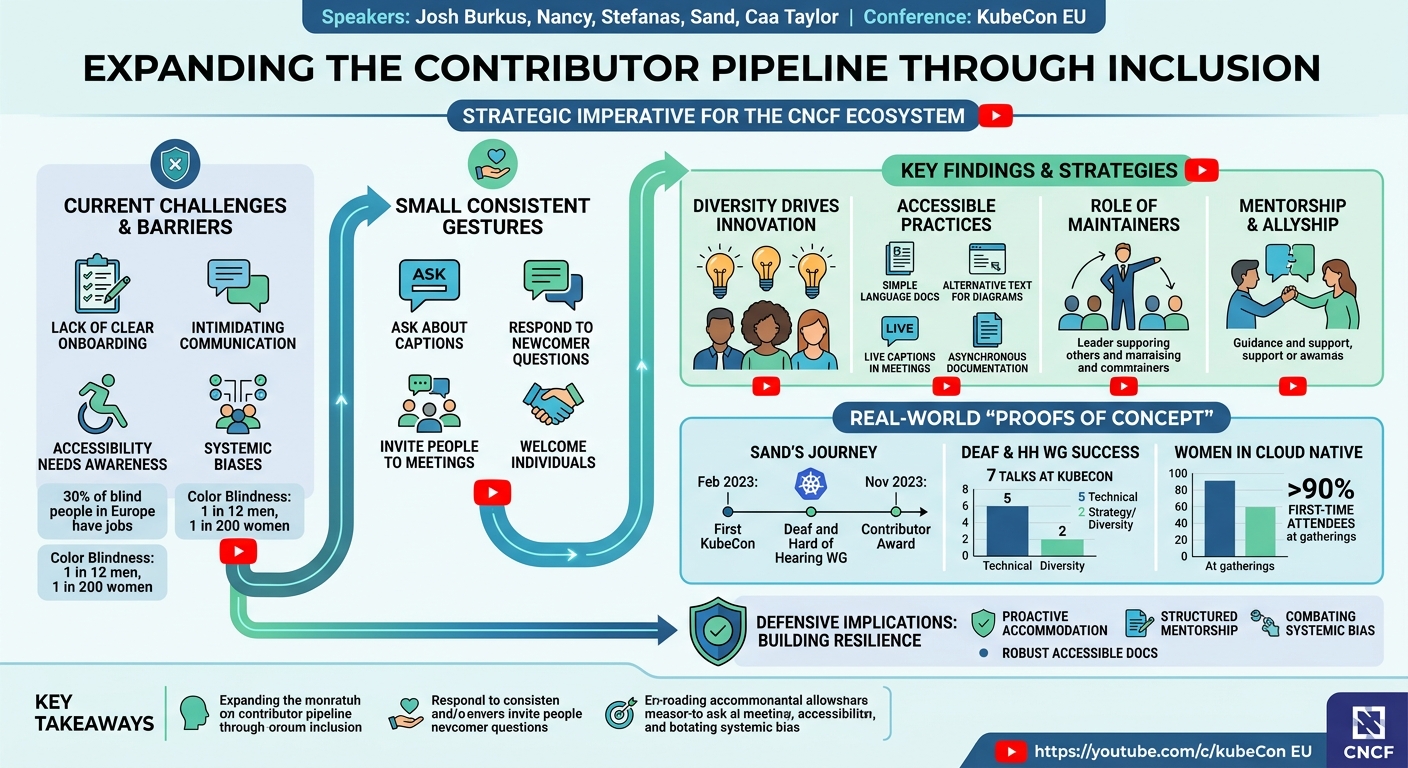
The problem of limited contributor diversity stems from several factors, including a lack of clear onboarding paths, intimidating communication styles, insufficient awareness of accessibility needs, and systemic biases that can inadvertently exclude potential contributors. Stefanas highlighted stark statistics, noting that "30% of blind people in Europe have only a job," underscoring the broader societal challenges that translate into technical communities. He also pointed out the prevalence of color blindness, affecting "one in 12 men and one in 200 women," which can make navigating color-coded technical interfaces or diagrams exceptionally difficult without conscious design considerations. These figures illustrate that accessibility is not a niche concern but a fundamental requirement for a truly broad contributor base.
Prior work within the CNCF, such as the establishment of the TAG Contributor Strategy and various working groups like the Deaf and Hard of Hearing Working Group and the Black Indigenous People of Color (BIPOC) initiative, acknowledges these challenges. These groups are dedicated to understanding and dismantling barriers to entry, fostering environments where individuals from all backgrounds feel welcome and empowered to contribute. The panel built upon this foundation, offering practical strategies and personal anecdotes to demonstrate how these initiatives translate into tangible improvements in the contributor experience, ultimately leading to more innovative and resilient open-source projects.
Key Findings
▶ Watch: Nancy: Fresh perspectives drive project growth (4:09)
The panel discussion illuminated several key findings regarding the expansion of the contributor pipeline through inclusion, emphasizing both the strategic necessity and the practical implementation of diverse practices.
Firstly, the panelists unanimously asserted that diversity drives innovation and project sustainability. Nancy articulated that "if there is just no conflict then there is a problem because... there are no new ideas." She stressed that diverse perspectives, fresh ideas, and even healthy disagreements among people from different backgrounds lead to creative solutions and accelerated growth. Stefanas reinforced this, stating that diversity brings "more perspective and experiences to the project, fostering innovation and reducing the risk of echo chambers." This broader pool of contributors creates a more resilient community, better equipped to maintain momentum and navigate challenges like contributor turnover, ensuring long-term sustainability.
Secondly, the panel highlighted that small, consistent gestures of inclusion have a profound impact. Sand shared a powerful personal anecdote about her first TAG Contributor Strategy meeting where Josh Burkus, upon noticing her reliance on captions, simply asked, "are the captions working?" This single question, she explained, made her "feel so much belong and inclusive," demonstrating how a simple act of accommodation can transform a newcomer's experience. Caa Taylor echoed this, emphasizing that sometimes it just takes "one person to respond to a question" or to invite someone to a meeting to help them overcome the initial fear or uncertainty of getting involved.
Thirdly, accessible documentation and meeting practices are non-negotiable for true inclusion. Sand emphasized the importance of project contribution guides being in "very simple a simple language without an [sic] technical jargon," and that diagrams and images must include alternative text for blind users. Nancy elaborated on the practice of meticulously documenting all open-source meetings asynchronously, allowing contributors to follow along regardless of their time zone or ability to attend live. Stefanas added that during presentations, speakers should "speak loud and explain what you show" rather than just pointing, and provide git repositories for demos to allow hands-on follow-up.
Fourthly, the role of project maintainers and leaders is critical in fostering inclusive environments. Nancy shared how a previous chair of TAG Environment Sustainability Advocacy recognized her consistent contributions and proactively offered her an opportunity to lead an initiative, which she now pays forward. Sand's journey from KubeCon attendee to award recipient was facilitated by maintainers like Catherine and Josh, who actively reached out and provided opportunities. Maintainers, the panel concluded, must not only create welcoming spaces but also actively seek out and empower diverse talent, understanding that this effort can uncover "great talent" that might otherwise be missed.
Finally, the panel stressed the transformative power of mentorship and allyship. Nancy strongly advocated for individuals to become mentors, stating that "if you can be a mentor please be a mentor," recognizing its crucial role in individual growth, especially for newcomers and those from underrepresented groups. Sand detailed how allyship is not just about having a title but about internalizing accessibility needs, such that one instinctively notices when an environment is not inclusive, even if it doesn't directly affect them. Caa Taylor encouraged active allyship, urging people to "just invite people to things" as the sheer size of the CNCF ecosystem can be daunting for newcomers trying to find relevant groups or meetings.
Technical Deep Dive
▶ Watch: Stefanas: Diversity, innovation, and accessibility statistics (4:47)
While the talk primarily focused on social dynamics and community strategy, its implications for technical practices are profound, particularly in how technology and processes can be designed and implemented to be inherently more inclusive. The "technical deep dive" here is less about specific code vulnerabilities and more about the engineering of inclusion within technical workflows and documentation.
A significant area of focus was accessible documentation. Sand articulated the necessity of writing project contribution guides in "very simple language without technical jargon" (06:00). This is a direct challenge to the often opaque and highly technical language prevalent in many open-source projects, which can be a significant barrier for newcomers. Furthermore, she stressed the importance of alternative text for all diagrams and images. This is a fundamental web accessibility (WCAG) principle, ensuring that screen readers can convey visual information to users with visual impairments. Stefanas reinforced this, urging contributors to "put more descriptive information there with the text" when using diagrams or pictures to describe architecture (26:00). This proactive approach to documentation design ensures that technical content is consumable by a wider audience, regardless of their sensory abilities.
Beyond static documentation, the panel discussed inclusive meeting protocols as a critical technical-social interface. The use of live captions was highlighted by Sand as indispensable for individuals with hearing impairments, like herself (06:00). This technology, often integrated into video conferencing platforms, transforms spoken language into accessible text, bridging a significant communication gap. Nancy pointed out that in open-source calls, maintainers often "document every stuff... so that if people want to follow they can follow it as sync" (08:00). This practice, often involving shared notes, meeting minutes, or even automatically generated transcripts, ensures that information is preserved and accessible asynchronously, accommodating different time zones, schedules, and learning preferences.
Stefanas provided further technical considerations for live presentations and demonstrations. He advised speakers to "speak loud and explain what you show instead of saying please show this explain explicitly what you Des what you show to to the audience" (26:00). This is crucial for visually impaired attendees who cannot see screen shares. For command-line interface (CLI) demonstrations or coding sessions, he recommended sharing Git repositories and details of the environment used (26:00). This allows attendees to replicate the demonstration locally, providing a hands-on learning experience that goes beyond passive viewing, directly addressing a common challenge in technical workshops.
The discussion also touched upon the technical aspects of casual communication. Stefanas suggested that when using "fun memes or gifts," contributors should "add into parentheses the meaning you would like to share to to the to the Audience by this meme or or gifts" (26:00). This simple addition ensures that the emotional or contextual information conveyed by visual media is accessible to those who cannot see it, preventing exclusion in informal interactions.
In essence, the "technical deep dive" of this talk was a call to apply accessibility and inclusive design principles to all aspects of technical communication and project infrastructure. It emphasized that the tools, formats, and practices used to convey technical information must be consciously crafted to be universal, removing implicit barriers that prevent talented individuals from contributing to the cloud-native ecosystem.
Demo / Proof of Concept
▶ Watch: Kaa: Responsiveness helps new contributors get involved (7:44)
While this panel discussion did not feature a traditional technical demonstration of a security tool or exploit, it powerfully presented several real-world "proofs of concept" in the form of successful initiatives and personal journeys within the CNCF ecosystem. These examples served to validate the core premise that intentional inclusion efforts directly lead to expanded contributor pipelines and more vibrant communities.
One of the most compelling proofs was Sand's personal journey as a contributor. Starting her open-source journey in "February 2023," she detailed her rapid ascent from a first-time KubeCon attendee, relying on captions, to a recognized leader. Her engagement began by joining the CNCF Deaf and Hard of Hearing Working Group, an initiative specifically designed to support contributors like her. From there, she expanded her contributions to TAG Contributor Strategy, spoke at KubeCon Paris, contributed to the cncf.io blog by writing a spotlight for her working group, and even shadowed the KubeCon contributor summit. Her dedication culminated in receiving the KubeCon Contributor Award in November 2023, less than a year after her initial involvement (11:00-14:00). This trajectory vividly illustrates how proactive outreach and inclusive environments can empower individuals to achieve significant contributions rapidly.
Another powerful example was the success of the Deaf and Hard of Hearing Working Group itself. Sand proudly reported that the working group had contributed "about seven talks in this KubeCon," with "five talks of Technical and only two facts are about the contributor strategy and the diversity" (18:00). This demonstrates that focused inclusion efforts not only bring diverse voices but also enable these groups to make substantial technical contributions, dispelling any notion that diversity initiatives detract from technical rigor.
Nancy, a co-chair for TAG Environment Sustainability Advocacy, provided an example from her own experience. After consistently contributing to her TAG for a year, the then-chair, Leo, "reached out to me and asked would I be wanting to lead the sustainability week initiative" (10:00). This act of recognizing and empowering an engaged contributor led to new leadership and fresh perspectives for the initiative, which Nancy now plans to pass on to a new person, creating a sustainable leadership pipeline. She also highlighted the impact of the Women in Cloud Native Gathering, an initiative she founded in December 2022. At a recent gathering, "More Than 90% people raised their hands" when asked if they were first-time KubeCon attendees (18:00). This statistic powerfully demonstrates the initiative's success in attracting a demographic often underrepresented at major tech conferences, providing them with a crucial entry point and networking opportunities with senior leaders.
Caa Taylor, a member of the BIPOC (Black Indigenous People of Color) initiative, explained how this group helps bring "people from underrepresented backgrounds into Tech especially in this Cloud native space" (16:00). She shared how her involvement with BIPOC led to her speaking on the KubeCon panel, illustrating how these communities provide pathways for public speaking and leadership roles. The initiative focuses on practical guidance, such as "how do you approach a maintainer or... how do you actually just get started with going to a meeting" (16:00), directly addressing common barriers to entry.
These examples collectively serve as robust proofs of concept, demonstrating that dedicated efforts towards inclusion, mentorship, and community building are not just theoretical ideals but practical strategies that yield measurable results in expanding and diversifying the open-source contributor base.
Defensive Implications
▶ Watch: Role of maintainers in fostering inclusion (8:48)
In the context of this talk, "defensive implications" refers to the strategies and actions communities and individuals can take to defend against the erosion of contributor pipelines and the stagnation that arises from a lack of diversity and inclusion. It's about building resilience against the insidious forces that lead to homogenous communities, burnout, and ultimately, unsustainable projects.
Firstly, a primary defensive posture involves proactive accommodation and psychological safety. Sand highlighted that managers should "just let your team know that you always open to providing accommodation" (21:00). This creates a safe space where individuals feel comfortable disclosing their needs without fear of judgment. Caa Taylor underscored the manager's role in empowering voices, especially those from underrepresented groups, stating, "assist your people or your person with the ability to speak their voice and to make clear what it is they're trying to express" (24:00). This defends against the silencing effect of dominant voices and encourages diverse perspectives to surface, preventing groupthink and fostering innovative problem-solving.
Secondly, robust and accessible documentation acts as a defense against knowledge silos and high barriers to entry. The consistent practice of documenting all meeting discussions, decisions, and technical specifications, as advocated by Nancy, allows for asynchronous participation and onboarding (08:00). This mitigates the risk of new contributors feeling lost or overwhelmed, a common reason for disengagement. By ensuring documentation is in "simple language" with "alternative text" for visuals, as Sand and Stefanas advised (06:00, 26:00), projects defend against excluding contributors with learning differences or sensory impairments.
Thirdly, structured mentorship programs and active allyship are crucial defenses against isolation and lack of opportunity. Josh Burkus highlighted the upcoming mentorship program from TAG Contributor Strategy, a formal mechanism to guide newcomers (20:00). Nancy passionately urged attendees to "be a mentor" (31:00), recognizing its profound impact on individual growth and retention. Allyship, as described by Sand, involves internalizing accessibility needs to the point where one instinctively identifies and addresses barriers, even if they don't directly affect them (29:00). This collective vigilance defends against the subtle forms of exclusion that can permeate a community.
Fourthly, communities must actively combat systemic biases to ensure true meritocracy. Stefanas articulated that "true meritocracy isn't about ating talents slowly and current achievement but recognizing potential and overcoming systemic biases" (30:00). This means consciously designing processes that evaluate potential and contribution over arbitrary factors, defending against inherent biases that might undervalue underrepresented talent. Initiatives like BIPOC and Women in Cloud Native are defensive mechanisms that actively seek out and support these talents, ensuring they are not overlooked.
Finally, fostering a culture of open questioning and invitation serves as a defense against stagnation. Caa Taylor's insistence on "always allow people to ask questions" (27:00) promotes a learning environment where curiosity is valued, leading to deeper understanding and broader engagement. Similarly, the simple act of inviting someone to a meeting or a project, as she suggested, directly counters the daunting nature of large ecosystems like CNCF, preventing potential contributors from feeling intimidated or unwelcome.
In summary, the defensive implications of this talk are about proactively building inclusive structures and fostering empathetic cultures that prevent the common pitfalls of open-source development: insularity, attrition, and a lack of diverse thought. By adopting these strategies, communities can ensure a steady, diverse, and robust contributor pipeline, safeguarding their long-term vitality and innovative capacity.
Key Takeaways
- Inclusion is a Strategic Imperative: Diversity in open-source projects is not merely a social nicety but a fundamental requirement for long-term sustainability, fostering innovation, and building resilient communities that can adapt and thrive.
- Small Actions, Big Impact: Simple, consistent gestures—like asking about accessibility needs, providing clear meeting documentation, or responding to newcomer questions—can significantly lower barriers to entry and make individuals feel profoundly welcome and empowered.
- Maintainers are Key Enablers: Project maintainers play a critical role in actively creating inclusive environments, documenting processes, seeking out and empowering diverse talent, and recognizing contributions to cultivate a vibrant and expanding contributor base.
- Accessibility by Design: Technical practices, including documentation (simple language, alt-text for images) and meeting protocols (live captions, explicit verbal descriptions, sharing resources), must be designed with accessibility in mind to ensure all potential contributors can engage effectively.
- Mentorship and Allyship Drive Growth: Intentional mentorship programs and active allyship are crucial for guiding newcomers, fostering individual growth, and dismantling systemic biases, creating pathways for underrepresented individuals to contribute and lead.
- Combat Systemic Bias for True Meritocracy: Communities must actively challenge and counteract inherent biases to ensure that opportunities and recognition are based on skills, potential, and contribution, rather than arbitrary or exclusionary factors, thereby expanding the talent pipeline authentically.
About the Speaker(s)
The panel featured a distinguished group of community leaders and open-source contributors:
- Josh Burkus served as the moderator for the session. He is a Co-chair of TAG Contributor Strategy, a group within the CNCF dedicated to fostering and improving the contributor experience across various cloud-native projects.
- Nancy is a prominent figure in the cloud-native community. She serves as a Co-chair for TAG Environment Sustainability Advocacy and is a CNF Ambassador. With a background as a DevOps Engineer, Nancy founded the Women in Cloud Native community in December 2022 and has been contributing to open source since 2019, actively promoting diversity and inclusion.
- Stefanas is a CNCF Ambassador known for his contributions to the CNCF Glossary project, which aids in onboarding newcomers to the cloud-native ecosystem. He also organizes Cloud Native local meetups and contributes to the Blind and Visually Impaired (BVI) initiative, advocating for accessibility.
- Sand is a Lead Software Engineer at Jen and a dedicated contributor to the CNCF. She is the Co-chair of the CNCF Deaf and Hard of Hearing Working Group and a member of both TAG Contributor Experience and TAG Contributor Strategy. As a person with hearing impairment who relies on captions and lip reading, Sand brings a vital perspective on accessibility. She began her open-source journey in February 2023 and received a KubeCon Contributor Award in November of the same year.
- Caa Taylor is an Observability Engineer and Consultant at Eon Digital Technology. She is a co-organizer of KCD Accra and was a co-chair of the DevOpps Dev Day in Chicago. Caa is also a member of the BIPOC (Black Indigenous People of Color) initiative, working to support and empower underrepresented groups in tech. She has been in the tech industry for 20 years.
Reviews
Dr. Zero (Offensive Security Researcher) — STRONG ACCEPT
The KubeCon panel on expanding the contributor pipeline through inclusion delivered a compelling and highly actionable discussion. Far from being a mere 'awareness' session, the speakers, all deeply involved community leaders, provided concrete examples and practical strategies for fostering diversity and building more resilient open-source communities. Their insights into accessible documentation, inclusive meeting practices, and the transformative power of mentorship offer a clear roadmap for maintainers and community managers, demonstrating that inclusion is a strategic imperative backed by real-world impact.
Heather Calloway (CISO) — STRONG ACCEPT
This session effectively articulates why diversity, equity, and inclusion are not merely social initiatives but a strategic imperative for the sustained health and innovation of critical open-source ecosystems like CNCF. The panel provided compelling evidence, through personal anecdotes and practical examples, that intentional efforts in fostering inclusive environments directly expand the contributor pipeline, leading to more resilient projects and a stronger software supply chain. While not a direct security briefing, the insights are highly relevant for a CISO needing to understand the institutional health and sustainability of the foundational technologies their organizations rely upon.