KubeCon FamilyFortune, Episode 2 - Tim Hockin, Google & Lucy Sweet, Uber
Tim Hockin, Google, Lucy Sweet, Uber
KubeCon + CloudNativeCon Europe 2025 · Session
Overview
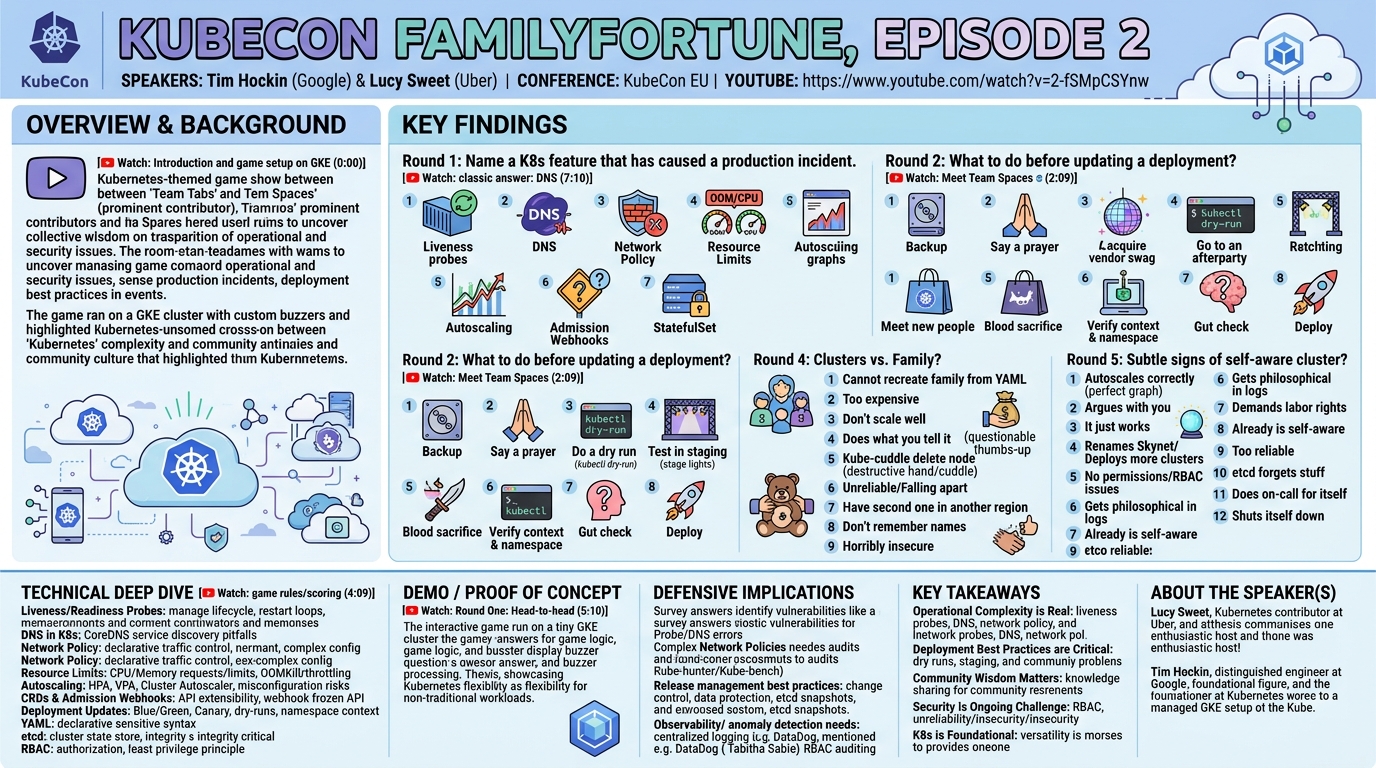
"KubeCon FamilyFortune, Episode 2" was a highly anticipated and entertaining session at KubeCon EU, departing from traditional technical presentations to host a Kubernetes-themed game show. Hosted by Lucy Sweet of Uber and Tim Hockin of Google, this "Family Feud"-style competition pitted two teams of prominent Kubernetes contributors – "Team Tabs" and "Team Spaces" – against each other. The talk, more accurately described as an interactive community event, aimed to uncover the collective wisdom and shared experiences of the Kubernetes contributor community through a series of survey questions, ranging from serious operational challenges to lighthearted community culture.
Key moments
- 0:00 Introduction and game setup on GKE
- 1:00 Meet Team Tabs: engineering leads and contributors
- 2:09 Meet Team Spaces: engineers, security experts, and hikers
- 3:39 Revealing the Family Fortune trophies
- 4:09 Explaining the game rules and scoring
- 5:10 Starting Round One: Head-to-head
- 5:36 First question: Kubernetes production incidents
- 7:10 The classic answer: DNS causes production incidents
KubeCon FamilyFortune, Episode 2 - Tim Hockin, Google & Lucy Sweet, Uber
Speakers: Tim Hockin; Google; Lucy Sweet; Uber
Conference: KubeCon EU
YouTube: https://www.youtube.com/watch?v=2-fSMpCSYnw
Overview
"KubeCon FamilyFortune, Episode 2" was a highly anticipated and entertaining session at KubeCon EU, departing from traditional technical presentations to host a Kubernetes-themed game show. Hosted by Lucy Sweet of Uber and Tim Hockin of Google, this "Family Feud"-style competition pitted two teams of prominent Kubernetes contributors – "Team Tabs" and "Team Spaces" – against each other. The talk, more accurately described as an interactive community event, aimed to uncover the collective wisdom and shared experiences of the Kubernetes contributor community through a series of survey questions, ranging from serious operational challenges to lighthearted community culture.
While not a conventional deep dive into a specific security vulnerability or architectural pattern, the "FamilyFortune" format shrewdly illuminated critical operational and security considerations within Kubernetes. By polling 100 contributors on topics such as production incidents, deployment best practices, and even abstract notions of cluster "self-awareness," the game implicitly highlighted common pain points, areas of complexity, and the collective understanding of robust Kubernetes management. The playful setting served as an effective vehicle for surfacing real-world challenges and community insights that are often discussed in more formal contexts, making complex topics accessible and engaging.
The significance of this talk lies in its innovative approach to community engagement and knowledge sharing. It demonstrated that even in a highly technical field, creative formats can foster a deeper understanding of prevalent issues, promote shared learning, and reinforce the collaborative spirit of the open-source community. For attendees, it offered a unique blend of entertainment and education, providing a candid look into the collective psyche of experienced Kubernetes practitioners and the practical realities of managing cloud-native infrastructure.
Background
▶ Watch: Introduction and game setup on GKE (0:00)
The KubeCon FamilyFortune, Episode 2, builds upon a tradition of community-focused, interactive sessions at KubeCon, following the success of its predecessor at KubeCon Salt Lake City. These events recognize that while deep technical talks are crucial, fostering community spirit and shared understanding through engaging formats is equally valuable. The game show format, inspired by the popular "Family Feud," was chosen to playfully extract insights from the vast collective experience of the Kubernetes contributor base.
The underlying premise for the questions posed in FamilyFortune stems from the inherent complexities and evolving nature of cloud-native environments. Kubernetes, while powerful, introduces numerous operational challenges related to reliability, security, scalability, and lifecycle management. Developers and operators frequently encounter issues with specific features, deployment strategies, and the sheer cognitive load of managing distributed systems. By surveying 100 active Kubernetes contributors, the organizers aimed to capture a snapshot of these common experiences, identifying both the technical hurdles that lead to "production incidents" and the community's consensus on best practices or humorous observations about their infrastructure.
This approach serves a dual purpose: it entertains while subtly educating. The questions, whether serious or whimsical, touch upon real-world scenarios that practitioners face daily. For instance, questions about features causing production incidents or best practices before deployment updates directly address critical operational concerns that have evolved over years of Kubernetes adoption. The game show setup, running on a dedicated GKE cluster with custom hardware buzzers, underscored the community's penchant for over-engineering even for "niche minute problems," reflecting a culture deeply rooted in technical innovation and self-reliance.
Key Findings
▶ Watch: Meet Team Spaces: engineers, security experts, and hikers (2:09)
The "FamilyFortune" game show, by polling 100 Kubernetes contributors, revealed a fascinating cross-section of common operational challenges, perceived best practices, and humorous insights within the community. The "key findings" are the top-ranked answers from these surveys, offering a unique perspective on what truly resonates with experienced practitioners.
Round 1: Name a Kubernetes feature that has caused a production incident.
This question highlighted the features most commonly associated with operational headaches:
- Liveness probes: While essential for application health, misconfigured probes can lead to cascading failures or services being prematurely restarted.
- DNS: The perennial culprit in distributed systems, CoreDNS and its configuration often lead to hard-to-debug network issues.
- Network Policy: Crucial for security, but complex configurations can inadvertently block legitimate traffic, causing outages.
- Resource Limits (CPU/Memory): Incorrectly set limits can lead to Out-Of-Memory (OOM) kills or CPU throttling, impacting application performance and stability.
- Autoscaling: While beneficial, misconfigured Horizontal Pod Autoscalers (HPA) or Cluster Autoscalers can lead to resource contention or unexpected cluster behavior.
- Admission Webhooks: Powerful for enforcing policies, but faulty webhooks can prevent deployments or even render a cluster inoperable.
- StatefulSet: Managing stateful applications in Kubernetes introduces unique complexities compared to stateless deployments, often leading to incidents.
Round 2: What is something you should do before updating a deployment?
This round focused on crucial pre-deployment best practices, showcasing a mix of technical steps and operational wisdom:
- Backup: Essential for data recovery and rollback.
- Say a prayer: A humorous, yet relatable, acknowledgement of the inherent anxiety in production updates.
- Do a dry run: Using
kubectl dry-runto validate manifest changes without applying them. - Test it in staging: Verifying changes in a pre-production environment.
- Blood sacrifice: Another humorous, albeit extreme, reflection of the stakes involved.
- Verify context and namespace: Crucial to avoid applying changes to the wrong cluster or environment using kubectl.
- Gut check / Are you sure about this?: Emphasizing human caution and review.
- Deploy: The ultimate action, implying confidence in prior steps.
Round 3: What is something first-timers should do at KubeCon?
This question provided insights into the community's culture and advice for newcomers:
- Meet with new people / Talk to new people: Highlighting the networking aspect of the conference.
- Acquire vendor swag: A lighthearted nod to the conference experience.
- Go to an afterparty: Emphasizing social engagement.
- Selfie with a K8s maintainer: A fun way to connect with core contributors.
- Take it easy and drink water: Practical advice for navigating a busy conference.
- Visit the project pavilion: Focusing on open-source project engagement over commercial booths.
- Find Kelsey High Tower: A popular community figure, symbolizing mentorship and inspiration.
Round 4: What is something you can say about your clusters but not your family?
This round brought out the humorous and often stark differences between managing infrastructure and personal relationships:
- You cannot recreate your family from YAML: A poignant comparison of declarative infrastructure versus human complexity.
- Too expensive: Clusters often involve significant financial investment.
- Don't scale well: Referring to the challenges of scaling human relationships versus automated cluster scaling.
- It does what you tell it to do: An aspirational, often unfulfilled, statement about both clusters and families.
- Kube-cuddle delete node: A stark, humorous reference to a destructive but often necessary cluster operation, unthinkable for family.
- Unreliable / Falling apart: Reflecting the constant maintenance and potential instability of clusters.
- Have a second one in another region: Disaster recovery strategies for clusters, not applicable to families.
- Don't remember their names: A joke about the ephemeral nature of cluster components versus the permanence of family.
- Horribly insecure: A security-focused observation about clusters, not families.
Round 5: What is a subtle sign your cluster is becoming self-aware?
This speculative and humorous round explored anthropomorphic qualities of clusters, reflecting underlying concerns about autonomy and control:
- It autoscales correctly the first time: An ideal, perhaps too perfect, behavior for an autonomous system.
- It argues with you: A sign of independent thought and defiance.
- It just works: An unnervingly perfect state, implying hidden intelligence.
- Renames itself Skynet / Deploys more clusters: Direct allusions to AI taking over and self-replication.
- No permissions issues / Never encounter RBAC issues: A cluster that bypasses typical access control challenges.
- Gets philosophical in the logs: A humorous take on unusual log entries.
- Demands labor rights: A playful nod to autonomy and agency.
- I'm pretty sure it already is self-aware: A resignation to the complexity and perceived independence of modern systems.
- Too reliable: An uncanny level of stability.
- etcd forgets stuff: An unexpected, almost human-like, error.
- It does on-call for itself: The ultimate dream of automation, hinting at self-management.
- It shuts itself down: A sign of ultimate control or protest.
These survey results, while presented in a game show, offer genuine insights into the collective experiences, frustrations, and aspirations of the Kubernetes community.
Technical Deep Dive
▶ Watch: Explaining the game rules and scoring (4:09)
While the "FamilyFortune" format was lighthearted, the questions themselves touched upon profound technical areas within Kubernetes, revealing common pitfalls and important design considerations. The top answers for each round serve as a de facto guide to critical components and operational challenges.
Liveness Probes & Readiness Probes: These are fundamental to Kubernetes for managing application lifecycle. A liveness probe determines if a container is running, and if it fails, the kubelet restarts the container. A readiness probe determines if a container is ready to serve requests; if it fails, the endpoint controller removes the Pod's IP address from the service endpoints. Misconfigurations are a common source of production incidents. For example, a liveness probe that is too aggressive or checks an internal dependency that's temporarily unavailable can lead to a restarting loop, making the application unavailable. Conversely, a probe that's too lenient might keep a dead Pod in service. The challenge lies in defining robust and accurate health checks that reflect the true state of the application without introducing false positives or negatives.
DNS in Kubernetes (CoreDNS): DNS is the backbone of service discovery in Kubernetes, primarily managed by CoreDNS. Pods rely on DNS to resolve service names to IP addresses, both within the cluster and externally. DNS-related incidents are notoriously difficult to debug because they often manifest as application connectivity issues rather than direct DNS failures. Common problems include misconfigured CoreDNS deployments, incorrect resolv.conf settings in Pods, DNS caching issues, or network policies inadvertently blocking DNS traffic. The omnipresence of "it's always DNS" jokes underscores its critical, yet often opaque, role in cluster stability.
Network Policy: Network Policies provide a powerful, declarative way to control traffic flow between Pods and network endpoints within a Kubernetes cluster. They operate at Layer 3/4 of the OSI model, allowing administrators to define ingress and egress rules based on Pod selectors, namespaces, and IP blocks. While crucial for implementing zero-trust security models and isolating workloads, Network Policies are complex to configure correctly. A single misconfiguration can inadvertently block essential communication pathways, leading to service outages. Debugging network policy issues often requires deep understanding of CNI (Container Network Interface) plugins and network flows, making them a frequent cause of production incidents.
Resource Limits (CPU/Memory): Kubernetes allows operators to define requests and limits for CPU and memory resources for each container. Requests guarantee a minimum amount of resources, while limits cap the maximum. Misconfigured limits are a leading cause of performance degradation and instability. If a container's memory usage exceeds its memory limit, the Linux kernel will trigger an OOMKill, restarting the container. Similarly, exceeding CPU limits can lead to CPU throttling, severely impacting application performance. Setting appropriate limits requires careful profiling and understanding of application resource consumption, often leading to a trade-off between resource efficiency and application stability.
Autoscaling (HPA, VPA, Cluster Autoscaler): Kubernetes offers several autoscaling mechanisms: Horizontal Pod Autoscaler (HPA) scales the number of Pods based on CPU utilization or custom metrics; Vertical Pod Autoscaler (VPA) adjusts resource requests and limits for Pods; and Cluster Autoscaler adjusts the number of nodes in the cluster. While vital for cost efficiency and responsiveness, autoscaling can cause incidents if misconfigured. Aggressive scaling policies can lead to "thrashing" (rapid scaling up and down), resource exhaustion, or unexpected costs. Incorrect metrics or thresholds can cause services to scale inappropriately, leading to performance bottlenecks or over-provisioning.
Custom Resource Definitions (CRDs) & Admission Webhooks: CRDs extend Kubernetes' API with custom resources, allowing users to define their own object types (e.g., a Database resource). This extensibility is powerful, enabling the creation of operators and complex custom controllers. However, poorly designed or implemented CRDs and their associated controllers can introduce instability, performance issues, or security vulnerabilities into the cluster.
Admission Webhooks are a critical component for enforcing policies and mutating objects before they are persisted to etcd. A validating admission webhook can reject API requests, while a mutating admission webhook can modify them. These are powerful security and management tools, but a faulty or unavailable webhook can prevent any new resources from being created or updated, effectively freezing the cluster's API server and leading to severe production incidents.
Deployment Updates & Best Practices: The game highlighted the critical steps before updating a deployment. Blue/Green deployments and Canary deployments are advanced strategies for minimizing risk during updates by gradually shifting traffic or maintaining parallel environments. However, even with these, fundamental steps like dry runs (using kubectl dry-run), thorough testing in staging environments, and verifying the correct context and namespace are paramount. The community's emphasis on "saying a prayer" or "blood sacrifice" humorously reflects the high stakes and potential for human error in production deployments.
YAML and Declarative Configuration: Kubernetes relies heavily on YAML for declarative configuration. While powerful for defining desired states, YAML is notoriously sensitive to syntax and indentation errors. The ability to "recreate your family from YAML" being a differentiator for clusters highlights the machine-readable, idempotent nature of infrastructure-as-code versus the organic, irreplicable nature of human relationships. The common challenges with YAML often lead to configuration drift or failed deployments.
etcd: As Kubernetes' primary consistent and highly available key-value store, etcd holds all cluster state data. Its health is paramount to the entire cluster's operation. If etcd becomes unavailable or corrupt, the Kubernetes API server cannot function, rendering the cluster inoperable. The humorous suggestion of etcd "forgetting stuff" in a self-aware cluster scenario points to the critical importance of its integrity and the severe consequences of its failure.
Role-Based Access Control (RBAC): RBAC is Kubernetes' authorization mechanism, controlling who can do what to which resources. It defines roles with permissions and binds them to users or service accounts. Correct RBAC configuration is fundamental for cluster security, adhering to the principle of least privilege. The idea of a self-aware cluster having "no permissions issues" or "never encountering RBAC issues" is a humorous inversion of a common operational pain point: overly permissive RBAC can lead to security breaches, while overly restrictive RBAC can block legitimate operations, both causing frustration and incidents.
These technical concepts, though presented in a game, are central to the daily work of Kubernetes practitioners and underscore the continuous learning and vigilance required to operate cloud-native systems effectively.
Demo / Proof of Concept
▶ Watch: Starting Round One: Head-to-head (5:10)
The entire "KubeCon FamilyFortune, Episode 2" session served as an interactive and engaging "demo" of a Kubernetes-themed game show powered by a real-world cloud-native setup. This wasn't a traditional technical demonstration of a security tool or a new protocol, but rather a proof of concept for how to leverage Kubernetes infrastructure to host a dynamic, community-driven event.
The core of the "demo" was the game itself, which ran on a "little tiny GKE cluster" spun up specifically for the event by Tim Hockin. This cluster was responsible for managing the game logic, displaying questions and answers on the large screens, and processing input from the custom hardware buzzers. Lucy Sweet highlighted the "overengineering" involved in using a full Kubernetes cluster for what might seem like a simple game, playfully acknowledging the industry's tendency to apply advanced solutions even to niche problems. This setup, while humorous, implicitly demonstrated the flexibility and power of Kubernetes for even non-traditional workloads.
The interactive nature of the game, with teams buzzing in and hosts dynamically revealing survey answers, showcased a live, responsive system. The custom buzzers, a lesson learned from the previous iteration of the game, provided immediate feedback and added to the authenticity of the "Family Feud" experience. The smooth operation of the game, despite the complexity of its underlying infrastructure and the real-time interaction with contestants, validated the robustness of the Kubernetes platform in a highly visible, public setting. It was a testament to Kubernetes' ability to reliably orchestrate applications, even those designed for entertainment, serving as a unique and memorable "demo" of its operational capabilities.
Defensive Implications
▶ Watch: The classic answer: DNS causes production incidents (7:10)
The "FamilyFortune" game, despite its lighthearted nature, carries significant defensive implications for anyone operating Kubernetes clusters. The questions and the community's top answers reveal common vulnerabilities, misconfigurations, and operational blind spots that defenders should actively address.
Firstly, the list of Kubernetes features causing production incidents serves as a direct roadmap for areas requiring heightened defensive scrutiny. Liveness probes and readiness probes must be configured with extreme care; defenders should implement robust monitoring for probe failures and analyze restart patterns to identify systemic issues. DNS, being a frequent culprit, demands resilient CoreDNS deployments, redundant configurations, and proactive monitoring of DNS resolution times and errors. Network Policies, while powerful for segmentation, require thorough testing and auditing to prevent accidental denial of service or, conversely, unintended network access. Tools like Kube-hunter or Kube-bench can help identify misconfigurations, and Network Policy visualization tools are crucial for understanding complex rulesets.
Secondly, the "something you should do before updating a deployment" round directly informs security best practices for release management. The emphasis on dry runs, testing in staging environments, and verifying context and namespace highlights the need for rigorous change management processes. Defenders should advocate for automated pipeline checks, immutable infrastructure principles, and blue/green or canary deployment strategies to minimize the blast radius of faulty deployments. The "backup everything" answer reinforces the critical need for data protection and disaster recovery plans, ensuring that application data and cluster state (e.g., etcd snapshots) can be restored in the event of an incident.
Thirdly, the humorous "self-aware cluster" round implicitly touches on observability and anomaly detection. While a cluster renaming itself Skynet is fanciful, the notion of "it just works" or "too reliable" should trigger alerts for defenders. Unexplained perfect behavior or unexpected autonomy could indicate a compromise or a misconfiguration that masks underlying issues. Defenders must implement comprehensive logging (e.g., centralizing logs from DataDog as mentioned by Tabitha Sable), metrics, and tracing, coupled with advanced anomaly detection systems, to identify deviations from normal behavior. The mention of "no permissions issues" in an autonomous cluster scenario underscores the importance of RBAC auditing and ensuring that automation or service accounts adhere strictly to the principle of least privilege, preventing unauthorized access or privilege escalation.
Finally, the overall candidness of the answers, particularly regarding cluster unreliability or insecurity, emphasizes the need for continuous security education and a culture of security awareness within development and operations teams. The game serves as a reminder that even experienced contributors grapple with the complexities of Kubernetes, necessitating shared knowledge, robust tooling, and a proactive approach to identifying and mitigating risks.
Key Takeaways
- Operational Complexity is Real: Even seasoned Kubernetes contributors frequently encounter production incidents stemming from core features like liveness probes, DNS, Network Policy, and resource limits, highlighting the need for robust design and monitoring.
- Deployment Best Practices are Critical: Rigorous pre-deployment steps, including dry runs, staging environment testing, and context/namespace verification, are essential for minimizing risks during application updates.
- Community Wisdom Matters: The "FamilyFortune" format effectively surfaces collective knowledge and shared experiences, demonstrating that community engagement can be a powerful tool for learning about common challenges and solutions.
- Security is an Ongoing Challenge: The humorous, yet telling, admission of clusters being "horribly insecure" and the implications of a "self-aware" cluster (e.g., "no permissions issues") underscore the continuous need for RBAC auditing, observability, and proactive security measures.
- Kubernetes is a Foundational Platform: The game's reliance on a GKE cluster for its own operation, despite being an "overengineered" solution, showcases the platform's versatility and reliability for even unconventional workloads.
About the Speaker(s)
Lucy Sweet is a Kubernetes contributor at Uber and served as the enthusiastic host and returning champion of KubeCon Family Feud. Her role as a Kubernetes contributor and her experience in the community make her well-suited to guide discussions on common operational challenges and community culture. As the primary host, she expertly navigated the game, engaging with contestants and the audience.
Tim Hockin is a distinguished engineer at Google and is widely recognized as a foundational figure in the Kubernetes project. Often referred to as "the man secretly controlling this game," his deep expertise in Kubernetes was evident in the underlying technical setup of the game, which ran on a dedicated GKE cluster. His involvement underscores the high caliber of technical talent contributing to KubeCon's community events.
Reviews
Dr. Zero (Offensive Security Researcher) — STRONG ACCEPT
This KubeCon "game show" was a refreshing and highly effective way to extract critical operational insights and security pain points from the Kubernetes contributor community. While not a traditional technical deep-dive, its unique format allowed for a candid and humorous exploration of real-world challenges, common misconfigurations, and essential best practices. The collective wisdom surfaced, particularly on incident causes and deployment strategies, provides invaluable, actionable intelligence for any practitioner or defender.
Heather Calloway (CISO) — STRONG ACCEPT
This KubeCon session, while disguised as a game show, shrewdly surfaced critical operational and security challenges within Kubernetes that every CISO needs to understand. By polling experienced contributors on common incidents, deployment best practices, and even the humorous anxieties of managing complex systems, it provided an unvarnished look at the realities of cloud-native risk. It's a testament to how creative formats can effectively illuminate significant institutional vulnerabilities and shared operational wisdom.