So What The Heck Is This Radio Stuff Anyway
Exploding Lemur
RF Village @ DEF CON 33 · Day 1 · RF Village
Overview
In this highly accessible and foundational talk delivered at RF Village, Exploding Lemur (Nick) demystifies the often-intimidating world of radio frequency (RF) communications. Aimed at hackers, security professionals, and anyone curious about the unseen waves that underpin modern technology, the presentation breaks down complex RF principles into understandable concepts. The talk covers everything from the basic physics of electromagnetic waves to the intricate workings of Software Defined Radios (SDRs) and various modulation techniques.
Key moments
- 0:00 Introduction to radio and electromagnetic spectrum
- 2:00 Dispelling myths: RF is non-ionizing radiation
- 4:00 Fundamental RF math: Speed of light and decibels
- 6:00 Wavelength calculation and frequency relationship
- 7:40 Evolution of radio: From spark gap to SDR
- 10:00 Antenna function: Receiving signals and tuning
So What The Heck Is This Radio Stuff Anyway
Speakers: Exploding Lemur
Conference: RF Village
YouTube: https://www.youtube.com/watch?v=v76lYD5odfA
Overview
In this highly accessible and foundational talk delivered at RF Village, Exploding Lemur (Nick) demystifies the often-intimidating world of radio frequency (RF) communications. Aimed at hackers, security professionals, and anyone curious about the unseen waves that underpin modern technology, the presentation breaks down complex RF principles into understandable concepts. The talk covers everything from the basic physics of electromagnetic waves to the intricate workings of Software Defined Radios (SDRs) and various modulation techniques.
Exploding Lemur, a self-proclaimed geek and long-time ham radio operator, leverages his extensive experience to provide a comprehensive primer on RF. He emphasizes the practical implications of these concepts, making a compelling case for why understanding "this radio stuff" is crucial for anyone engaging with wireless security, signal analysis, or even just debunking common misconceptions about technologies like 5G. The talk serves as an essential entry point for individuals looking to explore the vast and critical domain of wireless communications from a security perspective.
The significance of this talk lies in its ability to bridge the knowledge gap for those without a formal RF engineering background. By elucidating the core mechanisms of radio—how signals are generated, transmitted, received, and processed—it empowers attendees to better comprehend the attack surface of wireless devices, interpret spectrum analyzer outputs, and ultimately, engage more effectively with the burgeoning field of RF hacking and defense.
Background
▶ Watch: Introduction to radio and electromagnetic spectrum (0:00)
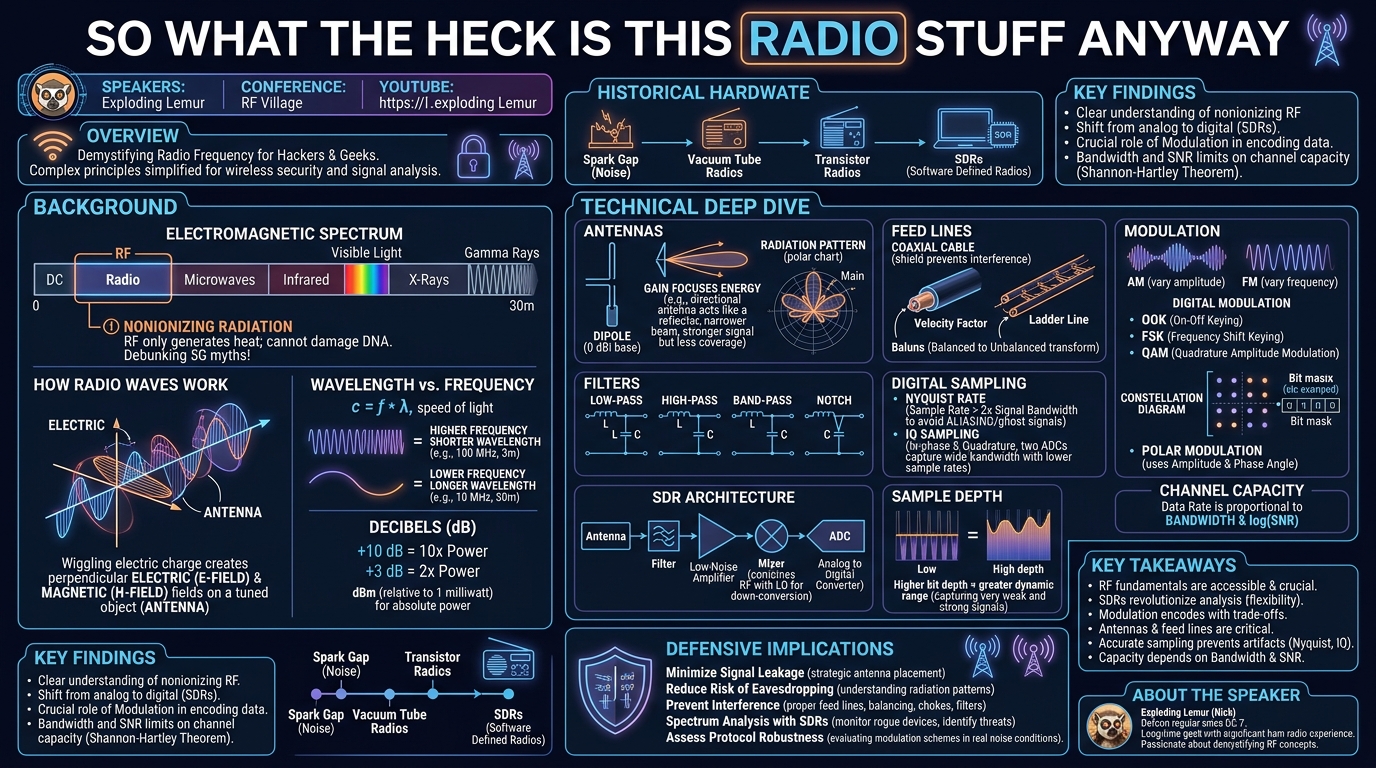
The talk begins by situating radio within the broader electromagnetic spectrum, spanning from DC (zero Hertz) up to visible light and beyond. Exploding Lemur clarifies that radio frequency (RF) radiation is nonionizing radiation, meaning it only generates heat and cannot alter DNA, effectively debunking prevalent myths about technologies like 5G. The spectrum is typically divided into specific bands by regional authorities for various use cases, such as land mobile, public safety, and maritime satellite communications.
The fundamental principle of radio wave generation is likened to wiggling a slinky: oscillating an electric charge on a tuned object, known as an antenna, produces an electromagnetic wave. This wave comprises two perpendicular components: an electric field (E-field) and a magnetic field (H-field). The speaker notes that specialized antennas can be designed to specifically pick up the H-field, which can be advantageous in noisy low-frequency environments like HF listening stations, as magnetic noise tends to be more localized.
Key mathematical concepts and units are introduced to quantify RF signals. The speed of light in a vacuum is approximated as 300 million meters per second, a crucial constant for calculating wavelength. The decibel (dB) is presented as a logarithmic unit for measuring relative change, where 10 dB represents a 10x increase, and 3 dB signifies a doubling of power. For absolute power measurements, dBm (decibels relative to 1 milliwatt) is used, with 0 dBm equating to 1 milliwatt. The inverse relationship between wavelength and frequency is highlighted: higher frequencies correspond to shorter wavelengths (e.g., 100 MHz has a 3-meter wavelength, while 10 MHz has a 30-meter wavelength).
A brief historical overview traces the evolution of radio technology, starting with inefficient spark gap transmitters used for Morse code (Continuous Wave, CW) that generated broadband noise. This progressed to crystal radios, which utilized tuned circuits (inductor and capacitor) and germanium diodes (the "crystal") for Amplitude Modulation (AM) reception. The advent of vacuum tubes provided signal rectification (diodes) and amplification (triodes), later superseded by compact transistor radios employing solid-state devices. This historical trajectory culminates in modern Software Defined Radios (SDRs), which digitize the RF spectrum as close to the antenna as possible, offloading complex signal processing to software running on FPGAs or general-purpose computers.
Key Findings
▶ Watch: Fundamental RF math: Speed of light and decibels (4:00)
While not a traditional research talk presenting novel "findings," Exploding Lemur's presentation effectively distills and articulates several fundamental principles and "discoveries" for newcomers to RF. The core "findings" for the audience are the clarified understanding of how radio works from first principles, the critical parameters that define wireless communication, and the architectural underpinnings of modern RF systems.
One key insight is the clear distinction between ionizing and nonionizing radiation, firmly establishing that RF cannot cause DNA damage, thereby dispelling common misinformation surrounding wireless technologies. The talk meticulously explains the inverse relationship between frequency and wavelength, a cornerstone of RF physics, and introduces the logarithmic nature of decibels for power measurement, crucial for understanding signal strength and loss.
The presentation highlights the evolution of radio from rudimentary spark gaps to sophisticated Software Defined Radiios (SDRs), emphasizing the paradigm shift where signal processing moves from analog hardware to digital software. This transition is presented as a "finding" in terms of how modern RF systems are designed and analyzed, enabling unprecedented flexibility and analytical capability for security researchers.
Furthermore, the talk elucidates the critical role of modulation in encoding information onto a carrier wave, detailing various techniques like AM, FM, On-Off Keying (OOK), Frequency Shift Keying (FSK), and advanced methods like Quadrature Amplitude Modulation (QAM) and polar modulation. These explanations reveal how data density is achieved at the expense of channel noise tolerance.
Finally, a significant "finding" for the audience is the introduction of the Shannon-Hartley theorem (implicitly, as "channel capacity theorem"), which quantifies the maximum theoretical data rate of a communication channel. This principle reveals the profound impact of bandwidth (linear effect) and signal-to-noise ratio (SNR) (logarithmic effect) on data throughput, providing a mathematical framework for understanding the limits and potential of wireless communication. The speaker's emphasis on Nyquist rate and IQ sampling also clarifies the challenges and solutions for accurately digitizing wideband RF signals, preventing artifacts like aliasing.
Technical Deep Dive
▶ Watch: Wavelength calculation and frequency relationship (6:00)
The technical deep dive of the talk covers the essential components and processes involved in RF communication, from antenna design to digital signal processing.
Antennas
Antennas are introduced as crucial transducers that convert electrical signals into electromagnetic waves and vice-versa. A basic dipole antenna is described as having two elements, resonating at specific frequencies and bandwidths. Antenna gain, measured in dBi (decibels isotropic), quantifies an antenna's ability to focus RF energy. A hypothetical isotropic antenna, radiating perfectly in all directions, serves as the 0 dBi reference. A standard dipole typically exhibits 3 dBi gain, producing a donut-shaped radiation pattern. Increasing gain concentrates the signal into a narrower beam, enhancing signal strength in a specific direction but reducing coverage elsewhere, analogous to a light bulb with a reflector. The radiation pattern of directional antennas is illustrated with polar charts, showing the main lobe (strongest signal) and undesirable side lobes or back-lobe leakage. Various antenna types are mentioned, including dish antennas (with reflector and feed), log-periodic antennas (wideband, slightly directional), cell phone sector antennas, and biquad antennas.
Feed Lines
To connect the antenna to the radio, feed lines are necessary. The most common type is coaxial cable, consisting of an outer jacket, a shield, a dielectric insulator, and a center conductor. The signal travels along the center conductor, while the shield prevents external interference and provides the return path. Twin lead and ladder line are also mentioned. An important concept is velocity factor, which describes the speed of light through the cable material, often 66% to 80% of the speed of light in a vacuum, a critical consideration when cable length is wavelength-dependent. The talk touches on balanced vs. unbalanced signals. Coaxial cable handles unbalanced signals, where the signal and ground return paths are distinct. Mismatched impedance in unbalanced lines can lead to common mode current on the shield, causing unwanted RF radiation. Baluns (balanced-to-unbalanced transformers) are used to convert between these signal types.
Filters
Filters are essential for isolating desired frequency ranges. Common types include:
- Low-pass filters: Block frequencies above a certain cutoff.
- High-pass filters: Block frequencies below a certain cutoff.
- Band-pass filters: Allow only a specific range of frequencies to pass.
- Notch filters: Cut out a narrow band of frequencies.
These can be constructed using LC filters (inductors and capacitors), where capacitors block low frequencies and pass high, and inductors do the opposite. Other types include crystal filters (using resonant quartz crystals), SAW (Surface Acoustic Wave) filters (converting RF to acoustic waves on a resonant device), and cavity filters (resonant metal cans). The speaker humorously expresses disdain for distributed element filters, which use traces, stubs, and slots on circuit boards to achieve filtering effects through "evil magic."
Software Defined Radio (SDR) Architecture
The core architecture of an SDR is presented as an antenna connected to an Analog-to-Digital Converter (ADC), followed by digital signal processing. To optimize this, several components are added:
- Filter: An initial filter (e.g., low-pass for direct sampling HF SDRs) rejects out-of-band signals to prevent aliasing.
- Low-Noise Amplifier (LNA): Positioned after the filter, the LNA boosts the signal strength without introducing significant additional noise, crucial for detecting weak signals.
- Mixer and Local Oscillator (LO): For signals outside the ADC's direct sampling range, a mixer combines the incoming RF signal with a fixed-frequency signal from a Local Oscillator (LO). The mixer outputs the original signals, the LO signal, and critically, the sum and difference frequencies. This allows down-conversion of high-frequency signals (e.g., 600 MHz) to a lower intermediate frequency (e.g., 20 MHz) that falls within the ADC's bandwidth (e.g., 30 MHz). This process is fundamental to tuning an SDR.
Digital Sampling
The conversion from analog to digital is governed by key principles:
- Nyquist Rate: To accurately capture a signal, the sampling rate of the ADC must be at least twice the highest frequency present in the signal's bandwidth. Failing to meet this Nyquist criterion results in aliasing, where a higher frequency signal is incorrectly reconstructed as a lower frequency "ghost signal" that isn't actually present.
- IQ Sampling (In-phase and Quadrature Sampling): To capture wide bandwidths efficiently, two ADCs can be used, operating 90 degrees out of phase. This technique, found in devices like RTLSDR dongles, allows a wider signal bandwidth to be captured at a lower effective sample rate than a single ADC would require. For example, two ADCs sampling at 2.2 Msps can capture 2.2 MHz of signal, whereas a single ADC would need to sample at 4.4 Msps. IQ data, represented as real (in-phase) and imaginary (quadrature) components, allows for full signal reconstruction in software.
- Sample Depth (Bit Depth): The number of bits used to represent each sample (e.g., 16-bit, 24-bit). Higher bit depth provides greater dynamic range, allowing the capture of both strong and very weak signals simultaneously without losing detail, much like distinguishing a whisper from a cannon blast in audio recording.
Modulation
Modulation is the process of encoding data onto a carrier signal.
- Amplitude Modulation (AM): The strength (power) of the carrier signal is varied according to the input signal (e.g., voice loudness).
- Frequency Modulation (FM): The frequency of the carrier signal is shifted up or down, with the amount of shift related to the input signal's loudness and the rate of shift related to its frequency.
- On-Off Keying (OOK): The simplest digital modulation, where the signal is either present (on) or absent (off), common in key fobs.
- Frequency Shift Keying (FSK): Different frequencies represent different binary values (e.g., one frequency for '1', another for '0').
- Quadrature Amplitude Modulation (QAM): A more advanced digital modulation technique where the in-phase (I) and quadrature (Q) components are plotted as X and Y coordinates on a constellation diagram. Each point on the diagram represents a unique bit mask (e.g., 16-QAM has 16 points), allowing more bits to be packed into each symbol. QAM requires a much cleaner, less noisy channel.
- Polar Modulation: Encodes data using amplitude (radius) and phase angle (theta) instead of X-Y coordinates, offering similar data packing capabilities.
Channel Capacity
The talk concludes this section with the "channel capacity theorem," which states that the maximum theoretical data capacity of a channel is proportional to its bandwidth and the logarithm of its signal-to-noise ratio (SNR). Using examples, Exploding Lemur demonstrates that doubling bandwidth linearly doubles capacity, while improvements in SNR have a logarithmic, but still significant, impact. For instance, a 20 MHz bandwidth with a 70 dB SNR (signal at -20 dBm, noise floor at -90 dBm) yields a theoretical capacity of 86 Mbps, which can increase to 112 Mbps with a 50 dB SNR improvement (signal at -60 dBm, noise at -110 dBm) and further to 225 Mbps by doubling the bandwidth to 40 MHz. The concept of MIMO (Multiple Input Multiple Output) for further capacity increase is also briefly mentioned.
Demo / Proof of Concept
▶ Watch: Evolution of radio: From spark gap to SDR (7:40)
This foundational talk did not feature a live demonstration or proof-of-concept exploit. Instead, its purpose was to build a strong theoretical understanding of radio frequency principles, components, and signal processing techniques. The speaker focused on explaining how RF systems work at a fundamental level, providing the necessary groundwork for attendees to understand and potentially build their own demos or proofs of concept in the future.
Defensive Implications
▶ Watch: Antenna function: Receiving signals and tuning (10:00)
Understanding the fundamental principles of RF, as outlined in Exploding Lemur's talk, has profound defensive implications for cybersecurity professionals. Wireless systems are ubiquitous, and their security often hinges on the underlying RF characteristics.
Firstly, the talk clarifies that RF radiation is nonionizing, directly countering misinformation that can distract from actual security concerns. Defenders can use this knowledge to educate and reassure stakeholders, focusing resources on verifiable threats rather than unfounded fears about biological effects.
A deep understanding of antennas and their radiation patterns is critical. Knowing how antenna gain focuses signals means defenders can strategically place wireless access points or monitoring equipment to minimize signal leakage outside a secure perimeter, reducing the risk of eavesdropping or unauthorized access. Conversely, understanding side lobes reveals potential vectors for signal interception even with highly directional antennas.
The discussion on feed lines and common mode current highlights potential vulnerabilities. Unwanted RF radiation from poorly configured or damaged feed lines can inadvertently broadcast sensitive information or create interference that could be exploited for denial-of-service attacks. Defenders should ensure proper cabling, impedance matching, and the use of chokes where necessary to mitigate these issues.
Filters are essential defensive tools. Implementing appropriate low-pass, high-pass, band-pass, or notch filters can protect sensitive receivers from strong out-of-band interference or jamming attempts, ensuring the integrity and availability of wireless communications. Understanding filter types (LC, crystal, SAW, cavity, distributed element) allows for informed selection and implementation in secure designs.
The detailed explanation of Software Defined Radios (SDRs) empowers defenders to become active participants in the RF spectrum. SDRs enable spectrum analysis, allowing security teams to monitor for unauthorized transmissions, rogue devices, or anomalous signal activity within their operational environment. By understanding Nyquist rates, aliasing, and IQ sampling, defenders can correctly configure SDRs for accurate signal capture and analysis, avoiding misinterpretation of ghost signals or missed threats. This capability is vital for identifying and responding to wireless intrusions, unauthorized data exfiltration, or even sophisticated jamming attacks.
Finally, the overview of modulation techniques and the Shannon-Hartley theorem provides a framework for evaluating the robustness of wireless protocols. Defenders can assess whether a chosen modulation scheme is appropriate for the expected signal-to-noise ratio and bandwidth of an environment, anticipating potential vulnerabilities to noise, interference, or low-power attacks. For instance, knowing that QAM requires a "much quieter channel" indicates its potential susceptibility in noisy environments compared to simpler schemes like FSK, guiding choices in secure wireless deployments.
In essence, Exploding Lemur's talk equips defenders with the foundational knowledge to understand the RF attack surface, implement effective countermeasures, and proactively monitor the wireless environment for threats.
Key Takeaways
- RF Fundamentals are Accessible and Crucial: Radio frequency communication, while seemingly complex, is built upon understandable physical principles (electromagnetic waves, frequency, wavelength) that are vital for anyone in cybersecurity to grasp.
- SDRs Revolutionize RF Analysis: Software Defined Radios (SDRs) have transformed RF by digitizing signals close to the antenna, allowing flexible and powerful signal processing, analysis, and experimentation using software.
- Modulation Encodes Data with Trade-offs: Various modulation techniques (AM, FM, OOK, FSK, QAM) encode information onto carrier waves, each offering different trade-offs between data density, bandwidth efficiency, and tolerance to channel noise.
- Antennas and Feed Lines are Critical Components: Antenna characteristics like gain and radiation pattern, along with feed line properties like velocity factor and balance, significantly impact signal transmission, reception, and potential for interception or interference.
- Accurate Digital Sampling Prevents Artifacts: Proper digital sampling, adhering to the Nyquist rate and often employing IQ sampling, is essential to accurately capture and reconstruct RF signals, preventing misleading artifacts like aliasing.
- Channel Capacity is Governed by Bandwidth and SNR: The theoretical maximum data rate of a wireless channel is linearly dependent on its bandwidth and logarithmically dependent on its signal-to-noise ratio (SNR), providing a mathematical basis for understanding wireless performance limitations.
About the Speaker(s)
The speaker, known as Exploding Lemur (Nick), is a seasoned participant in the hacker community, having attended Defcon since Defcon 7. He identifies as a long-time "geek" with a passion for computers and a significant background in ham radio. His experience as a ham radio operator, which he's been involved with for "mumble mumble years cuz I'm old," provides him with a deep, practical understanding of RF principles. Exploding Lemur's talk reflects his commitment to demystifying complex technical subjects and making them accessible to a broader audience, particularly those new to the intricacies of radio frequency communication.
Reviews
Dr. Zero (Offensive Security Researcher) — SOLID
A competent, well-structured RF 101 primer that does exactly what it sets out to do: give the RF-curious hacker a working mental model of the stack from EM physics through SDR architecture and modulation. No novel research, no demos, no edge — but the RF Village floor is exactly the right venue for this kind of foundational content, and it's executed with genuine depth for the lane it's in.
Heather Calloway (CISO) — PASS
A competent RF primer for newcomers to wireless hacking — well-delivered and accessible — but firmly outside my lane. No governance angle, no institutional accountability, no defender decision path at the organizational level. This is scope, not a criticism.