Secure Authorization Of ECU Privileges In Automobiles
Paul Chopineau
S4x24 - ICS Security Conference · Day 1 · Stage 2
Overview
In his S4x24 talk, "Secure Authorization Of ECU Privileges In Automobiles," Paul Chopineau delves into the critical, yet often overlooked, challenge of managing privilege escalation within the complex ecosystem of modern vehicles. Drawing a compelling parallel between automobiles and Industrial Control Systems (ICS), Chopineau argues that securing access to Electronic Control Units (ECUs) is fundamental to vehicle safety and cyber resilience. The talk highlights how the automotive industry, in its rapid evolution towards software-defined vehicles, is encountering security challenges akin to those faced by traditional Operational Technology (OT) environments, but often at an accelerated pace and scale. The core message is that without robust, scalable authorization mechanisms, vehicles remain vulnerable to unauthorized reconfiguration, leading to potential safety hazards, theft, and operational disruptions.
Key moments
- 0:00 Introduction to ECU security and automotive threats
- 3:00 Real-world car hacks: Toyota RAV4 and Pwn2Own
- 4:30 Talk agenda and the importance of standardization
- 5:00 Regulatory cybersecurity requirements and automotive industry shift
- 6:00 Practical use cases for securing ECU privileges
- 8:00 Why cryptography is essential for scalable authentication
Secure Authorization Of ECU Privileges In Automobiles
Speakers: Paul Chopineau
Conference: S4
YouTube: https://www.youtube.com/watch?v=J5aeAYxcc24
Overview
In his S4x24 talk, "Secure Authorization Of ECU Privileges In Automobiles," Paul Chopineau delves into the critical, yet often overlooked, challenge of managing privilege escalation within the complex ecosystem of modern vehicles. Drawing a compelling parallel between automobiles and Industrial Control Systems (ICS), Chopineau argues that securing access to Electronic Control Units (ECUs) is fundamental to vehicle safety and cyber resilience. The talk highlights how the automotive industry, in its rapid evolution towards software-defined vehicles, is encountering security challenges akin to those faced by traditional Operational Technology (OT) environments, but often at an accelerated pace and scale. The core message is that without robust, scalable authorization mechanisms, vehicles remain vulnerable to unauthorized reconfiguration, leading to potential safety hazards, theft, and operational disruptions.
Chopineau’s presentation is particularly relevant given the increasing connectivity and software complexity of contemporary cars. As vehicles transform into "plants on wheels," the ability to control and reconfigure their numerous ECUs becomes a prime target for malicious actors, from organized crime syndicates to sophisticated nation-state groups. The talk emphasizes that traditional security approaches, such as relying on passwords, are wholly inadequate for the unique constraints and vast scale of the automotive sector. Instead, Chopineau advocates for a standardized, cryptographic solution that not only addresses current vulnerabilities but also prepares the industry for future challenges, benefiting the broader ICS community facing similar issues.
Background
▶ Watch: Introduction to ECU security and automotive threats (0:00)
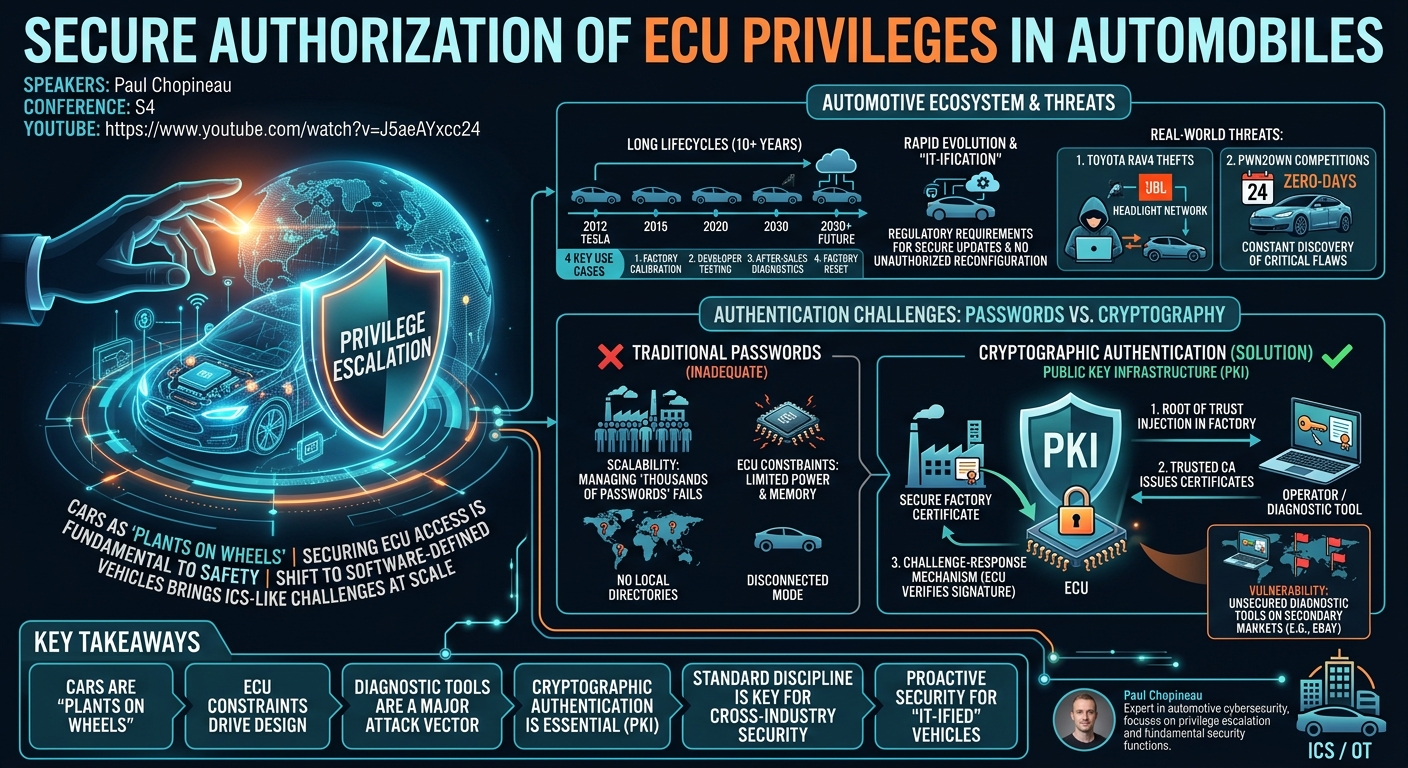
Modern automobiles are intricate networks of interconnected systems, far removed from the purely mechanical machines of the past. At their heart are Electronic Control Units (ECUs), specialized embedded systems responsible for managing nearly every function of a car. A typical vehicle can contain roughly 100 ECUs, each historically dedicated to a precise function—from engine injection and brake mastering to steering and infotainment. Over the years, these units have grown significantly in power and complexity, with the in-vehicle infotainment (IVI) system often serving as a central hub capable of reconfiguring a vast array of vehicle parameters, such as switching between "sports mode" and "eco mode."
Chopineau aptly characterizes a car as a "plant on wheels that moves," highlighting the long development cycles and operational lifespans that mirror those of industrial plants. For instance, the Tesla Model S, which began development in 2007, saw its first phase rollout in 2012, with subsequent phases in 2016 and three years prior to the talk (around 2021). Vehicles purchased today are expected to operate well beyond 2030, meaning an architecture designed nearly two decades ago must remain secure for years to come. This extended lifecycle, combined with rapid technological advancements and increasing connectivity, presents unique cybersecurity challenges.
The threats to vehicle security are no longer theoretical; they are tangible and growing. Chopineau cites two compelling examples:
- Toyota RAV4 Thefts: Organized criminal groups have exploited vulnerabilities in Toyota RAV4 models, where hackers found a way to reconfigure a JBL speaker to inject malicious code into the car's network. By unmounting a headlight and plugging into the network, attackers could unlock and steal the vehicle.
- Pwn2Own Competitions: Prestigious hacking competitions like Pwn2Own regularly expose significant vulnerabilities. The 2023 edition (and subsequent 2024 event) saw participants uncover 24 zero-days on Teslas alone, underscoring the constant discovery of critical flaws even in leading-edge vehicles.
These real-world incidents, coupled with the increasing "IT-ification" of cars—where software bugs are expected and require patching in production—have led regulators to impose strong cybersecurity requirements. These regulations mandate that unauthorized individuals must not be able to reconfigure a car and that secure, reliable update mechanisms are in place to prevent hardware from being "bricked." The accelerating development cycles, particularly driven by competition from Chinese manufacturers and the electric vehicle market, further push the automotive industry into a realm where IT-like development and patching practices are becoming the norm.
Chopineau outlines four critical use cases within the automotive lifecycle that necessitate secure privilege management:
- Factory Calibration: During manufacturing, specific vehicle parameters (e.g., brake configuration based on the car's exact weight) need to be calibrated to the individual vehicle as it rolls off the assembly line.
- Developer Testing: Engineers require the ability to switch parts into and out of "dev mode" for testing and validation before production release.
- After-Sales Diagnostics: Service technicians need to access extensive logs and reconfigure ECUs to diagnose and fix malfunctions in customer vehicles. This is highlighted as one of the most challenging use cases due to its distributed nature.
- Factory Reset: The ability to perform a full factory reset on malfunctioning hardware is increasingly required by regulators.
These scenarios all demand a mechanism to authenticate users against ECUs securely and at scale, a challenge that traditional password-based methods cannot meet.
Key Findings
▶ Watch: Talk agenda and the importance of standardization (4:30)
The central premise of Paul Chopineau's talk is the urgent need for a robust, scalable, and secure method to authorize human users for privilege escalation on vehicle ECUs, moving decisively beyond the antiquated concept of passwords. The talk highlights that the automotive industry, much like the Industrial Control Systems (ICS) sector, faces a critical gap in its security architecture regarding human authentication and authorization for low-level hardware access.
Chopineau's key findings revolve around four core challenges that traditional security mechanisms fail to address in the automotive context:
- Scalability: Car manufacturers produce millions of vehicles annually, each containing roughly 100 ECUs. A solution must scale to an entire fleet, meaning managing "thousands of passwords on the field" is an unworkable proposition. The authentication system must seamlessly integrate across a vast global network of factories, dealerships, and service centers.
- ECU Constraints: Unlike general-purpose computers, ECUs possess extremely limited software and power capabilities. They cannot perform complex cryptographic computations or retain a large number of secrets. Any authentication mechanism must be lightweight and efficient, adapted to these resource-constrained environments.
- Absence of Local Directories: It's impractical to maintain local directories of authorized users on each individual car or even at every dealership worldwide. A centralized, yet distributed, authentication system is required that doesn't rely on local, per-device user management.
- Disconnected Mode Operation: Vehicles often operate in environments without network connectivity. An authorization system must function reliably even when the car is offline, such as in remote areas or if its connectivity systems are malfunctioning.
To overcome these formidable challenges, Chopineau posits that cryptography is the "most obvious choice" and the only viable foundation for authenticating human beings against vehicle ECUs. The talk identifies cryptographic authentication based on a Public Key Infrastructure (PKI) as the suitable role model. This approach leverages the inherent strengths of PKI for secure identity management and access control, offering a scalable and robust alternative to passwords.
Furthermore, a significant finding is the observation that the automotive industry, in its rapid "IT-ification," is currently "a bit ahead" of the ICS industry in confronting these specific challenges related to connecting systems to clouds, managing numerous access points, and handling distributed user authentication. This positions the automotive sector as a potential blueprint for ICS, emphasizing the shared need for standardization to make cybersecurity easier, more effective, and less costly across both domains. The common ground lies in the fundamental requirement to secure privilege escalation on critical embedded systems.
Technical Deep Dive
▶ Watch: Regulatory cybersecurity requirements and automotive industry shift (5:00)
The proposed solution for secure authorization of ECU privileges centers on a Public Key Infrastructure (PKI), a well-established cryptographic framework. Chopineau outlines a straightforward, yet robust, mechanism for authentication:
- Root of Trust Injection: The foundational step involves injecting a root of trust onto each ECU during the manufacturing process in the factory. This typically involves embedding a unique cryptographic key pair or a trusted certificate onto the hardware. This ensures that each ECU can verify the authenticity of incoming requests.
- Trusted Certification Authority (CA): A central, highly secure Certification Authority (CA) is established within the car manufacturer's IT system, deep behind firewalls. This CA is responsible for issuing and managing digital certificates for authorized operators and diagnostic tools.
- Challenge-Response Mechanism:
- When an operator (e.g., a service technician) attempts to access an ECU, the ECU generates a unique challenge (a random data string).
- The operator, using a diagnostic tool (often a laptop with specialized software, referred to as a "diagnostic suitcase"), signs this challenge with their unique private key. This private key is securely stored on the operator's diagnostic tool and is associated with their identity.
- The operator's diagnostic tool then sends the signed challenge along with their public key to the ECU.
- The ECU, using the pre-injected root of trust, verifies the operator's public key against the trusted CA's certificates. If the public key is valid and belongs to a trusted entity, the ECU then uses that public key to verify the signature of the challenge.
- If both the public key and the signature are verified, the operator is authenticated and granted the appropriate privileges.
This cryptographic approach directly addresses the limitations of ECUs: they don't need to store thousands of passwords, only a trusted root certificate. The heavy computational lifting of key generation and certificate management is handled by the centralized PKI and the operator's more powerful diagnostic tool, leaving the ECU with simpler verification tasks.
However, Chopineau identifies a critical vulnerability in the current implementation of this ecosystem: the exposure of the PKI to the wider dealership network. While the PKI itself should remain isolated within the manufacturer's secure IT environment, the process of issuing certificates to diagnostic tools and managing their lifecycle across a global network of resellers presents significant challenges.
The existing "diagnostic suitcase" model, which is a standard laptop equipped with specific cables and software, represents a major weak point. These tools, designed for legitimate diagnostic and reconfiguration tasks, are often not adequately secured. Chopineau points out that these diagnostic suitcases, containing the necessary software and potentially certificates or access tokens, can be found "on eBay" from "all the major car manufacturers." This means that unauthorized individuals can acquire legitimate tools, potentially bypassing intended security controls and gaining the ability to reconfigure vehicles. The problem isn't just the physical tool; it's the lack of a robust, real-time identity and access management system that ties the diagnostic tool to a specific, authorized human operator and revokes access if the tool is compromised or stolen.
The parallel drawn with the ICS industry is crucial here. As factories become more connected, and more personnel require access to production systems, the same challenges of distributed authentication, resource-constrained devices, and the need for standardized, scalable cryptographic solutions become apparent. The automotive industry's push towards securing ECU access, driven by rapid development cycles and regulatory pressure, offers valuable lessons for ICS in implementing robust PKI-based authorization systems.
Demo / Proof of Concept
▶ Watch: Practical use cases for securing ECU privileges (6:00)
The talk provided a detailed conceptual framework and highlighted real-world vulnerabilities and proposed solutions for securing ECU privileges. While Paul Chopineau effectively used diagrams and examples to illustrate the current state and the envisioned cryptographic authentication process, an explicit live demonstration or a technical proof-of-concept of the proposed PKI solution was not presented during the talk. The presentation focused on the architectural and systemic challenges and the high-level technical approach to overcome them.
Defensive Implications
▶ Watch: Why cryptography is essential for scalable authentication (8:00)
The insights presented by Paul Chopineau carry significant defensive implications for both the automotive and Industrial Control Systems (ICS) sectors. The core message is clear: robust, scalable, and standardized cryptographic authorization is no longer optional but a critical necessity for securing embedded systems against unauthorized access and manipulation.
Defenders in the automotive industry should prioritize the following actions:
- Implement a Robust PKI for ECU Authorization: Transition away from any existing password-based or insecure token-based authentication methods for ECU access. Establish a comprehensive Public Key Infrastructure (PKI) where each ECU is provisioned with a trusted root of trust during manufacturing. All human operators (e.g., factory personnel, developers, service technicians) and their diagnostic tools must be issued cryptographic certificates by a securely managed Certification Authority (CA). This ensures that only cryptographically verified entities can initiate privilege escalation requests.
- Secure the Supply Chain and Factory Key Injection: The initial injection of the root of trust into ECUs in the factory is a critical security step. Manufacturers must implement stringent security controls around this process to prevent the compromise of master keys or the injection of unauthorized roots of trust. This includes physical security, logical access controls, and auditing of key management systems within the production environment.
- Strengthen Diagnostic Tool Security and Lifecycle Management: The "diagnostic suitcase" represents a significant attack vector. Manufacturers must:
- Tie certificates to specific individuals: Ensure that diagnostic tools are not merely "branded" but are cryptographically bound to an authorized individual and their specific role.
- Implement strong hardware security: Consider hardware security modules (HSMs) or secure elements within diagnostic tools to protect private keys.
- Enforce strict lifecycle management: Implement robust processes for issuing, renewing, and, critically, revoking certificates associated with diagnostic tools. If a tool is lost, stolen, or an employee leaves, its associated certificates must be immediately revoked across the entire fleet, if possible.
- Integrate with centralized identity management: Connect diagnostic tool authentication to a centralized identity and access management (IAM) system that can provide real-time authorization based on user roles and current security policies, even in disconnected modes.
- Embrace Standardization for Interoperability and Security: The call for standardization is a key defensive strategy. By working towards common protocols and architectures for secure privilege management across different manufacturers and even industries (automotive, rail, ICS), the collective security posture can be significantly improved. Standardization reduces complexity, fosters shared security best practices, and makes it easier to implement and audit secure systems.
- Adapt to "IT-ification" with OT-Specific Needs: Vehicles are increasingly becoming software-defined, operating under "IT-like" development cycles where bugs are expected. Defenders must adopt agile security practices, including continuous vulnerability management, secure software development lifecycles (SSDLC), and over-the-air (OTA) update capabilities. However, these must be implemented with an understanding of OT-specific constraints, such as real-time safety requirements, limited ECU resources, and the need for robust update mechanisms that prevent bricking critical hardware.
- Continuous Monitoring and Threat Intelligence: Implement robust logging and monitoring capabilities within the vehicle's network and backend systems to detect anomalous activity related to ECU access and configuration. Leverage threat intelligence from industry groups and security researchers (like those at Pwn2Own) to anticipate and defend against emerging attack vectors.
By adopting these defensive measures, organizations can significantly enhance the security posture of their vehicles and industrial systems, mitigating the risks associated with unauthorized privilege escalation and ensuring the safety and integrity of their operations.
Key Takeaways
- Cryptographic Authentication is Essential: Password-based security is fundamentally inadequate for securing ECU privileges in modern vehicles due to scalability, resource constraints, and disconnected operation challenges. Public Key Infrastructure (PKI) is the recommended, scalable solution.
- Cars are "Plants on Wheels": The automotive industry faces security challenges akin to Industrial Control Systems (ICS), characterized by long operational lifecycles, numerous embedded devices (ECUs), and the critical need to secure privilege escalation against real-world threats like theft and zero-day exploits (e.g., Toyota RAV4, Pwn2Own on Teslas).
- ECU Constraints Drive Design: Vehicle ECUs have limited software and power capabilities, necessitating lightweight cryptographic authentication methods that offload complex computations to more powerful diagnostic tools and centralized PKI.
- Diagnostic Tools are a Major Attack Vector: Current "diagnostic suitcases" are vulnerable to unauthorized acquisition (e.g., sales on eBay), highlighting the need for stronger security, lifecycle management, and individual binding of cryptographic identities to these tools.
- Standardization is Key for Cross-Industry Security: The challenges of securing embedded system access are common across automotive, rail, and ICS sectors. Standardization of cryptographic authorization mechanisms can make cybersecurity easier, more effective, and less costly for all.
- Proactive Security for "IT-ified" Vehicles: As cars become more software-defined and connected, manufacturers must embrace agile security development, robust update mechanisms (preventing bricking), and continuous vulnerability management, while still accounting for OT-specific safety requirements.
About the Speaker(s)
Paul Chopineau is an expert in automotive cybersecurity, focusing on fundamental security functions like mastering privilege escalation in critical embedded systems. His work specifically addresses the unique challenges of securing Electronic Control Units (ECUs) within vehicles. Through his presentations, he draws crucial parallels between the evolving cybersecurity landscape of the automotive industry and the Industrial Control Systems (ICS) sector, advocating for increased standardization and the adoption of robust cryptographic solutions to enhance security and operational integrity across both domains. His insights are grounded in several years of experience working within the automotive industry.
Reviews
Dr. Zero (Offensive Security Researcher) — STRONG ACCEPT
Chopineau delivers a solid, no-nonsense technical deep dive into the critical, often overlooked, problem of secure privilege authorization for automotive ECUs. He correctly identifies the fatal flaws of traditional password-based approaches in a resource-constrained, distributed environment and champions a PKI-based cryptographic solution. While the underlying technology isn't groundbreaking, the application to the complex automotive ecosystem, the clear articulation of real-world vulnerabilities like compromised diagnostic tools, and the relevant parallels drawn to ICS make this a highly impactful and actionable session. It's the kind of real talk the industry needs, cutting through the…
Heather Calloway (CISO) — STRONG ACCEPT
Paul Chopineau’s talk on securing ECU privileges in automobiles is a highly relevant and actionable discussion for any CISO or security leader navigating the complexities of connected operational technology. He clearly articulates the critical business and safety risks posed by inadequate authorization mechanisms in modern vehicles, drawing compelling parallels to Industrial Control Systems. The presentation effectively translates deep technical challenges—like ECU constraints and disconnected operations—into a strategic imperative for adopting robust PKI-based authentication, while also exposing a significant governance failure in the current state of diagnostic tool security.