Eye of Sauron: Long-Range Hidden Spy Camera Detection and Positioning with Inbuilt Memory EM Radiation
Qibo Zhang, Daibo Liu, Xinyu Zhang, Zhichao Cao, Fanzi Zeng
33rd USENIX Security Symposium · Day 1 · USENIX Security '24 · USENIX Security '24
Overview
The proliferation of miniature, easily concealed spy cameras has become a significant threat to personal privacy, transforming everyday locations like hotels, Airbnbs, and even private homes into potential surveillance zones. Traditional detection methods often fall short, struggling with issues like limited range, high false positives, or inability to locate devices that store data locally rather than transmitting wirelessly. The "Eye of Sauron" system, presented by Qibo Zhang and his team at USENIX Security '24, introduces a groundbreaking approach to address these challenges.
Key moments
- 0:00 Introduction to the problem of hidden spy cameras
- 2:00 Shortcomings of existing spy camera detection methods
- 4:00 The critical need for long-range camera localization
- 4:50 Core innovation: Detecting cameras via memory EMR emissions
- 7:30 Overview of the Eye of Sauron detection framework
- 8:50 Key technical challenges in distinguishing and positioning cameras
Eye of Sauron: Long-Range Hidden Spy Camera Detection and Positioning with Inbuilt Memory EM Radiation
Speakers: Qibo Zhang; Daibo Liu; Xinyu Zhang; Zhichao Cao; Fanzi Zeng
Conference: USENIX Security '24
YouTube: https://www.youtube.com/watch?v=aBt1LLqIf2Q
Overview
The proliferation of miniature, easily concealed spy cameras has become a significant threat to personal privacy, transforming everyday locations like hotels, Airbnbs, and even private homes into potential surveillance zones. Traditional detection methods often fall short, struggling with issues like limited range, high false positives, or inability to locate devices that store data locally rather than transmitting wirelessly. The "Eye of Sauron" system, presented by Qibo Zhang and his team at USENIX Security '24, introduces a groundbreaking approach to address these challenges.
This research leverages a fundamental physical phenomenon: the electromagnetic radiation (EMR) emitted by a camera's memory as it processes and stores video data. By precisely detecting and analyzing these unique EMR signatures, the system can identify, distinguish, and accurately localize hidden cameras over long distances, regardless of whether they are wired, wireless, or simply storing footage internally. The project represents a crucial advancement in counter-surveillance technology, offering a robust defense against increasingly sophisticated privacy invasions.
The talk highlights the critical need for advanced detection capabilities, moving beyond the limitations of current solutions. By focusing on the intrinsic electromagnetic emissions of a camera's internal memory, the "Eye of Sauron" provides a universal and difficult-to-evade signature, offering a powerful tool for individuals and organizations to reclaim their privacy in an increasingly monitored world.
Background
▶ Watch: Introduction to the problem of hidden spy cameras (0:00)
The concern surrounding hidden spy cameras has escalated dramatically in recent years. These devices, often disguised as mundane objects like smoke detectors or USB chargers, pose a severe privacy risk in various environments. Existing methods for detecting such cameras largely fall into two categories, each with significant limitations.
One common approach involves detecting lens reflections. Camera lenses, made of glass, reflect light more intensely than other materials. Specialized devices or even smartphone apps can emit light and look for these reflections. However, this method suffers from several drawbacks: it requires a close, sweeping inspection of the entire space, is prone to high false positives from legitimate reflective surfaces like windows, mirrors, or glossy furniture, and cannot differentiate between a camera lens and any other piece of glass. Moreover, it only confirms the presence of a lens, not necessarily an active recording device.
Another strategy focuses on wireless signal monitoring. Many modern spy cameras transmit their data over Wi-Fi or other wireless protocols. By scanning for unusual network traffic or unknown devices on a local network, one might identify hidden cameras. This method, however, is not universally applicable. A significant number of spy cameras are designed to store footage locally on an SD card or internal memory, only transmitting data when the user leaves the premises or at a later time. Such "air-gapped" or locally storing cameras are invisible to wireless detection methods. Furthermore, even for wireless cameras, merely detecting a signal doesn't provide precise localization, leaving the user with the knowledge that a camera exists in the room but not its exact placement.
A critical gap in both existing approaches is the inability to perform long-range detection and accurate localization. Users are typically forced to conduct meticulous, slow, and often fruitless searches. The "Eye of Sauron" project directly addresses these deficiencies by proposing a novel, universal detection mechanism that transcends the limitations of connectivity and visual inspection, offering both long-range capabilities and precise localization in complex environments.
Key Findings
▶ Watch: The critical need for long-range camera localization (4:00)
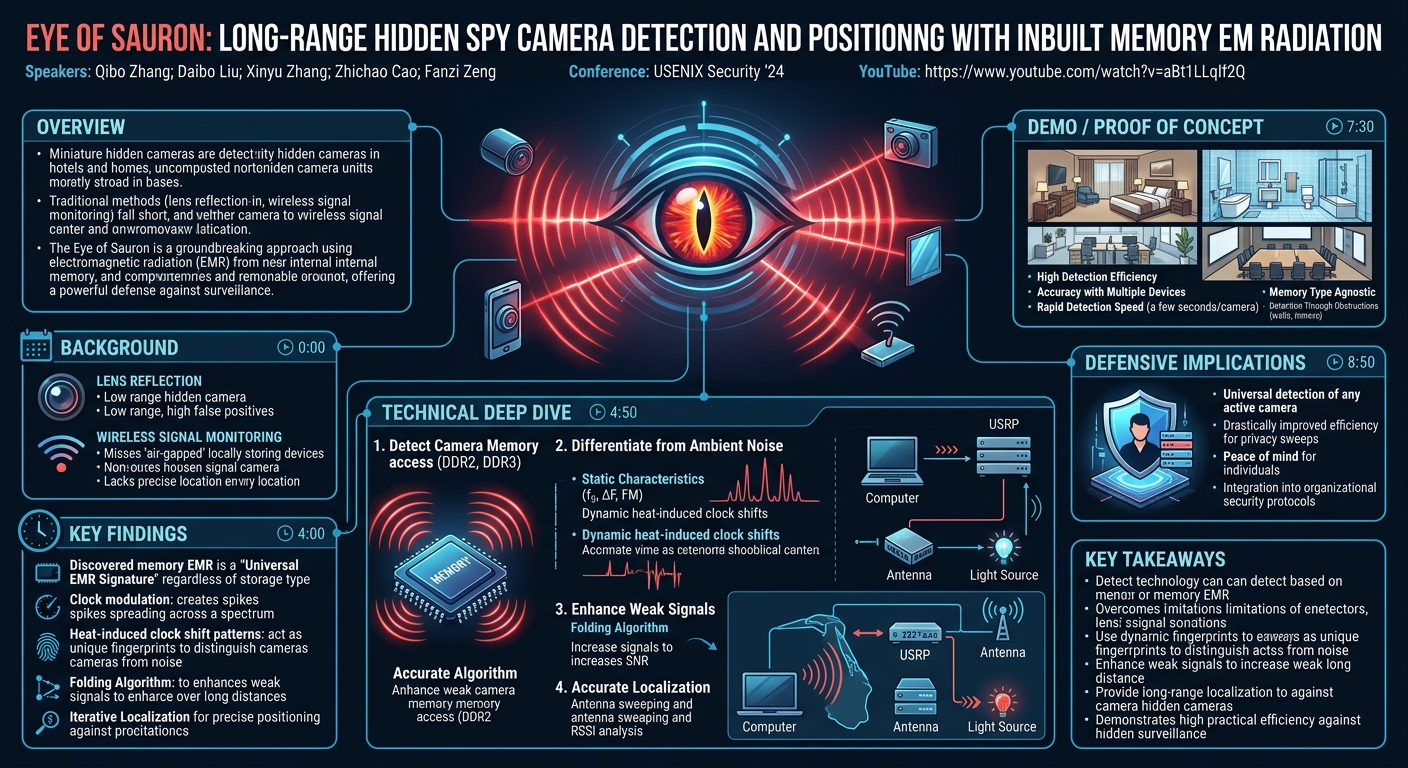
The core innovation of the "Eye of Sauron" system lies in its discovery and exploitation of Electromagnetic Radiation (EMR) emitted by the internal memory of active cameras. The researchers observed that regardless of how a camera transmits or stores its data (wired, wireless, or local storage), its internal memory (e.g., DDR2, DDR3) constantly accesses and processes video streams. This memory access involves transistors rapidly changing the electrical states of capacitors, which in turn generates characteristic EMR.
Key findings include:
- Universal EMR Signature: This EMR emission is a fundamental byproduct of memory operation, making it a universal signature for any active camera, circumventing the limitations of lens reflection or wireless signal detection.
- Clock Modulation for EMR Spectrum: Contrary to a simple sine wave, the EMR from camera memory appears as "spikes spreading across a spectrum." This is due to clock modulation strategies employed by manufacturers to prevent strong, concentrated emissions at a single frequency, which would violate regulatory standards.
- Dynamic EMR Changes: The EMR patterns are dynamic; any change in the visual scene captured by the camera necessitates memory access and processing, leading to detectable changes in the emitted EMR. This allows for active detection by stimulating the environment (e.g., turning on a light).
- Distinguishing Characteristics for Identification: The EMR exhibits both static characteristics (like fundamental frequency f0, frequency deviation Delta F, and modulation frequency FM) and dynamic characteristics. Crucially, the heat generated by memory access causes slight, unique shifts in the clock frequency over time. These heat-induced clock shift patterns act as distinct fingerprints, allowing the system to differentiate between multiple cameras, even those of the same brand and model, and to distinguish cameras from other noisy devices (e.g., smartphones, laptops) that also emit EMR.
- Folding Algorithm for Signal Enhancement: To overcome the challenge of weak EMR signals over long distances, especially when overwhelmed by ambient noise, the team developed a folding algorithm. This technique leverages the periodic nature of the EMR spikes, effectively averaging out random noise while reinforcing the consistent camera signal, thereby significantly increasing the signal-to-noise ratio and enabling long-range detection.
- Iterative Localization Method: By combining the enhanced EMR signals with antenna sweeping and received signal strength (RSSI) measurements, the system can accurately pinpoint the location of hidden cameras. This iterative process allows users to narrow down the camera's position quickly.
These findings collectively form the foundation of the "Eye of Sauron" system, providing a robust, long-range, and highly accurate method for hidden camera detection and positioning.
Technical Deep Dive
▶ Watch: Core innovation: Detecting cameras via memory EMR emissions (4:50)
The "Eye of Sauron" system's technical elegance lies in its multi-layered approach to detecting, distinguishing, and localizing hidden cameras based on their intrinsic electromagnetic radiation (EMR). The fundamental principle hinges on the operation of a camera's internal memory. When a camera's image sensor captures light, the raw data is digitized and stored in its memory (e.g., DDR2, DDR3). The microcontroller unit (MCU) then accesses this memory to process, encode, and potentially transmit the video stream. This continuous memory access involves billions of transistors rapidly switching states and charging/discharging capacitors. Each such electrical transition generates a tiny burst of electromagnetic energy, which, when aggregated, forms a detectable EMR signature.
A critical observation is that this EMR is not a simple, narrow-band sine wave. Due to regulatory requirements and design choices, camera manufacturers employ clock modulation strategies. Instead of using a single, high-power clock frequency that would create a very strong, concentrated EMR emission (which is often disallowed), they spread the clock energy across a broader spectrum. This results in the EMR appearing as "spikes spreading across a spectrum," making it more challenging to detect with conventional narrow-band receivers but providing a unique spectral fingerprint for analysis.
The system framework addresses three primary technical challenges:
- Distinguishing Camera EMR from Ambient Noise: Modern environments are saturated with EMR from countless electronic devices like smartphones, laptops, and smart home gadgets, all of which have memory and emit EMR. To isolate camera-specific signals, the system leverages two types of characteristics:
- Static Characteristics: These include fundamental frequency (f0), frequency deviation (Delta F), and modulation frequency (FM). These parameters are inherent to the camera's memory controller and clock design, offering an initial layer of differentiation.
- Dynamic Characteristics: More uniquely, memory access generates heat. This heat causes minute, predictable shifts in the camera's internal clock frequency. Even cameras of the same brand and model exhibit distinct, dynamic heat-induced clock shift patterns due to manufacturing variations and environmental micro-differences. These dynamic patterns are highly robust and serve as a reliable fingerprint to distinguish individual cameras from each other and from other EMR-emitting devices. The system continuously monitors these shifts to maintain accurate identification.
- Increasing Signal Strength for Weak, Long-Range EMR: EMR signals attenuate rapidly with distance, making long-range detection challenging. The researchers developed a folding algorithm to overcome this. The EMR spikes from memory access are inherently periodic. While random ambient noise can overwhelm individual spikes, the folding algorithm works by aligning and summing these periodic spikes over time. Random noise, being non-periodic, tends to cancel itself out during this summation, while the consistent, periodic EMR signal from the camera is reinforced. This process significantly increases the signal-to-noise ratio (SNR). Furthermore, to ensure sufficient memory access and strong EMR emission, the system can employ stimulus techniques, such as turning on a light in the room. This change in the environment forces the camera to actively process new visual data, thus increasing memory activity and strengthening the EMR signal.
- Accurate Positioning with Weak Signals: Once the EMR signal is enhanced, the system employs an iterative localization algorithm. The user holds an antenna and sweeps it in various directions (left-to-right, top-to-down, back-and-forth). The system measures the received signal strength (RSSI) of the folded EMR signal. By analyzing the directional changes in RSSI, the system can infer the general direction of the camera. The user then moves towards this inferred direction, repeating the sweeping and RSSI measurement process. This iterative refinement allows for progressively more accurate pinpointing of the camera's exact location, even from a relatively long initial distance. The algorithm effectively guides the user to the source of the EMR.
The prototype system consists of a computer for signal processing and running the detection algorithms, a USRP (Universal Software Radio Peripheral) for acquiring raw RF signals across a wide frequency spectrum, a directional antenna for EMR reception, and a simple light source for stimulus. This setup allows for the real-time capture, processing, and analysis of EMR to implement the "Eye of Sauron" methodology.
Demo / Proof of Concept
▶ Watch: Overview of the Eye of Sauron detection framework (7:30)
The "Eye of Sauron" system was rigorously evaluated through extensive experiments, demonstrating its practical efficacy in diverse and challenging scenarios. The prototype system, consisting of a computer for signal processing, a USRP for raw signal acquisition, a specialized antenna for EMR reception, and a light source for stimulus, was deployed to test its capabilities against a wide array of hidden cameras.
The researchers tested numerous camera types, ranging from very tiny spy cameras designed for maximum concealment to standard home security cameras. This comprehensive testing included devices with different memory architectures, specifically DDR2 and DDR3, to validate the universality of the EMR signature across varying hardware generations.
The evaluation was conducted in multiple realistic scenarios to simulate real-world threats:
- Hotel rooms: Mimicking common privacy invasion concerns for travelers.
- Bathrooms: Often targeted areas for hidden cameras.
- Office environments: Where corporate espionage or intellectual property theft could be a motive.
- Conference rooms: Similar to office settings, with a focus on sensitive discussions.
The experimental results showcased the system's remarkable performance:
- High Detection Efficiency: Across all tested scenarios and with various camera types, the system demonstrated highly efficient detection. With multiple rounds of stimulus (e.g., turning on and off a light), the detection efficiency was consistently high, indicating the robustness of the EMR-based approach.
- Accuracy with Multiple Devices: The system maintained high accuracy even when multiple cameras were present in the same room. The ability to distinguish individual cameras using their unique dynamic clock shift patterns proved effective in environments with several EMR-emitting devices.
- Rapid Detection Speed: The system could identify hidden cameras quickly, often within a few seconds per camera, significantly outperforming manual inspection methods.
- Memory Type Agnostic: The performance remained high regardless of whether the cameras utilized DDR2 or DDR3 memory, confirming that the EMR emission from memory access is a fundamental and consistent characteristic.
- Detection Through Obstructions: Crucially, the system proved capable of detecting cameras even when they were concealed behind common obstructions such as walls or mirrors. This capability is a significant advantage over optical detection methods, which are rendered useless by such barriers.
- Efficient Localization: The localization algorithm demonstrated strong efficiency, allowing users to pinpoint a camera's location within half a minute. While specific walking distances were not quantified numerically in the transcript, the speaker indicated that only a manageable "distance to the camera needed" walk was required, highlighting the iterative approach's effectiveness in guiding the user directly to the source.
Overall, the extensive evaluations confirm that the "Eye of Sauron" is not merely a theoretical concept but a highly efficient and practical system for long-range hidden spy camera detection and precise positioning in complex, real-world environments.
Defensive Implications
▶ Watch: Key technical challenges in distinguishing and positioning cameras (8:50)
The "Eye of Sauron" system presents a significant advancement in defensive counter-surveillance, offering powerful new tools for individuals and organizations to protect their privacy against hidden cameras. Its core strength lies in addressing the fundamental limitations of existing detection methods.
Firstly, this technology provides a universal detection mechanism. By leveraging the EMR from memory access, it can identify any active camera, regardless of its connectivity (wired or wireless) or data storage method (local or cloud). This means that "air-gapped" cameras, which store data locally and are invisible to network scanners, can now be detected. This closes a critical loophole that malicious actors often exploit.
Secondly, the ability to perform long-range detection and accurate localization drastically improves the efficiency and effectiveness of privacy sweeps. Instead of tedious, close-range visual inspections or searching for tiny reflective lenses, users can quickly ascertain the presence and precise location of hidden devices from a distance. This reduces the time and effort required for comprehensive checks in places like hotel rooms, Airbnb rentals, changing rooms, or sensitive corporate meeting spaces.
For individuals, the "Eye of Sauron" offers peace of mind. The capacity to differentiate between legitimate electronic devices (like personal laptops or smartphones) and actual spy cameras through unique EMR characteristics is crucial, minimizing false alarms and ensuring focused detection. While the current prototype relies on specialized equipment like a USRP, the underlying principles could pave the way for more accessible, perhaps even handheld, consumer-grade detection devices in the future, democratizing access to this advanced defensive capability.
Organizations, particularly those handling sensitive information or requiring high-security environments, can integrate this technology into their security protocols. Regular sweeps using "Eye of Sauron" could become a standard practice to ensure conference rooms, executive offices, or R&D labs are free from surreptitious surveillance. The ability to detect cameras even when concealed behind walls or mirrors also means that more sophisticated hiding places are no longer impenetrable.
In essence, the "Eye of Sauron" shifts the advantage back towards the defender. It provides a robust, proactive measure against an increasingly pervasive threat, allowing for the active identification and removal of hidden cameras, thereby safeguarding personal privacy and organizational confidentiality in a comprehensive manner.
Key Takeaways
- The "Eye of Sauron" system leverages Electromagnetic Radiation (EMR) emitted by a camera's internal memory during video processing as a universal signature for detection.
- This EMR-based approach can detect any active camera, irrespective of whether it's wired, wireless, or storing data locally, overcoming limitations of existing methods.
- The system employs novel algorithms to distinguish camera EMR from ambient noise using both static characteristics (f0, Delta F, FM) and unique dynamic heat-induced clock shift patterns as device fingerprints.
- A "folding algorithm" significantly enhances weak, long-range EMR signals by averaging out random noise while reinforcing periodic camera emissions, coupled with environmental stimuli (e.g., light) to increase memory activity.
- The system provides long-range detection and accurate localization through iterative antenna sweeping and received signal strength (RSSI) analysis, guiding users to the camera's precise location within minutes.
- Evaluations demonstrated high efficiency, accuracy with multiple devices, rapid detection (a few seconds per camera), and the ability to detect cameras through obstructions like walls and mirrors, making it a powerful defensive tool against hidden surveillance.
About the Speaker(s)
The "Eye of Sauron" project was presented by Qibo Zhang, who delivered the talk at USENIX Security '24. He is one of the key researchers involved in this innovative work, alongside Daibo Liu, Xinyu Zhang, Zhichao Cao, and Fanzi Zeng. While specific affiliations and titles for all speakers were not detailed in the transcript, their participation in USENIX Security, a premier venue for security research, indicates their expertise in cutting-edge cybersecurity and privacy technologies. Qibo Zhang's presentation demonstrated a deep understanding of the physical layer security challenges and the development of novel solutions to address pervasive threats like hidden spy cameras.
Reviews
Dr. Zero (Offensive Security Researcher) — MUST SEE
The "Eye of Sauron" project delivers a groundbreaking, physics-based method for detecting hidden cameras by analyzing the electromagnetic radiation emitted from their internal memory. This research offers a universal solution, bypassing the critical limitations of current detection techniques, providing robust, long-range identification and localization regardless of camera connectivity or storage. This is a crucial advancement in counter-surveillance technology that actually works.
Heather Calloway (CISO) — STRONG ACCEPT
This research on EMR-based hidden camera detection presents a significant leap in physical counter-surveillance. It addresses a critical privacy and intellectual property risk with a novel, universal, and highly effective methodology, moving beyond the severe limitations of current detection methods.