Defending Against Data Reconstruction Attacks in Federated Learning: An Information Theory Approach
Qi Tan, Qi Li, Yi Zhao, Zhuotao Liu, Xiaobing Guo, Ke Xu
33rd USENIX Security Symposium · Day 1 · USENIX Security '24 · USENIX Security '24
Overview
In an era increasingly defined by data-driven decision-making, Federated Learning (FL) has emerged as a critical paradigm, promising to unlock the power of distributed data while simultaneously safeguarding privacy. Unlike traditional machine learning, where raw data from various parties is aggregated into a central repository for training, FL enables each participant to train models locally and only share aggregated model parameters or gradients with a central server. This distributed approach aims to mitigate the "isolated data island" problem and address privacy concerns by keeping sensitive raw data on local devices. However, this talk from USENIX Security '24, presented by Mi Chen on behalf of a team of researchers from T University, reveals a significant Achilles' heel in this promising technology: data reconstruction attacks.
Key moments
- 0:45 Understanding data reconstruction attacks in Federated Learning
- 2:00 Three key questions guiding the research approach
- 2:20 Why data reconstruction is possible: An information theory perspective
- 4:30 Information accumulation in model parameters during training
- 5:30 Limiting information flow by adding Gaussian noise to parameters
- 8:00 Efficient defense: Shifting noise addition to the data space
- 8:50 Experimental results demonstrating effectiveness of the defense mechanism
Defending Against Data Reconstruction Attacks in Federated Learning: An Information Theory Approach
Speakers: Qi Tan, Qi Li, Yi Zhao, Zhuotao Liu, Xiaobing Guo, Ke Xu (Presented by Mi Chen from T University)
Conference: USENIX Security '24
YouTube: https://www.youtube.com/watch?v=kjBzIzMQiYk
Overview
In an era increasingly defined by data-driven decision-making, Federated Learning (FL) has emerged as a critical paradigm, promising to unlock the power of distributed data while simultaneously safeguarding privacy. Unlike traditional machine learning, where raw data from various parties is aggregated into a central repository for training, FL enables each participant to train models locally and only share aggregated model parameters or gradients with a central server. This distributed approach aims to mitigate the "isolated data island" problem and address privacy concerns by keeping sensitive raw data on local devices. However, this talk from USENIX Security '24, presented by Mi Chen on behalf of a team of researchers from T University, reveals a significant Achilles' heel in this promising technology: data reconstruction attacks.
The presentation delves into the fundamental mechanisms that allow attackers to reconstruct original training data from shared model parameters, even in a federated setting. The core assertion is that existing privacy-preserving techniques in FL, such as Differential Privacy (DP) or various heuristic methods like gradient compression, often lack theoretical guarantees against these sophisticated reconstruction attacks, leaving a critical vulnerability unaddressed. This research introduces a novel, information theory-driven framework to precisely understand why data reconstruction occurs and, more importantly, how to effectively prevent it with strong theoretical underpinnings and practical efficiency.
This work is pivotal because it shifts the focus of FL privacy from merely obscuring parameters to fundamentally controlling the flow of information from sensitive data into the shared model updates. By quantifying and constraining this information leakage at each step of the training process, the proposed defense offers a robust, generalizable, and practically implementable solution to a pressing privacy challenge. It not only provides a deeper theoretical understanding of FL security but also delivers a pragmatic defense that significantly outperforms current state-of-the-art methods in both privacy protection and computational efficiency.
Background
▶ Watch: Understanding data reconstruction attacks in Federated Learning (0:45)
The evolution of machine learning has been marked by a constant tension between data utility and data privacy. In traditional, centralized machine learning, the aggregation of vast datasets from diverse sources allows for the training of powerful models. However, this centralized approach inherently creates "data islands" where sensitive raw data is exposed, leading to significant privacy risks and regulatory challenges. Federated Learning (FL) was conceived as a decentralized solution to this dilemma. By enabling clients to train models on their local datasets and only share aggregated model parameters (or gradients) with a central server, FL promised to allow collaborative model building without ever exposing raw, sensitive data. This design was widely believed to offer a strong privacy guarantee, as only "abstract" model information, not the original data, traverses network boundaries.
However, the perceived privacy benefits of FL have been increasingly challenged by sophisticated attack vectors. Recent research has demonstrated that even seemingly innocuous model parameters or gradients can inadvertently leak substantial information about the underlying training data. One of the most potent and concerning of these is the data reconstruction attack. These attacks leverage the shared model parameters to infer or even precisely reconstruct the original raw data points used by individual clients. This capability undermines the fundamental privacy premise of FL, as an attacker observing shared parameters could, for instance, reconstruct sensitive medical images, personal financial records, or proprietary corporate data.
The existing landscape of privacy-preserving techniques in FL has largely struggled to provide effective and provable defenses against data reconstruction. Differential Privacy (DP), a gold standard for privacy, offers strong theoretical guarantees against specific types of inferences (e.g., whether an individual's data was included in the training set). However, as the authors highlight, DP is "not proven to be effective against data reconstruction attacks" in a general sense, often requiring significant utility trade-offs to achieve even partial protection. Beyond DP, various heuristic methods have been explored, such as gradient compression (reducing the precision of shared gradients) or adjusting batch sizes (changing the number of samples used in each local update). While these methods might intuitively seem to reduce information leakage, they "lack theoretical guarantee" regarding their effectiveness against determined reconstruction attackers. The efficacy of these current defenses against the specific threat of data reconstruction remains "unclear," leaving a critical gap in FL security.
Recognizing this critical vulnerability and the theoretical void, the researchers set out to explore federated learning from a deeper perspective. Their aim was to leverage an information theory approach to precisely understand the fundamental mechanisms driving data reconstruction and to develop a provably effective defense. Their investigation was structured around three pivotal questions:
- Why can data be reconstructed from parameters? This question probes the underlying information flow.
- What happens during model training? This focuses on the dynamics of information exchange and accumulation.
- How can we limit data reconstruction? This seeks to translate theoretical understanding into practical, effective defenses.
By addressing these questions, the research provides not just a patch, but a foundational re-evaluation of FL privacy, aiming to secure its future against increasingly sophisticated threats.
Key Findings
▶ Watch: Why data reconstruction is possible: An information theory perspective (2:20)
The research presented at USENIX Security '24 offers several groundbreaking findings that fundamentally reshape our understanding of data reconstruction attacks in Federated Learning and provide a robust framework for their defense.
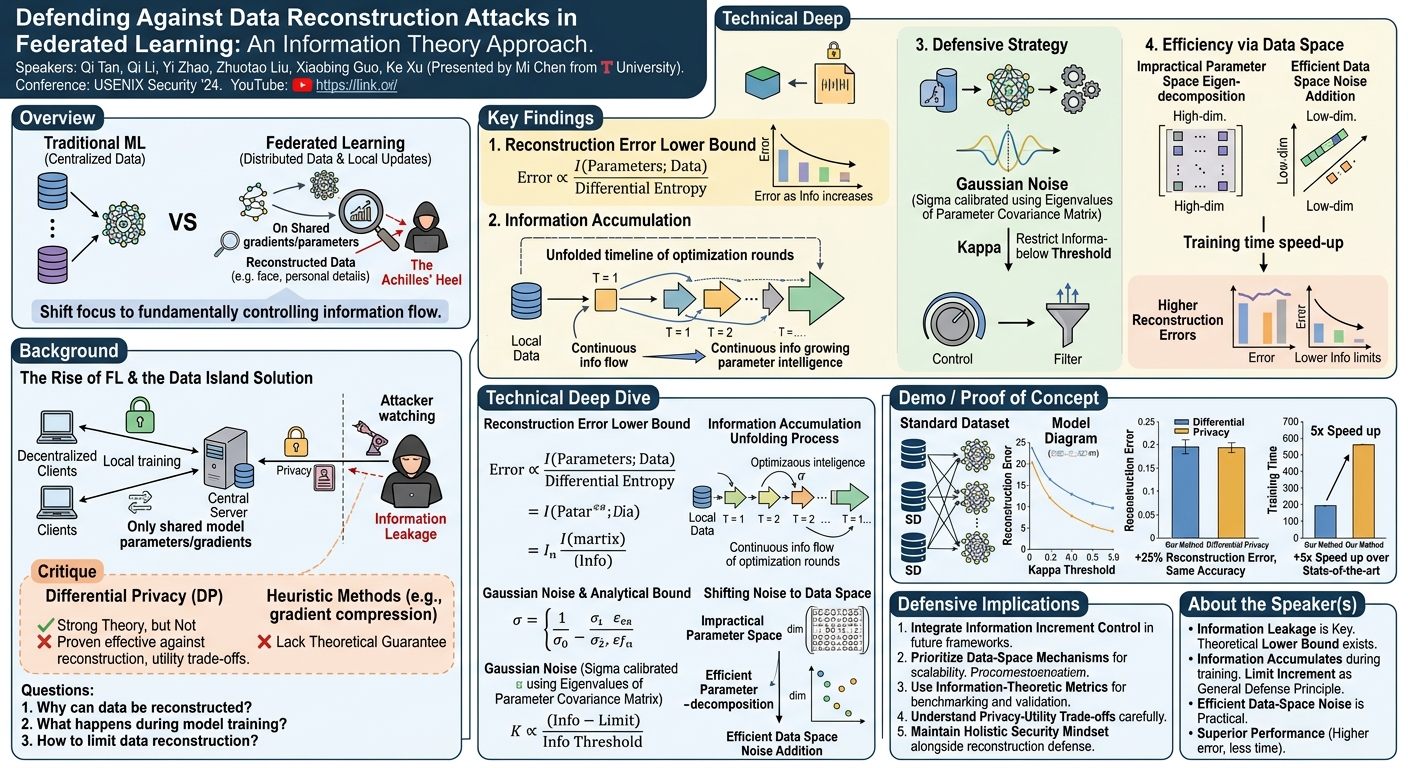
Firstly, the talk establishes a theoretical basis for why data reconstruction attacks are possible. Using information theory, the researchers demonstrate that the reconstruction error—a metric quantifying how accurately an attacker can recover original data from model parameters—has a lower bound. This lower bound is determined by two primary factors: the differential entropy of the dataset, which reflects its inherent complexity (and is typically constant during training), and, more critically, the information contained within the model parameters. This is a crucial insight: the more information about the original data that resides within the shared parameters, the lower the reconstruction error an attacker can achieve, and thus, the more successful the attack. The core finding here is that "the information within the model parameters allows for data reconstruction."
Secondly, the research provides a clear answer to what happens during model training that enables this leakage. By "unfolding" the recurrent FL optimization process along a timeline, the team discovered a systematic information accumulation. Specifically, "the information included in the model is increased after each step of model update." This means that in every optimization round, information gradually flows from the local datasets into the model parameters. This continuous increment leads to a cumulative build-up of sensitive data information within the parameters, making them increasingly susceptible to reconstruction attacks as training progresses.
Thirdly, and most significantly for defense, the researchers developed a method to quantify and limit this information increment. They proposed adding Gaussian noise to the model parameters. The choice of Gaussian noise is strategic, as it allows for the analytical determination of an upper bound for the information increment at each step. This upper bound is calculated using the eigenvalues of the covariance matrix of the original noiseless parameters. By setting a specific threshold, denoted as Kappa, for this upper bound, the system can determine the precise scale (sigma) of Gaussian noise needed to ensure that the information increment in any given round remains below this privacy budget. This quantification is a critical breakthrough, providing a "precise way to measure the effectiveness of these techniques" and establishing that "limiting information is the general method to restrict data reconstruction."
Finally, the talk addresses a major practical challenge: the computational burden of applying noise in high-dimensional parameter spaces. For models with millions of parameters (like ChatGPT with 70.5 million parameters, cited in the talk as an example), recalculating eigenvalues for noise application at each training round is "Impractical." The researchers found that the information increment at a given time step is a specific type of mutual information that is "independent of previous parameter" states, depending solely on the current training process. This insight allowed them to shift the noise application from the high-dimensional parameter space to the typically low-dimensional and time-invariant data space. This innovation dramatically improves efficiency, making the defense practically deployable without prohibitive overhead.
The experimental validation further solidified these findings:
- Restricting information increment demonstrably leads to higher reconstruction errors, confirming its effectiveness.
- The proposed method significantly outperforms Differential Privacy, increasing reconstruction error by 25% while maintaining comparable model accuracy.
- Operating in the data space yields a remarkable five times speed up in training time compared to state-of-the-art methods, proving its practical viability for large-scale FL deployments.
These key findings collectively provide a theoretical foundation and a practical, efficient solution for defending against data reconstruction attacks, making FL a more trustworthy and secure technology.
Technical Deep Dive
▶ Watch: Information accumulation in model parameters during training (4:30)
The technical core of this research lies in its rigorous application of information theory to dissect the privacy vulnerabilities in Federated Learning and engineer a robust defense. The journey begins with understanding the fundamental concept of reconstruction error, which quantifies the adversary's success. A lower reconstruction error implies a more successful attack, meaning the attacker can more accurately recover the original training data. The researchers established a theoretical lower bound for this reconstruction error. This bound is dictated by two factors: the differential entropy of the dataset, which inherently captures its complexity, and the mutual information between the model parameters and the underlying data. Since the dataset's complexity (differential entropy) is generally constant during training, the susceptibility to reconstruction attacks primarily hinges on the quantity of data-specific information embedded within the shared model parameters. This foundational insight clarifies why data reconstruction is possible: the parameters inevitably encapsulate information about the data they were trained on.
To understand how this information accumulates, the researchers tackled the inherent complexity of the FL training process, which involves multiple recurrent optimization steps. Rather than treating it as a black box, they "unfolded" the recurrent process along a timeline. This analytical technique allowed them to visualize and derive clear relationships between variables at each discrete optimization step. What they discovered was critical: "the information included in the model is increased after each step of model update." This means that with every local training iteration and subsequent parameter aggregation, more information from the clients' local datasets flows into and accumulates within the global model parameters. This information accumulation is a continuous process, making the model parameters increasingly informative about the original data over successive rounds, thereby enhancing the attacker's ability to reconstruct.
The pivotal step towards defense involved quantifying and controlling this information flow. The goal was to restrict the amount of data information contained in the model parameters. To achieve this, the researchers introduced Gaussian noise to the model parameters before they are shared. Gaussian noise was chosen specifically because its properties allow for the analytical determination of an upper bound on the information increment. Through rigorous derivation based on information theory principles, they showed that this upper bound can be precisely calculated using the eigenvalues of the covariance matrix of the original noiseless parameters.
The defense mechanism then operates as follows: a threshold (Kappa) is defined, representing the maximum permissible information increment per optimization round. By solving for the sigma (standard deviation) of the Gaussian noise, the system ensures that the information increment, bounded by the eigenvalues, remains below this predefined Kappa. This strategy effectively constrains the growth of data-specific information within the model parameters, thereby limiting the precision of any potential reconstruction attack. This method not only provides a provable guarantee but also offers a theoretical framework to assess the effectiveness of other privacy-preserving techniques, such as differential privacy, and even heuristic methods like gradient compression or batch size adjustments, by quantifying their impact on information leakage. The core principle established is that "limiting information is the general method to restrict data reconstruction."
A significant practical hurdle, however, emerged from this approach. The calculation of eigenvalues for the covariance matrix, especially for high-dimensional models (e.g., modern deep neural networks with tens of millions of parameters like those in large language models), is computationally intensive. Performing eigen-decomposition for such massive matrices at every optimization round during training is "extremely difficult" and "Impractical." This efficiency challenge threatened the practical applicability of the theoretical defense.
To overcome this, the researchers revisited the formulation of the information increment. They made a crucial observation: the information increment at a given time T can be expressed as a specific type of mutual information that is "independent of previous parameter" states. This means the increment "depends solely on the training process at that time T" and the current data, not on the cumulative parameter state from previous rounds. This decoupling allowed for a fundamental shift in the point of intervention. Instead of adding noise to the high-dimensional, constantly evolving parameter space, the noise could be added directly to the data space before local model updates. The data space is typically "low dimensional and time invariant," meaning its structure and dimensionality are fixed and much smaller than the parameter space. This shift significantly enhances the efficiency of the defense, making the training time "independent of the number of parameters" and enabling a practical, scalable solution for real-world FL deployments.
Demo / Proof of Concept
▶ Watch: Efficient defense: Shifting noise addition to the data space (8:00)
While the presentation did not feature a live, interactive demonstration in the traditional sense, the researchers provided compelling experimental validation and a robust proof of concept for their proposed defense mechanism. Their methodology involved a comprehensive evaluation across "various data sets using different model architectures," demonstrating the generalizability and effectiveness of their approach. Although specific datasets or model types were not explicitly named in the transcript, typical evaluations in this domain often involve standard image datasets like MNIST, CIFAR-10, or text datasets, trained on models such as Convolutional Neural Networks (CNNs) or Recurrent Neural Networks (RNNs).
The core of their experimental validation focused on demonstrating the direct correlation between the applied information increment constraint (the Kappa threshold) and the resulting reconstruction error. The findings unequivocally showed that "a lower threshold of the information increment constraint leads to higher reconstruction errors." This is precisely the desired outcome, as a higher reconstruction error signifies a more difficult and less accurate data reconstruction for an attacker, thus indicating a more effective defense. The researchers explicitly stated, "the higher reconstruction errors is the better of the defense," confirming the success of their information theory-based strategy in limiting data leakage.
Beyond simply proving effectiveness, the team benchmarked their method against existing privacy-preserving techniques, particularly Differential Privacy (DP). Their results highlighted a significant advantage: "compared to differential privacy, our method increase its reconstruction error by 25% while still keeping the same model accuracy." This is a critical finding. Often, enhancing privacy comes at the cost of model utility (accuracy). The ability to achieve a 25% improvement in reconstruction resistance without sacrificing model accuracy positions their method as a superior alternative to DP for mitigating this specific attack vector.
Furthermore, the experimental evaluation meticulously addressed the practical efficiency concerns of implementing such a defense. The shift from adding noise in the parameter space to the data space was crucial for scalability. The results confirmed that "operating in the data space significantly improves the efficiency of restricting information increment," making training time decoupled from the sheer number of model parameters. This is especially vital for large, complex models that would otherwise face prohibitive computational costs. The efficiency gains were substantial: "compared with the state of the art, we can have a five times speed up in terms of the training time." This dramatic improvement in training speed, combined with superior privacy guarantees, underscores the practical viability and strong potential for real-world adoption of their proposed defense mechanism. The comprehensive experimental results serve as a strong proof of concept, validating both the theoretical underpinnings and the practical advantages of their information theory approach.
Defensive Implications
▶ Watch: Experimental results demonstrating effectiveness of the defense mechanism (8:50)
The findings from this research carry profound defensive implications for the design and deployment of secure Federated Learning systems. The talk's core message—that information is central to data reconstruction and that this information accumulates during training—should fundamentally reorient how defenders approach privacy in FL.
Firstly, this work provides a much-needed theoretical grounding for defending against data reconstruction attacks. Unlike heuristic methods, which lack guarantees, or Differential Privacy, which isn't specifically optimized for reconstruction, this approach offers a quantifiable and provable method to control privacy leakage. Defenders can now define a specific privacy budget (Kappa threshold) in terms of information increment and have a concrete understanding of its impact on an attacker's ability to reconstruct data. This moves FL privacy from a qualitative assurance to a quantitative, measurable guarantee against a critical threat.
Secondly, the practical innovation of shifting noise application from the parameter space to the data space is a game-changer for scalability and adoption. High-dimensional models have historically posed a significant challenge for privacy-preserving mechanisms due to computational overhead. By demonstrating that effective information control can be achieved in the lower-dimensional, time-invariant data space, the researchers have made this robust defense practically viable for large-scale, real-world FL deployments, including those involving complex deep learning models. This eliminates a major barrier to widespread implementation.
Thirdly, this information theory framework offers a powerful analytical tool for evaluating and comparing various privacy-preserving FL techniques. Defenders can leverage the concept of information increment to rigorously assess how well any given method (e.g., different gradient compression schemes, secure aggregation protocols, or various DP implementations) truly limits data information leakage against reconstruction. This allows for informed decision-making in selecting and configuring FL privacy mechanisms based on concrete, measurable criteria, rather than relying on intuition or generalized privacy claims.
For practitioners and system architects, the defensive implications translate into several actionable recommendations:
- Integrate Information Increment Control: Future FL frameworks should consider incorporating mechanisms for directly controlling information increment, leveraging the principles outlined in this research. This could involve adding carefully calibrated noise to client-side data or local gradients before they are used for model updates or shared.
- Prioritize Data-Space Mechanisms: When designing privacy-preserving FL, preference should be given to methods that operate efficiently in the data space, as these offer superior scalability and performance compared to parameter-space interventions for reconstruction attacks.
- Benchmarking and Validation: Organizations deploying FL should use information-theoretic metrics to benchmark and validate the effectiveness of their chosen privacy solutions specifically against data reconstruction attacks. This goes beyond simply measuring model accuracy or general DP guarantees.
- Understand Trade-offs: While the proposed method achieves high reconstruction error with minimal accuracy loss, defenders must still carefully consider the trade-off between the desired level of privacy (lower Kappa, higher reconstruction error) and the acceptable impact on model utility and training speed in their specific application context.
- Holistic Security Mindset: While this research addresses data reconstruction, FL systems still face other threats (e.g., model inversion, membership inference, poisoning attacks). A holistic security strategy remains essential, but this work provides a strong foundation for addressing a critical and previously under-theorized vulnerability.
In essence, this research empowers defenders with a scientifically grounded, efficient, and highly effective strategy to counter data reconstruction attacks, thereby bolstering the privacy promises of Federated Learning and accelerating its secure adoption across sensitive domains.
Key Takeaways
- Information Leakage is Key: Data reconstruction attacks in Federated Learning are fundamentally enabled by the leakage and accumulation of sensitive data information within shared model parameters during the training process.
- Theoretical Lower Bound: Information theory provides a precise lower bound for reconstruction error, directly linking attack success to the amount of data-specific information contained in the model parameters.
- Information Accumulation: During each optimization round of FL training, information from local datasets gradually flows into and accumulates within the global model parameters, making them increasingly vulnerable.
- General Defense Principle: Limiting this increment of information at each training step, rather than just obscuring parameters, serves as a general and theoretically sound defense against data reconstruction attacks.
- Efficient Data-Space Noise: The proposed defense efficiently implements this information constraint by adding calibrated Gaussian noise directly to the low-dimensional data space, avoiding the prohibitive computational costs of operating in high-dimensional parameter space.
- Superior Performance: The method significantly outperforms Differential Privacy by increasing reconstruction error by 25% while maintaining model accuracy, and offers a remarkable five times speed up in training time compared to state-of-the-art methods.
About the Speaker(s)
The research paper "Defending Against Data Reconstruction Attacks in Federated Learning: An Information Theory Approach" was authored by Qi Tan, Qi Li, Yi Zhao, Zhuotao Liu, Xiaobing Guo, and Ke Xu. The talk at USENIX Security '24 was presented by Mi Chen from T University, representing the collaborative efforts of the team. While specific titles and affiliations for all authors were not detailed in the transcript, the presentation implies that the team is affiliated with T University, a prominent institution engaged in advanced research. Their collective work focuses on critical areas of machine learning security and privacy, particularly within the context of Federated Learning. This paper showcases their expertise in applying fundamental theoretical concepts, such as information theory, to address complex, real-world security challenges in distributed computing environments.
Reviews
Dr. Zero (Offensive Security Researcher) — MUST SEE
This talk delivers a foundational re-evaluation of Federated Learning privacy, presenting a novel information theory framework to precisely quantify and control data leakage against reconstruction attacks. It offers a theoretically sound and practically efficient defense that significantly outperforms existing methods like Differential Privacy without sacrificing model accuracy, making secure FL deployments viable for complex models.
Heather Calloway (CISO) — STRONG ACCEPT
This research delivers a critical, theoretically sound defense against data reconstruction attacks in Federated Learning, a significant vulnerability undermining FL's privacy promise. By quantifying and controlling information leakage at the data level, it offers a provably effective and computationally efficient solution, fundamentally shifting how organizations should approach privacy in AI/ML governance.