Ahoy SAILR! There is No Need to DREAM of C: A Compiler-Aware Structuring Algorithm for Binary Decompilation
Zion Leonahenahe Basque (PhD student · Arizona State University)
33rd USENIX Security Symposium · Day 1 · USENIX Security '24 · USENIX Security '24
Overview
In the realm of binary analysis, the ability to transform machine code back into human-readable source code — a process known as decompilation — is a cornerstone for security researchers, reverse engineers, and software auditors. Despite decades of research and advancements, the output of modern decompilers often bears little resemblance to the original source, frequently riddled with unintuitive constructs like goto statements, redundant code, and complex Boolean logic. This divergence from source code significantly hinders comprehension, making tasks like vulnerability discovery, malware analysis, and intellectual property protection more challenging and time-consuming.
Key moments
- 0:00 Decompilation doesn't look like original source code
- 2:00 Compiler optimizations, especially jump threading, make decompilation difficult
- 3:00 Three key research goals to improve decompilation accuracy
- 3:58 Schema-based vs. go-to-less control flow structuring algorithms explained
- 4:58 Motivating example comparing Hex-Rays, DREAM, and source code
- 6:00 Decompilers alter original control flow graph structure significantly
- 6:40 Deeply understanding compilers is key to better decompilation
Ahoy SAILR! There is No Need to DREAM of C: A Compiler-Aware Structuring Algorithm for Binary Decompilation
Speakers: Zion Leonahenahe Basque, PhD Student, Arizona State University
Conference: USENIX Security '24
YouTube: https://www.youtube.com/watch?v=drNGRv2vQLY
Overview
In the realm of binary analysis, the ability to transform machine code back into human-readable source code — a process known as decompilation — is a cornerstone for security researchers, reverse engineers, and software auditors. Despite decades of research and advancements, the output of modern decompilers often bears little resemblance to the original source, frequently riddled with unintuitive constructs like goto statements, redundant code, and complex Boolean logic. This divergence from source code significantly hinders comprehension, making tasks like vulnerability discovery, malware analysis, and intellectual property protection more challenging and time-consuming.
Zion Leonahenahe Basque, a PhD student at Arizona State University, presented "Ahoy SAILR! There is No Need to DREAM of C," a groundbreaking talk at USENIX Security '24 that directly confronts this long-standing problem. The talk introduces SAILR (Source-Aware Intermediate Language Recovery), a novel compiler-aware structuring algorithm for binary decompilation. SAILR's core premise is that to effectively reverse the compilation process, one must deeply understand the mechanisms of compilation itself, rather than solely relying on software engineering metrics to simplify decompiler output.
This work is significant because it challenges the conventional wisdom that compilers are entirely lossy processes, demonstrating that they leave behind artifacts that can be leveraged for more accurate decompilation. By systematically identifying and reversing specific compiler optimizations, SAILR aims to produce decompiled code that is remarkably closer to the original source, thereby drastically improving the usability and interpretability of binary analysis results. This shift in perspective offers a path forward for decompilation research, moving beyond mere code simplification towards genuine source code recovery.
Background
▶ Watch: Decompilation doesn't look like original source code (0:00)
The journey from high-level source code to executable binary is a complex one, orchestrated by compilers. While many view compilation as a black box where source code goes in and an opaque binary emerges, it involves numerous intermediate steps and transformations. Crucially, compilers apply various optimizations to enhance performance, reduce code size, or both. These optimizations are not monolithic; they can be broadly categorized into two types: generic code optimizations and machine code optimizations.
Generic code optimizations operate at a higher, more abstract level, often manipulating the program's control flow in ways that resemble manual source code edits. An example highlighted in the talk is jump threading, where redundant jumps or conditions are eliminated, often introducing goto statements in the optimized intermediate representation. These transformations, while beneficial for execution efficiency, are precisely what contribute to the "crazy stuff" and structuring failures seen in decompiler outputs. Historically, decompilers have treated these gotos as problems to be mitigated with software engineering techniques, rather than as artifacts of specific compiler actions.
The field of control flow structuring is where decompilers attempt to convert the flat, graph-like representation of a program's Control Flow Graph (CFG) into hierarchical, structured code (like if/else, while, for loops). Two predominant approaches have emerged:
- Schema-based structuring: This method relies on pattern matching known control flow structures (e.g., if-else, sequence). When a decompiler cannot match a pattern, it inserts a
gotostatement to bridge the gap, effectively signaling a "structuring failure." Tools like Hex-Rays, Ghidra, and Binary Ninja predominantly use schema-based approaches, and the presence ofgotos in their output is a direct consequence of this. The talk provides an example of Hex-Rays introducing a "spuriousgoto" that was not present in the original source code. - Goto-less structuring algorithms: Developed to address the perceived "ugliness" of
gotos, these algorithms prioritize eliminating them entirely. They achieve this through techniques like code duplication or Boolean duplication, where conditions are replicated or complex Boolean expressions are generated to enforce proper scoping without explicit jumps. DREAM, an academic standard for goto-less decompilation, exemplifies this approach. While it successfully avoidsgotos, the talk demonstrates that this often comes at the cost of introducing excessive Boolean logic, redundant code, and a more complex control flow graph than the original source.
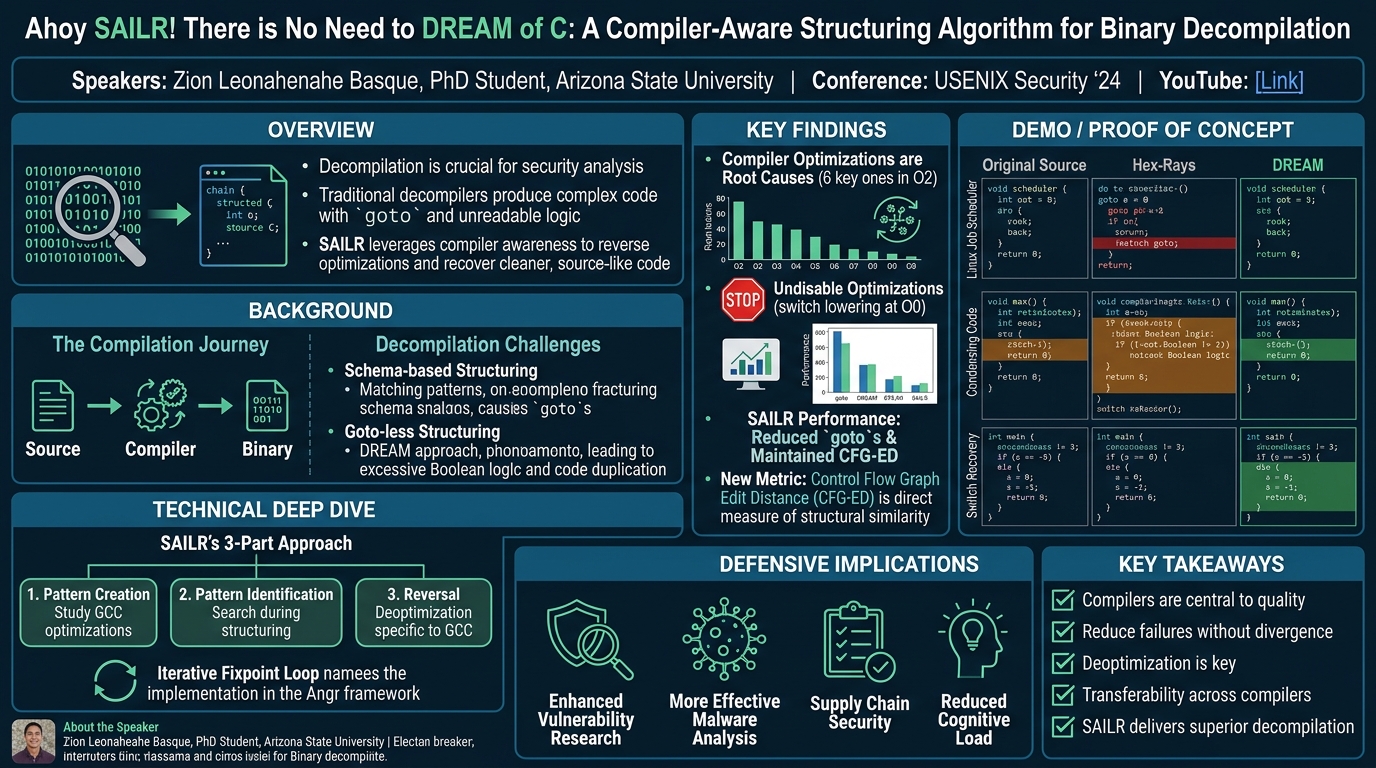
The talk uses a motivating example derived from the Linux kernel job scheduler to illustrate these deficiencies. Comparing the original source with outputs from Hex-Rays and DREAM, it becomes clear that both industry-standard and academic-leading decompilers produce code that significantly diverges from the original. Hex-Rays introduces spurious gotos and an expanded CFG, while DREAM, despite being goto-less, generates numerous Boolean conditions and additional calls to functions like refresh_jobs, leading to an even more complex CFG with more nodes and edges than the source. This indicates that optimizing solely for software engineering metrics (like absence of gotos) without understanding the compiler's role can push decompilation further away from source exactness.
Key Findings
▶ Watch: Three key research goals to improve decompilation accuracy (3:00)
The central insight of SAILR is that compilers are not entirely lossy processes. Instead, they leave behind discernible artifacts in the compiled binary that indicate specific optimizations have occurred. These artifacts, often manifesting as gotos or specific control flow patterns, have traditionally been misconstrued as problems to be fixed by decompilers, rather than clues to be interpreted. By adopting a "compiler-aware" perspective, SAILR turns these perceived failures into opportunities for deoptimization.
The research identified several critical findings:
- Compiler Optimization as the Root Cause: The study systematically investigated how various compiler optimizations contribute to structuring failures in decompilation. Focusing on the commonly used O2 optimization set in GCC 9, the researchers pinpointed six specific optimizations that cause the majority of damage to decompilation quality. These include transformations that introduce
gotos, duplicate code, or condense blocks. - Undisableable Optimizations: Even at O0 (no optimization), the study found that
gotos and structuring failures still occur. This is attributed to certain fundamental optimizations, such as switch lowering, which are built directly into the compiler and cannot be disabled. These "built-in" optimizations are another source of divergence from source code that decompilers must account for. - Categorization of Optimization Effects: The identified optimizations were categorized by their impact on decompilation:
- Duplication: Optimizations that cause code or logic to be replicated.
- Code Condensing: Optimizations that merge multiple basic blocks into a single block.
- Other Transformations: Miscellaneous changes, such as code movement, that alter the expected structure.
- The Need for New Metrics: Traditional software engineering metrics (e.g., number of
gotos, cyclomatic complexity) have proven insufficient for evaluating decompilation quality against the original source. The talk highlights that simply reducinggotos, as seen with DREAM, can lead to a greater divergence from the source's actual control flow. To address this, SAILR introduces Control Flow Graph Edit Distance (CFG-ED) as a more robust metric. CFG-ED quantifies the number of edits (insertions, deletions, substitutions of nodes and edges) required to transform the CFG of the decompiled output into the CFG of the original source code, providing a direct measure of structural similarity. - SAILR's Performance: On a dataset of 26 C Debian packages comprising over 7,000 unique functions, SAILR demonstrated superior performance. It achieved a significant reduction in
gotostatements (nearly a factor of three compared to Hex-Rays) while maintaining a CFG-ED similar to or better than industry-standard decompilers like Hex-Rays. This indicates that SAILR successfully reduces structuring failures without sacrificing structural similarity to the source, unlike goto-less approaches which often double the CFG-ED of schema-based decompilers.
Technical Deep Dive
▶ Watch: Schema-based vs. go-to-less control flow structuring algorithms explained (3:58)
SAILR's approach to compiler-aware decompilation is fundamentally about deoptimization: reversing the effects of specific compiler optimizations to reconstruct a control flow closer to the original source. This process is integrated directly into the control flow structuring phase of decompilation. The SAILR structuring algorithm operates in three distinct parts:
- Pattern Creation for Optimization Effects: The first step involves meticulously studying how GCC 9, chosen as a representative compiler, implements its optimizations. For each identified optimization that causes significant structuring failures (duplication, condensing, or miscellaneous transformations), SAILR develops specific patterns. These patterns are designed to recognize the tell-tale artifacts left behind by the compiler in the binary's intermediate representation. For instance, an optimization like jump threading might leave a specific sequence of conditional jumps and unconditional jumps that can be identified.
- Identification of Patterns During Structuring: As the decompiler processes the lifted CFG, the SAILR algorithm actively searches for these pre-defined patterns. This identification occurs during the structuring phase, allowing the decompiler to make informed decisions about how to group and order basic blocks. Unlike schema-based methods that only match high-level structures (like
if-else), SAILR's patterns are lower-level, targeting the specific micro-structures introduced by compiler optimizations. - Reversal According to GCC 9 Implementation: Once an optimization pattern is identified, SAILR applies a corresponding deoptimization transformation. This reversal is not a generic "undo" but is specifically tailored to the known behavior and implementation of that optimization within GCC 9. By understanding the compiler's logic, SAILR can reconstruct the original control flow more accurately. For example, if a code condensing optimization merged several blocks, SAILR might split them back into their original logical components or reintroduce the original branching logic.
SAILR is implemented within the open-source Angr decompiler framework. The deoptimization process is iterative, using a fixpoint loop to repeatedly apply deoptimization rules until no further improvements can be made. In practice, this loop typically converges within approximately three iterations, indicating its efficiency.
To facilitate rigorous comparison, the researchers also reimplemented several existing structuring algorithms, including Phoenix, DREAM, and a forthcoming algorithm from Rev's, alongside SAILR within the Angr framework. This standardized environment allowed for a fair evaluation across different approaches.
A crucial aspect of SAILR's evaluation methodology is its reliance on the newly introduced Control Flow Graph Edit Distance (CFG-ED) metric. Traditional metrics like goto count or Boolean count are shown to be insufficient, as reducing one can inflate another or lead to greater structural divergence from the source. CFG-ED, by measuring the minimum number of graph edits (node insertions/deletions/substitutions, edge insertions/deletions/substitutions) required to transform the decompiled CFG into the source CFG, provides a direct and comprehensive measure of structural similarity. Recognizing that computing exact graph edit distance is computationally expensive, the team developed a new, more efficient algorithm for CFG-ED, details of which are available in their accompanying paper.
The evaluation dataset comprised 26 C Debian packages, encompassing over 7,000 unique functions, compiled with multiple compilers. This extensive dataset ensures the generalizability of SAILR's findings. The results clearly demonstrated that SAILR achieves a significant reduction in gotos (e.g., nearly a factor of three reduction compared to Hex-Rays) while maintaining or improving CFG-ED, indicating a closer approximation to the original source code structure without the pitfalls of excessive Boolean logic or code duplication seen in goto-less approaches like DREAM (which often doubled Hex-Rays' CFG-ED).
Demo / Proof of Concept
▶ Watch: Decompilers alter original control flow graph structure significantly (6:00)
While the talk did not feature a live, interactive demo, it effectively showcased SAILR's capabilities through illustrative examples directly comparing its output against industry-standard (Hex-Rays) and academic-standard (DREAM) decompilers, as well as the original source code. These examples served as compelling proofs of concept for SAILR's ability to produce more accurate and readable decompilation.
Key demonstrations included:
- The Motivating Example (Linux Kernel Job Scheduler): In this specific case, Hex-Rays failed to perfectly match the original structure, introducing an extra
goto. DREAM, whilegoto-less, introduced numerous redundant Booleans and additional function calls. SAILR, however, was shown to perfectly match all the original Booleans, calls, and the overall structure, demonstrating its ability to reconstruct the intended control flow with high fidelity. - Condensing Expanded Code: In scenarios where compilers introduce optimizations that expand the code (e.g., by duplicating blocks or creating complex jump sequences), Hex-Rays' output often reflects this expansion with additional
gotos and fragmented logic. SAILR successfully identified the underlying optimization and condensed the decompiled code back to a form much closer to the source, making it significantly more compact and understandable. - Reducing If-Else Trees to Switches: A common problem in decompilation is the transformation of a compact
switchstatement in source code into a sprawling series of nestedif-elsestatements in the decompiled output. This drastically reduces readability and makes understanding the program's logic difficult. SAILR demonstrated its ability to reverse the compiler'sswitch loweringoptimization, reconstructing the originalswitchstatement from the complexif-elsetree, thereby restoring the semantic intent and improving clarity.
These examples clearly illustrate that SAILR is not merely reducing cosmetic issues like gotos but is genuinely reconstructing the original structural and semantic intent of the source code by understanding and reversing the compilation process.
Defensive Implications
▶ Watch: Deeply understanding compilers is key to better decompilation (6:40)
The advancements brought by SAILR have profound implications for defensive security. Improved decompilation quality directly translates to enhanced capabilities for security analysts, incident responders, and software developers:
- Enhanced Vulnerability Research and Bug Hunting: When decompiled code closely resembles the original source, it becomes significantly easier for security researchers to identify logical flaws, subtle bugs, and potential vulnerabilities. The cognitive load of understanding complex,
goto-laden code is drastically reduced, allowing researchers to focus on the security implications rather than struggling with obfuscated control flow. This accelerates the discovery of zero-day vulnerabilities and aids in auditing legacy codebases. - More Effective Malware Analysis: Malware often employs various obfuscation techniques to hinder analysis. While these techniques operate at different levels, a decompiler that can produce more readable and accurate code from the underlying binary significantly streamlines the reverse engineering process. Analysts can more quickly understand malware's functionality, command-and-control mechanisms, and evasion tactics, leading to faster detection and mitigation strategies.
- Supply Chain Security and Software Bill of Materials (SBOMs): With increasing focus on supply chain security, understanding the components within third-party binaries is crucial. SAILR's ability to generate code closer to the source makes it easier to verify that a compiled binary matches its declared source code, detect unauthorized modifications, or identify unwanted functionalities. This aids in creating more accurate and trustworthy SBOMs.
- Improved Patch Analysis: Security teams often analyze patches to understand how vulnerabilities were fixed. Better decompilation allows for more precise diffing between patched and unpatched binaries, revealing the exact changes made at the source level rather than just the assembly or intermediate representation. This facilitates a deeper understanding of the fix and helps in identifying potential bypasses.
- Reduced Cognitive Load for Reverse Engineers: The primary benefit for any reverse engineer is the reduction in mental effort required to understand a binary. By presenting code that mirrors the original source, SAILR minimizes the need for manual reconstruction of control flow, interpretation of complex Boolean logic, and tracing of
gotostatements, allowing experts to be more productive and efficient. - Better Binary Auditing and Compliance: For industries with stringent compliance requirements, auditing compiled binaries against security standards is critical. Decompiled code that is structurally similar to source code simplifies the auditing process, making it easier to demonstrate compliance and identify deviations.
In essence, SAILR provides defenders with a more powerful lens through which to examine binaries, turning opaque machine code into a transparent representation that is amenable to human understanding and automated analysis alike.
Key Takeaways
- Compilers are Central to Decompilation Quality: For over 30 years, decompilation research has largely ignored the deep intricacies of the compilation process, focusing instead on software engineering metrics. Understanding compiler optimizations is crucial for producing high-quality decompilation.
- Reduce Structuring Failures Without Divergence: Effective decompilers should aim to reduce visible structuring failures (like
gotos) without introducing new complexities or significantly diverging from the original source code's control flow structure. - Deoptimization is Key to Source Exactness: Compilers leave artifacts of their optimizations in binaries. By identifying and reversing these specific optimizations, decompilers can achieve a much higher degree of source code exactness.
- Transferability Across Compilers: The principles and patterns learned from studying one compiler (e.g., GCC 9) regarding its optimizations and their deoptimization are often transferable and applicable to other compilers, suggesting a broader impact for this research.
- SAILR Delivers Superior Decompilation: The SAILR algorithm significantly improves decompilation quality, drastically reducing
gotostatements (nearly a factor of three) while maintaining or improving structural similarity to the original source code, as measured by Control Flow Graph Edit Distance.
About the Speaker(s)
Zion Leonahenahe Basque is a PhD student at Arizona State University. His research focuses on advancing binary analysis techniques, particularly in the realm of decompilation. Through his work on SAILR, he is contributing to a deeper understanding of the interplay between compilers and decompilers, aiming to bridge the gap between compiled binaries and their original source code representations. His presentation at USENIX Security '24 highlights his expertise in compiler internals and control flow analysis.
Reviews
Dr. Zero (Offensive Security Researcher) — MUST SEE
This work introduces SAILR, a compiler-aware decompilation algorithm that fundamentally shifts how we approach binary structuring. By systematically reversing compiler optimizations and using a robust new metric, SAILR generates code significantly closer to original source, drastically improving readability and utility for reverse engineers. This is a critical advancement for the field.
Heather Calloway (CISO) — STRONG ACCEPT
This talk presents a significant technical advancement in binary decompilation by enabling more accurate and readable code reconstruction. The ability to reverse compiler optimizations directly enhances capabilities for vulnerability research, malware analysis, and supply chain security, offering tangible improvements to a security program's operational effectiveness and risk intelligence.