Less is More: Revisiting the Gaussian Mechanism for Differential Privacy
Tianxi Ji (Texas Tech), Pan Li
33rd USENIX Security Symposium · Day 1 · USENIX Security '24 · USENIX Security '24
Overview
Differential Privacy (DP) stands as a foundational framework for privacy-preserving data analysis, machine learning, and AI. At its core, DP aims to quantify and limit the privacy loss incurred when statistical queries are performed on sensitive datasets. A cornerstone mechanism for achieving DP, particularly for numerical computations, is the Gaussian mechanism, which adds random noise drawn from a Gaussian distribution to query results. However, as demonstrated by Tianxi Ji and Pan Li in their USENIX Security '24 talk, "Less is More: Revisiting the Gaussian Mechanism for Differential Privacy," existing Gaussian mechanisms suffer from a significant limitation: their accuracy loss scales linearly with the dimensionality of the query, a phenomenon they term the "curse of dimensionality."
Key moments
- 0:00 Introduction and technical contribution summary
- 2:40 Identifying the "curse": accuracy loss scales with dimension
- 3:54 Hint from literature: privacy loss related to one dimension
- 4:47 Introducing R1SMG: Rank-One Singular Multivariate Gaussian mechanism
- 6:00 Privacy guarantee and proof sketch using random geometry
- 7:08 Main conclusion: accuracy loss decreases with dimension
- 8:00 Scheme stability properties and an important caveat
Less is More: Revisiting the Gaussian Mechanism for Differential Privacy
Speakers: Tianxi Ji, Graduate Student, Texas Tech; Pan Li, Professor, Texas Tech
Conference: USENIX Security '24
YouTube: https://www.youtube.com/watch?v=_5_yvaL0NBU
Overview
Differential Privacy (DP) stands as a foundational framework for privacy-preserving data analysis, machine learning, and AI. At its core, DP aims to quantify and limit the privacy loss incurred when statistical queries are performed on sensitive datasets. A cornerstone mechanism for achieving DP, particularly for numerical computations, is the Gaussian mechanism, which adds random noise drawn from a Gaussian distribution to query results. However, as demonstrated by Tianxi Ji and Pan Li in their USENIX Security '24 talk, "Less is More: Revisiting the Gaussian Mechanism for Differential Privacy," existing Gaussian mechanisms suffer from a significant limitation: their accuracy loss scales linearly with the dimensionality of the query, a phenomenon they term the "curse of dimensionality."
This talk introduces a novel DP scheme, the Rank One Singular Multivariate Gaussian (R1SM-SMG) mechanism, designed to mitigate this curse. By fundamentally rethinking the structure of the added noise, the R1SM-SMG mechanism leverages principles of random geometry to achieve a geometric representation of privacy loss. This innovative approach allows for a more efficient noise addition strategy, resulting in an expected accuracy loss that decreases as dimensionality increases, ultimately converging to a constant in high-dimensional settings. The work not only presents a theoretically sound mechanism but also empirically demonstrates its superior utility and stability compared to classical Gaussian variants, offering a significant advancement for privacy-preserving applications dealing with high-dimensional data.
The implications of this research are substantial for practitioners and researchers in fields requiring strong privacy guarantees. By breaking the linear dependency between accuracy loss and data dimensionality, the R1SM-SMG mechanism enables more accurate query results with the same privacy budget, or equivalent accuracy with a tighter budget, especially in scenarios involving complex, multi-dimensional queries common in modern data science. This talk provides a critical re-evaluation of a widely used DP primitive, paving the way for more efficient and robust differentially private systems.
Background
▶ Watch: Introduction and technical contribution summary (0:00)
Differential Privacy (DP) provides a rigorous mathematical definition of privacy, ensuring that the presence or absence of any single individual's data in a dataset does not significantly alter the outcome of an analysis. Formally, a mechanism M satisfies (ε, δ)-Differential Privacy if, for any two neighboring datasets D and D' (differing by exactly one record), and for any possible output S in the range of M, the following holds: P(M(D) ∈ S) ≤ e^ε * P(M(D') ∈ S) + δ. Here, ε (epsilon) is the privacy budget, controlling the degree of privacy loss, with smaller ε implying stronger privacy. δ (delta) represents the probability of a privacy breach, typically set to a very small value (e.g., 10^-5 or 10^-9).
A critical component in understanding and analyzing DP mechanisms is the Privacy Loss Random Variable (PLRV), defined as log(P(M(D) = output) / P(M(D') = output)). The (ε, δ)-DP condition can then be restated as the probability of the PLRV exceeding ε being less than δ.
For numerical queries, especially those with real-valued outputs, the Gaussian mechanism is a widely adopted tool to achieve (ε, δ)-DP. It operates by adding carefully calibrated Gaussian noise to the query result. The amount of noise added is directly proportional to the L2 sensitivity of the query function, denoted as Δf, which is the maximum change in the output of the query when a single record is added or removed from the dataset.
The talk highlighted several existing variants of the Gaussian mechanism:
- Classical Gaussian Mechanism: Adds Independent and Identically Distributed (IID) Gaussian noise to each element of the output vector
f(X). - Analytic Gaussian Mechanism: Also adds IID noise but with a different variance calibration, often providing tighter bounds.
- Matrix-Variant Gaussian Mechanism: Adds noise directly from a matrix-valued Gaussian distribution, where the covariance matrix is calibrated by privacy parameters and sensitivity.
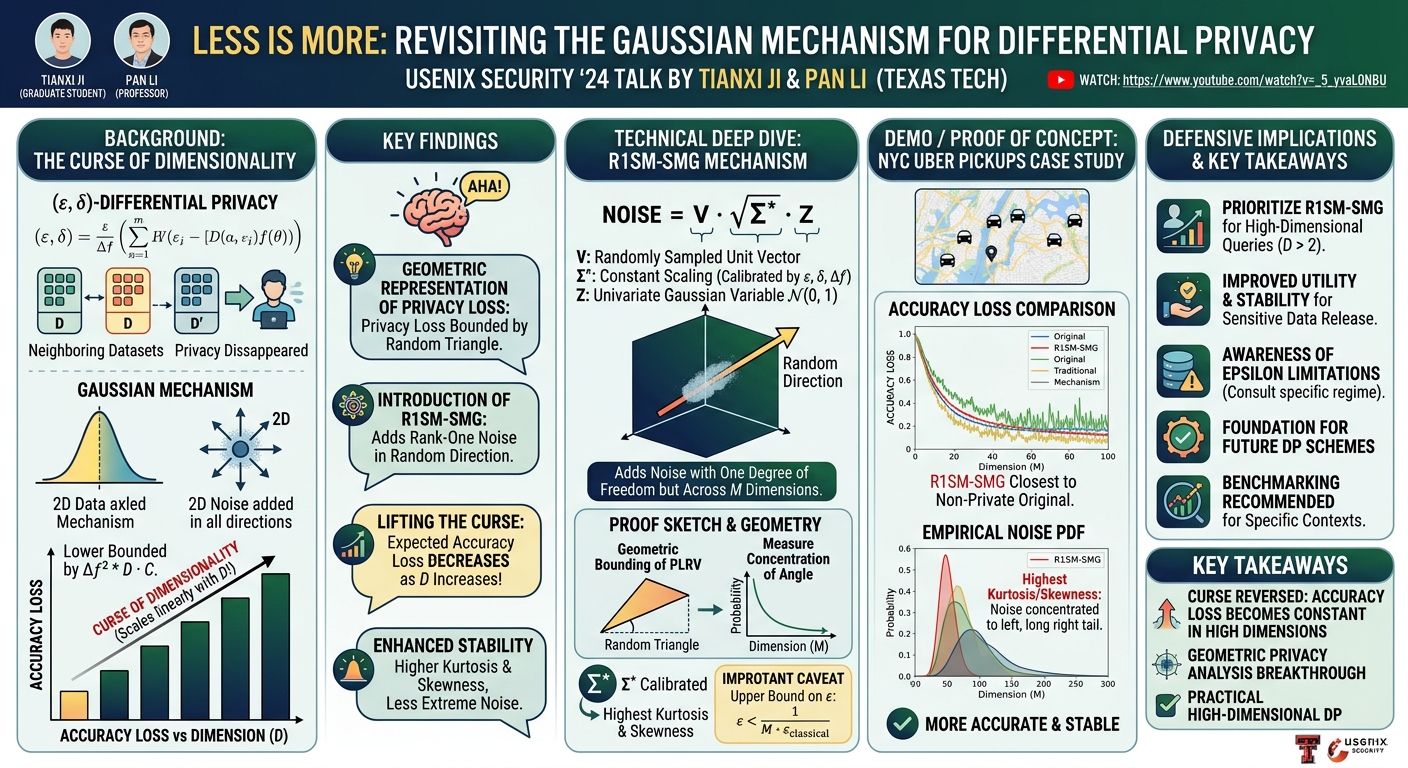
Despite their utility, all these existing Gaussian mechanisms share a common limitation regarding accuracy. The accuracy loss for any noise-adding mechanism is defined as the difference between the mechanism's output and the original query result. For Gaussian mechanisms, the expected accuracy loss is directly related to the trace of the covariance matrix of the added noise. Specifically, for the classical, analytic, and matrix-variant Gaussian mechanisms, this trace is lower bounded by Δf^2 D C, where Δf is the sensitivity, D is the dimensionality of the query output, and C is some constant. This relationship reveals the fundamental "curse of dimensionality": the expected accuracy loss scales linearly with D. This means that for high-dimensional queries, a substantial amount of noise must be added to satisfy DP, significantly degrading the utility of the output. This curse poses a practical challenge for applying DP in modern machine learning and data analysis tasks that frequently involve high-dimensional feature spaces or model parameters.
The speaker noted a crucial hint in the book by Dwork and Roth, suggesting that the privacy loss in high dimensions is often related to only one dimension of the Gaussian noise and the sensitivity. This observation provided the initial inspiration to explore new noise addition strategies that could break the linear dependency on dimensionality.
Key Findings
▶ Watch: Hint from literature: privacy loss related to one dimension (3:54)
The central contribution of this research is the identification and proposed solution to the "curse of dimensionality" in existing Gaussian mechanisms for Differential Privacy. The authors present several key findings:
- Geometric Representation of Privacy Loss: The talk introduces a novel geometric interpretation of privacy loss in DP. For their proposed mechanism, the privacy loss in high dimensions can be bounded by the sum of two edges of a random triangle. This geometric perspective, coupled with the measure concentration of random geometric objects (like angles between random vectors), forms the basis for their improved privacy analysis.
- Introduction of the R1SM-SMG Mechanism: The authors propose a new DP scheme called the Rank One Singular Multivariate Gaussian (R1SM-SMG) mechanism. Unlike traditional Gaussian mechanisms that add noise across all dimensions, R1SM-SMG adds noise that is effectively concentrated along a single, randomly chosen direction in the high-dimensional space. This "rank one" nature of the noise is key to its efficiency.
- Lifting the Curse of Dimensionality: The most significant finding is that the R1SM-SMG mechanism effectively "lifts the curse" of dimensionality. While existing Gaussian mechanisms exhibit an expected accuracy loss that scales linearly with the query dimension
D, the R1SM-SMG mechanism demonstrates an expected accuracy loss that decreases asDincreases. AsDapproaches infinity, the expected accuracy loss converges to a constant value, independent of the dimension. This philosophical concept, akin to "hiding your data in the crowd," implies that in very high-dimensional settings, privacy can be achieved with only a limited, constant amount of added noise, leading to significantly better utility.
- Enhanced Stability: Beyond improved accuracy, the R1SM-SMG mechanism also exhibits superior stability compared to other Gaussian variants. Stability is measured using kurtosis (a descriptor of tail extremity) and skewness (a descriptor of the bulk of the probability mass). The R1SM-SMG mechanism achieves the highest kurtosis and skewness among the compared Gaussian schemes. This means that its noise distribution is less likely to generate extreme large magnitudes, concentrating more probability mass towards smaller noise values, which is beneficial for utility.
In summary, the research fundamentally re-evaluates how Gaussian noise is applied in DP, demonstrating that a carefully constructed, rank-one noise structure can overcome the long-standing challenge of dimensionality-dependent accuracy loss, leading to more accurate and stable differentially private computations in high-dimensional environments.
Technical Deep Dive
▶ Watch: Introducing R1SMG: Rank-One Singular Multivariate Gaussian mechanism (4:47)
The core of Differential Privacy (DP) relies on the (ε, δ)-DP definition: for any mechanism M and any two neighboring datasets D and D', the probability of observing any specific output S from M(D) is bounded by e^ε times the probability of observing S from M(D'), plus a small probability δ. This relationship is quantified by the Privacy Loss Random Variable (PLRV), log(P(M(D) = output) / P(M(D') = output)), where the (ε, δ)-DP condition means P(PLRV > ε) ≤ δ.
Existing Gaussian mechanisms, whether classical, analytic, or matrix-variant, add noise to a query result f(X). The accuracy loss, defined as the Frobenius norm squared of the added noise, ||Noise||^2, has an expected value equal to the trace of the noise's covariance matrix, Tr(Cov(Noise)). For these mechanisms, this trace is lower bounded by (Δf)^2 D C, where Δf is the L2 sensitivity of the query function, D is the dimensionality of the query output, and C is a constant. This linear dependence on D is the curse of dimensionality that degrades utility in high-dimensional settings.
The key insight for overcoming this curse stems from the observation that privacy loss in high dimensions is often effectively governed by a single dimension of the Gaussian noise. This led to the development of the Rank One Singular Multivariate Gaussian (R1SM-SMG) mechanism.
The R1SM-SMG mechanism adds noise in a distinctive manner:
Noise = V sqrt(Σ) * Z
Where:
Vis a randomly sampled unit vector from a unit sphere embedded in anM-dimensional space. This meansVrepresents a random direction shooting from the origin.Σ*(Sigma star) is a constant scaling factor, carefully calibrated by the privacy parameters (ε,δ) and the sensitivityΔf.Zis a univariate Gaussian random variable (e.g.,N(0, 1)).
The randomness of V is crucial. It ensures that the Privacy Loss Random Variable is well-defined and prevents potential privacy leakage that could occur if a fixed, non-random direction were used, which might be in the null space of certain data differences. By scaling a univariate Gaussian noise Z along a random direction V, the mechanism effectively adds noise with only "one degree of freedom" in terms of its magnitude, but distributed across M dimensions.
The privacy guarantee for R1SM-SMG holds as long as the dimension M is greater than 2 and the constant Σ* is sufficiently large, specifically Σ* > 2 (Δf)^2 / (ε ψ), where ψ is a constant derived from a complex expression involving the Gamma function and privacy parameters.
The proof sketch for R1SM-SMG's privacy guarantee leverages geometric principles and measure concentration:
- Geometric Bounding of PLRV: The privacy loss can be bounded by the sum of the two edges of a "random triangle" formed by the query difference vector and the added noise vectors for two neighboring datasets.
- Circumcircle Diameter: For any triangle, an edge is bounded by the diameter of its circumcircle multiplied by the sine of the opposite angle. The diameter can be expressed as an edge divided by the sine of its opposite angle. In this context, the angle happens to be the angle between the two random noise vectors applied to the different datasets.
- Measure Concentration of Angle: The crucial step involves analyzing the measure concentration of this random angle. It is shown that the probability of the angle deviating significantly from
π/2(an isogonal angle) is extremely small, and this probability is set toδ. AsMapproaches infinity, this angle converges toπ/2. - Bounding PLRV with Sine Value: Consequently, the PLRV can be bounded using a value involving the sine of this random angle. By showing that
P(|angle - π/2| > θ0)is very small (δ), the mechanism can ensureP(PLRV > ε) ≤ δ.
This analytical framework leads to the remarkable conclusion regarding accuracy: for any high-dimensional query, the expected accuracy loss of R1SM-SMG decreases as M increases. As M approaches infinity, this loss becomes a constant. This is a direct reversal of the curse of dimensionality, meaning that for very high-dimensional data, the relative noise added becomes less impactful on utility.
Furthermore, the R1SM-SMG mechanism demonstrates superior stability. Stability is quantified by kurtosis (describing the extremity of tails, with higher kurtosis indicating less likelihood of extreme values) and skewness (describing the asymmetry of the distribution, with higher skewness meaning more probability mass concentrated to the left and a longer right tail). The R1SM-SMG mechanism achieves the highest kurtosis and skewness among other Gaussian variants, implying it is less likely to generate noise with a large magnitude, thereby further enhancing utility.
A caveat to the R1SM-SMG scheme, similar to classical Gaussian mechanisms, is an upper bound on ε. For classical Gaussian mechanisms, ε is typically required to be less than 1. For R1SM-SMG, the exact upper bound is still under investigation, but a rule of thumb suggests it should be smaller than 1 / (M * ε_classical), where ε_classical is the privacy parameter used in the classical Gaussian mechanism. This indicates that while R1SM-SMG offers significant advantages in high dimensions, there are practical limits to the ε values for which its guarantees hold.
Demo / Proof of Concept
▶ Watch: Main conclusion: accuracy loss decreases with dimension (7:08)
The practical utility and superior performance of the R1SM-SMG mechanism were empirically validated through a case study involving the private release of Uber pickup data in New York City. This real-world dataset provides a compelling scenario to demonstrate the mechanism's effectiveness in a high-dimensional context.
In this case study, the privacy budget ε was set to a very stringent value of 10^-5, while other relevant parameters were set to 0.5. The goal was to compare the accuracy of the R1SM-SMG mechanism against various existing Gaussian mechanisms in preserving the utility of the Uber pickup data while satisfying the specified privacy budget.
The results clearly showed that the R1SM-SMG mechanism's output was "the most close to the non-private original Uber pickups." This was visually represented by a plot where the R1SM-SMG curve (plotted in red) adhered much more closely to the original, non-private data distribution compared to the outputs generated by classical, analytic, or matrix-variant Gaussian mechanisms. This empirical finding directly supports the theoretical claim that R1SM-SMG significantly reduces accuracy loss in high-dimensional settings.
Beyond accuracy, the demonstration also included an empirical evaluation of the stability properties. The empirical Probability Density Function (PDF) of the noise added by R1SM-SMG was plotted and compared against the PDFs of noise from other Gaussian schemes. The R1SM-SMG's PDF (red curve) exhibited a distinct characteristic: "much of its mass concentrated to the left and the right tail is very long." In contrast, the PDFs of other Gaussian mechanisms typically showed a more bell-shaped curve with mass concentrated in the center. This empirical observation confirms the theoretical finding regarding higher kurtosis and skewness for R1SM-SMG. Practically, it means that the R1SM-SMG mechanism is less likely to generate noise with a large magnitude, thereby introducing smaller perturbations to the data on average, which directly translates to better utility.
The Uber pickups case study effectively served as a proof of concept, illustrating R1SM-SMG's ability to provide more accurate and stable differentially private outputs for high-dimensional queries compared to its predecessors, making it a promising candidate for real-world applications.
Defensive Implications
▶ Watch: Scheme stability properties and an important caveat (8:00)
The R1SM-SMG mechanism presents significant implications for defenders, data scientists, and privacy engineers working with sensitive, high-dimensional data. Understanding its strengths and limitations is crucial for informed decision-making in deploying differentially private systems.
- Prioritize for High-Dimensional Queries: For applications involving high-dimensional query outputs (where
D > 2), R1SM-SMG should be a primary consideration. Traditional Gaussian mechanisms incur accuracy loss that scales linearly withD, making them increasingly impractical for largeD. R1SM-SMG, by contrast, offers an accuracy loss that decreases withDand becomes constant in the limit, meaning it provides superior utility for a given privacy budget in these scenarios. This is particularly relevant for tasks like releasing machine learning model parameters, complex statistical aggregates, or high-dimensional feature vectors.
- Improved Utility and Stability: Defenders can expect better utility (more accurate results) and enhanced stability (less likelihood of extreme noise magnitudes) when implementing R1SM-SMG. The higher kurtosis and skewness mean that the noise distribution is more concentrated around smaller values, leading to less perturbation of the original data. This translates to more reliable insights from privately released data.
- Awareness of Epsilon Upper Bound: While R1SM-SMG offers significant advantages, practitioners must be mindful of the
εupper bound. The talk highlights thatεshould be smaller than1 / (M * ε_classical)for R1SM-SMG, indicating that very largeεvalues (which imply weaker privacy but higher utility) might not be directly achievable or well-bounded by this specific mechanism. Organizations need to carefully evaluate their privacy budget requirements and ensure they fall within the effective regime of R1SM-SMG. Further research is ongoing to derive exact privacy regimes, which will provide clearer guidelines.
- Foundation for Future DP Schemes: The geometric representation of privacy loss and the leverage of measure concentration in random geometry objects are fundamental theoretical contributions. These insights can inspire the design of other novel DP mechanisms, potentially extending beyond Gaussian noise, for various data types and query functions. Defenders should stay abreast of these ongoing research directions to integrate the latest advancements into their privacy-preserving pipelines.
- Benchmarking and Empirical Validation: When implementing DP, it's crucial to benchmark the performance of different mechanisms against specific datasets and query types. The Uber pickups case study provides a template for empirical evaluation. Defenders should conduct similar evaluations to confirm R1SM-SMG's benefits in their unique operational contexts, comparing its accuracy and stability against other suitable DP mechanisms.
In essence, R1SM-SMG offers a powerful tool for privacy engineers to achieve more practical and useful differentially private results for high-dimensional data, but its application requires a nuanced understanding of its specific operating conditions, particularly concerning the privacy budget.
Key Takeaways
- Curse of Dimensionality in DP: Traditional Gaussian mechanisms for Differential Privacy suffer from an accuracy loss that increases linearly with the dimensionality of the query output, severely limiting their utility for high-dimensional data.
- Introducing R1SM-SMG: The Rank One Singular Multivariate Gaussian (R1SM-SMG) mechanism is a novel DP scheme that addresses this limitation by adding noise along a single, randomly chosen direction.
- Reversed Accuracy Loss: R1SM-SMG reverses the curse, achieving an expected accuracy loss that decreases as dimensionality increases, eventually becoming a constant in high-dimensional settings, allowing data to "hide in the crowd."
- Enhanced Stability: The R1SM-SMG mechanism demonstrates superior stability, characterized by higher kurtosis and skewness, indicating a lower likelihood of generating large noise magnitudes compared to other Gaussian variants.
- Geometric Privacy Analysis: The mechanism's guarantees are derived from a geometric representation of privacy loss and leverage the measure concentration of random geometric objects, providing a new analytical framework for DP.
- Practical Utility for High-Dimensional Data: Empirical evaluation, such as with Uber pickup data, confirms R1SM-SMG's ability to produce significantly more accurate and stable differentially private outputs for high-dimensional queries, albeit with a specific operating regime for the privacy parameter
ε.
About the Speaker(s)
The talk "Less is More: Revisiting the Gaussian Mechanism for Differential Privacy" was presented by Tianxi Ji, a graduate student from Texas Tech University. The research is a joint work with Pan Li, a professor also affiliated with Texas Tech. Their work focuses on advancing the theoretical foundations and practical applications of Differential Privacy, particularly in addressing challenges related to high-dimensional data and the efficiency of privacy-preserving mechanisms. Their contribution at USENIX Security '24 highlights their expertise in privacy-preserving data analysis and statistical learning.
Reviews
Dr. Zero (Offensive Security Researcher) — MUST SEE
This talk introduces the R1SM-SMG mechanism, a novel approach to the Gaussian mechanism for Differential Privacy. It fundamentally overturns the "curse of dimensionality" that plagues existing methods, achieving accuracy loss that decreases with dimensionality rather than increases. This geometric re-evaluation of noise addition offers significantly improved utility and stability for high-dimensional private data release.
Heather Calloway (CISO) — STRONG ACCEPT
This research delivers a significant practical advancement in Differential Privacy, directly tackling the 'curse of dimensionality' that has hindered the utility of existing Gaussian mechanisms. By introducing the R1SM-SMG mechanism, it offers a credible path to achieving more accurate and stable privacy-preserving data releases for high-dimensional data, making DP a more viable tool for critical business applications.