X.509DoS: Exploiting and Detecting Denial-of-Service Vulnerabilities in Cryptographic Libraries using Crafted X.509 Certificates
Bing Shi
34th USENIX Security Symposium (USENIX Security '25) · Day 1 · Software Security 1
Overview
In the realm of cybersecurity research, a significant amount of attention is typically directed towards vulnerabilities that compromise the confidentiality or integrity of data. However, the critical aspect of availability often receives comparatively less focus. The talk "X.509DoS" by Bing Shi addresses this gap by presenting a comprehensive study on denial-of-service (DoS) vulnerabilities within cryptographic libraries, specifically those exploitable through maliciously crafted X.509 certificates. This research unveils a new class of attacks, dubbed X.509DoS, that leverage subtle flaws in certificate parsing and validation to trigger resource exhaustion or crashes in widely used systems.
Key moments
- 0:00 Introduction to X.509 DoS vulnerabilities
- 2:00 X.509 certificate chain validation overview
- 4:00 Categorizing DoS risks in crypto libraries
- 5:30 Automated tool and 18+ vulnerabilities discovered
- 6:10 Threat Model 1: Mutual TLS handshake CPU exhaustion
- 8:00 Threat Model 2: macOS app signature DoS
- 10:00 Remote macOS DoS exploit via crafted email
X.509DoS: Exploiting and Detecting Denial-of-Service Vulnerabilities in Cryptographic Libraries using Crafted X.509 Certificates
Speakers: Bing Shi
Conference: USENIX Security
YouTube: https://www.youtube.com/watch?v=VeO-3Pjnvpo
Overview
In the realm of cybersecurity research, a significant amount of attention is typically directed towards vulnerabilities that compromise the confidentiality or integrity of data. However, the critical aspect of availability often receives comparatively less focus. The talk "X.509DoS" by Bing Shi addresses this gap by presenting a comprehensive study on denial-of-service (DoS) vulnerabilities within cryptographic libraries, specifically those exploitable through maliciously crafted X.509 certificates. This research unveils a new class of attacks, dubbed X.509DoS, that leverage subtle flaws in certificate parsing and validation to trigger resource exhaustion or crashes in widely used systems.
The core motivation behind this work stems from the observation that while X.509 certificates are fundamental to secure communication across virtually all modern systems, their intricate processing mechanisms present a ripe attack surface for availability-impacting vulnerabilities. The speaker demonstrates how attackers can create bespoke certificates that, when processed by vulnerable cryptographic libraries, lead to severe DoS conditions such as CPU exhaustion, memory depletion, or outright system crashes. Crucially, these attacks are often effective even before a certificate's signature is verified, meaning an attacker does not require a Certificate Authority's private key to forge a valid certificate, thereby broadening the threat landscape significantly.
The implications of X.509DoS are profound, impacting critical infrastructure components ranging from TLS servers to operating system security services. The research not only identifies and responsibly discloses over 18 novel vulnerabilities, many of which have received CVE assignments, but also illustrates real-world exploitation scenarios. These include rendering web servers unresponsive during mutual TLS handshakes and even achieving remote zero-click persistence DoS against entire operating systems like macOS. This work underscores the urgent need for developers and security practitioners to re-evaluate the resilience of cryptographic implementations against availability threats.
Background
▶ Watch: Introduction to X.509 DoS vulnerabilities (0:00)
X.509 is the cornerstone standard for public key infrastructure (PKI), defining the format of digital certificates essential for establishing trust and securing communication across diverse applications. Its most ubiquitous application is within the Transport Layer Security (TLS) protocol, which underpins secure web browsing via HTTPS. A typical TLS connection involves a certificate chain comprising a root certificate, one or more intermediate certificates, and a leaf certificate (also known as an end-entity certificate). The leaf certificate is directly associated with the website or service, with its subject field containing identity information like the common name (e.g., usenix.org).
The critical component of an X.509 certificate is the TBSCertificate field, which contains all the identity and public key information. This field is signed by the issuer's private key, and the resulting digital signature is appended to the certificate. During certificate chain validation, the signature of a given certificate is verified using the public key from its issuer's certificate. This process repeats iteratively, ascending the chain until a trusted root certificate is reached. While seemingly straightforward, the secure implementation of this validation process is notoriously complex, with even minor oversights potentially introducing severe DoS risks.
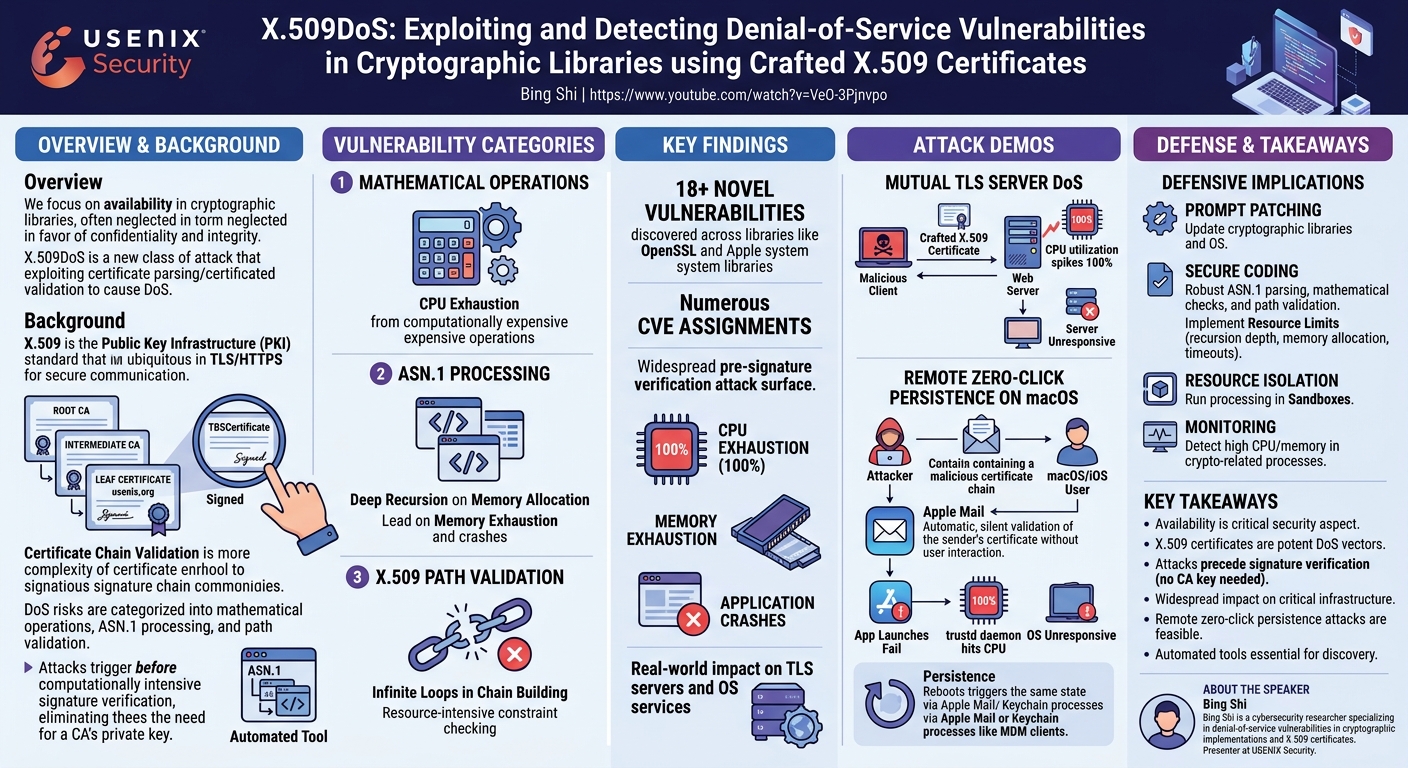
The research categorizes these DoS risks into three primary classes: mathematical operations, ASN.1 processing, and X.509 path validation. Within these categories, the study delves into 10 distinct types of behaviors and corresponding implementation flaws that can be exploited. A key insight of this work is that because these vulnerabilities manifest during the initial parsing or subsequent path validation stages—which occur before the computationally intensive and cryptographically significant signature verification step—an attacker can craft malicious certificates without needing access to a Certificate Authority's private key to resign them. This capability allows for arbitrary modification of certificate structures, making the exploitation of these DoS risks highly practical and dangerous. The intricate, nested structure of ASN.1 sequences in X.509 certificates further complicates manual crafting, necessitating automated tooling for effective research and exploitation.
Key Findings
▶ Watch: Categorizing DoS risks in crypto libraries (4:00)
The "X.509DoS" research uncovered a significant landscape of previously unaddressed availability vulnerabilities in widely used cryptographic libraries. Through systematic testing, Bing Shi and colleagues discovered over 18 distinct denial-of-service vulnerabilities, many of which have been responsibly disclosed to vendors and subsequently assigned CVE (Common Vulnerabilities and Exposures) numbers. These findings challenge the prevalent notion that cryptographic library vulnerabilities primarily concern confidentiality or integrity, highlighting the critical oversight of availability.
A central finding is the prevalence of exploitable flaws within the initial stages of X.509 certificate processing—specifically during parsing and path validation. This pre-signature verification attack surface is crucial because it eliminates the need for an attacker to possess a valid CA private key, allowing for the arbitrary crafting of malicious certificates. The identified vulnerabilities manifest in various forms, including CPU exhaustion, memory exhaustion, and application crashes, directly impacting the availability of services and systems.
To demonstrate the real-world impact, the study focused on vulnerabilities found in prominent cryptographic ecosystems, notably OpenSSL and Apple's system libraries. The research showcases how these vulnerabilities can be weaponized against critical infrastructure:
- Mutual TLS servers: An attacker acting as a malicious client can send a crafted certificate during a handshake, causing the server's CPU to reach 100% utilization and render the service unresponsive.
- Operating system security services: On macOS, a crafted certificate chain can trigger a DoS in the
trustddaemon, leading to applications failing to launch and potentially making the entire operating system unresponsive.
Furthermore, the research demonstrated a sophisticated remote zero-click persistence attack against Apple's ecosystem, leveraging crafted certificates sent via email. This attack vector highlights the severe implications of X.509DoS, as it can be triggered without user interaction and persist across reboots. The consistent presence of these vulnerabilities across diverse and widely adopted cryptographic implementations underscores a systemic weakness in how X.509 certificates are handled, necessitating a fundamental re-evaluation of security postures in this critical area.
Technical Deep Dive
▶ Watch: Automated tool and 18+ vulnerabilities discovered (5:30)
The technical foundation of X.509DoS lies in the intricate and often error-prone processing of X.509 certificates by cryptographic libraries. The vulnerabilities identified fall into three main categories, each targeting different aspects of certificate handling:
- Mathematical Operations: This category encompasses vulnerabilities where certain certificate field values, when processed, lead to computationally expensive or infinite mathematical operations. While the transcript does not provide specific examples, such issues often arise from edge cases in cryptographic algorithms or large number arithmetic within certificate extensions. For instance, excessively large prime numbers or malformed cryptographic parameters embedded within a certificate could trigger disproportionate CPU cycles or memory allocations during processing, leading to DoS.
- ASN.1 Processing: X.509 certificates are encoded using Abstract Syntax Notation One (ASN.1), a standard for representing data structures. ASN.1 processing is a highly complex task, especially when dealing with nested sequences, optional fields, and variable-length encoding. Vulnerabilities in this category typically involve crafted certificates that exploit parsing logic, leading to:
- Excessive loops: A maliciously constructed ASN.1 structure might cause a parser to enter an unexpectedly long loop when iterating through elements, consuming excessive CPU time.
- Deep recursion: Recursive parsing of deeply nested ASN.1 structures can exhaust the call stack, leading to a crash.
- Memory allocation issues: Incorrect handling of length fields or malformed data within ASN.1 sequences can trick parsers into allocating vast amounts of memory, leading to memory exhaustion and system instability or crashes. The speaker explicitly mentions the "complex nested ASN.1 sequence structure" as a challenge for manual crafting, implying that these structures are ripe for exploitation.
- X.509 Path Validation: This category focuses on flaws in the logic used to build and validate a certificate chain from the leaf certificate up to a trusted root. Path validation involves numerous checks, including signature verification (though the DoS occurs before this), validity periods, name constraints, policy constraints, and basic constraints. Vulnerabilities here could involve:
- Infinite loops in chain building: Crafted certificates might create a cyclical dependency or an extremely long, valid-looking chain that causes the validation engine to loop indefinitely or for an excessive duration.
- Resource-intensive constraint checking: Maliciously constructed constraints (e.g., extremely complex name constraints or policy OIDs) could force the validation engine to perform computationally prohibitive checks.
- Certificate revocation list (CRL) / Online Certificate Status Protocol (OCSP) processing: While not explicitly detailed in the transcript, issues related to malformed or excessively large CRLs or OCSP responses could also fall under path validation DoS if they are processed during the validation phase.
A critical technical detail emphasized by the speaker is that these vulnerabilities are exploitable during certificate parsing or path validation, which invariably happens before signature verification. This means that an attacker does not need to compromise a Certificate Authority's private key to sign a valid, malicious certificate. Instead, they can arbitrarily modify the certificate's structure and content, knowing that the DoS will trigger long before the cryptographic signature is ever checked, making these attacks highly practical and difficult to defend against at the cryptographic layer.
To facilitate the discovery and exploitation of these vulnerabilities, the researchers developed an automated tool. This tool streamlines the generation and modification of complex, crafted X.509 certificates, overcoming the challenge of manually manipulating ASN.1 structures. It also aids in the detection of DoS vulnerabilities by systematically submitting these crafted certificates to various cryptographic library APIs and monitoring resource consumption (CPU, memory) and system stability. This automated approach was instrumental in uncovering the reported "over 18 vulnerabilities" across different libraries.
Demo / Proof of Concept
▶ Watch: Threat Model 2: macOS app signature DoS (8:00)
The talk presented two compelling threat models and corresponding proofs of concept to illustrate the real-world impact of X.509DoS attacks.
1. Mutual TLS Handshake DoS against Web Servers:
The first demonstration focused on the mutual TLS handshake scenario, where both the server and the client present certificates for authentication. In this setup, an attacker assumes the role of a malicious client. During the initial handshake phase, the attacker sends a carefully crafted X.509 certificate to the target server. This certificate is engineered to exploit a DoS vulnerability within the server's underlying cryptographic library (e.g., OpenSSL).
Upon receiving and attempting to parse this malicious certificate, the server's CPU utilization rapidly spikes to 100%. By repeating this process across multiple connections or with a sufficiently potent single certificate, the attacker can exhaust all available CPU cores on the server. The immediate consequence is that the legitimate users attempting to access the website find it completely unresponsive, effectively achieving a denial-of-service on the remote server. This demo highlights how a vulnerability in a fundamental component like a cryptographic library can directly translate into crippling service outages for critical web infrastructure.
2. App Signature Verification DoS and Remote Zero-Click Persistence on macOS:
The second, and arguably more impactful, demonstration targeted Apple's ecosystem, specifically the mechanism for app signature verification on macOS. Operating systems like macOS rely on certificate verification to ensure that applications originate from trusted publishers and have not been tampered with. On macOS, app signatures and associated certificates are stored in a data blob referenced by a load command called LC_CODE_SIGNATURE. The verification process is handled by a specific system daemon named trustd. When a user attempts to open an app, another daemon, launchd, sends an XPC request to trustd to validate the app's certificates. The validation result, crucial for determining app launch permission, is returned via an XPC response.
The attack involves an attacker crafting a malicious certificate chain. If trustd's certificate validation implementation contains a DoS vulnerability, processing this chain causes trustd to become unresponsive, often reaching 100% CPU utilization. Consequently, any user attempting to open an app will find it unresponsive because trustd cannot properly respond to launchd's verification requests. As system resources continue to be consumed, this can eventually lead to the entire macOS becoming unresponsive.
The most alarming aspect of this threat model is the demonstration of a remote zero-click persistence attack. The attacker can craft an SMS email containing the malicious certificate chain and send it to the target user's Apple Mail address. Crucially, once the email arrives, Apple Mail automatically and silently triggers the validation of the sender's certificates, even if the user never opens or reads the email. This automatic validation immediately causes trustd to spike to 100% CPU utilization, rendering the system unresponsive. Furthermore, Apple Mail adds these certificates to the recipient's keychain.
The attack achieves persistence through two mechanisms:
- If the user reboots the device, and Apple Mail is configured to automatically restore or is manually reopened, the validation of the embedded certificates will be re-triggered, causing
trustdto become unresponsive again. - Since the certificates are added to the keychain, other processes like MDM (Mobile Device Management) clients might trigger validation of keychain certificates immediately upon user login after a reboot, leading to
trustd's unresponsiveness once more.
This remote zero-click persistence attack is not limited to macOS; the speaker notes that the same attack is applicable to iOS and other operating systems within Apple's ecosystem, highlighting a critical and widespread vulnerability affecting millions of devices.
Defensive Implications
▶ Watch: Remote macOS DoS exploit via crafted email (10:00)
The "X.509DoS" research provides critical insights for defenders, emphasizing the need to bolster the resilience of systems against availability attacks stemming from X.509 certificate processing. The primary defensive implications are multifaceted:
- Prompt Patching and Updates: The most immediate action for defenders is to ensure that all cryptographic libraries and operating systems are kept up-to-date with the latest security patches. The discovery of over 18 vulnerabilities, many with assigned CVEs, underscores the ongoing need for vigilance in applying vendor-provided fixes. This includes updating components like OpenSSL, system-level security daemons (e.g.,
trustdon macOS), and applications that process X.509 certificates.
- Secure Coding Practices for Cryptographic Library Developers: The research highlights systemic weaknesses in how X.509 certificates are handled. Developers of cryptographic libraries must adopt more robust secure coding practices, particularly concerning ASN.1 parsing, mathematical operations on untrusted inputs, and complex X.509 path validation logic. This includes:
- Implementing stringent input validation and sanitization for all certificate fields.
- Careful handling of recursive structures and deeply nested ASN.1 sequences to prevent stack exhaustion or infinite loops.
- Imposing resource limits (e.g., maximum recursion depth, maximum memory allocation for parsed structures, timeouts for complex computations) during certificate processing to gracefully degrade rather than crash or exhaust resources.
- Employing fuzzing techniques specifically tailored for X.509 and ASN.1 structures to uncover edge cases that could lead to DoS conditions. The automated tool developed in this research could serve as a model for such efforts.
- Resource Isolation and Sandboxing: Critical components responsible for certificate processing, such as system daemons like
trustd, should ideally operate within highly restricted environments or sandboxes. This limits the potential impact of a DoS vulnerability. If a certificate processing component exhausts its allocated resources, it should not be able to bring down the entire system or other critical services. Implementing robust process isolation and resource quotas can contain the blast radius of such attacks.
- Monitoring and Anomaly Detection: Organizations should implement enhanced monitoring for unusual resource consumption (CPU, memory) in processes known to handle X.509 certificates. This includes:
- Monitoring web servers for sudden spikes in CPU utilization during TLS handshakes, especially when processing client certificates in mutual TLS setups.
- Monitoring system daemons (e.g.,
trustdon macOS/iOS) for sustained high CPU usage or crashes, which could indicate an ongoing X.509DoS attack. - Alerting on unusual network traffic patterns related to certificate exchanges.
- Awareness of Remote Zero-Click Vectors: The remote zero-click persistence attack via Apple Mail serves as a stark reminder that seemingly innocuous actions (like receiving an email) can trigger severe system-level DoS. Users and administrators should be aware of these vectors and the importance of timely OS and application updates, especially for mail clients and operating system security components.
By addressing these defensive implications, the security community can move towards a more resilient posture against the often-overlooked threat of denial-of-service attacks facilitated by crafted X.509 certificates.
Key Takeaways
- Availability is a Neglected but Critical Security Aspect: Traditional cryptographic vulnerability research often overlooks Denial-of-Service (DoS) attacks, focusing instead on confidentiality and integrity. The X.509DoS research highlights that availability threats, particularly those stemming from cryptographic implementations, warrant equal attention.
- X.509 Certificates are Potent DoS Vectors: The complex and intricate structure of X.509 certificates, combined with the extensive logic required for their parsing and validation, creates a significant attack surface for resource exhaustion and system crashes.
- Attacks Precede Signature Verification: A critical enabler for X.509DoS is that vulnerabilities can be exploited during certificate parsing or path validation, before the cryptographic signature is verified. This means attackers do not need a Certificate Authority's private key to craft effective malicious certificates.
- Widespread Impact on Critical Infrastructure: DoS vulnerabilities were found in widely used cryptographic libraries like OpenSSL and within Apple's ecosystem, demonstrating the potential to render web servers unresponsive and even crash entire operating systems (macOS, iOS).
- Remote Zero-Click Persistence Attacks are Feasible: The research demonstrated a severe remote zero-click persistence DoS attack against macOS and iOS, where a crafted certificate sent via email can automatically trigger system unresponsiveness and persist across reboots, without any user interaction.
- Automated Tools are Essential for Discovery and Exploitation: Due to the complexity of X.509 and ASN.1 structures, automated tools are crucial for efficiently generating, modifying, and testing crafted certificates to discover and demonstrate these types of DoS vulnerabilities.
About the Speaker(s)
Bing Shi is a researcher whose work focuses on uncovering and understanding denial-of-service vulnerabilities within cryptographic libraries, particularly those related to X.509 certificates. His research, as presented at USENIX Security, emphasizes the overlooked aspect of availability in cryptographic security. He is dedicated to exploring how crafted inputs, specifically X.509 certificates, can be leveraged to exploit flaws in complex parsing and validation logic, leading to critical resource exhaustion or system crashes. His work involves developing automated tools for vulnerability discovery and demonstrating real-world threat models against widely used systems and services.
Reviews
Dr. Zero (Offensive Security Researcher) — STRONG ACCEPT
Solid USENIX-quality research that carves out a genuinely underexplored attack surface: DoS via maliciously crafted X.509 certificates exploitable before signature verification, with 18+ CVEs and a particularly nasty zero-click persistence demo against Apple's trustd. The pre-sig-verify insight is the real contribution — it collapses the attacker's barrier to near zero and makes the entire class of bugs immediately weaponizable at scale.
Heather Calloway (CISO) — WEAK
Technically credible research with a genuinely alarming finding — the Apple zero-click persistence attack — but the talk fails to cross the gap from vulnerability disclosure to operational or governance relevance. Defenders and security leaders leave with patch advice they already knew, not a changed understanding of risk ownership or program posture.
→ Top-rated talks at 34th USENIX Security Symposium (USENIX Security '25)
All talks from 34th USENIX Security Symposium (USENIX Security '25)