CoVault: Secure, Scalable Analytics of Personal Data
Roberta De Viti
34th USENIX Security Symposium (USENIX Security '25) · Day 1 · System Security 1: Threat Detection, Exploitation, and Adaptive Defenses
Overview
This article details the findings presented in the USENIX Security paper "X.509DoS: Exploiting and Detecting Denial-of-Service Vulnerabilities in Cryptographic Libraries using Crafted X.509 Certificates." Authored by a team of researchers from Alibaba Group and Indiana University Bloomington, led by Bing Shi, the paper addresses a critical, yet often overlooked, facet of cryptographic security: Denial-of-Service (DoS) vulnerabilities. While previous research has predominantly focused on confidentiality and integrity within the CIA Triad, this work shines a spotlight on availability, revealing how cryptographic libraries, despite their foundational role in security, are susceptible to DoS attacks.
Read the paper · Download the PDF (PDF) · Slides
Paper abstract
Existing studies predominantly focus on cryptographic vulnerabilities affecting confidentiality or integrity, with limited attention to those impacting availability. To fill this gap, we conduct a comprehensive study targeting implementations vulnerable to DoS (Denial-of-Service) attacks within cryptographic libraries. Notably, we observed that these vulnerable implementations are frequently associated, directly or indirectly, with X.509 certificates. Consequently, we facilitate the launch of DoS attacks by using crafted X.509 certificates as attack vectors, which we termed X.509DoS in this work. Leveraging the tool we developed for rapid generation of crafted certificates and detection of DoS vulnerabilities, we successfully discovered 18 new vulnerabilities and identified 12 previously known CVEs across seven mainstream cryptographic libraries. Our findings demonstrate the effectiveness of exploiting and detecting DoS vulnerabilities via X.509 certificates, revealing that X.509DoS is a widespread threat that has not been well-studied previously. Our work also shows that strict adherence to textbooks or standards does not guarantee security, highlighting the need for cryptographic library developers to pay more attention to real-world considerations.
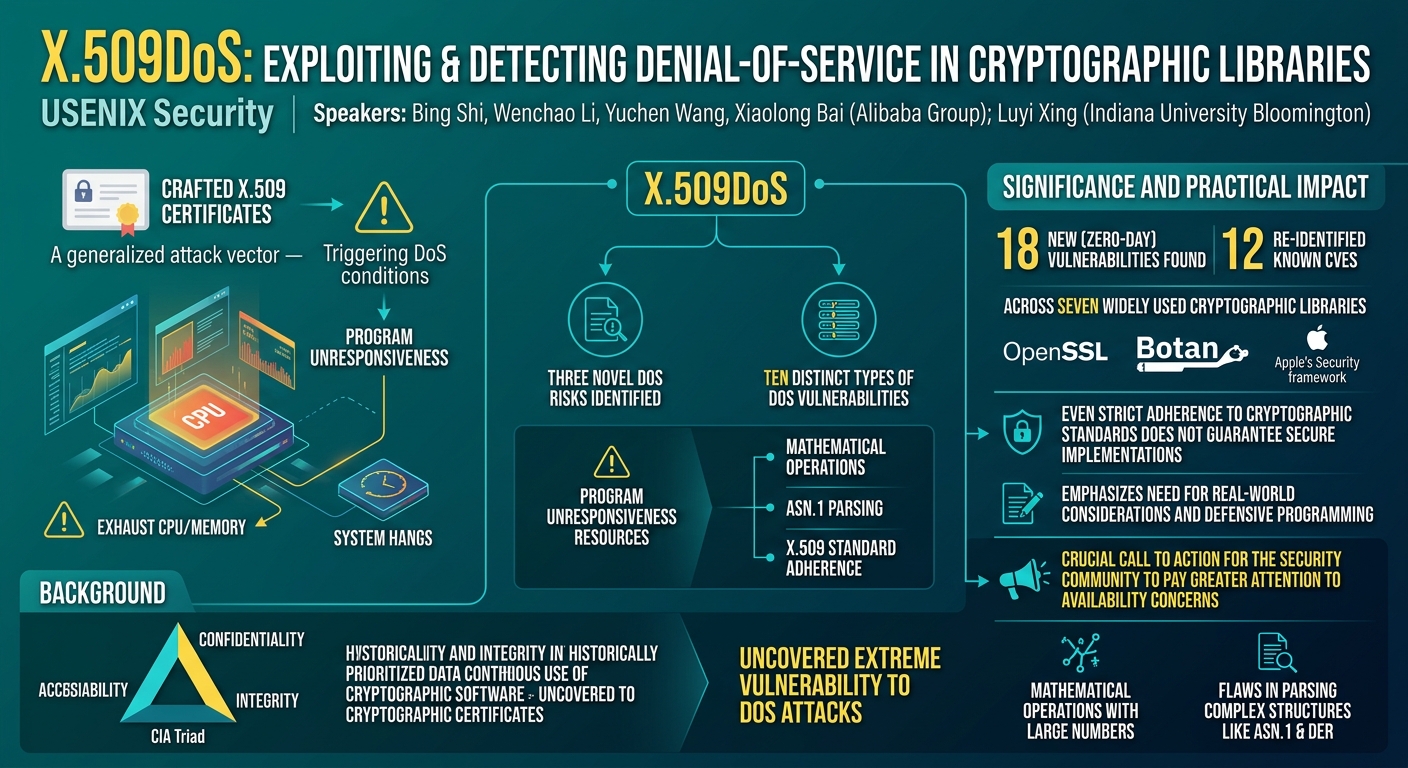
X.509DoS: Exploiting and Detecting Denial-of-Service Vulnerabilities in Cryptographic Libraries using Crafted X.509 Certificates
Speakers: Bing Shi, Wenchao Li, Yuchen Wang, Xiaolong Bai (Alibaba Group); Luyi Xing (Indiana University Bloomington)
Conference: USENIX Security
YouTube: This article is based on a peer-reviewed conference paper, not a recorded talk. Therefore, no video or YouTube URL is available.
Overview
This article details the findings presented in the USENIX Security paper "X.509DoS: Exploiting and Detecting Denial-of-Service Vulnerabilities in Cryptographic Libraries using Crafted X.509 Certificates." Authored by a team of researchers from Alibaba Group and Indiana University Bloomington, led by Bing Shi, the paper addresses a critical, yet often overlooked, facet of cryptographic security: Denial-of-Service (DoS) vulnerabilities. While previous research has predominantly focused on confidentiality and integrity within the CIA Triad, this work shines a spotlight on availability, revealing how cryptographic libraries, despite their foundational role in security, are susceptible to DoS attacks.
The core contribution of this research is the identification of crafted X.509 certificates as a generalized and potent attack vector for triggering DoS conditions. The authors introduce the term X.509DoS to describe these attacks, demonstrating that malicious certificates can be engineered to exhaust system CPU or memory resources, leading to program unresponsiveness or complete system hangs. The paper not only uncovers three novel DoS risks but also synthesizes ten distinct types of DoS vulnerabilities exploitable through this vector, encompassing issues related to mathematical operations, ASN.1 parsing, and X.509 standard adherence.
The significance of this study is underscored by its practical impact: the researchers successfully discovered 18 new (zero-day) vulnerabilities and re-identified 12 previously known CVEs across seven widely used cryptographic libraries, including OpenSSL, Botan, and Apple's Security framework. The findings highlight that even strict adherence to cryptographic textbooks and standards does not guarantee secure implementations, emphasizing the need for developers to integrate robust real-world considerations and defensive programming practices. This work serves as a crucial call to action for the security community to pay greater attention to availability concerns in cryptographic software.
Background
The landscape of cryptographic security research has historically emphasized vulnerabilities impacting confidentiality (e.g., side-channel attacks) and integrity (e.g., hash collisions). The CIA Triad (Confidentiality, Integrity, Availability) serves as a fundamental model for assessing security impacts, yet availability-related risks, particularly DoS vulnerabilities, have received comparatively limited attention in cryptographic implementations. This phenomenon stems from a common misconception that cryptography primarily secures data in terms of secrecy and authenticity, with a lesser role in maintaining system availability.
However, this paper challenges that assumption, observing that cryptographic libraries are inherently vulnerable to DoS attacks due to two intrinsic characteristics. Firstly, cryptographic implementations frequently involve mathematical operations with large numbers (e.g., 1024-bit integers), which are rarely encountered in non-cryptographic contexts. Inefficient handling of these large numbers can lead to excessive computation. Secondly, these implementations often deal with complex structures and encoding rules, such as ASN.1 (Abstract Syntax Notation One) and DER (Distinguished Encoding Rules), which are intricately designed for structured data exchange. Flaws in parsing these complex structures can also be exploited.
To validate this observation, the researchers conducted an in-depth audit of seven highly popular third-party cryptographic libraries: OpenSSL, Botan, Bouncy Castle, Crypto++, GnuTLS, phpseclib, and Apple's platform-specific Security framework. These libraries are foundational components in numerous secure communication protocols and applications. The audit specifically focused on how mathematical computations or structure parsing methods could introduce DoS risks.
Central to this research is an understanding of the underlying technologies. Public-key cryptography often relies on the difficulty of mathematical problems, frequently involving finite fields like Fp (prime field) and F2m (binary extension field). Operations in these fields, such as addition, multiplication, squaring, and inversion, are critical for algorithms like Elliptic Curve Cryptography (ECC) and ECDSA (Elliptic Curve Digital Signature Algorithm). The representation of elements in F2m, for instance, can involve polynomials represented as bit strings, which are then stored in word vectors for efficiency. Crucially, operations like deriving the y-coordinate for an ECC point from its x-coordinate often involve solving quadratic equations or finding square roots, which can be computationally intensive.
ASN.1 is an interface description language used to define structured data, and DER specifies how ASN.1 objects are encoded into a byte stream using a TLV (Tag, Length, Value) triplet structure. The Tag identifies the type, Length specifies content size, and Value holds the data. DER supports primitive types (e.g., INTEGER, OID) and structured types (e.g., SEQUENCE, CHOICE), allowing for hierarchical nesting. OBJECT IDENTIFIERs (OIDs), used extensively in X.509, have specific DER encoding rules that involve converting dot-decimal integers into base-128 sub-identifiers. PEM (Privacy-Enhanced Mail) encoding, which uses Base64, is often used to transmit binary DER data over ASCII-only systems.
X.509 is the widely used ASN.1-based certificate format, standardizing certificate structure with fields like tbsCertificate, signatureAlgorithm, and signatureValue. Key components within a certificate include issuer, subject (containing type-value pairs like commonName and emailAddress), and subjectPublicKeyInfo (specifying the algorithm and public key data). For ECC public keys, parameters might reference a named curve, and the public key data often involves x and y coordinates, potentially in a compressed format that requires decompression algorithms. Path validation is another critical process, involving verifying certificate chains, checking signatures, and evaluating extensions like nameConstraints and certificatePolicies, which can involve complex tree traversals and comparisons. The attack model for X.509DoS is built on the premise that certificate parsing or validation occurs before signature verification, allowing adversaries to craft malicious certificates without needing a private key for re-signing.
Key Findings
The comprehensive study on Denial-of-Service vulnerabilities in cryptographic libraries yielded several significant findings, demonstrating the widespread and underexplored nature of X.509DoS attacks:
- Discovery of Novel DoS Risks: The research identified three previously unexamined DoS risks within cryptographic library implementations, specifically related to the handling of mathematical operations in finite fields and ASN.1 structure parsing. These novel risks form a crucial part of the generalized attack surface.
- Generalized Attack Vector: Crafted X.509 Certificates: The study established crafted X.509 certificates as a unified and highly effective attack vector to exploit DoS vulnerabilities. This vector can trigger a total of 10 distinct types of DoS risks, including the three newly discovered ones, by manipulating specific fields and structures within certificates or certificate chains.
- Widespread Vulnerability: Through rigorous testing, the researchers successfully discovered 18 new (zero-day) vulnerabilities across seven mainstream cryptographic libraries: OpenSSL, Botan, Bouncy Castle, Crypto++, GnuTLS, phpseclib, and Apple's Security framework. These findings were responsibly disclosed, with many already assigned CVE numbers (e.g., CVE-2024-34703, CVE-2024-54538) or in the process of assignment.
- Identification of Known CVEs: Beyond novel discoveries, the research also successfully identified 12 previously known CVEs in historical versions of these libraries, validating the effectiveness and completeness of their detection methodology.
- Effectiveness and Efficiency of X.509DoSTool: The authors developed an automated tool, X.509DoSTool, for rapid generation of crafted certificates and detection of DoS vulnerabilities. Evaluation demonstrated that the tool is both effective and efficient, accurately identifying vulnerabilities without false positives and covering a broad range of potential DoS risks.
- Real-world Threat Demonstration: The practical impact of X.509DoS was demonstrated through successful proof-of-concept attacks. This included launching DoS attacks against a web server developed with Botan during a TLS handshake and against Apple's macOS operating system via its fundamental Security framework and the
trustdprocess, leading to system-wide unresponsiveness. - Limitations of Standard Adherence: A crucial insight from the work is that strict adherence to cryptographic textbooks or standards alone does not guarantee security. The paper highlights the necessity for cryptographic library developers to pay greater attention to real-world implementation considerations, including robust input validation and resource management, especially when handling data from untrusted sources.
- Comprehensive Coverage: The detection approach systematically covers DoS risks arising from three logically related aspects: the X.509 certificate (or chain) itself, the ASN.1 implementation used for decoding, and the mathematical implementation supporting cryptographic algorithms within the certificate.
Technical Deep Dive
The technical foundation of X.509DoS attacks lies in exploiting specific implementation flaws within cryptographic libraries, particularly those related to mathematical operations, ASN.1 parsing, and X.509 certificate validation. The paper categorizes these into 10 distinct risks, detailing three novel ones in Section 4 and expanding on their exploitation via crafted X.509 certificates in Section 5.
Novel DoS Risks in Cryptographic Libraries
The researchers identified three new categories of DoS risks:
- Risk-1 (Math I/II: Performing arithmetic operations in F2m - No limit on the size of m):
- Flaw: Implementations of finite field arithmetic in F2m, such as multiplication, squaring, reduction, or inversion, often involve loops iterating
mtimes (wheremis the degree of the reduction polynomial). If there are no restrictions on the size ofm, an attacker can provide an excessively largem(e.g., greater than 2^32). - Impact: This leads to pseudo-infinite loops (CWE-834) causing CPU exhaustion. Additionally, operations like string initialization for large
mcan result in one-time memory exhaustion (CWE-789). - Example Operations: The "shift-and-add" multiplication algorithm (Algorithm 1 in the paper) and the algorithm for solving quadratic equations
z^2 + z = β(Algorithm 2) both exhibitm-iteration loops.
- Risk-2 (Math III: Performing reduction in F2m - No check on the order of the indices):
- Flaw: Optimized reduction algorithms for specific polynomials like
f(x) = x^m + x^t + 1(Algorithm 3) often use an array of indices (e.g.,idxs = {m, t}). Implementations implicitly assumet < mand sorted indices. Ift > mor the order is not checked, calculations likem - tcan result in negative values. - Impact: In languages like C++,
m - tcould lead to negative overflow, turning into a very large positive number, which when used as an array index, causes an out-of-bounds error (CWE-129) and ultimately a crash. Similar issues arise when generating bit strings from unsortedidxs(Listing 1).
- Risk-5 (ASN.1 I: Decoding ASN.1 objects in structured types - No limit on the number of elements):
- Flaw: When parsing ASN.1 objects of structured types (e.g., SEQUENCE, CHOICE), some implementations lack limits on the number of elements. If each element involves additional processing (e.g., handling CHOICE types, traversing parent nodes, or GUI-related layout constraints), a large number of elements can accumulate significant computational overhead.
- Impact: This leads to CPU exhaustion due to excessive iteration and redundant path traversals, especially with deeply nested structures.
Generalized Attack Vector: Crafted X.509 Certificates
The researchers developed specific methodologies, termed "Exploits," to leverage crafted X.509 certificates to trigger these and other DoS risks. The core idea is to embed malicious parameters or structures within the certificate that, when parsed by a vulnerable library, lead to resource exhaustion or crashes. The attack model assumes parsing/validation precedes signature verification, thus no private key is needed.
Here's how some of the key risks are exploited:
- Exploit-1 (Targets Risk-1, Math I/II):
- Method: Generate a standard certificate with an E(F2m) public key (e.g.,
sect233k1). Modify the value ofmto be extremely large (e.g., > 2^32). Crucially, adjust the public key point to its compressed form (prefix0x03). - Trigger: Point decompression requires solving a quadratic equation (Algorithm 2) to recover the y-coordinate, which involves
m-iteration loops and F2m arithmetic, leading to CPU/memory exhaustion.
- Exploit-2 (Targets Risk-2, Math III):
- Method: Craft a certificate with an E(F2m) public key where the parameters
mandtfor the reduction polynomialf(x) = x^m + x^t + 1are swapped or set such thatm < t. - Trigger: During point decompression (which involves reduction), the
m < tcondition triggers out-of-bounds access in the optimized reduction algorithm (Algorithm 3), causing a crash.
- Exploit-3 (Targets Risk-3, Math I):
- Flaw: Lack of primality check on
pwhen computing square roots modulopin Fp. - Method: Generate a certificate with an E(Fp) public key (e.g.,
secp256k1). Modifypto a composite number, and use a compressed public key point. - Trigger: Finding square roots modulo
pfor point decompression becomes extremely complex or enters inefficient paths whenpis composite, leading to CPU exhaustion.
- Exploit-4 (Targets Risk-4, Math I):
- Flaw: Lack of size constraint on
pwhen performing primality testing (e.g., Miller-Rabin). - Method: Modify
pin the certificate's public key to a very large prime number (e.g., a Mersenne prime like 2^21701 - 1). - Trigger: If the library performs a primality check on
p(either explicitly or as a mitigation for Risk-3), the immense size ofpcauses significant CPU exhaustion during the primality test.
- Exploit-5 (Targets Risk-5, ASN.1 I):
- Method: Utilize X.509 fields defined as SEQUENCE OF, such as
subjectAltNameornameConstraintswithin theextensionsfield. Populate these fields with an extremely large number of elements (e.g., 2^15 subject alternative names). - Trigger: The parsing process involves extensive decoding and iteration for each element, accumulating time overhead and leading to CPU exhaustion.
- Exploit-6 (Targets Risk-6, ASN.1 II):
- Flaw: Failure to check if the length specified in the DER Length field matches the actual data length.
- Method: Craft a DER-encoded object where the Length field claims an enormous size, but the Value field is empty or very small. For example, for a
commonNameattribute (UTF8String), use0x0C, 0x85, 0x05, 0x00, 0x00, 0x00, 0x00. Here,0x85indicates a long form length of 5 bytes, claiming a length of0x0500000000(which is 20GB). - Trigger: The library attempts to allocate 20GB of memory for string initialization, causing immediate memory exhaustion and a crash.
- Exploit-7 (Targets Risk-7, ASN.1 I/II):
- Flaw: Lack of size limitation on sub-identifiers when decoding a DER-encoded OID.
- Method: Modify an OID (e.g., for
commonName) to contain an arbitrarily large number of0xFFbytes, ending with0x7F. This creates a massive sub-identifier when decoded (e.g.,0x06, A, BwhereBis0x55followed by many0xFFs and a0x7F). - Trigger: Decoding this large sub-identifier incurs significant time overhead (CPU exhaustion) and potentially excessive memory allocation if the OID's dotted-decimal representation is handled as a string.
- Exploit-8 (Targets Risk-8, X.509 I):
- Flaw: No limits on the number of names or constraints during path validation.
- Method: Generate a certificate chain where each certificate contains a large number (e.g., 2^16) of
subjectAltNameentries and correspondingnameConstraintsin intermediate CAs. Configure them to maximize comparison iterations (e.g., only the last name matches, or no names match excluded subtrees). - Trigger: The extensive comparisons during path validation lead to severe CPU exhaustion.
- Exploit-9 (Targets Risk-9, X.509 I/II):
- Flaw: No limits on the number of nodes created during policy tree construction.
- Method: Craft a certificate chain where each certificate asserts two policies (OID1, OID2) and, except for the leaf, includes a complete Cartesian product mapping between them.
- Trigger: This constructs a rapidly growing policy tree (e.g., a perfect binary tree with
2^l - 1nodes for depthl=32), causing gradual memory exhaustion during path validation.
- Exploit-10 (Targets Risk-10, X.509 I/II):
- Flaw: Failure to detect cycles in the issuer relationships during certificate path initialization.
- Method: Create three certificates
cert1, cert2, cert3such thatcert1is issued bycert2,cert2bycert3, andcert3bycert1, forming a cycle. - Trigger: When the library attempts to build the certification path and search for the root, it enters an infinite loop, leading to CPU exhaustion.
Tool Development: X.509DoSTool
To automate these complex attacks and detections, the researchers developed X.509DoSTool. This Python-based tool comprises two main modules:
- Composer: Handles certificate generation and modification.
generatecommand: Creates normal certificates using OpenSSL and then modifies them according to the exploit methodologies (e.g., for largem,p, or manysubjectAltNameentries). It can also generate malicious certificate chains.editcommand: Provides fine-grained modification of DER-encoded data (TLV triplets) for specific fields, essential for exploits like Risk-6 and Risk-7 that violate standard re-encoding.- Detector: Automates vulnerability detection.
- Executes shell scripts that call target cryptographic library APIs to parse certificates or validate chains.
- Uses
psutilto monitor CPU and memory consumption of the library process. - Defines thresholds (e.g., 80% average CPU utilization over 10 seconds, 50% average monotonically increasing memory utilization over 5 seconds) to identify resource exhaustion.
- Analyzes error messages for crashes.
The tool provides an efficient way to test libraries against X.509DoS threats, enabling the discovery of new vulnerabilities and the re-identification of known ones.
Demo / Proof of Concept
The researchers conducted compelling demonstrations of X.509DoS attacks using newly discovered vulnerabilities to illustrate the real-world impact on typical scenarios like TLS handshakes and application signature verification.
Attack on TLS Handshake (Botan)
Using Botan v3.2.0 (the latest version before the fix) and a vulnerability related to Risk-4 (primality testing of large p), the team demonstrated DoS attacks in both one-way and mutual TLS authentication.
- One-Way Authentication (Client DoS): A malicious server was deployed using
tls_serverwith a pre-crafted certificate designed to exploit Risk-4. When a client (usingtls_client) connected, the client's Botan process rapidly escalated to 100% CPU utilization, rendering it unresponsive. This shows how a malicious server could easily take down a client application by simply sending a malformed certificate. - Mutual Authentication (Server DoS): In this scenario, a malicious client initiated a connection to an HTTPS website configured with mutual authentication (Botan's Hybrid TLS Test Server project). The client sent a crafted certificate, exploiting the same Risk-4 vulnerability. The server's Botan process quickly reached 100% CPU utilization, and repeated attacks could exhaust all CPU cores. Consequently, accessing the website's URL in a browser showed it was no longer accessible, demonstrating a successful server-side DoS against an HTTPS service.
- Note on TLS Message Injection: The paper also noted that in implementations where certificates are parsed locally before transmission, an adversary could use TLS message injection to replace a valid certificate with a crafted one mid-handshake, making the recipient vulnerable even if the sender's local parsing is robust.
Attack on App Verification (Apple Security)
A particularly severe demonstration involved the Apple Security framework on macOS Sonoma v14.6.1, leveraging a newly discovered vulnerability related to Risk-8 (excessive name constraints), identified as CVE-2024-54538. The attack targeted trustd, a critical system component responsible for system-wide certificate validation and app signature verification.
- Local Attack: By simply double-clicking a crafted certificate chain on macOS, the validation process was triggered. Activity Monitor showed
trustd's CPU usage quickly reaching 100%. This renderedtrustdunresponsive, preventing any application from launching and ultimately leading to a complete system-wide hang, making macOS unresponsive. - Remote Attack (0-click, Persistent): A more potent attack involved sending an S/MIME email containing the crafted certificate chain to the victim's email address. When the built-in Mail app on macOS received the email, it automatically added the certificate chain to the Keychain without user interaction or notification (0-click). This implicit action triggered certificate chain validation by
trustd, leading to the same system-wide DoS. The attack exhibited three critical characteristics: - Remote: Launched by sending an email.
- 0-click: No user interaction required.
- Persistent: The email and certificates are stored persistently. Upon system reboot, macOS attempts to restore previously opened apps, which triggers
trustdto validate signatures, causing the DoS to recur automatically. Furthermore, in enterprise MDM (Mobile Device Management) environments, themdmclientprocess iterates all Keychain certificates immediately after login, causing the DoS to recur even before apps are restored. Apple has acknowledged the severity of this remote attack.
Impact vs. Certificate Size
The researchers also quantified the relationship between the impact of a DoS attack and the size of the crafted certificate (in PEM format). For vulnerabilities related to Risk-5 (no limit on elements), Risk-7 (large OID sub-identifiers), and Risk-8 (many name constraints) on macOS (Vulnerabilities No. 16, 17, and 18 in Table 3):
- Vulnerability No. 16 (Risk-5): Increasing the number of
subjectAltNameentries from 1000 to 3000 (certificate size from 6KB to 24KB) linearly increased the CPU exhaustion duration from ~3 seconds to ~200 seconds. - Vulnerability No. 17 (Risk-7): Increasing the value of the crafted OID sub-identifier (certificate size from 70KB to 153KB) proportionally increased maximum memory allocation from ~9GB to ~37GB.
- Vulnerability No. 18 (Risk-8): For a certificate chain of depth 3, increasing
subjectAltNameandnameConstraintsfrom 5000 to 20000 per certificate (chain size from 0.27MB to 1.5MB) significantly increased CPU exhaustion duration from ~12 seconds to ~293 seconds. The 1.5MB chain was sufficient to render macOS completely unresponsive.
These demonstrations provide concrete evidence of the practical feasibility and severe consequences of X.509DoS attacks, underscoring the urgency of addressing these vulnerabilities.
Defensive Implications
The X.509DoS research highlights critical areas for improving the security posture of cryptographic libraries and systems. Mitigation strategies should be multi-faceted, encompassing direct vulnerability fixes, improved programming practices, and re-evaluation of feature sets.
- Direct Vulnerability Remediation: The most immediate defensive measure is to implement explicit checks for the 10 identified DoS risks. This includes:
- Size Constraints: Enforcing strict upper bounds on the size of
min F2m arithmetic (Risk-1), the length of the Length field in DER (Risk-6), and the size of OID sub-identifiers (Risk-7). - Input Validation: Thoroughly validating the order and relationships of parameters, such as the
idxsarray for F2m reduction (Risk-2), to prevent out-of-bounds access. - Primality Checks: Ensuring proper primality testing for
pin Fp operations and imposing limits on the size of numbers subjected to such tests (Risks 3 and 4). - Element Limits: Setting maximum limits on the number of elements in ASN.1 structured types (Risk-5), subject alternative names, and name constraints in X.509 certificates (Risk-8).
- Cycle Detection: Implementing robust mechanisms to detect and prevent cycles in certificate chains during path building (Risk-10) and policy tree construction (Risk-9).
- Adherence to Secure Programming Practices: Beyond specific vulnerability fixes, developers should adopt general secure coding principles:
- Resource Throttling: Introduce counters in complex loops (especially
whileloops) to ensure they terminate after a predefined number of iterations, preventing pseudo-infinite loops. - Memory Allocation Limits: Implement pre-allocation checks to ensure that requested memory sizes do not exceed predefined thresholds before allocating indeterminate amounts of memory, preventing large-scale one-time memory exhaustion.
- Input Sanitization: While X.509DoS focuses on crafted valid-looking inputs, the underlying principle of robust input handling for all unstructured user inputs is paramount.
- Efficient Implementations and Attack Cost: Cryptographic library developers should prioritize efficient algorithms. Even if security checks on parameters are missed, using more performant implementations (e.g., optimized F2m multiplication algorithms) can significantly increase the computational cost for an attacker to achieve a DoS, effectively mitigating the practical impact of certain vulnerabilities. Additionally, systems consuming certificates can impose size limits on incoming certificates (e.g., OpenSSL's default 100 KiB maximum certificate size in TLS), which can act as a partial defense against attacks requiring large certificate sizes (e.g., Exploit-5, Exploit-7, Exploit-8).
- Re-evaluation and Deprecation of Redundant Features: The research implicitly suggests that reduced functionality can sometimes lead to fewer attack surfaces. While not a primary defense strategy, developers should critically evaluate the necessity of features based on the library's intended use. For instance, early ECC standards allowed custom curve parameters, a feature later prohibited by RFC 5480. Many libraries still support this for backward compatibility. Future versions should consider deprecating such features, focusing on rigorously evaluated, NIST-recommended curves to reduce complexity and potential attack vectors.
- Certificate Authority (CA) Vigilance: It's crucial to recognize that X.509DoS exploits occur during certificate parsing or validation, which precedes signature verification. This means that self-signed certificates are sufficient, and attacks do not rely on certificates from trusted CAs. However, CAs themselves process Certificate Signing Requests (CSRs). If CSRs embed crafted components related to the identified mathematical, ASN.1, or X.509 risks, CAs could either issue a malicious certificate (especially for Exploit-7 to Exploit-10, which don't compromise CSR validity) or their own servers could be subjected to DoS attacks when parsing these crafted requests. CAs should therefore enhance their validation processes for CSRs to identify and reject such malicious constructs.
By implementing these defensive strategies, the security community can significantly strengthen cryptographic libraries against the widespread and often-overlooked threat of X.509DoS attacks, enhancing the overall availability of systems reliant on secure communications.
Key Takeaways
- Availability is a Neglected Threat: DoS vulnerabilities in cryptographic libraries are a significant and understudied area, often overshadowed by confidentiality and integrity concerns, despite their critical impact on system availability.
- X.509 Certificates are a Potent Attack Vector: Crafted X.509 certificates serve as a generalized and effective attack vector, dubbed X.509DoS, capable of exploiting a wide range of DoS vulnerabilities in cryptographic implementations.
- Standards Alone Are Insufficient: Strict adherence to cryptographic textbooks or standards does not guarantee secure implementations; robust real-world considerations, input validation, and resource management are crucial.
- Widespread Vulnerabilities Discovered: The research uncovered 18 new (zero-day) vulnerabilities and re-identified 12 known CVEs across seven mainstream cryptographic libraries, demonstrating the prevalence of these issues.
- Severe Real-World Impacts: X.509DoS attacks can lead to severe consequences, ranging from application crashes and web server inaccessibility to complete system-wide DoS, as demonstrated by attacks on Botan-based servers and Apple's macOS
trustdprocess. - Multi-Faceted Mitigation Required: Defending against X.509DoS necessitates a comprehensive approach, including specific checks for identified risks, general secure programming practices, deprecation of redundant features, and increased vigilance from Certificate Authorities.
About the Speaker(s)
The research presented in this paper was a collaborative effort by Bing Shi, Wenchao Li, Yuchen Wang, and Xiaolong Bai from Alibaba Group, alongside Luyi Xing from Indiana University Bloomington. These researchers are engaged in the field of software security, with a particular focus on identifying and mitigating vulnerabilities within critical software components like cryptographic libraries. Their collective expertise spans areas such as cryptographic implementation analysis, vulnerability discovery, and the development of automated security tools. Through this work, they contribute significantly to enhancing the understanding and defense against Denial-of-Service attacks in widely used cryptographic systems.
Reviews
Dr. Zero (Offensive Security Researcher) — STRONG ACCEPT
Solid systems security work that systematically maps a neglected attack surface. The 10-risk taxonomy is genuinely useful, the 18 zero-days across seven libraries demonstrate real impact, and the Apple macOS 0-click attack chain is the kind of finding that justifies the whole paper. Not groundbreaking exploitation technique, but thorough and actionable.
Heather Calloway (CISO) — STRONG ACCEPT
Solid vulnerability research with direct operational relevance. Eighteen zero-days across foundational crypto libraries—including OpenSSL, Botan, and Apple Security—means this isn't theoretical. The macOS attack chain (remote, 0-click, persistent via S/MIME) is the kind of finding that changes procurement conversations and MDM policy.
→ Top-rated talks at 34th USENIX Security Symposium (USENIX Security '25)
All talks from 34th USENIX Security Symposium (USENIX Security '25)