SpeechGuard: Recoverable and Customizable Speech Privacy Protection
Jingmiao Zhang (University of Science and Technology of China)
34th USENIX Security Symposium (USENIX Security '25) · Day 3 · Privacy 2: Consent, Compliance, and Provable Privacy
Overview
In an era where speech data permeates nearly every aspect of daily life – from voice assistants and online meetings to social media and smart cars – the imperative for robust privacy protection has never been more critical. The USENIX Security talk, "SpeechGuard: Recoverable and Customizable Speech Privacy Protection," delivered by Jingmiao Zhang from the University of Science and Technology of China, introduces a pioneering system designed to address the multifaceted privacy challenges inherent in spoken information. This work stands out by not only safeguarding sensitive speech data but also by ensuring its recoverability for authorized parties and offering unparalleled customizability in access control.
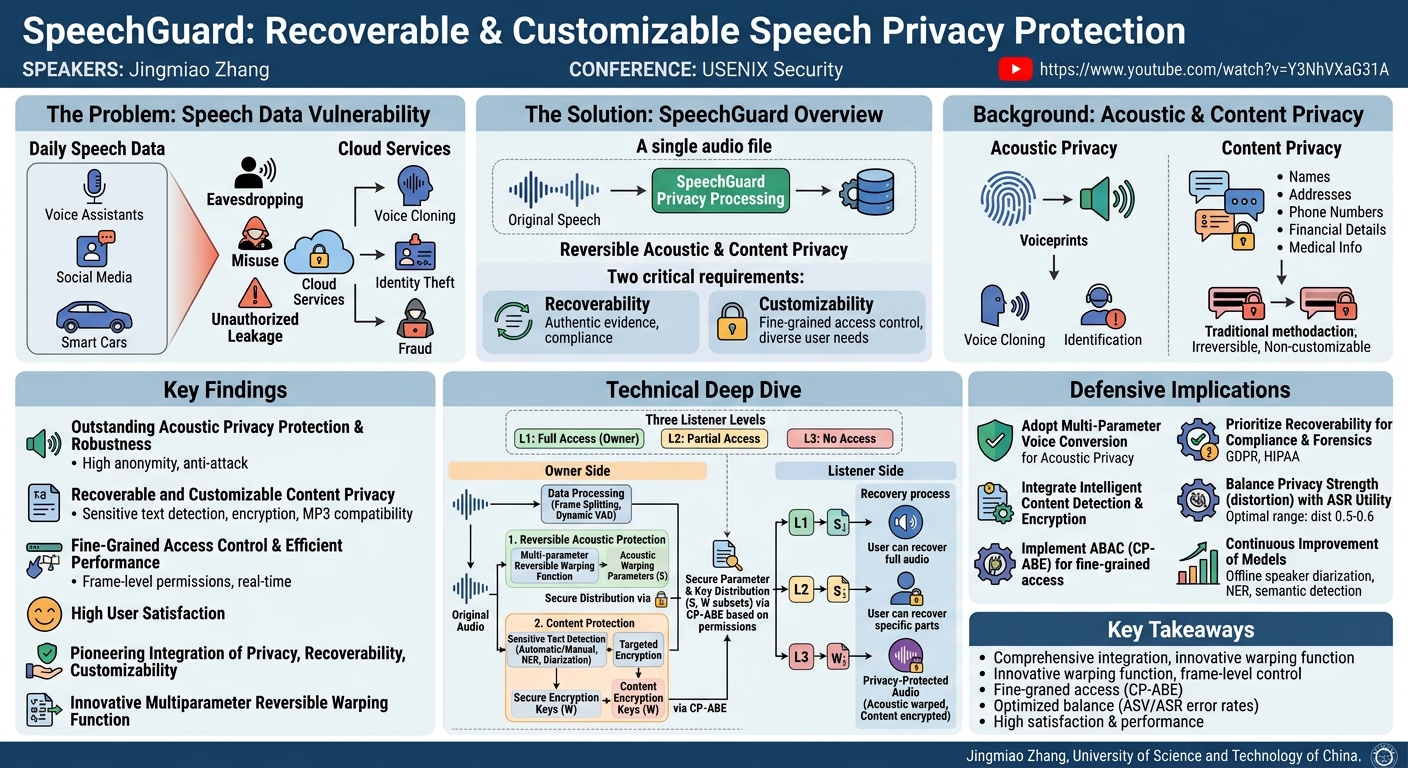
Key moments
- 0:00 Introduction to speech privacy challenges and needs
- 2:00 Emphasizing recoverability and customizability requirements
- 4:26 SpeechGuard's goals: privacy, quality, recoverability, customizability
- 6:00 SpeechGuard's listener levels and adversary threat model
- 8:00 Overview of SpeechGuard's privacy protection architecture
- 10:00 Acoustic privacy: basic voice conversion and its vulnerabilities
- 11:22 Enhancing acoustic privacy with multi-parameter warping function
SpeechGuard: Recoverable and Customizable Speech Privacy Protection
Speakers: Jingmiao Zhang
Conference: USENIX Security
YouTube: https://www.youtube.com/watch?v=Y3NhVXaG31A
Overview
In an era where speech data permeates nearly every aspect of daily life – from voice assistants and online meetings to social media and smart cars – the imperative for robust privacy protection has never been more critical. The USENIX Security talk, "SpeechGuard: Recoverable and Customizable Speech Privacy Protection," delivered by Jingmiao Zhang from the University of Science and Technology of China, introduces a pioneering system designed to address the multifaceted privacy challenges inherent in spoken information. This work stands out by not only safeguarding sensitive speech data but also by ensuring its recoverability for authorized parties and offering unparalleled customizability in access control.
The core problem SpeechGuard tackles is the vulnerability of speech data once shared or processed in cloud environments, where it faces risks of eavesdropping, misuse, and unauthorized leakage. Such breaches can lead to severe consequences, including voice cloning, identity theft, and fraud based on sensitive personal information. Traditional privacy solutions often fall short by permanently altering or removing sensitive parts of audio, rendering the original information irrecoverable and applying a uniform level of protection that ignores diverse user needs and access requirements.
SpeechGuard pioneers a comprehensive approach that integrates reversible acoustic and content privacy mechanisms. It aims to protect unique voiceprints (acoustic privacy) and sensitive semantic details (content privacy) while maintaining high speech quality for non-sensitive portions. By enabling fine-grained control over what information is protected, how strongly it's protected, and who can access or recover it, SpeechGuard offers a practical, secure, and user-friendly solution that aligns with the complex demands of modern speech applications and regulatory frameworks.
Background
▶ Watch: Introduction to speech privacy challenges and needs (0:00)
The pervasive nature of speech data in contemporary society creates a rich landscape for innovation but also a significant battleground for privacy. Users interact with speech-based technologies daily, generating vast quantities of data that often contain highly personal and identifiable information. The privacy challenges in this domain can be broadly categorized into two critical areas: acoustic privacy and content privacy. Acoustic privacy focuses on protecting a speaker's unique voiceprint, which can be used for identification or even voice cloning. Content privacy, on the other hand, concerns the safeguarding of sensitive semantic information embedded within speech, such as names, addresses, phone numbers, financial details, or medical information.
When speech data is shared with or processed by third-party cloud services, it becomes susceptible to a range of threats. Malicious actors could eavesdrop on communications, misuse data for purposes beyond its original intent, or leak it to unauthorized parties. The potential consequences are severe, ranging from identity fraud and financial theft to the unauthorized creation of synthetic voices that mimic an individual. This escalating threat landscape underscores an urgent need for effective privacy protection measures that go beyond mere obfuscation.
Beyond basic protection, two often-overlooked requirements are crucial for real-world applicability: recoverability and customizability. Audio owners frequently desire the ability to preserve all original information, not just a protected version, especially when storing data in the cloud. Furthermore, specific scenarios, such as legal investigations or compliance audits, necessitate access to untempered, authentic audio recordings as evidence. Current privacy solutions, which often rely on irreversible methods like redaction or permanent alteration, fail to meet this crucial recoverability requirement, leading to permanent loss of original data.
Equally important is customizability. A single audio file often contains a mix of sensitive and non-sensitive information. Users may wish to allow cloud services to process general conversational content while strictly protecting private details. Moreover, different listeners may require varying levels of access. For instance, a user might share their real voice with trusted friends but a protected version with strangers on social media, or restrict certain content for children while providing full access to adults. Most existing methods lack this flexibility, applying a blanket level of protection to all listeners regardless of their permissions or the specific content. This rigidity severely limits their utility in practical, dynamic environments.
SpeechGuard was developed to overcome these limitations. Its core objective is to protect speech privacy while maintaining high speech quality, ensuring that information can be fully or partially recovered based on authorized permissions. It aims to significantly increase the error rates for Automatic Speaker Verification (ASV) and Automatic Speech Recognition (ASR) for sensitive information, thereby making it difficult for adversaries to extract private details, while simultaneously preserving high ASR accuracy for non-sensitive content. This balance between strong privacy and practical utility is a distinguishing characteristic of the SpeechGuard system.
Key Findings
▶ Watch: SpeechGuard's goals: privacy, quality, recoverability, customizability (4:26)
SpeechGuard introduces a novel and comprehensive solution that addresses critical gaps in existing speech privacy protection mechanisms. The key findings and contributions highlighted by the research demonstrate its effectiveness, flexibility, and practical utility:
- Outstanding Acoustic Privacy Protection and Robustness: SpeechGuard achieves a high level of acoustic privacy, effectively protecting speaker identity. Its innovative multiparameter reversible warping function provides strong defense against various attacks, including reducing attacks, which attempt to guess parameters and reverse conversion. This results in high anonymity for the speaker while maintaining the overall speech quality and enabling high-fidelity recovery for authorized users.
- Recoverable and Customizable Content Privacy: The system uniquely offers both recoverable and customizable content privacy. By combining sensitive text detection with encryption, SpeechGuard allows for the selective protection of specific semantic information. Crucially, it supports encrypted sensitive text recovery for authorized listeners and ensures flexible audio format compatibility, including lossy formats like MP3, without affecting playback or headers.
- Fine-Grained Access Control and Efficient Real-Time Performance: SpeechGuard implements a sophisticated access control mechanism that operates at a frame level, enabling precise authorization. Audio owners can define granular permissions, allowing different listener groups to access varying subsets of acoustic and content information. The system also demonstrates efficient real-time performance, making it suitable for practical applications requiring immediate processing.
- High User Satisfaction: User studies conducted as part of the evaluation process revealed high levels of satisfaction with SpeechGuard's usability, the strength of its protection, and its recovery capabilities. This indicates that the system is not only technically sound but also meets user expectations for practical privacy tools.
- Pioneering Integration of Privacy, Recoverability, and Customizability: SpeechGuard is presented as the first system to successfully combine these three critical aspects for speech protection. Previous methods often achieved one or two but rarely all three in a robust and practical manner. This holistic approach marks a significant advancement in the field of speech privacy.
- Innovative Multiparameter Reversible Warping Function: The core technical innovation for acoustic privacy is the development of a multiparameter reversible warping function. This function significantly enhances anonymity and provides robust resistance against sophisticated attacks, representing a substantial improvement over single-parameter or dual-parameter warping techniques.
Together, these findings position SpeechGuard as a robust, flexible, and user-centric solution that addresses the complex and evolving landscape of speech privacy, offering a blueprint for future secure speech processing systems.
Technical Deep Dive
▶ Watch: SpeechGuard's listener levels and adversary threat model (6:00)
SpeechGuard's architecture is meticulously designed to provide both acoustic and content privacy, coupled with recoverability and customizability. The system operates through distinct phases, from initial data processing to secure distribution and recovery.
Threat Model and Assumptions
The system defines a clear threat model to guide its design. The audio owner is responsible for publishing speech after it has undergone privacy processing. Three levels of listeners are defined:
- L1 Listeners: Possess the highest level of access, equivalent to the owner, capable of recovering all private information.
- L2 Listeners: Can recover only a specific portion of private information, based on assigned permissions.
- L3 Listeners: Have no access to private information and cannot recover any protected data.
Adversaries are assumed to have access to the published privacy-protected audio. These adversaries might attempt to guess protected parameters and decryption keys to bypass security measures. They are also assumed to employ advanced tools such as Automatic Speaker Verification (ASV) to infer speaker identity and Automatic Speech Recognition (ASR) to recover sensitive content from the protected speech. Crucially, both L2 and L3 listeners are considered potential adversaries if they attempt to access information beyond their authorized permissions. Furthermore, cloud servers are assumed to be "honest but curious," meaning they will not tamper with the audio data but may attempt to analyze it to learn private information.
Solution Overview
SpeechGuard's solution is bipartite, involving processes on both the audio owner's side and the listener's side:
- Audio Owner Side:
- Reversible Acoustic Privacy Protection: This is achieved using VT1-based voice conversion, which generates warping parameters. These parameters are key to distorting the speaker's voice while ensuring it can be reversed.
- Content Privacy Protection: This involves sensitive text detection combined with encryption. The process produces encryption keys specifically for sensitive information.
- Distribution: The generated warping parameters and encryption keys are then securely distributed according to the permissions assigned to each listener group.
- Listener Side:
- Authorized users leverage their assigned private keys (warping parameters for acoustic recovery, encryption keys for content recovery) to access the specific acoustic and content information they are permitted to see.
Data Processing
Before applying any privacy protection measures, the system performs an initial data processing step:
- Frame Splitting: The speech audio is split into fixed 36-millisecond frames. This fine-grained segmentation allows for precise, frame-level control over privacy protection.
- Voice Activity Detection (VAD): A dynamic threshold voice activity detection mechanism is employed to group these individual frames into voiced and unvoiced segments. These segments serve as the fundamental units for subsequent voice conversion operations, ensuring that transformations are applied intelligently to meaningful speech components.
Acoustic Privacy Protection: Multiparameter Reversible Warping
The foundation of SpeechGuard's acoustic privacy protection lies in its enhanced WTLM-based voice conversion.
- Basic Warping Function: Initially, the system considers a basic piecewise linear warping function. This function maps the original frequency (
omega) using a single parameter (alpha) and a turning point (omega0). While invertible (knowingalphaallows recovery), this single-parameter approach is vulnerable. An adversary could potentially guessalphaor even approximate it, leading to a "reducing attack" where the distorted voice is too close to the original. - Multiparameter Warping Function: To overcome this vulnerability, SpeechGuard introduces a multiparameter warping function. Instead of a single parameter, the system randomly selects a number
nof parameters and generatesnpairs ofalphaandbetavalues. Each speech segment is then subjected to its own unique set of these warping parameters. This design significantly increases the complexity for an attacker, making it exponentially harder to guess all the parameters needed to reverse the conversion. The randomization of parameter size, selection, and diverse distortion directions provides a much stronger layer of protection.
A critical aspect of this multiparameter warping is the selection of an appropriate range for the warping parameters. This involves balancing privacy strength with speech quality:
- Distortion Strength (
dist): This metric is defined as the area between the warping curve and the identity function. A higherdistvalue indicates a more heavily modified voice and, consequently, stronger privacy protection. - Balancing Act: The goal is to maximize the ASV error rate (making speaker identification difficult) while minimizing the ASR error rate for non-sensitive content (preserving intelligibility). Through extensive experiments, SpeechGuard found that an optimal range for the distortion strength (
dist) is between 0.5 and 0.6. Audio owners retain the flexibility to adjust thisdistvalue according to their specific privacy needs.
Content Privacy Protection: Sensitive Text Detection and Encryption
Content privacy in SpeechGuard is achieved through a two-step process:
- Sensitive Text Detection: The system aims to identify and encrypt all frames containing sensitive information. Detection can be performed in two ways:
- Automatic Detection: This leverages techniques like speaker diarization to identify who is speaking and Named Entity Recognition (NER) to locate sensitive patterns (e.g., names, addresses, phone numbers, financial data, medical terms, etc.).
- Manual Option: Audio owners can manually review, adjust, or delete detected sensitive text after recording, correcting any potential errors from automatic detection.
- Encryption: Once sensitive text segments are identified, each is assigned a unique encryption key. All these keys are managed collectively by the system. Importantly, SpeechGuard supports lossy formats like MP3 by encrypting only the data frames, leaving the headers unaffected. This ensures smooth playback and compatibility across various platforms without requiring full decryption for basic audio rendering.
Access Control and Privacy Recovery
SpeechGuard's design enables precise authorization and privacy recovery, leveraging its frame-level reversible operations.
- Privacy Management: The system manages two distinct types of privacy information:
- Acoustic Privacy: Controlled by the collection of warping parameters, denoted as
S. - Content Privacy: Controlled by the collection of encryption keys, denoted as
W. - Permission Groups: The audio owner defines various permission groups and assigns specific subsets of
SandWto these groups. This allows for extremely fine-grained control, ensuring that different listeners only access the information they are explicitly authorized to see. - Secure Distribution: To ensure the secure delivery of these parameters and keys to authorized groups, SpeechGuard employs Ciphertext Policy Attribute-Based Encryption (CP-ABE). CP-ABE allows data to be encrypted such that only users possessing a specific set of attributes (permissions) can decrypt it, providing a robust mechanism for secure, policy-driven access control.
Demo / Proof of Concept
▶ Watch: Acoustic privacy: basic voice conversion and its vulnerabilities (10:00)
While the talk transcript does not detail a live demonstration, the "Evaluation" section implicitly describes the results of a working system and its validation, effectively serving as a proof of concept. SpeechGuard's capabilities were demonstrated through rigorous evaluation, highlighting several key outcomes:
- Acoustic Privacy Efficacy: The system achieved outstanding acoustic privacy protection, indicating that the multiparameter reversible warping function successfully obscured speaker identity. This was evidenced by increased ASV error rates for unauthorized parties, demonstrating its robustness against identification attempts and reducing attacks. Despite this strong privacy, the system maintained high speech quality for the protected audio, ensuring that the modifications were not overly disruptive to the listening experience. Authorized recovery was also demonstrated to be high-fidelity, producing audio close to the original.
- Content Privacy Functionality: The evaluation confirmed the system's ability to selectively encrypt sensitive text and allow its recovery only by authorized listeners. This included successful handling of various audio formats, such as MP3, by encrypting data frames without corrupting headers, thus preserving playback functionality for all listeners while securing sensitive content.
- Access Control Granularity: The system successfully showcased its fine-grained access control, allowing different listener groups (L1, L2, L3) to experience varying levels of privacy and access specific subsets of acoustic and content information based on their assigned permissions. The secure distribution mechanism via CP-ABE was implied to be functional in delivering these permissions.
- Performance and Usability: The evaluation confirmed the system's efficient real-time performance, suggesting its practicality for integration into live speech processing pipelines. Furthermore, user studies provided crucial feedback, indicating high satisfaction with SpeechGuard's overall usability, the perceived strength of its privacy protection, and its unique recoverability features. These studies validate the system's design from a user perspective, demonstrating that it is not only technically sound but also meets practical user needs.
In essence, the evaluation results serve as a comprehensive demonstration that SpeechGuard is a practical, secure, and user-friendly system capable of delivering on its promises of recoverable and customizable speech privacy protection.
Defensive Implications
▶ Watch: Enhancing acoustic privacy with multi-parameter warping function (11:22)
SpeechGuard offers profound implications for defenders operating in environments rich with speech data. Its capabilities provide a blueprint for implementing robust, adaptable, and compliant privacy solutions. Organizations and individuals handling sensitive spoken information should consider the following defensive strategies based on SpeechGuard's principles:
- Adopt Multi-Parameter Voice Conversion: Organizations should move beyond simplistic voice obfuscation techniques. Implementing multi-parameter reversible warping functions, similar to SpeechGuard's, is crucial for strong acoustic privacy. This technique significantly enhances anonymity and provides robust defense against sophisticated reducing attacks that attempt to reverse privacy transformations. Such methods make it substantially harder for attackers to identify speakers from protected audio.
- Integrate Intelligent Sensitive Content Detection and Encryption: Defenders must employ advanced techniques for sensitive text detection, such as Named Entity Recognition (NER) and speaker diarization, to automatically identify and flag private information within speech. This content should then be encrypted at a granular level, ideally frame-by-frame, to ensure that only authorized parties can access it. The ability to encrypt only specific data frames while preserving audio headers (as demonstrated for MP3) is vital for maintaining compatibility and playback utility.
- Implement Attribute-Based Access Control (ABAC) for Speech Data: Leveraging frameworks like Ciphertext Policy Attribute-Based Encryption (CP-ABE) is essential for establishing fine-grained access control over speech data. This allows organizations to define complex policies based on user attributes (e.g., role, department, clearance level) and data attributes (e.g., sensitivity, speaker, content type). Such a system ensures that different listeners or applications receive precisely the level of access they are authorized for, minimizing data exposure.
- Prioritize Recoverability for Compliance and Forensics: The recoverability feature of SpeechGuard is critical for compliance with regulations like GDPR, HIPAA, and CCPA, which often require data subjects to have access to their original data or for organizations to provide authentic records for legal purposes. Defenders should seek or develop solutions that allow authorized recovery of original acoustic and content information, ensuring that data is not permanently lost while still being protected. This capability is invaluable for audits, investigations, and legal discovery.
- Balance Privacy Strength with Utility: When configuring privacy parameters, defenders must carefully balance the distortion strength (for acoustic privacy) with the need to maintain ASR accuracy for non-sensitive content. As SpeechGuard demonstrated, finding an optimal range (e.g.,
distbetween 0.5 and 0.6) allows for strong privacy without unduly sacrificing the utility of the speech data for authorized applications or general understanding. This ensures that privacy measures do not cripple legitimate business operations. - Continuous Improvement of Detection Models: The accuracy of sensitive text detection and speaker diarization models is paramount. Defenders should invest in continuously improving these offline speaker diarization and NER models, potentially exploring semantic-level detection using advanced NLP techniques and contextual analysis, as suggested for future work. This enhances the precision of privacy protection and reduces false positives or negatives.
By adopting these strategies, organizations can establish a robust, adaptable, and legally compliant framework for managing speech data, effectively mitigating privacy risks in an increasingly voice-centric world.
Key Takeaways
- SpeechGuard pioneers a comprehensive system that uniquely combines privacy, recoverability, and customizability for speech data protection, addressing critical limitations of prior irrecoverable and non-customizable methods.
- The innovative multiparameter reversible warping function is central to SpeechGuard's acoustic privacy, significantly enhancing speaker anonymity and providing strong resistance against reducing attacks by making parameter guessing exceptionally difficult.
- Frame-level sensitive text detection via techniques like Named Entity Recognition (NER) and speaker diarization, combined with targeted encryption, secures sensitive content while allowing for authorized recovery and compatibility with lossy audio formats like MP3.
- Ciphertext Policy Attribute-Based Encryption (CP-ABE) enables fine-grained access control, allowing audio owners to define precise permissions for different listener groups (L1, L2, L3) to access specific subsets of acoustic and content information.
- SpeechGuard carefully balances robust privacy protection (evidenced by increased ASV error rates for adversaries) with the preservation of speech utility (maintaining low ASR error rates for non-sensitive content), demonstrating an optimal distortion strength range of 0.5 to 0.6.
- The system's efficient real-time performance and high user satisfaction underscore its practicality and readiness for deployment in real-world scenarios, making it a valuable tool for managing speech privacy.
About the Speaker(s)
Jingmiao Zhang is a researcher affiliated with the University of Science and Technology of China. This presentation at USENIX Security highlights their expertise in speech privacy, secure systems design, and advanced signal processing techniques for audio data. The work presented reflects a collaborative effort within the institution, focusing on practical and innovative solutions to contemporary cybersecurity challenges.
Reviews
Dr. Zero (Offensive Security Researcher) — SOLID
Legitimate academic security research on speech privacy with a technically coherent design — multiparameter reversible warping plus CP-ABE for access control is a reasonable architecture. The work is competent but niche, and the 'first to combine all three' framing is the kind of claim that deserves more adversarial scrutiny than a conference talk typically gets.
Heather Calloway (CISO) — WEAK
Technically credible research on speech privacy protection with genuine novelty in combining recoverability, customizability, and acoustic anonymization. But this is a systems paper delivered to a technical audience, and it makes no serious attempt to connect to the organizational, regulatory, or governance dimensions where speech data risk actually lives for most institutions.
→ Top-rated talks at 34th USENIX Security Symposium (USENIX Security '25)
All talks from 34th USENIX Security Symposium (USENIX Security '25)