Treebeard: A Scalable and Fault Tolerant ORAM Datastore
Amin Setayesh
34th USENIX Security Symposium (USENIX Security '25) · Day 3 · Privacy 4: Privacy-Preserving Computation
Overview
In the realm of data privacy, encryption has long been considered the gold standard for protecting sensitive information. However, this talk, "Treebeard: A Scalable and Fault Tolerant ORAM Datastore," presented by Amin Setayesh at USENIX Security, challenges this conventional wisdom by highlighting a critical vulnerability often overlooked: access pattern leakage. Even when data is fully encrypted and outsourced to a cloud database, the patterns of how users interact with that data can inadvertently reveal significant insights to an adversary. This talk introduces Treebeard, a novel Oblivious RAM (ORAM) system designed to address these fundamental privacy gaps, offering a robust solution that is not only secure but also scalable, fault-tolerant, and performant.
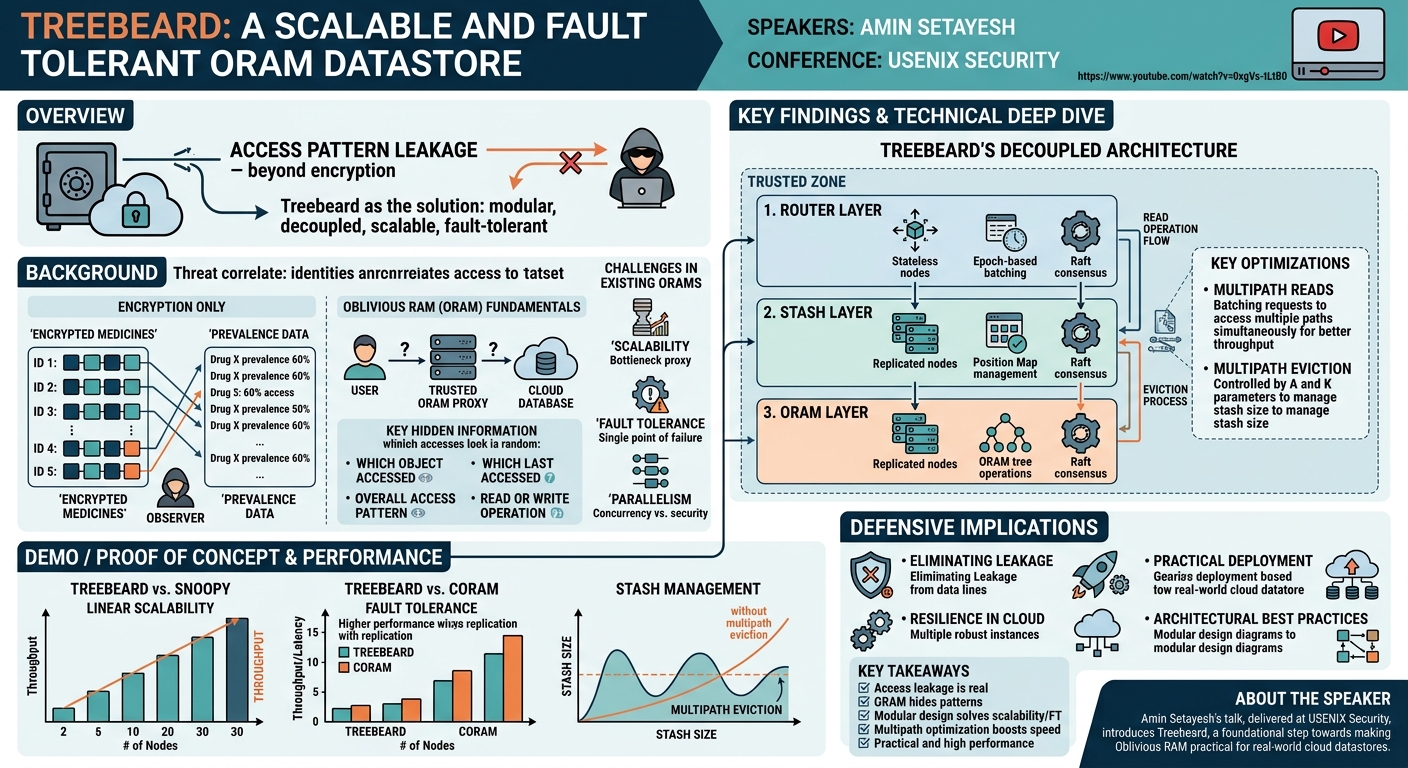
Key moments
- 0:00 Introduction: The threat of access pattern leakage
- 2:00 ORAM's purpose and typical centralized proxy architecture
- 3:00 Three key ORAM challenges: scalability, fault tolerance, parallelism
- 3:40 Explaining why parallelism and security are challenging
- 6:50 Introducing Treebeard: a modular, secure, and performant ORAM
- 7:20 Treebeard's decoupled three-layer proxy architecture overview
- 8:00 High-level overview of Treebeard's read operation flow
Treebeard: A Scalable and Fault Tolerant ORAM Datastore
Speakers: Amin Setayesh
Conference: USENIX Security
YouTube: https://www.youtube.com/watch?v=0xgVs-tLtB0
Overview
In the realm of data privacy, encryption has long been considered the gold standard for protecting sensitive information. However, this talk, "Treebeard: A Scalable and Fault Tolerant ORAM Datastore," presented by Amin Setayesh at USENIX Security, challenges this conventional wisdom by highlighting a critical vulnerability often overlooked: access pattern leakage. Even when data is fully encrypted and outsourced to a cloud database, the patterns of how users interact with that data can inadvertently reveal significant insights to an adversary. This talk introduces Treebeard, a novel Oblivious RAM (ORAM) system designed to address these fundamental privacy gaps, offering a robust solution that is not only secure but also scalable, fault-tolerant, and performant.
The core problem Treebeard tackles is the inherent trade-off between privacy, performance, and reliability in existing ORAM solutions. Traditional ORAM architectures often rely on a centralized proxy, which inevitably becomes a single point of failure and a performance bottleneck, hindering their adoption in real-world, high-throughput applications. Setayesh details how Treebeard's modular, decoupled architecture and innovative optimizations overcome these limitations, presenting a practical ORAM datastore capable of protecting against sophisticated access pattern attacks without sacrificing the operational demands of modern cloud environments. This research is crucial for any organization handling sensitive data in outsourced or untrusted computing infrastructures, offering a path towards truly private data management.
Background
▶ Watch: Introduction: The threat of access pattern leakage (0:00)
The premise of this research begins with a fundamental re-evaluation of data privacy in outsourced environments. While encryption safeguards the content of data, it typically does not obscure the metadata associated with data access. Amin Setayesh illustrates this with a compelling example: imagine a dataset of encrypted medicines, mapping an ID to a specific drug, outsourced to a cloud provider. An attacker, observing the frequency with which certain encrypted records are accessed—say, one record accessed 60% of the time, another 10%—can correlate these access patterns with publicly available information (e.g., prevalence of certain diseases or drug prescriptions). This correlation can allow the attacker to deduce the identity of the encrypted medicine, effectively circumventing the protection offered by encryption alone. This phenomenon is known as access pattern leakage.
To counter this, Oblivious RAM (ORAM) was introduced. ORAM is a cryptographic primitive designed to make all data accesses appear random to an untrusted storage provider. It meticulously hides four critical pieces of information:
- Which object was accessed: The adversary cannot tell which specific record a user requested.
- Which object was last accessed: All historical access information is obscured.
- The overall access pattern: Whether accesses are skewed, sequential, or random is hidden.
- Whether a client reads or writes data: The type of operation is also concealed.
A typical ORAM architecture involves two untrusted zones: the user (who might be malicious) and the cloud database holding the outsourced data. Sandwiched between them is a trusted zone—the ORAM proxy—responsible for enforcing the oblivious access logic. This proxy transforms user requests into a series of random-looking accesses to the untrusted storage, ensuring no patterns leak.
However, existing ORAM systems face significant challenges that impede their practical deployment. These challenges fall into three broad categories:
- Scalability: Many ORAM systems struggle to handle increasing data volumes or user loads, often sacrificing performance for security.
- Fault Tolerance: The reliance on a centralized ORAM proxy introduces a single point of failure. If the proxy goes down, the entire system becomes unavailable or, worse, leaks information upon recovery.
- Parallelism: Achieving high concurrent throughput while maintaining ORAM's strong security guarantees is notoriously difficult.
Setayesh delves into why these challenges are particularly difficult to solve simultaneously with security:
- Parallelism and Security: Consider two concurrent access scenarios. With distinct concurrent accesses (e.g., request A for block A, request B for block B), the ORAM system can access block A and dummy blocks for other paths, and similarly for B, without leakage. However, with non-distinct concurrent accesses (e.g., both requests A and B target block A), naively accessing block A twice and then dummy blocks for other paths would reveal to the adversary that block A was accessed twice, compromising obliviousness. This requires sophisticated coordination to ensure all accesses appear random. The speaker notes that familiarity with tree ORAM schemes like PathORAM and RingORAM (discussed in detail in the paper) can aid in understanding these mechanisms.
- Scalability and Security: A single ORAM proxy, as mentioned, becomes a severe bottleneck. While one might consider scaling by adding more cloud databases, the proxy remains the choke point. Distributing the proxy itself across multiple machines is complex. Static mappings of data blocks to specific proxies are insecure, as they can reveal information. Dynamically swapping data blocks between proxies for load balancing is challenging to achieve with high performance while maintaining security.
- Fault Tolerance and Security: The single-proxy bottleneck also exacerbates fault tolerance issues. If a request for block A is partially processed, and the proxy fails, retrying the request after recovery can be problematic. If the retry accesses the same real block A but generates different random dummy blocks, an adversary observing both access patterns (before and after failure) can infer that block A was accessed, thus compromising security. This highlights the delicate balance required to maintain obliviousness even in the face of system failures.
The core problem, as articulated by the speaker, is that no existing ORAM system effectively offers all three—scalability, fault tolerance, and parallelism—concurrently with the strong security guarantees ORAM proposes.
Key Findings
▶ Watch: Three key ORAM challenges: scalability, fault tolerance, parallelism (3:00)
Treebeard represents a significant advancement in the field of Oblivious RAM, presenting a modular system specifically engineered to overcome the long-standing challenges of scalability, fault tolerance, and performance in ORAM deployments. The key findings and contributions of this work include:
- Modular and Decoupled Architecture: Treebeard introduces a novel three-layered architecture within the trusted ORAM proxy zone: a Router layer, a Stash layer, and an ORAM layer. This decoupling of responsibilities—in stark contrast to traditional monolithic ORAM proxies—enables unprecedented parallelism and horizontal scaling across all components.
- Enhanced Parallelism and Horizontal Scaling: Each of Treebeard's layers is designed for high parallelism. The Router layer is stateless, enabling easy scaling. The Stash and ORAM layers support horizontal scaling by adding more nodes, distributing the workload and eliminating single points of contention.
- Robust Fault Tolerance via Raft Consensus: Treebeard achieves strong fault tolerance by replicating the critical Stash and ORAM layers using the Raft consensus algorithm. This ensures that even if individual nodes or entire layers fail, the system can continue operating securely and reliably, preventing information leakage during recovery scenarios.
- Innovative Performance Optimizations: To boost performance, Treebeard incorporates two key optimizations:
- Multipath Reads: Requests are aggressively batched and processed in a multipath manner, significantly reducing the number of interactions with the underlying storage and improving throughput.
- Multipath Eviction: To manage the increased stash size resulting from multipath reads, an intelligent multipath eviction strategy is employed, controlled by parameters
A(eviction rate) andK(path count), ensuring the stash remains manageable. - Demonstrated Superior Performance and Scalability: Through rigorous evaluation, Treebeard proves its ability to scale linearly with an increasing number of machines. It maintains consistent performance across varying block sizes and outperforms existing high-throughput ORAM systems like Snoopy in scalability and CORAM in fault-tolerant performance.
- Manageable Stash Size: Despite the aggressive multipath reads, the multipath eviction mechanism effectively keeps the size of the stash within acceptable limits, confirming the practicality of the system.
In essence, Treebeard provides a comprehensive solution that simultaneously addresses the critical operational requirements of real-world systems—scalability, fault tolerance, and high performance—while upholding the stringent access pattern privacy guarantees of ORAM.
Technical Deep Dive
▶ Watch: Explaining why parallelism and security are challenging (3:40)
Treebeard's innovative design centers on a multi-layered, decoupled architecture that redefines the traditional ORAM proxy. Instead of a single, monolithic trusted component, Treebeard distributes responsibilities across three distinct layers within the trusted zone, sitting between the untrusted users and the untrusted cloud storage. These layers are the Router layer, the Stash layer, and the ORAM layer. This architectural choice is fundamental to achieving high parallelism, horizontal scaling, and fault tolerance.
High-Level Architecture
The trusted zone in Treebeard comprises:
- Router Layer: This is the outermost layer, responsible for initial request handling.
- Stash Layer: This layer maintains the position map (which indicates where logical blocks are mapped in the ORAM tree) and temporarily stores blocks that have been fetched from the ORAM tree or are awaiting eviction.
- ORAM Layer: This layer directly interacts with the untrusted cloud storage, performing the actual ORAM tree operations.
By decoupling these responsibilities, Treebeard ensures that no single component becomes a bottleneck, a common issue in prior ORAM systems. Each layer can be scaled independently, contributing to the system's overall scalability and resilience.
Read Operation Flow
A typical read operation in Treebeard follows a precise sequence:
- Request Ingress: User requests first arrive at the Router layer.
- Batching by Router: The Router layer batches incoming requests using an epoch-based batching scheme. This is a stateless layer, meaning it does not maintain any persistent state, which simplifies its scaling and recovery. It deterministically maps any block request to a specific Stash node. No replication is performed for Router nodes, with the paper providing justification for its security without replication.
- Forward to Stash Layer: Batched requests are then forwarded to the appropriate Stash layer nodes.
- Position Map Lookup (Stash Layer): The Stash layer, which holds the position map, determines which paths and storage locations in the ORAM tree correspond to the requested blocks. It also manages the local stash of blocks.
- Forward to ORAM Layer: The Stash layer then forwards these requests to the ORAM layer to retrieve the actual paths from the underlying untrusted storage.
- ORAM Tree Access (ORAM Layer): The ORAM layer performs the oblivious access operations on the ORAM tree stored in the cloud.
- Response: The retrieved data is sent back through the layers to the user.
Eviction Process
Eviction is a critical component of ORAM, where blocks temporarily stored in the stash are written back to the ORAM tree to maintain obliviousness and manage stash size. In Treebeard:
- Interval-based Eviction: Eviction is initiated at regular intervals.
- Stash-driven Eligibility: Unlike traditional ORAMs where the ORAM proxy directly manages eviction, in Treebeard, the Stash layer plays a more active role. After requests are processed, the Stash layer identifies blocks within its temporary storage (which are now eligible for eviction) that correspond to specific paths in the ORAM tree.
- Eviction Request to ORAM Layer: These eligible blocks are then sent to the ORAM layer.
- Push to Storage: The ORAM layer pushes these blocks back into the untrusted cloud storage, updating the ORAM tree structure obliviously.
Layer-Specific Optimizations
Router Layer:
- Statelessness: Crucial for horizontal scaling and fault tolerance. Any Router node can handle any request, and its failure does not compromise state.
- Epoch-based Batching: Groups requests over specific time intervals to optimize processing in downstream layers.
- Deterministic Mapping: Ensures consistency and load distribution to Stash nodes without revealing information.
Stash Layer:
- Position Map Management: Central to ORAM operation, mapping logical block addresses to physical locations in the tree.
- Fault Tolerance: Achieved through replication using the Raft consensus algorithm. This ensures that the position map and temporary stash contents are resilient to node failures.
ORAM Layer:
The ORAM layer is where Treebeard introduces its most significant performance optimizations:
- Multipath Reads: This is a key innovation. Instead of traditional ORAM systems that independently access a single path in the tree for each request (or a small batch), Treebeard aggressively batches requests and performs multipath reads. This means that multiple paths in the ORAM tree are accessed concurrently for a single batch of requests. This significantly improves performance by reducing the number of round trips to storage and leveraging parallelism. The system is designed to retrieve duplicate blocks only once per batch, further optimizing data fetching.
- Multipath Eviction: The aggressive nature of multipath reads means that the Stash layer can accumulate blocks faster. To counteract this and prevent the stash from growing uncontrollably, Treebeard employs multipath eviction. This process is controlled by two parameters:
A(eviction rate): Determines how frequently eviction is performed.K(path count): Specifies how many paths in the ORAM tree are targeted for eviction during each eviction cycle.
This mechanism ensures that blocks are pushed back to K paths in the tree every A times, effectively managing the stash size while maintaining high performance.
The combination of this decoupled architecture with sophisticated batching, multipath operations, and robust consensus mechanisms allows Treebeard to deliver an ORAM system that is truly scalable, fault-tolerant, and performant, addressing the limitations of prior work.
Demo / Proof of Concept
▶ Watch: Treebeard's decoupled three-layer proxy architecture overview (7:20)
While the talk does not feature a live demonstration in the traditional sense, Amin Setayesh presents a comprehensive evaluation of Treebeard's performance and capabilities through a series of experiments. The setup details for these experiments are available in the accompanying paper, ensuring reproducibility and transparency. The evaluation focuses on validating Treebeard's claims regarding scalability, fault tolerance, and stash management, comparing its performance against state-of-the-art ORAM systems.
Scalability Analytics
Treebeard's scalability was rigorously tested and compared against Snoopy, another high-throughput ORAM system. The results demonstrate that Treebeard achieves linear scalability as the number of machines (nodes) in the system increases. This is a crucial finding, indicating that Treebeard can effectively handle growing workloads by simply adding more resources. Furthermore, the evaluation shows that Treebeard maintains consistent performance across various block sizes without any meaningful degradation, highlighting its adaptability to different data types and access patterns. The impact of scaling each of the three layers (Router, Stash, ORAM) was also analyzed, revealing that each layer's node count has distinct effects on the overall system's scaling behavior, allowing for fine-grained optimization.
Fault Tolerance Comparison
To assess its fault tolerance, Treebeard was compared with CORAM, another system designed with fault tolerance in mind. For a fair, "apples-to-apples" comparison, both systems were configured with the same replication factors. The experiments revealed that Treebeard significantly outperforms CORAM in terms of throughput and latency while offering the same strong fault tolerance guarantees. This superior performance under fault-tolerant conditions underscores the efficiency of Treebeard's architecture and its use of the Raft consensus algorithm for state replication in the Stash and ORAM layers.
Stash Management Experiment
A critical concern with performance optimizations like multipath reads is the potential for the temporary stash to grow excessively, consuming too much memory and impacting performance. Treebeard's evaluation included specific experiments to validate its stash management strategy. The results confirm that, despite the aggressive multipath reads, the integrated multipath eviction mechanism effectively keeps the stash size manageable. While the stash size might be "a bit higher" than systems like RingORAM, the speaker emphasizes that this is a justifiable trade-off given the substantial performance gains and other capabilities offered by Treebeard. This demonstrates that Treebeard successfully balances performance and resource utilization without compromising security.
These evaluations collectively serve as a robust proof of concept, demonstrating that Treebeard is not merely a theoretical construct but a practical, high-performance ORAM datastore capable of meeting the demands of real-world cloud environments.
Defensive Implications
▶ Watch: High-level overview of Treebeard's read operation flow (8:00)
The introduction of Treebeard carries significant implications for defenders seeking to enhance data privacy and security in an increasingly outsourced and cloud-centric world. The core message is clear: traditional encryption alone is insufficient to protect against sophisticated adversaries who can exploit access pattern leakage. ORAM, and specifically a practical implementation like Treebeard, becomes an indispensable tool in a robust defensive strategy.
- Mitigating Access Pattern Leakage: The primary defensive implication is Treebeard's ability to eliminate access pattern leakage. Organizations handling highly sensitive data—such as patient health records (PHI), financial transactions, intellectual property, or classified information—can now outsource this data to untrusted cloud providers with a much higher degree of confidence. By making all data accesses appear random, Treebeard prevents adversaries from inferring sensitive information through traffic analysis or frequency analysis, a threat that cryptographic encryption alone cannot address.
- Enabling Practical ORAM Deployment: Previous ORAM systems have been largely impractical for real-world deployment due to their prohibitive performance overheads, lack of scalability, or vulnerability to single points of failure. Treebeard's modular, decoupled architecture, combined with its demonstrated scalability and fault tolerance, fundamentally changes this landscape. Defenders can now consider integrating ORAM into their data infrastructure without facing insurmountable operational challenges. This opens the door for ORAM to move from academic curiosity to a deployable security primitive.
- Resilience in Cloud Environments: The fault tolerance provided by Treebeard's use of the Raft consensus algorithm for the Stash and ORAM layers is crucial for maintaining data availability and security in dynamic cloud environments. Defenders no longer need to fear that a proxy failure will not only disrupt service but also compromise the very privacy guarantees the ORAM system is meant to provide. This resilience is vital for mission-critical applications where downtime and data exposure are unacceptable.
- Architectural Best Practices: Treebeard's success highlights the benefits of a decoupled, layered architecture for complex security systems. Defenders can learn from this approach when designing their own secure systems, recognizing that distributing responsibilities and enabling horizontal scaling can lead to more robust, performant, and maintainable solutions.
- Informed System Selection: For security architects and engineers, Treebeard provides a benchmark for what is achievable in ORAM. When evaluating privacy-enhancing technologies for outsourced databases, they should scrutinize solutions for their ability to deliver not just security, but also the necessary scalability, fault tolerance, and performance demonstrated by Treebeard. Understanding the trade-offs, such as the manageable increase in stash size, is essential for making informed deployment decisions.
In essence, Treebeard empowers defenders to implement a deeper layer of privacy for their outsourced data, moving beyond content encryption to truly obscure the patterns of data access. This capability is critical for achieving comprehensive data privacy in the modern threat landscape.
Key Takeaways
- Access pattern leakage is a critical privacy threat that traditional data encryption alone cannot solve, as demonstrated by the medicine dataset example.
- Oblivious RAM (ORAM) is essential for hiding access patterns, making all data accesses appear random to untrusted storage providers and preventing inference of sensitive information.
- Traditional ORAM systems face significant challenges in achieving scalability, fault tolerance, and parallelism due to their centralized, monolithic proxy architectures.
- Treebeard introduces a novel, modular, and decoupled ORAM architecture with Router, Stash, and ORAM layers, designed to overcome these limitations and enable horizontal scaling and high parallelism.
- Key optimizations like multipath reads and multipath eviction significantly boost performance while effectively managing the temporary stash size, making Treebeard practical for real-world use.
- Treebeard demonstrates superior scalability and fault tolerance compared to existing systems like Snoopy and CORAM, proving it can deliver strong privacy guarantees without sacrificing operational requirements.
About the Speaker(s)
The talk "Treebeard: A Scalable and Fault Tolerant ORAM Datastore" was presented by Amin Setayesh. Based on the provided metadata and transcript, no specific title or company affiliation for Amin Setayesh is available.
Reviews
Dr. Zero (Offensive Security Researcher) — SOLID
Treebeard solves a real and underappreciated problem — access pattern leakage in outsourced storage — and the architectural contributions (decoupled Router/Stash/ORAM layers, multipath reads/eviction, Raft-backed fault tolerance) are technically legitimate and non-trivial. This is solid systems security research that advances the ORAM practicality problem meaningfully, but it's firmly a conference paper presentation rather than a field-defining talk, and the novelty ceiling is limited by how niche practical ORAM deployment remains.
Heather Calloway (CISO) — PASS
Solid academic systems research on a real cryptographic problem — access pattern leakage is underappreciated in practice. But this is pure distributed systems and cryptographic primitives work, and it never crosses into operational territory where a CISO, security architect, or policymaker could act on it.
→ Top-rated talks at 34th USENIX Security Symposium (USENIX Security '25)
All talks from 34th USENIX Security Symposium (USENIX Security '25)