What History’s Greatest Heist Can Teach Us About Defense In Depth
Pete Stegemeyer
DEF CON 32 Main Stage · Day 1 · Main Stage
Overview
In "What History’s Greatest Heist Can Teach Us About Defense In Depth," Pete Stegemeyer, a seasoned senior security engineer and an unexpected authority on historical heists, draws compelling parallels between the physical security failures of the infamous Antwerp Diamond Heist and the vulnerabilities commonly found in digital defense in depth strategies. Stegemeyer leverages his unique expertise to dissect the 2003 "School of Turin" operation, which targeted the supposedly impregnable Antwerp Diamond Center, resulting in the theft of an estimated $100 million to $1 billion in valuables.
Key moments
- 0:00 Introduction and talk's unique premise
- 1:15 Overview of the Antwerp Diamond Heist
- 2:00 Security features of the Antwerp Diamond Center
- 3:30 Detailed layers of the vault's security
- 5:45 Physical security mapped to network diagram
- 6:40 Introducing the notorious School of Turin heist crew
- 8:00 Reconnaissance: Notarbartolo's 18-month infiltration
What History’s Greatest Heist Can Teach Us About Defense In Depth
Speakers: Pete Stegemeyer
Conference: DEF CON 32
YouTube: https://www.youtube.com/watch?v=pri4EJ0634c
Overview
In "What History’s Greatest Heist Can Teach Us About Defense In Depth," Pete Stegemeyer, a seasoned senior security engineer and an unexpected authority on historical heists, draws compelling parallels between the physical security failures of the infamous Antwerp Diamond Heist and the vulnerabilities commonly found in digital defense in depth strategies. Stegemeyer leverages his unique expertise to dissect the 2003 "School of Turin" operation, which targeted the supposedly impregnable Antwerp Diamond Center, resulting in the theft of an estimated $100 million to $1 billion in valuables.
This talk is a crucial exploration for security professionals, offering a fresh perspective on identifying and mitigating systemic weaknesses in complex security architectures. By mapping the attackers' methodologies and the defenders' missteps in a real-world physical breach to cyber warfare, Stegemeyer illuminates how a cascade of seemingly minor oversights can collectively undermine even the most sophisticated security frameworks. The central thesis is that while the thieves were highly skilled, their success was primarily a testament to a series of fundamental security failures, providing invaluable lessons for anyone responsible for protecting digital assets.
Background
▶ Watch: Introduction and talk's unique premise (0:00)
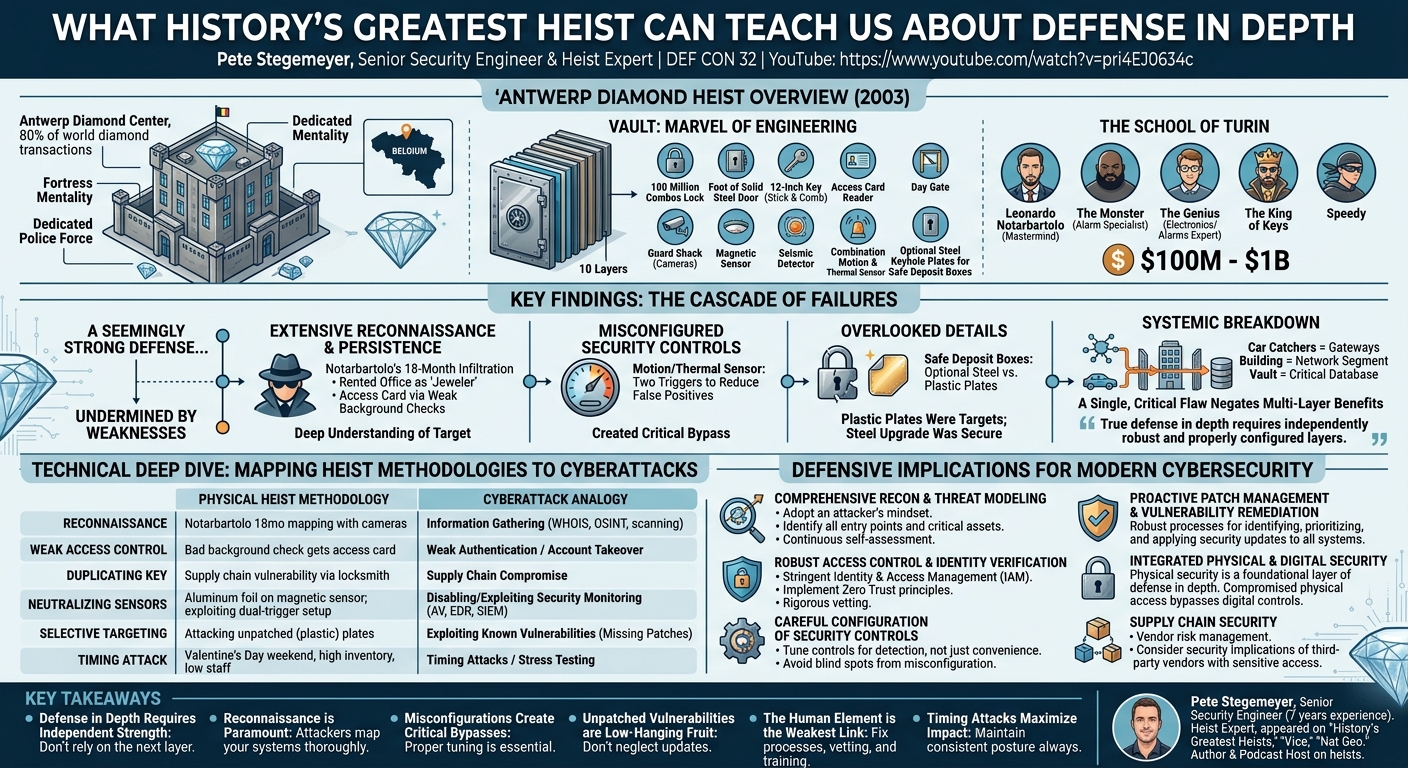
The Antwerp Diamond Center, located in Antwerp, Belgium, is a global nexus for diamond trading, handling an astonishing 80% of worldwide diamond transactions. Its critical importance led many to believe it was "too big to attack," fostering a false sense of invincibility. The facility was situated in the most secure district of Antwerp, protected by both a dedicated private police force and a local police presence immediately outside its perimeter. Access to the district was tightly controlled via a traffic control point featuring hydraulic spikes, designed to regulate all vehicular entry and exit. Within this fortified zone, the Diamond Center itself comprised multiple buildings (A, B, and C blocks) housing various offices and jewelers.
At the heart of this seemingly unassailable fortress was the vault, described by Stegemeyer as "a marvel of engineering" with ten distinct security features. These included a formidable combination lock boasting 100 million possible combinations, a door constructed from a foot of solid steel, and a unique 12-inch key that separated into two parts (the stick and the comb) to prevent single-point compromise. Further layers comprised a day gate (an inner door), a magnetic sensor designed to trigger an alarm if the door's magnetic field was broken, a guard shack with cameras monitoring the vault, an access card reader, and a seismic detector to thwart tunneling attempts. A particularly critical layer was a combination motion and thermal sensor, which, due to a history of false positives, was configured to only activate if both motion and elevated temperature were detected simultaneously. Finally, the individual safe deposit boxes within the vault offered an optional upgrade from a standard plastic keyhole plate to a more robust steel one – a detail that would prove highly significant.
The heist itself was executed by a group known to the police as the "School of Turin," an unofficial name for a collective of highly specialized thieves who collaborated on jobs based on required skill sets. Their mastermind, Leonardo Notarbartolo, orchestrated the operation alongside a crew known by colorful nicknames: "The Monster" (an alarm specialist, nearly 7 feet tall), "The Genius" (another alarm and electronics expert), "The King of Keys," and "Speedy." This combination of advanced physical security measures and a highly organized, specialized threat actor set the stage for what would become one of history's most audacious and instructive heists.
Key Findings
▶ Watch: Security features of the Antwerp Diamond Center (2:00)
The central revelation of the Antwerp Diamond Heist, as articulated by Pete Stegemeyer, is that the heist was not a triumph of impenetrable ingenuity over robust security, but rather a stark illustration of how a "cascade of failures" within a seemingly strong defense in depth strategy can lead to catastrophic compromise. Despite the Diamond Center's formidable, multi-layered physical security, each layer contained exploitable weaknesses, which the School of Turin meticulously identified and leveraged.
One of the most significant findings was the critical role of extensive reconnaissance and persistence. Leonardo Notarbartolo, the mastermind, spent 18 months prior to the heist embedding himself within the Diamond Center's ecosystem. He rented an office, claiming to be a jeweler, and was granted an access card to the vault area with minimal vetting – a glaring failure in access control and background checks. During this prolonged period, Notarbartolo repeatedly visited the facility and the vault, using hidden cameras concealed in his pockets and duffel bag to map out its layout, security systems, and operational routines. This deep understanding of the environment allowed the thieves to identify specific points of vulnerability in the existing security infrastructure.
Crucially, the talk highlighted how individual security components, while impressive on paper, were undermined by misconfigurations or overlooked details. The combination motion and thermal sensor in the vault, for instance, was designed to prevent false positives by requiring both motion and a significant temperature change. This design decision, intended to improve operational efficiency, inadvertently created a critical bypass mechanism for the attackers. Similarly, the safe deposit boxes offered an optional upgrade from a plastic keyhole plate to a steel one. Those who "chose not to patch everything" by sticking with the plastic plates became easy targets, while those who opted for the steel upgrade remained secure. This directly parallels the importance of patch management in the digital realm.
Stegemeyer emphasized that the Antwerp Diamond Center's security system, when viewed through a network security lens, suffered from the equivalent of "somebody put an open port on this part that connected to the world and then it just kind of had a tunnel to the vault." This analogy underscores that even with numerous layers, a single, critical flaw or misconfiguration can create an unhindered path for attackers, negating the benefits of other security controls. The heist ultimately demonstrated that true defense in depth requires not just many layers, but layers that are independently robust, properly configured, and regularly reviewed to prevent such a systemic breakdown.
Technical Deep Dive
▶ Watch: Detailed layers of the vault's security (3:30)
The Antwerp Diamond Heist provides a masterclass in exploiting security weaknesses, offering direct analogies to sophisticated cyberattack methodologies. The operational planning by the School of Turin, led by Leonardo Notarbartolo, mirrored the stages of a modern cyberattack, beginning with meticulous reconnaissance. For 18 months, Notarbartolo established persistence by renting an office within the Diamond Center, gaining unfettered access to the facility and its vault. This initial access was granted due to a severe lapse in background checks; Notarbartolo, a known criminal, was permitted to operate within the highly secure complex. His hidden cameras meticulously documented the vault's physical layout, the placement of security devices, and the daily routines of staff, providing critical intelligence for the attack phase.
The vault itself, a marvel of engineering, featured ten distinct security mechanisms, each of which the School of Turin systematically neutralized or bypassed.
The combination lock with its 100 million possibilities was likely overcome through specialized skills, possibly involving the "King of Keys," though the exact method isn't detailed in the transcript. More explicitly, the unique 12-inch key, separated into two parts, was duplicated by Notarbartolo, who took the pieces to a local locksmith. This highlights a critical supply chain vulnerability or an insider threat risk, as the locksmith, unknowingly or otherwise, facilitated a key component of the breach.
Once past the primary door, the magnetic sensor designed to detect door openings was neutralized using aluminum foil, effectively preventing the circuit from breaking and thus suppressing the alarm. The seismic detector, intended to prevent tunneling, was presumably bypassed by techniques that avoided vibrations, though the talk doesn't detail the precise method. However, the most instructive bypass involved the combination motion and thermal sensor. Due to a history of false positives, this sensor was deliberately configured to only trigger an alarm if both motion and an elevated temperature were detected simultaneously. This design flaw was a critical oversight; the thieves exploited it by either maintaining a low body temperature (e.g., through specialized gear or environmental manipulation not explicitly stated in the transcript but implied by the bypass) or moving with such extreme slowness as to avoid triggering the motion component, or both. This exemplifies how efforts to reduce nuisance alarms can inadvertently create a significant security gap.
The final layer of defense, the safe deposit boxes, presented another critical vulnerability. Owners were given the option to replace a standard plastic keyhole plate with a more robust steel one. The thieves specifically targeted boxes with the original plastic plates, which were easily broken, bypassing those that had been "patched" with steel. This provides a direct analogy to the importance of timely patch management in software and systems – neglecting updates leaves systems vulnerable to known exploits.
The timing of the heist, during Valentine's Day weekend, was a deliberate timing attack. This period ensured higher inventory levels (more diamonds and cash) and reduced staffing, minimizing the chances of detection and maximizing potential gains. The speaker's analogy of the entire system as a network, with the car catchers as gateways, the building as a network segment, and the vault as a critical database, vividly illustrates how a series of physical security failures can be directly mapped to network architecture vulnerabilities and access control weaknesses. The "open port" metaphor powerfully conveys how a single, unmitigated flaw can create a direct conduit to sensitive assets, regardless of how many other layers are theoretically in place.
Demo / Proof of Concept
▶ Watch: Introducing the notorious School of Turin heist crew (6:40)
The talk, "What History’s Greatest Heist Can Teach Us About Defense In Depth," did not feature a live technical demonstration or a software-based proof of concept in the traditional sense of a cybersecurity conference. Instead, the Antwerp Diamond Heist itself served as the ultimate proof of concept for the speaker's thesis. The real-world execution and successful outcome of this multi-layered physical breach, despite the advanced security measures in place, demonstrably validated the vulnerabilities and failures in defense in depth principles.
Pete Stegemeyer meticulously detailed the attackers' methods and the defenders' oversights, effectively using the historical event as a case study to illustrate how reconnaissance, persistence, and the exploitation of misconfigurations and unpatched weaknesses can lead to complete compromise. The narrative of the heist, from Notarbartolo's 18-month infiltration to the systematic bypassing of each security layer, functioned as a vivid, historical "demo" of how a determined adversary can navigate and defeat complex security systems when fundamental principles are neglected.
Defensive Implications
▶ Watch: Reconnaissance: Notarbartolo's 18-month infiltration (8:00)
The Antwerp Diamond Heist offers a treasure trove of lessons for modern cybersecurity defenders, highlighting that the principles of robust security transcend physical and digital domains. The primary defensive implication is the absolute necessity of a truly effective defense in depth strategy, where each security layer is independently strong and not reliant on the perfect functioning of others. Defenders must rigorously evaluate every control, asking not just "do we have this?" but "how robust is this, and how can it be bypassed?"
Comprehensive Reconnaissance and Threat Modeling: Defenders must adopt an attacker's mindset, conducting thorough threat modeling and reconnaissance of their own systems. This involves identifying all potential entry points, internal pathways, and critical assets. Just as Notarbartolo spent 18 months mapping the Diamond Center, security teams should continuously probe their networks for hidden "open ports" or unexpected tunnels to critical data.
Robust Access Control and Identity Verification: The failure to conduct background checks on Notarbartolo, allowing him to gain an access card and establish long-term persistence, underscores the critical importance of stringent identity and access management (IAM). Implementing Zero Trust principles, where no user or device is trusted by default, regardless of their location, is paramount. This includes rigorous vetting for all individuals granted access to sensitive areas or systems, even seemingly innocuous ones.
Careful Configuration of Security Controls: The misconfiguration of the motion and thermal sensor, designed to reduce false positives but ultimately creating a bypass, teaches a vital lesson. Security controls must be tuned to maximize detection without creating exploitable blind spots. Prioritizing operational convenience over security effectiveness can have devastating consequences. Instead of disabling or weakening controls, defenders should invest in better anomaly detection, threat intelligence, and alert correlation to reduce noise while maintaining vigilance.
Proactive Patch Management and Vulnerability Remediation: The distinction between plastic and steel keyhole plates highlights the enduring importance of patch management. Unaddressed vulnerabilities, even seemingly minor ones, represent low-hanging fruit for attackers. Organizations must have robust processes for identifying, prioritizing, and applying security updates to all systems, from operating systems and applications to hardware and physical infrastructure.
Physical Security as a Foundational Layer: In an increasingly digital world, the physical security of data centers, server rooms, and employee workstations is often overlooked. The heist serves as a powerful reminder that physical security is the first line of defense in depth. Compromised physical access can bypass numerous digital controls. This includes secure perimeters, access controls, surveillance, and environmental monitoring, all integrated into a holistic security posture.
Security Awareness and Training: The human element remains a significant vulnerability. Staff should be trained to recognize unusual or suspicious behavior, such as individuals spending excessive time in sensitive areas without clear purpose. A strong security culture, where employees understand their role in maintaining security and are empowered to report anomalies, can act as an invaluable early warning system.
Supply Chain Security: The duplication of the 12-inch key by an unsuspecting locksmith points to potential weaknesses in the supply chain. Defenders must consider the security implications of third-party vendors, suppliers, and service providers who might have access to sensitive components or information. Comprehensive vendor risk management is essential to prevent external entities from becoming unwitting conduits for attack.
By internalizing these lessons from a physical heist, cybersecurity professionals can significantly strengthen their digital defenses, moving beyond a checkbox mentality to build truly resilient and adaptive security architectures that can withstand sophisticated, multi-pronged attacks.
Key Takeaways
- Defense in Depth Requires Independent Strength: The heist vividly demonstrates that simply having multiple security layers is insufficient if each layer is not independently robust and properly configured. A single weak link can compromise the entire chain.
- Reconnaissance is Paramount for Attackers: Attackers will invest significant time and resources in reconnaissance to understand their target's defenses, routines, and vulnerabilities. Defenders must counter this by continuously assessing their own posture from an adversary's perspective.
- Misconfigurations Create Critical Bypass Opportunities: Security features, no matter how advanced, can be rendered useless by improper configuration (e.g., the motion/thermal sensor requiring two triggers to avoid false positives). Careful tuning and regular audits are essential.
- Unpatched Vulnerabilities are Low-Hanging Fruit: The difference between plastic and steel safe deposit box plates directly parallels the importance of timely patch management. Neglecting known vulnerabilities provides easy entry points for attackers.
- The Human Element is Often the Weakest Link: Failures in background checks and access control allowed the mastermind to establish long-term persistence, highlighting that human processes and trust models are critical security considerations.
- Timing Attacks Maximize Impact: Strategic timing, like the Valentine's Day weekend heist, can exploit periods of reduced vigilance, increased inventory, or diminished staffing, underscoring the need for consistent security posture regardless of operational cycles.
About the Speaker(s)
Pete Stegemeyer is a Senior Security Engineer with seven years of experience in the cybersecurity field. Beyond his professional role in digital security, Stegemeyer possesses a unique and extensive expertise in historical heists. He proudly identifies as a "heist expert," a claim substantiated by his consultations for prominent media outlets such as the History Channel, Vice, and National Geographic. He has appeared as an expert on "History's Greatest Heists with Pierce Brosnan" and is the author of a book and host of a podcast, both dedicated to exploring various historical heists. This dual background provides him with a distinctive perspective, allowing him to draw insightful parallels between real-world physical security breaches and the challenges faced in digital defense.
Reviews
Dr. Zero (Offensive Security Researcher) — STRONG ACCEPT
This talk, "What History’s Greatest Heist Can Teach Us About Defense In Depth," by Pete Stegemeyer, brilliantly leverages the infamous Antwerp Diamond Heist as a detailed case study to dissect the fundamental failures of complex security architectures. Stegemeyer, a unique blend of security engineer and heist expert, meticulously maps the physical security breaches and attacker methodologies to critical weaknesses in digital defense-in-depth strategies, offering highly actionable insights into reconnaissance, access control, misconfigurations, and patch management. It’s a compelling and novel approach that provides a fresh perspective on identifying and mitigating systemic vulnerabilities…
Heather Calloway (CISO) — STRONG ACCEPT
Pete Stegemeyer's session brilliantly leverages the Antwerp Diamond Heist to expose fundamental flaws in defense-in-depth strategies, offering critical lessons for modern cybersecurity leaders. It's a clear, unsentimental dissection of how a cascade of institutional failures, from lax access control to misconfigured sensors and unpatched vulnerabilities, can undermine even the most formidable security architectures. The talk effectively translates physical security oversights into actionable insights for governance, risk ownership, and operational resilience, making it highly relevant for any CISO or board member wrestling with systemic risk.