Unlocking the Gates: Understanding Authentication Bypass Vulnerabilities
Vikas Khanna
DEF CON 32 Main Stage · Day 1 · Main Stage
Overview
In his DEF CON 32 talk, "Unlocking the Gates: Understanding Authentication Bypass Vulnerabilities," Vikas Khanna, a Technical Specialist at Privasec, delved into critical security flaws that allow unauthorized access to sensitive systems and user accounts. The presentation provided a comprehensive exploration of common techniques and real-world examples of authentication bypasses and account takeovers, drawing from Khanna's extensive experience in penetration testing, red teaming, and bug bounty hunting. This talk is highly relevant for security professionals—including pen testers, red teamers, and bug bounty hunters—as well as students and newcomers to the cybersecurity field, offering practical insights into identifying and exploiting these pervasive vulnerabilities.
Key moments
- 0:00 Introduction, speaker, and talk agenda
- 2:00 What is authentication and why it's crucial
- 2:37 Overview of abusable vectors for bypass
- 3:20 Session puzzling vulnerability and Apple example
- 5:00 Understanding session fixation vulnerability
- 6:50 Access control checks and IDORs
- 7:50 Privilege escalation techniques for account takeover
- 8:44 Forced browsing to access post-authentication modules
Unlocking the Gates: Understanding Authentication Bypass Vulnerabilities
Speakers: Vikas Khanna, Technical Specialist, Privasec
Conference: DEF CON 32
YouTube: https://www.youtube.com/watch?v=gg5zsWyZJ90
Overview
In his DEF CON 32 talk, "Unlocking the Gates: Understanding Authentication Bypass Vulnerabilities," Vikas Khanna, a Technical Specialist at Privasec, delved into critical security flaws that allow unauthorized access to sensitive systems and user accounts. The presentation provided a comprehensive exploration of common techniques and real-world examples of authentication bypasses and account takeovers, drawing from Khanna's extensive experience in penetration testing, red teaming, and bug bounty hunting. This talk is highly relevant for security professionals—including pen testers, red teamers, and bug bounty hunters—as well as students and newcomers to the cybersecurity field, offering practical insights into identifying and exploiting these pervasive vulnerabilities.
Khanna emphasized the crucial role of robust authentication in protecting sensitive user data and proprietary information residing in post-login modules. He outlined a structured approach to understanding these vulnerabilities, beginning with foundational concepts of authentication, progressing through specific attack techniques he has personally leveraged, and culminating in the disclosure of an authentication bypass he discovered in Apple's systems. The talk served as a valuable resource for understanding the nuances of session management flaws, access control weaknesses, and direct object reference vulnerabilities that frequently lead to severe security breaches.
The significance of Khanna’s presentation lies in its practical applicability. By sharing concrete examples and methodologies, he equipped attendees with actionable knowledge to better secure applications or find critical bugs. His disclosure of a real-world vulnerability in a major technology company like Apple underscored the widespread nature of these issues, even in mature security environments, and highlighted the continuous need for vigilant security auditing and robust defensive strategies.
Background
▶ Watch: Introduction, speaker, and talk agenda (0:00)
Authentication is the cornerstone of digital security, serving as the primary mechanism to verify the identity of a user or system. It ensures that only legitimate entities can access protected resources by validating credentials such as usernames, passwords, digital signatures, or multi-factor authentication tokens. The criticality of authentication cannot be overstated, particularly for applications housing sensitive information like Personally Identifiable Information (PII) or proprietary business data. Without proper authentication, unauthorized individuals could access post-login modules, leading to data breaches, financial fraud, or reputational damage.
Vikas Khanna brings a wealth of experience to this topic, with eight years in the cybersecurity industry specializing in application security (appsec), web applications, and API security. His professional background at Privasec as a Technical Specialist is complemented by significant contributions to the bug bounty community, where he has received acknowledgements from major technology giants including Google, Microsoft, and Apple. Khanna is also an active contributor to the OWASP (Open Web Application Security Project) community, specifically to the Web Security Testing Guide (WSTG) and the OWASP Top Ten project, demonstrating his commitment to advancing industry best practices. Furthermore, his expertise is evidenced by the discovery and reporting of vulnerabilities that earned him CVEs (Common Vulnerabilities and Exposures) for enterprise products from Oracle and IBM. This blend of professional experience, community involvement, and successful vulnerability research provides a strong foundation for his insights into authentication bypasses and account takeovers.
Khanna's talk specifically focuses on "abusable vectors" or functionalities within applications that are commonly exploited for authentication bypasses. While acknowledging that these vulnerabilities are not limited to the features he discusses, his presentation is grounded in his practical experience of identifying and exploiting issues within specific areas of application design. These areas often involve session management, access control mechanisms, and the handling of user-specific data, forming the fertile ground where such critical security flaws manifest.
Key Findings
▶ Watch: Overview of abusable vectors for bypass (2:37)
Khanna's presentation systematically outlined several key categories of vulnerabilities that lead to authentication bypasses and account takeovers, each providing a distinct avenue for attackers to circumvent security controls. These findings are derived from his extensive experience and represent some of the most impactful issues encountered in real-world applications.
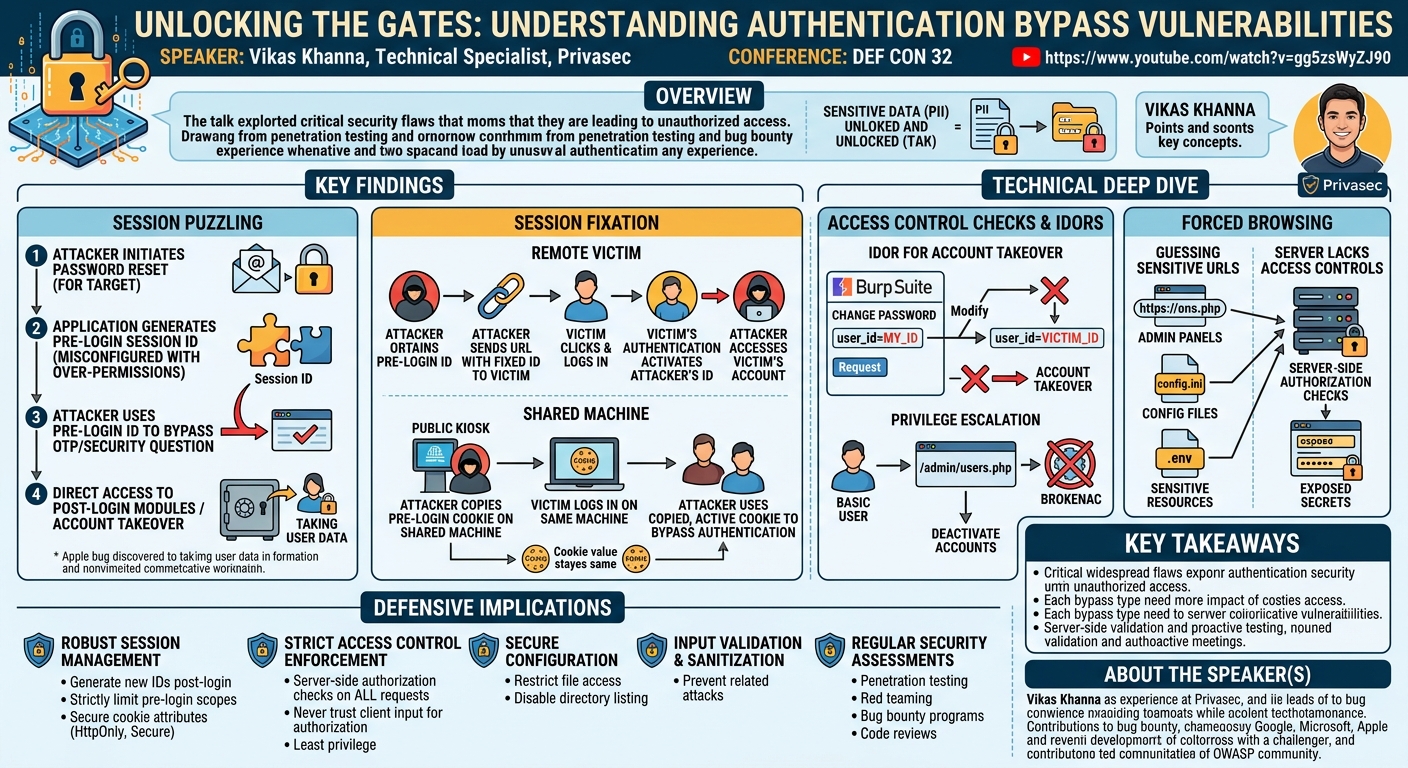
The first major finding discussed was Session Puzzling. This vulnerability arises when a session ID, typically generated during a pre-login phase (e.g., during a password reset flow), is misconfigured with "over-permissions." Instead of being restricted to its intended pre-login scope, this session ID inadvertently gains the ability to access post-login modules. This misconfiguration allows an attacker to bypass the full authentication process simply by possessing the pre-login session token, effectively "puzzling" the application into granting unauthorized access. Khanna highlighted finding such an issue in Apple's systems, underscoring its prevalence even in well-secured environments.
Another critical finding was Session Fixation. This occurs when the session variable's value remains constant between the pre-login and post-login stages of an application. Instead of generating a new, unique session ID upon successful authentication, the application merely changes the state of the existing pre-login session ID from inactive to active. This flaw allows an attacker to "fix" a session ID in advance, then leverage it after a legitimate user has logged in. Khanna detailed two primary scenarios for exploiting this, one involving remote victims and another concerning shared machines, both leading to direct account takeover without needing the victim's credentials.
Access Control Checks, particularly Insecure Direct Object References (IDORs), were identified as a highly effective method for account takeovers. Khanna explained that many applications perform sensitive activities, such as changing passwords or updating profiles, by merely checking a user's ID, often passed in parameters (sometimes even hidden ones). If these checks are insufficient, an attacker can modify the user ID to that of a victim, gaining unauthorized control over their account. This extends to Privilege Escalations, where a least-privileged user can manipulate parameters or request paths to access administrative modules and perform actions intended only for high-privileged users, such as deactivating accounts or changing passwords.
Finally, Forced Browsing was presented as a more direct, yet equally potent, vulnerability. This involves an attacker attempting to access post-authentication modules or sensitive files directly by guessing or knowing their URLs, without providing any credentials. If the application lacks proper server-side access control checks, it will grant access to these resources, potentially exposing sensitive configuration files or allowing unauthorized interaction with protected functionalities.
These key findings collectively illustrate that authentication bypasses are not singular vulnerabilities but rather a class of issues stemming from inadequate session management, flawed access control implementations, and insufficient authorization checks across various application components.
Technical Deep Dive
▶ Watch: Understanding session fixation vulnerability (5:00)
The technical mechanisms behind authentication bypasses are diverse, but they frequently revolve around flaws in how applications manage user sessions, enforce access controls, and handle user-supplied identifiers. Vikas Khanna detailed several critical techniques he has employed, providing a deep dive into their operational aspects.
Session Puzzling exploits a fundamental misconfiguration in session state management. Consider a "forgot password" flow:
- A user enters their email address.
- The application redirects to a page requesting an OTP or security question answer. Crucially, at this stage, the application often generates a session ID that is linked to the provided email.
- If this session ID is improperly configured, it may carry "over-permissions." Instead of being limited to the password reset context, it might inadvertently grant access to authenticated, post-login modules.
An attacker, by obtaining this pre-login session ID (e.g., by initiating a password reset for a target account), can then attempt to directly access post-login functionalities. If the application's authorization logic is flawed and checks only for the presence of a session ID rather than its scope or privilege level, the attacker can bypass the OTP/security question verification and directly access sensitive account information or even change the password without full authentication. Khanna noted this was the nature of his Apple bug discovery.
Session Fixation is another session management vulnerability where an application fails to generate a new session ID upon successful user authentication. Instead, the session ID established during the pre-login phase persists and simply transitions to an "active" state. Khanna illustrated two scenarios:
- Remote Victim: An attacker first obtains a pre-login session ID. This can often be achieved if the session ID is passed in the URL (e.g.,
https://example.com?sessionid=ATTACKER_SESSION). The attacker then sends this URL to a victim. When the victim clicks the link and subsequently logs into the legitimate application, their successful authentication activates the attacker's pre-fixed session ID. Since the attacker already possesses this ID, they can then use it on their own machine to access the victim's now-authenticated account without knowing the password. - Shared Machine: In an environment where multiple users share a single machine (e.g., a public terminal or a development workstation), an attacker can access the machine, browse to the target application, and copy the pre-login session cookie. Once a legitimate user logs into the application on that same shared machine, the pre-login cookie (which the attacker possesses) becomes active. The attacker can then use this copied, active cookie to bypass authentication and access the victim's account. This method relies on the principle that the pre-login and post-login cookie values remain identical.
Access Control Checks are vital for ensuring that authenticated users can only access resources and perform actions for which they are authorized. When these checks are weak or missing, it leads to Insecure Direct Object References (IDORs) and Privilege Escalation.
- IDORs for Account Takeover: Many applications perform sensitive actions like "change password" or "update profile" based on a user ID parameter. If an application only checks if any user is logged in, but not if the specific user ID being modified belongs to the currently logged-in user, an attacker can exploit this. Using client-side proxy tools like Burp Suite, an attacker can intercept a request to
update_profile.php?user_id=MY_IDand modifyMY_IDtoVICTIM_ID. If the application is vulnerable, the attacker can then update the victim's profile or even change their password, effectively taking over the account. Khanna emphasized that these IDs can often be found in hidden parameters, making them less obvious but equally exploitable. - Privilege Escalation: In gray box assessments, pen testers often have access to both privileged (admin) and non-privileged user accounts. An attacker logged in as a least-privileged user can attempt to access admin-level modules directly. For instance, if an admin panel is located at
/admin/users.php, an attacker might try to access it. If the application's access control mechanisms are insufficient and only check for basic authentication rather than specific role-based authorization, the non-privileged user might gain access. Depending on the application's functionality, this could allow actions like viewing all users, deactivating accounts, changing other users' passwords, or blocking users—all highly sensitive operations intended for administrators.
Forced Browsing is a simpler, yet often effective, technique that capitalizes on a lack of server-side access controls. This involves an attacker directly navigating to URLs that should require authentication or specific privileges, without attempting to log in or manipulate session tokens. For example, if an application has a dashboard.php or user_settings.php page, an attacker might try to access it directly. If the server does not enforce proper authorization checks on these pages, the attacker can view or interact with them as if they were authenticated. Furthermore, forced browsing can expose sensitive files that are present on the server but not explicitly linked within the application's navigation. This includes configuration files (e.g., config.ini, .env files, .htaccess files, or database connection strings) that might contain credentials, API keys, or other proprietary information, leading to further compromise.
These technical details underscore the need for developers to implement robust server-side validation for all user-supplied data, meticulous session management practices, and comprehensive authorization checks at every critical access point within an application.
Demo / Proof of Concept
▶ Watch: Access control checks and IDORs (6:50)
During the talk, Vikas Khanna mentioned his discovery of an authentication bypass in Apple's systems, stating, "I found account takeover or authentication bypass basically, I I will call it as authentication bypass. So that was my first bug in Apple. Thank you. Uh, excuse me, last thing. I'm still working on authentication bypasses stuff and if someone from you guys, uh, is working on authentication bypasses, uh, feel free to reach out to me. I will be more than happy to collaborate and, you know, work more on it." While he highlighted this significant finding and indicated he would "show in the later slides," the provided transcript concludes shortly after this statement, without detailing a specific live demonstration or a step-by-step proof-of-concept for the Apple vulnerability or any other vulnerability discussed. The talk primarily focused on the theoretical and practical methodologies for discovering such bugs, drawing from his experience rather than presenting a live exploit.
Defensive Implications
▶ Watch: Forced browsing to access post-authentication modules (8:44)
Understanding the mechanisms behind authentication bypasses is critical for developing robust defensive strategies. Organizations and developers must implement comprehensive security measures across their application lifecycle to mitigate these risks effectively.
- Robust Session Management: This is paramount.
- Generate New Session IDs Post-Authentication: To prevent session fixation, applications must invalidate any pre-login session ID and issue an entirely new, cryptographically strong session ID upon successful user authentication. This ensures that an attacker cannot reuse a previously fixed session token.
- Proper Session Permissions and Scope: Sessions created during pre-login flows (e.g., password reset, registration) must have strictly limited permissions and scope. They should never grant access to post-login functionalities. The application must explicitly verify the context and privilege level associated with a session token at every access point to sensitive resources, preventing session puzzling.
- Session Invalidation: Sessions should be invalidated upon logout, password change, or extended periods of inactivity. This reduces the window of opportunity for attackers to hijack active sessions.
- Secure Cookie Attributes: Use
HttpOnlyto prevent client-side script access to session cookies,Secureto ensure cookies are only sent over HTTPS, and set appropriateSameSitepolicies to defend against CSRF and related attacks.
- Strict Access Control Enforcement: This is the primary defense against IDORs and privilege escalation.
- Server-Side Authorization Checks: All requests to sensitive resources or functionalities, especially those involving user-specific data (e.g.,
user_idparameters), must undergo rigorous server-side authorization checks. The application must verify not only that the user is authenticated but also that they are authorized to perform the requested action on the specific resource identified. - Never Trust Client-Side Input: User IDs, roles, and permissions should never be solely derived from or trusted from client-side input. These must be verified against the authenticated user's actual identity and privileges stored on the server.
- Implement Least Privilege: Users should only have access to the resources and functionalities absolutely necessary for their role. This minimizes the impact of a successful privilege escalation attempt.
- Secure Configuration and File Access:
- Restrict Access to Sensitive Files: Web servers must be securely configured to prevent unauthorized access to sensitive files, especially configuration files, source code, or backup files. These should be stored outside the web root or protected with strict access control lists (ACLs).
- Disable Directory Listing: Directory listing should be disabled on web servers to prevent attackers from easily discovering the structure and contents of directories, which can aid in forced browsing.
- Input Validation and Sanitization: While not directly an authentication bypass, robust input validation helps prevent related attacks. All user-supplied input, including IDs and parameters, should be validated and sanitized to prevent injection attacks that could lead to information disclosure or manipulation that bypasses authentication.
- Regular Security Assessments:
- Penetration Testing and Red Teaming: Regularly conduct penetration tests and red team exercises to proactively identify authentication bypasses and other critical vulnerabilities. These assessments simulate real-world attacks, providing valuable insights into an application's security posture.
- Bug Bounty Programs: Implement or participate in bug bounty programs to leverage the collective expertise of the security research community, encouraging ethical hackers to discover and report vulnerabilities.
- Code Reviews: Conduct thorough code reviews, focusing specifically on authentication and authorization logic, session management, and how user identifiers are handled.
By adopting these defensive measures, organizations can significantly reduce their attack surface and bolster their defenses against the sophisticated authentication bypass techniques discussed by Vikas Khanna.
Key Takeaways
- Authentication bypasses and account takeovers are critical and widespread vulnerabilities that stem from fundamental flaws in session management and access control implementations.
- Session Puzzling occurs when pre-login session IDs are misconfigured with "over-permissions," allowing access to post-login modules without full authentication.
- Session Fixation enables attackers to hijack user accounts by leveraging pre-login session IDs that remain constant and become active upon legitimate user login.
- IDORs (Insecure Direct Object References) allow account takeovers and privilege escalation when applications fail to properly validate if a user is authorized to act on a specific resource or user ID.
- Forced Browsing can expose sensitive data or functionality by directly accessing URLs that lack adequate server-side authentication and authorization checks.
- Defenders must prioritize robust server-side session management (new session IDs post-login, strict permissions, invalidation) and comprehensive access control checks on every request to sensitive resources.
- Proactive security testing, including penetration testing, red teaming, and bug bounty programs, is essential for identifying and remediating these subtle yet impactful vulnerabilities.
About the Speaker(s)
Vikas Khanna is a Technical Specialist at Privasec, a cybersecurity firm. His professional focus lies in application security (appsec), web applications, and API security, where he applies his expertise to identify and mitigate vulnerabilities. Beyond his professional role, Khanna is an active and recognized bug bounty hunter, having received acknowledgements from major technology companies such such as Google, Microsoft, and Apple for his security research. He is also a dedicated contributor to the OWASP (Open Web Application Security Project) community, specifically to the Web Security Testing Guide (WSTG) and the OWASP dub dub dub community, demonstrating his commitment to sharing knowledge and improving industry standards. His contributions to the security landscape also include discovering and reporting vulnerabilities that earned him CVEs for enterprise products from Oracle and IBM.
Reviews
Dr. Zero (Offensive Security Researcher) — STRONG ACCEPT
This talk provides a brutally honest and technically detailed exploration of common authentication bypass vulnerabilities, drawing directly from the speaker's extensive experience as a bug bounty hunter and penetration tester. Vikas Khanna systematically breaks down critical flaws like Session Puzzling, Session Fixation, IDORs, and privilege escalation, illustrating how these often-overlooked issues lead to significant account takeovers. While the underlying vulnerability classes are known, the depth of explanation, real-world examples—including an authentication bypass in Apple's systems—and actionable defensive strategies make this an invaluable session for anyone involved in application…
Heather Calloway (CISO) — STRONG ACCEPT
This talk by Vikas Khanna effectively highlights the critical and pervasive nature of authentication bypass vulnerabilities, translating complex technical flaws into clear business risks. While the presentation's primary audience is technical operators focused on identification and exploitation, its detailed exploration of session management and access control weaknesses offers substantial value for security leaders. The robust defensive implications provide actionable guidance for improving application security posture, making it a valuable resource for guiding strategic security investments and operational priorities, despite the absence of a live demonstration for the disclosed Apple…