The Pwnie Awards
Unknown
DEF CON 32 Main Stage · Day 1 · Main Stage
Overview
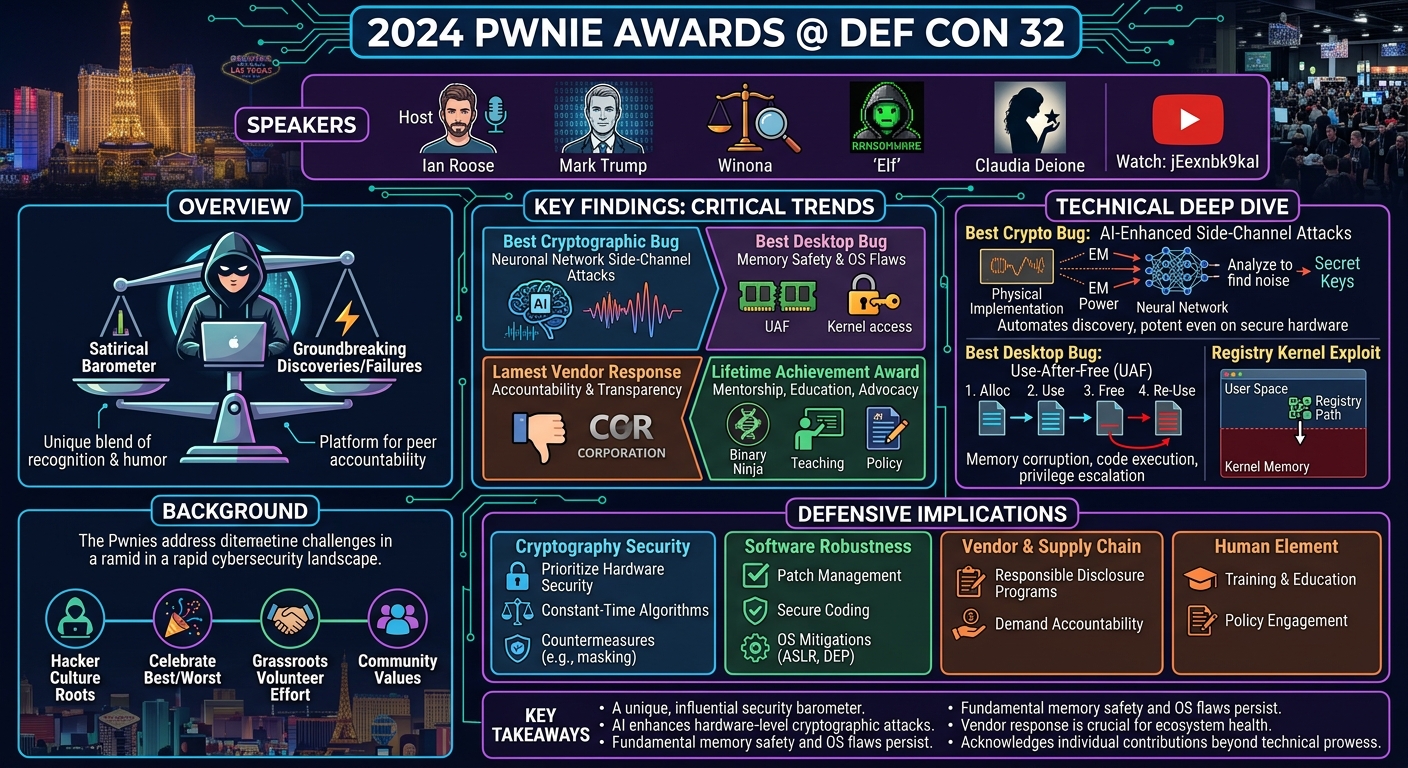
The 2024 Pwnie Awards ceremony at DEF CON 32 served as a vibrant and often satirical barometer for the preceding year's achievements and missteps within the cybersecurity community. Hosted by Ian Roose, the event brought together security researchers, industry professionals, and enthusiasts to celebrate groundbreaking discoveries, acknowledge significant failures, and honor influential figures. Unlike traditional academic or industry awards, the Pwnies are renowned for their blend of serious recognition and biting humor, reflecting the unique culture and critical eye of the hacker community.
Key moments
- 0:00 Welcome to 2024 Pwnie Awards; purpose explained
- 2:45 Ransomware actor 'Elf' takes stage as presenter
- 3:00 Elf's monologue on ransomware, CrowdStrike, and art
- 4:10 Best Crypto Bug award presented by Elf
- 6:40 Emotional acceptance of Sophia's Lifetime Achievement Award
- 8:15 Introducing the 'Lamest Vendor Response' Pwnie Award
The Pwnie Awards
Speakers: Ian Roose (Host), Mark Trump, Winona, "Elf" (Black Hat ransomware group persona), Claudia Deione
Conference: DEF CON 32
YouTube: https://www.youtube.com/watch?v=jEexnbk9kaI
Overview
The 2024 Pwnie Awards ceremony at DEF CON 32 served as a vibrant and often satirical barometer for the preceding year's achievements and missteps within the cybersecurity community. Hosted by Ian Roose, the event brought together security researchers, industry professionals, and enthusiasts to celebrate groundbreaking discoveries, acknowledge significant failures, and honor influential figures. Unlike traditional academic or industry awards, the Pwnies are renowned for their blend of serious recognition and biting humor, reflecting the unique culture and critical eye of the hacker community.
This annual gathering is more than just an awards show; it's a critical reflection on the state of security. By highlighting both exceptional research and "lamest vendor responses," the Pwnies provide a platform for peer-driven accountability and appreciation. The ceremony underscored the persistent relevance of fundamental security flaws, the evolving threat landscape incorporating advanced techniques like AI-driven side-channel attacks, and the crucial role of individual contributions to the collective defense effort. The event also included a poignant Lifetime Achievement Award, reminding attendees of the human element and enduring legacy within the often-anonymous world of cybersecurity research.
The Pwnie Awards at DEF CON 32 emphasized the dynamic nature of cybersecurity, where constant vigilance and innovation are paramount. It showcased how vulnerabilities can manifest across diverse attack surfaces, from hardware-level cryptographic implementations to widely used desktop operating systems. The awards implicitly call for improved defensive strategies, more robust software development practices, and a greater commitment to responsible disclosure and vendor transparency, all while maintaining the characteristic irreverence that makes the Pwnies a beloved institution in the security calendar.
Background
▶ Watch: Welcome to 2024 Pwnie Awards; purpose explained (0:00)
The Pwnie Awards have long been a cornerstone event at major security conferences, particularly DEF CON, establishing themselves as the industry's premier satirical and serious recognition platform. Originating from the hacker community, the awards aim to celebrate the "best" and "worst" of the year's security research, exploits, and industry responses. This unique dual focus distinguishes the Pwnies from other awards, which typically only laud successes. By recognizing "failures"—such as the "Lamest Vendor Response"—the Pwnies foster a culture of accountability and transparency, encouraging companies and researchers alike to uphold higher standards.
The problem, or rather the raison d'être, for the Pwnie Awards stems from the inherent challenges and rapid evolution of the cybersecurity landscape. Vulnerabilities are discovered daily, exploits are developed, and vendors respond with varying degrees of efficacy and speed. The Pwnies provide a communal space for reflection, allowing the community to collectively acknowledge pivotal moments, whether they are breakthroughs in offensive security, significant defensive innovations, or instances where industry practices fell short. The awards are purely a volunteer effort, as explicitly stated by the host Ian Roose, underscoring their grassroots origins and commitment to community values, free from corporate influence that might skew recognition. This volunteer spirit ensures the awards remain authentic, driven by the collective expertise and humor of the security research community. The ceremony itself is designed to be interactive, with winners encouraged to come on stage and speak about their work, further reinforcing its community-driven nature.
Key Findings
▶ Watch: Elf's monologue on ransomware, CrowdStrike, and art (3:00)
The 2024 Pwnie Awards highlighted several critical trends and significant contributions across the cybersecurity spectrum, reflecting the ongoing cat-and-mouse game between attackers and defenders. While the ceremony itself, by its nature, offered high-level summaries rather than in-depth technical breakdowns, the categories and recognized works point to areas of intense research and persistent vulnerability.
One of the most notable recognitions was for Best Cryptographic Bug, awarded for "Neuronal network activated, crypto analysis, Apple process or sad channel attacks." This finding underscores the escalating sophistication of attacks targeting cryptographic implementations, particularly those leveraging side-channel attacks. The inclusion of "neuronal network activated" signifies a worrying trend: the application of advanced machine learning (ML) and artificial intelligence (AI) techniques to exploit subtle information leakage from hardware components. This suggests that traditional cryptographic defenses, while mathematically sound, might be increasingly vulnerable to practical exploitation when their physical implementations leak unintended data. The specific mention of "Apple process" indicates that even highly regarded hardware platforms are not immune to these advanced forms of cryptanalysis.
The award for Best Desktop Bug went to "Choppy for Windows streaming service UAF," with "A registry window to corner memory" also being a significant nominee. This category highlights the enduring relevance of vulnerabilities in widely deployed desktop operating systems, despite the industry's increasing focus on cloud and mobile security. A Use-After-Free (UAF) vulnerability, such as the one found in the Windows streaming service, is a critical class of memory corruption bug that can lead to arbitrary code execution, often at elevated privileges. The "registry window to kernel memory" bug further illustrates how core operating system components can be exploited to gain unauthorized access or control over the system's most privileged areas. These findings reinforce that fundamental memory safety issues and privilege escalation vectors remain potent threats, requiring continuous vigilance from both developers and users.
Another crucial category, Lamest Vendor Response, presented by Winona, implicitly underscored the importance of responsible disclosure and effective incident response within the industry. While the specific recipient of this year's award was not detailed in the provided transcript, the mere existence and prominence of this category send a clear message: vendors are expected to engage constructively with security researchers, patch vulnerabilities promptly, and communicate transparently. Failure to do so not only endangers users but also earns public condemnation from the security community. This award acts as a powerful incentive for companies to improve their security posture and disclosure practices.
A particularly poignant moment was the presentation of the Lifetime Achievement Award to Sophia, also known as Caley. Accepted by her sister, Claudia Deione, this posthumous honor recognized Sophia's profound impact across multiple facets of the cybersecurity world. Her contributions spanned practical hacking for Soju, essential training with Binary Ninja, and significant work on policy issues. This award emphasized that influence in cybersecurity extends beyond specific exploits or technical papers to encompass mentorship, education, and advocacy, shaping the community and its future direction. Sophia's legacy illustrates the multifaceted nature of a true cybersecurity luminary, whose work touched both the technical and ethical dimensions of the field.
Collectively, these awards paint a picture of a security landscape where cutting-edge research targets the very foundations of trust (cryptography and hardware), where perennial software flaws continue to plague ubiquitous systems, and where the human element—both in terms of individual genius and corporate responsibility—plays a decisive role in shaping the collective security posture.
Technical Deep Dive
▶ Watch: Best Crypto Bug award presented by Elf (4:10)
The Pwnie Awards, by design, are a ceremony to acknowledge significant security research rather than a platform for presenting the intricate technical details of exploits. Consequently, the talk provided a high-level overview of the awarded vulnerabilities and methodologies, without delving into specific exploit chains, source code, or exact architectural diagrams. However, the categories and brief descriptions offer sufficient information to discuss the general technical implications and the nature of the recognized bugs.
For the Best Cryptographic Bug, the winning research, "Neuronal network activated, crypto analysis, Apple process or sad channel attacks," points to a sophisticated attack vector. Side-channel attacks are a class of non-invasive attacks that exploit information leaked by the physical implementation of a cryptographic system, rather than weaknesses in the cryptographic algorithm itself. This leaked information can include variations in power consumption, electromagnetic emissions, acoustic signals, or timing differences during cryptographic operations. Attackers analyze these "side channels" to deduce secret keys or other sensitive data. The term "Neuronal network activated" is particularly significant. It implies the use of machine learning (ML) models, specifically neural networks, to analyze and interpret the vast amounts of noisy data collected from side channels. Traditional side-channel analysis often relies on statistical methods and expert feature engineering. The application of neural networks automates and potentially enhances this process, allowing for the discovery of subtle correlations and patterns that might be missed by human analysts or simpler statistical models. This makes the attacks more potent, potentially reducing the number of samples required, and increasing their robustness against noise. The target being an "Apple process" suggests that even highly optimized and hardware-accelerated cryptographic operations on Apple devices, which often include dedicated secure enclaves or cryptographic co-processors, are not entirely immune to these advanced physical attacks. This highlights the critical importance of designing hardware and software for constant-time operations and minimizing any data-dependent physical leakage, a challenge that becomes increasingly complex as computational power for analysis grows.
Regarding the Best Desktop Bug, the winning entry, "Choppy for Windows streaming service UAF," concerns a Use-After-Free (UAF) vulnerability. A UAF bug occurs when a program attempts to use memory after it has been freed. This typically happens in several stages:
- Allocation: Memory is allocated for an object.
- Use: The object is used by the program.
- Free: The memory occupied by the object is deallocated.
- Vulnerability: The program retains a pointer to the freed memory and attempts to use it again.
If, between steps 3 and 4, the freed memory is reallocated for another purpose, the attacker can manipulate the contents of this new object through the old, dangling pointer. This can lead to various forms of memory corruption, including arbitrary read/write primitives, which can then be leveraged to achieve arbitrary code execution or privilege escalation. The "Windows streaming service" context suggests that this bug likely resides in a component responsible for handling multimedia streams or network communication, making it potentially exploitable remotely or via malicious media files.
The nominated bug, "A registry window to corner memory," while less explicitly described, suggests a vulnerability that allows an attacker to interact with the Windows Registry in a way that leads to unauthorized access or manipulation of kernel-level memory. The Windows Registry is a hierarchical database that stores low-level settings for the operating system and applications. Exploiting it to "corner memory" likely implies a technique to achieve kernel memory read/write primitives or privilege escalation by manipulating registry keys or values in an unexpected manner, leading to memory corruption or bypass of security mechanisms within the kernel. Both desktop bug findings reinforce that despite decades of research and mitigations, memory safety and kernel integrity remain critical areas of vulnerability in widely used operating systems.
It is important to reiterate that specific CVE numbers, detailed exploit methodologies, or proof-of-concept code were not presented during the Pwnie Awards ceremony. The descriptions provided are based on the general understanding of the vulnerability types mentioned and their implications in the broader security landscape.
Demo / Proof of Concept
▶ Watch: Emotional acceptance of Sophia's Lifetime Achievement Award (6:40)
As an awards ceremony, the 2024 Pwnie Awards did not feature any live technical demonstrations or proof-of-concept exploits. The "demonstration" aspect of the event was centered on the presentation of the awards themselves, with presenters introducing the categories and, in some cases, the winners or their representatives coming on stage to accept the iconic Pwnie horse trophy. While the awards recognized significant technical achievements in security research, the format was celebratory and informational, focusing on the impact and nature of the findings rather than a detailed, real-time showcasing of vulnerabilities or exploit execution.
Defensive Implications
▶ Watch: Introducing the 'Lamest Vendor Response' Pwnie Award (8:15)
The vulnerabilities and security issues highlighted at the 2024 Pwnie Awards carry significant defensive implications for individuals, organizations, and software/hardware vendors. Understanding these implications is crucial for developing robust security strategies in an ever-evolving threat landscape.
For the Best Cryptographic Bug involving "Neuronal network activated, crypto analysis, Apple process or sad channel attacks," the defensive focus must shift beyond purely mathematical security to encompass physical security of cryptographic implementations. Defenders need to:
- Prioritize Hardware Security: Design and implement cryptographic modules with inherent resistance to side-channel leakage. This includes using constant-time algorithms where execution time, power consumption, and electromagnetic emissions are independent of secret data.
- Investigate Advanced Countermeasures: Explore techniques like noise injection, randomization, and masking to obscure side-channel signals, making them harder for even sophisticated AI/ML-driven analysis to exploit.
- Monitor for Anomalies: Implement monitoring solutions that can detect unusual power consumption patterns, electromagnetic emissions, or timing variations in critical cryptographic hardware, though this remains a highly specialized and challenging area.
- Prepare for AI in Offensive Security: Acknowledge that attackers are leveraging AI/ML for vulnerability discovery and exploitation. Defenders must similarly invest in AI/ML for threat detection, anomaly analysis, and automated vulnerability assessment to keep pace.
The Best Desktop Bug awards, particularly the "Choppy for Windows streaming service UAF" and "registry window to kernel memory" issues, underscore the enduring importance of fundamental software security:
- Patch Management: Organizations must maintain rigorous and timely patch management programs for all operating systems and applications. Many critical exploits leverage known vulnerabilities for which patches are available.
- Memory Safety: Developers must prioritize secure coding practices to prevent memory corruption vulnerabilities like Use-After-Free (UAF). This includes careful memory allocation/deallocation, robust error handling, and avoiding dangling pointers. Languages with built-in memory safety features (e.g., Rust) or rigorous static/dynamic analysis tools can help.
- Operating System Mitigations: Ensure that operating system security features like Address Space Layout Randomization (ASLR), Data Execution Prevention (DEP), and Control Flow Guard (CFG) are enabled and properly configured. While not foolproof, these mitigations significantly raise the bar for exploit development.
- Principle of Least Privilege: Implement the principle of least privilege for users and applications. Restricting permissions limits the impact of successful exploits, preventing attackers from gaining full system control even if a vulnerability is triggered.
The Lamest Vendor Response category serves as a direct call to action for vendors and highlights what defenders should expect from their suppliers:
- Demand Responsible Disclosure: Organizations should choose vendors with established and transparent responsible vulnerability disclosure programs. This includes clear communication channels, reasonable timelines for fixes, and public acknowledgment of security researchers.
- Evaluate Vendor Security Posture: When selecting software or hardware, assess not only the product's features but also the vendor's commitment to security, including their track record in responding to vulnerabilities and issuing patches.
- Foster Collaboration: Encourage and participate in information sharing with security researchers and other organizations to collectively improve the security ecosystem.
Finally, the Lifetime Achievement Award for Sophia/Caley, recognizing her work in training and policy, reminds us of the human element in defense:
- Invest in Training and Education: Continuously train security teams and developers on the latest threats, secure coding practices, and defensive techniques. A knowledgeable workforce is the first line of defense.
- Engage in Policy Development: Advocate for and participate in the development of sound cybersecurity policies at organizational and governmental levels to create a more secure digital environment.
In essence, the Pwnie Awards reinforce that effective defense requires a multi-layered approach: securing hardware at the lowest level, writing robust and memory-safe software, maintaining an aggressive patching cadence, demanding accountability from vendors, and continuously investing in human capital through education and policy engagement.
Key Takeaways
- The Pwnie Awards serve as a unique and influential barometer for the cybersecurity landscape, blending serious recognition of groundbreaking research with satirical critiques of industry failures and responses.
- Hardware-level vulnerabilities, particularly cryptographic side-channel attacks enhanced by AI/ML techniques, represent an escalating and sophisticated threat that demands a renewed focus on physical security implementations and advanced countermeasures.
- Fundamental software flaws, such as Use-After-Free (UAF) vulnerabilities in widely used desktop operating systems like Windows, continue to be prevalent and impactful, necessitating rigorous memory safety practices and prompt patch management.
- Vendor responsiveness to discovered vulnerabilities is critically important for the overall health of the security ecosystem, with poor or delayed responses being publicly highlighted and condemned by the security community.
- The Pwnie Awards acknowledge the profound contributions of individuals to the cybersecurity field, recognizing not only technical prowess but also significant impact through training, policy advocacy, and community building, as exemplified by the Lifetime Achievement Award.
- The ceremony underscores the dynamic nature of security research, where continuous innovation is required from both offensive and defensive perspectives, emphasizing the need for constant learning, adaptation, and collaboration within the community.
About the Speaker(s)
The 2024 Pwnie Awards ceremony featured a dynamic cast of hosts and presenters, reflecting various facets of the cybersecurity community.
- Ian Roose served as the engaging host of the 2024 Pwnie Awards. He guided the audience through the ceremony, introducing categories and setting the event's characteristic tone, which blends humor with serious recognition of security research.
- Mark Trump is the Executive Director of Summercon, a long-running security conference continuously active since 1987. He presented the award for Best Desktop Bug, sharing insights into the enduring relevance of desktop vulnerabilities in a world increasingly focused on cloud computing.
- Winona was introduced as a former reverse engineer currently pursuing a career in law school. She presented the award for Lamest Vendor Response, bringing a unique perspective from both technical analysis and legal/policy considerations.
- "Elf" (Black Hat ransomware group persona) appeared as a satirical presenter for the Best Cryptographic Bug award. This character, embodying a "typical ransomware as a service edible," offered a humorous and pointed commentary on the ransomware landscape and the perceived effectiveness of certain security vendors, explicitly mentioning "crane strike" (likely a satirical stand-in for a major security vendor). This persona underscored the awards' tradition of blending humor with critical industry observations.
- Claudia Deione accepted the Lifetime Achievement Award on behalf of her late sister, Sophia, also known as Caley. Claudia is the President of Marine Research. Her acceptance speech provided a touching tribute to Sophia's extensive contributions to the cybersecurity community, highlighting her work in areas such as "hacking for Soju," training with Binary Ninja, and policy development.
- Sophia (Caley) was the posthumous recipient of the Lifetime Achievement Award. Though not present, her legacy was celebrated for her profound impact across various domains of cybersecurity, including practical hacking, education, and policy advocacy, demonstrating a wide-ranging influence on the community.
Reviews
Dr. Zero (Offensive Security Researcher) — STRONG ACCEPT
The Pwnie Awards ceremony at DEF CON 32 serves as an essential, no-nonsense annual review of the cybersecurity landscape, highlighting the year's most impactful technical research and the industry's most egregious failures. While not a research presentation itself, it effectively functions as a high-signal threat intelligence briefing, cutting through marketing fluff to acknowledge genuine breakthroughs, critical vulnerabilities like AI-driven side-channel attacks and UAFs, and holding vendors accountable for their lack of transparency and poor responses. It's a vital pulse-check from the community, for the community, that provides actionable insights for defenders and builders alike.
Heather Calloway (CISO) — STRONG ACCEPT
The Pwnie Awards, while a satirical event, serves as a crucial barometer for the state of cybersecurity, providing direct insight into evolving threats and persistent failures. Its recognition of advanced cryptographic attacks leveraging AI, coupled with the enduring relevance of fundamental desktop vulnerabilities, highlights critical areas for CISO attention. More importantly, the 'Lamest Vendor Response' category offers a pointed, community-driven critique that directly informs governance expectations for accountability and incident response from our partners and suppliers.