DC101 Panel
Unknown
DEF CON 32 Main Stage · Day 1 · Main Stage
Overview
The "DC101 Panel" at DEF CON 32 served as an essential orientation for attendees, particularly those new to the sprawling and often overwhelming environment of one of the world's largest hacker conferences. Led by Nikita, the Director of Content and Coordination and Chief Hacker Wrangler for Defcon, alongside key organizers Grifter (Contests and Events Lead) and Ada (Hotline Program Lead), this session aimed to demystify the DEF CON experience. It provided crucial logistical information, reinforced core cultural norms, and emphasized attendee well-being and engagement.
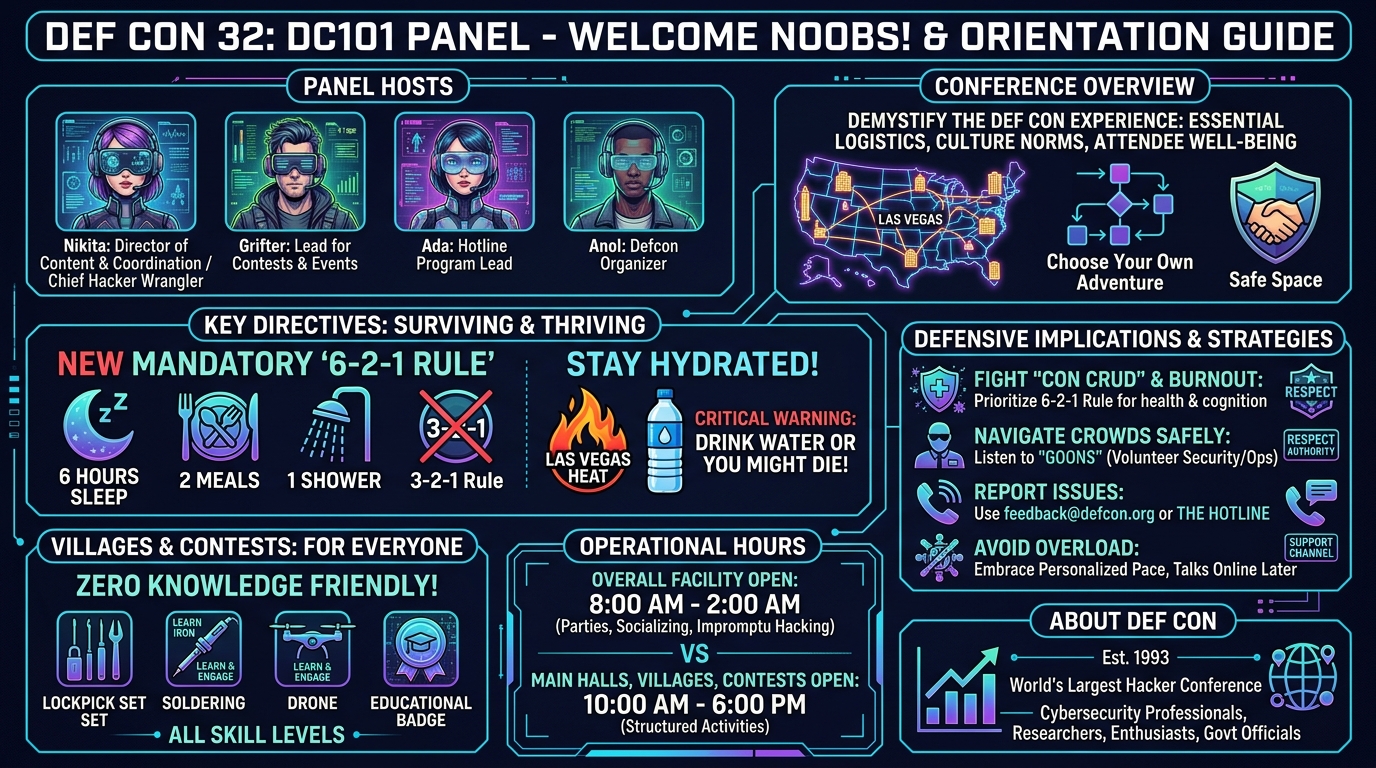
DC101 Panel
Speakers: Nikita, Director of Content and Coordination, Chief Hacker Wrangler for Defcon; Grifter, Lead for Contests and Events for Defcon; Ada, Hotline Program Lead; Anol
Conference: DEF CON 32
YouTube: https://www.youtube.com/watch?v=zGgPm2LeM8A
Overview
The "DC101 Panel" at DEF CON 32 served as an essential orientation for attendees, particularly those new to the sprawling and often overwhelming environment of one of the world's largest hacker conferences. Led by Nikita, the Director of Content and Coordination and Chief Hacker Wrangler for Defcon, alongside key organizers Grifter (Contests and Events Lead) and Ada (Hotline Program Lead), this session aimed to demystify the DEF CON experience. It provided crucial logistical information, reinforced core cultural norms, and emphasized attendee well-being and engagement.
This panel is significant because it encapsulates the ethos of DEF CON, moving beyond just technical talks to foster a community experience rooted in curiosity, experimentation, and mutual respect. For first-time attendees, or "noobs" as the conference affectionately terms them, it's a vital guide to navigating the extensive offerings, from structured talks and villages to impromptu late-night hacking sessions. The discussion highlighted practical advice, such as facility hours and the importance of self-care, while also setting expectations for an inclusive and exploratory environment.
Ultimately, the "DC101 Panel" is a foundational talk that underscores DEF CON's commitment to creating a welcoming yet challenging space for hackers of all skill levels. By addressing common pitfalls and encouraging a "choose your own adventure" approach, it empowers attendees to tailor their experience, engage authentically, and prioritize their health amidst the high-energy atmosphere of Las Vegas. It serves as a reminder that while the technical depth of DEF CON is paramount, the conference's vibrant community and unique culture are equally vital components of its enduring appeal.
Background
DEF CON, established in 1993, has grown into a colossal annual gathering that brings together tens of thousands of cybersecurity professionals, researchers, enthusiasts, and even government officials. Its reputation as a crucible for cutting-edge research, a hotbed for social engineering, and a vibrant marketplace of ideas often makes it an intimidating prospect for newcomers. The sheer scale of the conference – spanning multiple hotel venues, hosting hundreds of talks, workshops, villages, and contests – can lead to significant information overload and a sense of being lost.
The problem this panel addresses is multi-faceted. Firstly, the unique culture of DEF CON, with its blend of open-source ethos, adversarial thinking, and a historical emphasis on anonymity, can be difficult for outsiders to grasp. Unwritten rules, specific terminology (like "goons" for security staff), and the intense social dynamics require a degree of acculturation. Secondly, the physical environment of Las Vegas itself presents challenges: the desert heat, vast walking distances between venues, and the pervasive availability of alcohol can quickly lead to exhaustion and dehydration, impacting an attendee's ability to participate and enjoy the conference safely.
Historically, DEF CON attendees have embraced a somewhat extreme, "push-the-limits" mentality, exemplified by the traditional "3-2-1 rule" (three hours of sleep, two meals, one shower per day). While often recited with a sense of pride, this rule, as acknowledged by Nikita, who was attending her 21st DEF CON, has become increasingly unsustainable for many, particularly as the community ages and the demands of the conference intensify. This panel, therefore, represents an evolution in conference philosophy, shifting towards a more explicit emphasis on attendee well-being and a structured, yet flexible, approach to engagement, ensuring that the DEF CON experience remains accessible and enjoyable for everyone, regardless of their prior exposure or personal stamina.
Key Findings
While the DC101 Panel does not present traditional research findings, it delivers crucial directives and insights into navigating the DEF CON experience, acting as a foundational guide for attendees. The core "findings" are not discoveries in the scientific sense, but rather consolidated wisdom and updated mandates from the conference organizers to ensure a productive, safe, and enjoyable event for all.
A primary "finding" from the panel is the updated mandatory self-care protocol, evolving from the traditional, often jokingly enforced, "3-2-1 rule" (three hours of sleep, two meals, one shower). Recognizing the aging demographic of the DEF CON community and the physical demands of the event, Nikita, as Chief Hacker Wrangler, officially mandated a new "6-2-1 rule": six hours of sleep, two meals, and one shower every day. This significant shift underscores a heightened focus on attendee well-being, acknowledging that sustained engagement and learning require adequate rest and basic hygiene. Another panelist even advocated for "six hours of sleep, three meals, two showers," further emphasizing the importance of robust self-care.
Another critical directive pertains to hydration and physical safety. Attendees are explicitly warned about the dangers of dehydration in the Las Vegas environment, which combines desert heat with extensive walking and often late-night activities. The panel stressed the severe health risks, with Nikita stating, "You need to drink water or you might die." This direct warning highlights a common and serious issue faced by attendees and positions hydration as a non-negotiable aspect of personal safety at the conference.
The panel also clarified operational hours and activity zones. The entire facility is open to attendees from 8:00 AM to 2:00 AM, offering continuous opportunities for social interaction and impromptu hacking. However, the main halls, which house villages and contests, operate on a more structured schedule, open from 10:00 AM to 6:00 PM. This distinction is vital for attendees planning their days, ensuring they know when formal activities are accessible versus when the more free-form social events take precedence.
Furthermore, the panel articulated the "choose your own adventure" philosophy of DEF CON. Attendees are encouraged to disregard the pressure of following a rigid checklist of talks or villages. Instead, the emphasis is on finding "your people" and engaging with activities that genuinely spark interest. This approach acknowledges the overwhelming nature of the conference and promotes a personalized, organic learning and networking experience. It's reinforced by the assurance that talks will be available online later, removing the pressure to attend every live session.
Finally, a key "finding" for newcomers is the accessibility of villages and contests for all skill levels. The organizers explicitly design these interactive areas to be "zero knowledge" friendly, meaning anyone, regardless of their technical background, can walk in, learn something new, participate in an activity or workshop, and leave "better or more curiouser for it." This inclusivity is a cornerstone of DEF CON's educational mission, making it a welcoming environment even for those who might feel intimidated by the advanced topics discussed in main talks.
Technical Deep Dive
This talk, a DEF CON 101 panel, focuses entirely on orienting new attendees to the conference experience rather than delving into specific technical vulnerabilities, exploits, or architectural designs. As such, a traditional technical deep dive is not applicable. The content is centered on logistical information, cultural norms, and personal well-being advice crucial for navigating a large-scale hacker conference. There are no discussions of code, protocols, system architectures, or security methodologies in this introductory session. The "technical" aspect of DEF CON is found in the hundreds of other talks, villages, and contests that comprise the broader conference agenda, none of which were the subject of this particular panel.
Demo / Proof of Concept
Given the nature of this panel as an introductory guide to DEF CON, there were no technical demonstrations or proofs of concept presented. The session's purpose was to provide essential information and foster a welcoming environment for attendees, focusing on practical advice, conference logistics, and cultural expectations rather than showcasing specific hacks, tools, or research findings. The panel was entirely conversational, offering guidance from experienced organizers to the conference audience.
Defensive Implications
While the DC101 Panel does not address traditional cybersecurity defensive strategies against technical threats, it provides critical defensive implications for personal safety, well-being, and effective engagement within the unique environment of DEF CON. These implications are geared towards protecting oneself from physical harm, burnout, and social missteps, which are equally important for a successful conference experience.
The most prominent defensive implication is the mandatory adoption of the "6-2-1 rule" (six hours of sleep, two meals, one shower daily). This is a direct defense against "con crud" (the illness often contracted at large conferences), physical exhaustion, and cognitive impairment. Adequate sleep is crucial for maintaining alertness, making sound judgments, and effectively absorbing information from talks and workshops. Regular meals provide necessary energy, while personal hygiene helps prevent the spread of germs in crowded environments. Neglecting these basics can lead to a compromised immune system, reduced learning capacity, and a generally negative conference experience.
Another vital defensive measure emphasized is hydration. The panel's stark warning about the dangers of dehydration in Las Vegas highlights a significant environmental threat. Attendees are effectively advised to proactively defend against heatstroke, fatigue, and other dehydration-related health issues by consistently drinking water. This is particularly important given the physical activity involved in navigating large venues and the potential for alcohol consumption, which can exacerbate dehydration. Failure to hydrate can lead to severe medical emergencies, detracting entirely from the conference's purpose.
Furthermore, the directive to "listen to the goons" serves as a critical defensive strategy for navigating crowd control and maintaining personal safety. Goons are the volunteer security and operations staff of DEF CON, responsible for directing traffic, enforcing rules, and responding to incidents. Respecting their authority and following their instructions, even when they are "yelling to get your attention," is essential for preventing bottlenecks, ensuring orderly movement, and avoiding potentially dangerous situations. The provision of a formal feedback mechanism (emailing feedback@defcon.org or calling the hotline) acts as a defensive channel for attendees to report any issues or concerns regarding goon interactions, ensuring accountability and a safer environment.
Finally, the encouragement to embrace a "choose your own adventure" mindset and the assurance that it's "okay to be a noob" are defensive strategies against information overload and burnout. DEF CON can be overwhelming, and the pressure to attend every talk or visit every village can lead to stress and exhaustion. By advocating for a personalized approach, the panel helps attendees defend against the psychological toll of trying to do too much. It promotes a sustainable pace, allowing individuals to focus on areas of genuine interest, thereby maximizing their learning and enjoyment without sacrificing their well-being. This also implicitly defends against feelings of inadequacy, fostering an inclusive environment where all levels of expertise are valued.
Key Takeaways
- Prioritize Self-Care: The traditional "3-2-1 rule" has been updated to a mandatory "6-2-1 rule" (six hours of sleep, two meals, one shower) to ensure attendee well-being amidst the demanding DEF CON environment.
- Stay Hydrated: Las Vegas's climate and the conference's intensity make dehydration a significant health risk; attendees are strongly advised to consistently drink water to prevent serious health issues.
- Respect Staff Directives: Listen to the "goons" (DEF CON's operations and security staff) for crowd control and safety; formal channels like feedback@defcon.org and the hotline are available for any concerns.
- Embrace Exploration: DEF CON encourages a "choose your own adventure" philosophy, urging attendees to find what genuinely interests them rather than adhering to a rigid schedule, and reminding them that talks will be available online later.
- Villages are for Everyone: Interactive villages and contests are designed to be "zero knowledge" friendly, providing accessible learning and participation opportunities for all skill levels, from beginners to seasoned hackers.
- Know the Hours: While main halls, villages, and contests operate from 10:00 AM to 6:00 PM, the overall facility remains open from 8:00 AM to 2:00 AM for social events, parties, and impromptu hacking.
About the Speaker(s)
The DC101 Panel featured a team of experienced DEF CON organizers dedicated to facilitating a welcoming and engaging conference experience.
Nikita served as the primary speaker and moderator for the panel. She holds the pivotal roles of Director of Content and Coordination for Defcon and Chief Hacker Wrangler. Her extensive experience is underscored by the fact that DEF CON 32 marked her 21st attendance at the conference, providing her with deep insights into its evolving culture and logistical demands. Despite her significant experience, she openly admitted to being a nervous speaker, which humanized the leadership and fostered a relatable atmosphere for attendees.
Grifter was introduced as the Lead for Contests and Events for Defcon. His role highlights the diverse and interactive nature of the conference, which extends far beyond traditional talks to include numerous challenges and competitive hacking activities.
Ada manages the Hotline program, a crucial resource for attendees needing assistance or wishing to report issues during the conference. The hotline underscores DEF CON's commitment to attendee safety and providing support channels.
An additional speaker, Anol, was also introduced, though his specific role or title was not detailed beyond his name. The panel interaction humorously acknowledged a momentary "doxing" when his name was first mentioned, reflecting the conference's unique cultural norms around anonymity.
Reviews
Dr. Zero (Offensive Security Researcher) — STRONG ACCEPT
This panel, while explicitly non-technical, serves as an essential orientation for DEF CON attendees, particularly newcomers. It delivers critical logistical information, clarifies cultural norms, and, most importantly, mandates a significant and overdue shift in attendee self-care from the '3-2-1' to the '6-2-1' rule. The direct communication from core organizers provides undeniable credibility and actionable guidance, ensuring a safer and more productive experience for the conference population.
Heather Calloway (CISO) — STRONG ACCEPT
While not a technical deep dive or a session on enterprise cybersecurity, the DC101 Panel at DEF CON 32 stands out for its clear demonstration of institutional accountability and risk management. The shift to a mandated "6-2-1 rule" for attendee well-being, coupled with direct, actionable guidance on hydration and navigation, represents a mature approach to managing operational risk within the conference environment. This session provides critical, practical value for its intended audience, ensuring a safer and more productive experience, and embodies principles of clear communication and responsibility that any leader should appreciate.