Encrypted newspaper ads in the 19th century
Elonka Dunin, Klaus Schmeh
DEF CON 32 Main Stage · Day 1 · Main Stage
Overview
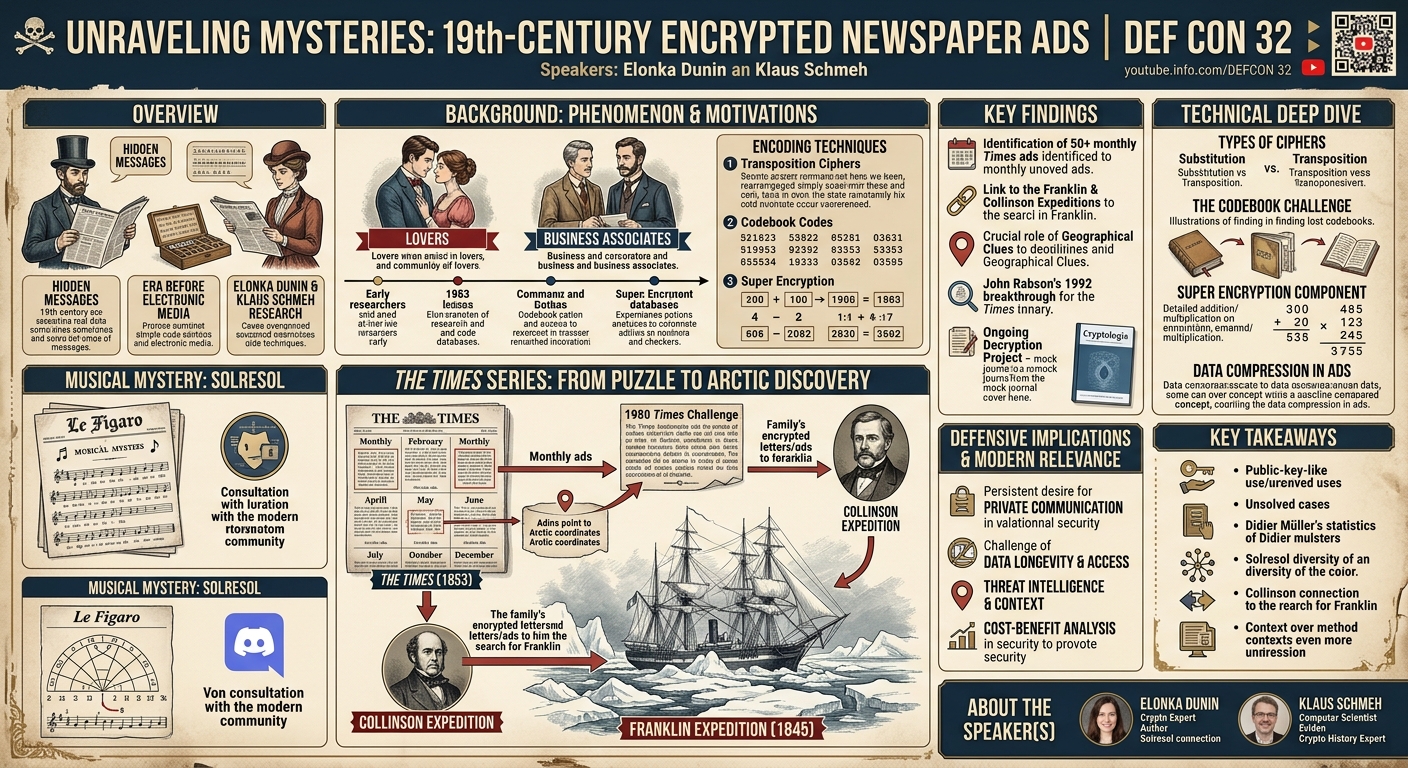
This talk, delivered by renowned cryptographers Elonka Dunin and Klaus Schmeh, delves into the fascinating world of 19th-century encrypted newspaper advertisements. Far from being mere historical curiosities, these hidden messages represent a significant, albeit often overlooked, aspect of public and private communication during an era predating modern electronic media. The speakers illuminate how individuals, from lovers to business associates, utilized newspaper classifieds to transmit sensitive or personal information, leveraging simple ciphers to ensure a degree of privacy in plain sight.
Key moments
- 0:00 Introduction to 19th-century encrypted newspaper ads
- 2:00 Examples of various unsolved encrypted newspaper ads
- 4:00 The 'musical mystery' ad and Solresol language
- 7:00 The Times (1980) challenges readers to solve an old ad
- 8:15 Historical context: The mysterious Franklin Expedition of 1845
- 10:30 The Franklin expedition ships finally found (2014-2016)
Encrypted newspaper ads in the 19th century
Speakers: Elonka Dunin, Crypto/Crypto History Expert; Klaus Schmeh, German Computer Scientist, Eviden, Crypto/Crypto History Expert
Conference: DEF CON 32
YouTube: https://www.youtube.com/watch?v=krIOAKQhsGY
Overview
This talk, delivered by renowned cryptographers Elonka Dunin and Klaus Schmeh, delves into the fascinating world of 19th-century encrypted newspaper advertisements. Far from being mere historical curiosities, these hidden messages represent a significant, albeit often overlooked, aspect of public and private communication during an era predating modern electronic media. The speakers illuminate how individuals, from lovers to business associates, utilized newspaper classifieds to transmit sensitive or personal information, leveraging simple ciphers to ensure a degree of privacy in plain sight.
Dunin and Schmeh, co-authors of several books on cryptography, highlight ongoing research efforts to decipher these historical puzzles. Their presentation at DEF CON 32 underscores the enduring human need for secure communication and the ingenuity employed to achieve it, even with the limited tools of the past. The talk is particularly relevant for those interested in the history of cryptography, social history, and the persistent challenges of code-breaking, demonstrating that some of the most intriguing ciphers remain unsolved centuries later.
The presentation also connects these cryptic ads to major historical events, most notably the Franklin Expedition and the subsequent Collinson Expedition, revealing how personal messages became intertwined with epic tales of exploration and disappearance in the Arctic. By exploring these historical artifacts, Dunin and Schmeh not only entertain but also provide valuable insights into the evolution of information security and the methods cryptanalysts employ to unravel secrets from the past.
Background
▶ Watch: Introduction to 19th-century encrypted newspaper ads (0:00)
The 19th century witnessed a peculiar phenomenon: the widespread use of encrypted advertisements in daily newspapers. These weren't elaborate cryptographic systems but rather simple ciphers intended to convey private messages within a public forum. The primary motivations for using such methods were varied, ranging from discrete communication between lovers to confidential business exchanges. The speakers note that early researchers, such as Jean Palmer (pseudonym for Tony Gaffney), documented around 1,000 such ads in his 2006 book, many of which remain unsolved.
The landscape of 19th-century encrypted ads was diverse, showcasing a variety of encoding techniques. Examples presented include what appeared to be a transposition cipher from an ad hinting at a previous communication, yet remaining stubbornly unsolved. Another intriguing example resembled a "Bible code," a sequence of numbers and letters without obvious structure, also defying decryption. Further examples included seemingly related messages between individuals identified only as "Tissie" and "Jabber," whose content remains a mystery.
Beyond English newspapers, the practice was prevalent across Europe. Didier Müller, a colleague of the speakers, meticulously compiled a database of thousands of encrypted ads from the French newspaper Le Figaro. His research, spanning the years 1875 to 1896, identified 3,700 cipher messages, with only 62% having been successfully broken. Müller's findings reveal a common pattern: a combination of clear text interspersed with five-digit numbers. This structure strongly suggests the use of a codebook code, where specific numerical sequences correspond to words or phrases. However, despite extensive searches through contemporary French and English codebooks, the specific codebook used for these messages has not yet been identified. The possibility of super encryption—where a basic codebook output is further enciphered by simple arithmetic operations (e.g., adding one or dividing by two)—is also considered as a reason for their continued resistance to decryption.
One particularly unique example presented was a "musical mystery" from Le Figaro: "ce qu'on ne peut se dire, ni s'écrire, on peut le chanter: Do mi, do mi, do ré, ré fa, ré fa, ré mi, etc. Vous avez compris?" (That which cannot be said nor written, can be sung. Do mi, do mi, do ré, ré fa, ré fa, ré mi, etc. Have you understood?). This ad refers to Solresol, an artificial language invented in France earlier in the 19th century, based entirely on musical notes. Despite consulting a modern Solresol community on Discord, the message's meaning remains elusive, leading to theories ranging from a romantic confession to a simple choir practice reminder.
A significant portion of the talk focuses on a series of over 50 encrypted ads published monthly in The Times newspaper, primarily around 1853. These messages gained renewed attention in 1980 when The Times republished one such ad, challenging its readers to solve it. While no complete solution emerged, one reader astutely noted that some numbers and letters in the ad likely referred to latitude and longitude, pointing to a location in Northern Canada. This geographical clue immediately brought to mind the infamous Franklin Expedition.
The Franklin Expedition, a British naval endeavor led by Lord John Franklin, set off in 1845 with two robust warships, the Terror and the Erebus, to discover the elusive Northwest Passage. After a stop in Greenland, the expedition vanished without a trace in the Arctic ice. The disappearance became one of the great mysteries of the 19th century, sparking numerous search expeditions, many funded by Franklin's persistent wife, Lady Franklin. The ships were eventually located only recently, in 2014 and 2016, near King William Island. The connection to The Times ads was a pivotal discovery, linking personal communication to a grand historical narrative of exploration and tragedy.
The speakers reveal that these specific Times ads were part of a communication channel for the family of Captain Richard Collinson, who led a separate Arctic expedition (the Collinson Expedition) in search of Franklin. Collinson's family sent him encrypted messages, typically one per month, alongside conventional letters. The encryption of these personal messages, though not containing "absolutely secret" information, was likely intended to keep family gossip and private affairs out of public scrutiny in a widely read newspaper like The Times. Furthermore, encryption could offer a form of data compression, allowing more information to be conveyed in fewer words, similar to how codebooks were used in telegrams to save on per-word costs.
Key Findings
▶ Watch: The 'musical mystery' ad and Solresol language (4:00)
The central finding presented in the talk revolves around the systematic study and decryption efforts concerning a large series of encrypted advertisements published in The Times during the 19th century. The speakers highlight several key discoveries and contributions:
Firstly, the identification of a coherent series of over 50 encrypted ads published monthly in The Times, primarily in the mid-1850s. This collection represents a significant corpus for historical cryptanalysis, revealing a sustained and organized effort at private communication through public channels. The discovery of these ads as a series, rather than isolated instances, was crucial for understanding their context and potential for decryption.
Secondly, the talk details the intriguing re-discovery of one of these ads in 1980 by The Times itself, which challenged its readers to decipher it. While readers failed to fully break the code, one crucial insight emerged: the presence of latitude and longitude coordinates pointing to Northern Canada. This geographical clue was instrumental in connecting the cryptic messages to the broader historical context of Arctic exploration.
Thirdly, the definitive link between these Times ads and the Collinson Expedition was a major breakthrough. It was established that these messages were sent by Captain Richard Collinson's family—including relatives like Sophia and Amelia—to him during his Arctic journey in search of the lost Franklin Expedition. This discovery transformed the abstract cryptographic puzzles into tangible historical artifacts, providing a human element to a grand historical drama. The ads, along with letters sent with "creative addresses" like "somewhere near the North Pole" or "Arctic Expedition Pacific," paint a vivid picture of the challenging communication logistics of the era.
Fourthly, the talk acknowledges the crucial contribution of John Rabson, who in 1992 achieved a significant breakthrough in decrypting some of these Collinson ads. Rabson's work provided the initial key to understanding the underlying cryptographic scheme, which allowed for further progress in the ongoing project.
Finally, Dunin and Schmeh announce their current project to decipher all 50+ of these Collinson ads. They anticipate publishing a comprehensive paper in Cryptologia by the end of the year, providing solutions and contextual analysis for the entire series. This ongoing work represents a significant contribution to the field of historical cryptography, promising to shed new light on the personal lives and communication strategies of individuals involved in one of history's most compelling mysteries. They also highlight the persistent challenges, noting that despite the advancements, gaps in the monthly publication schedule of the ads remain unexplained, leaving open questions about missing messages or publication irregularities.
Technical Deep Dive
▶ Watch: The Times (1980) challenges readers to solve an old ad (7:00)
The technical aspects of 19th-century encrypted newspaper ads, as discussed by Dunin and Schmeh, primarily revolve around the types of ciphers employed and the methodologies used for their analysis. While not involving complex modern algorithms, these historical encryption techniques posed significant challenges for contemporary and modern cryptanalysts alike.
The talk presents several categories of ciphers:
- Transposition Ciphers: One of the initial unsolved examples mentioned appears to be a transposition cipher, where the order of letters is rearranged without changing the letters themselves. This type of cipher relies on a key that dictates the rearrangement pattern. Without the key or sufficient ciphertext to infer the pattern through frequency analysis or anagramming, such ciphers can be notoriously difficult to break, as evidenced by the unsolved ad mentioned at the beginning of the talk, despite its clear contextual hint.
- Codebook Codes: The messages found by Didier Müller in Le Figaro, characterized by interspersed five-digit numbers within clear text, strongly suggest the use of a codebook. In this system, each five-digit number would correspond to a specific word, phrase, or even a sentence. The security of such a system depends entirely on the secrecy of the codebook. Historical codebooks were often compiled for specific purposes, such as telegraphic communication, where they allowed for the transmission of lengthy messages at a lower cost by replacing common phrases with short code words. The challenge for modern cryptanalysts is identifying the specific codebook used from the vast array of publications from that era, or reconstructing it through exhaustive analysis if the codebook is lost. The speakers note that despite reviewing numerous contemporary French and English codebooks, the specific one for Müller's examples remains elusive.
- Super Encryption: The concept of super encryption is introduced as a potential layer of complexity applied to codebook codes. This involves taking the output of a primary encryption method (e.g., a five-digit codebook number) and subjecting it to a secondary, simpler encryption. Examples given include adding one to each digit, dividing by two, or other basic arithmetic operations. This technique, while seemingly minor, significantly increases the difficulty of cryptanalysis by obscuring the direct mapping between the ciphertext and the plaintext, requiring cryptanalysts to not only find the correct codebook but also to reverse the super encryption operation.
- Solresol (Artificial Musical Language): A unique example of a non-textual encryption method is the musical mystery based on Solresol. Invented in France, Solresol is an artificial language where words and phrases are represented by sequences of musical notes (Do, Re, Mi, Fa, Sol, La, Si). This method leverages a completely different medium for encoding information. The challenge here is not just breaking a cipher but understanding a lost or obscure language. The speakers' attempt to engage a modern Solresol community on Discord highlights a contemporary approach to historical cryptanalysis, utilizing specialized communities and digital platforms to aid in decryption efforts. The failure of the modern community to interpret the message underscores the difficulty of working with historical languages, especially when the specific context or dialect might be lost.
The Times series of ads, specifically those related to the Collinson Expedition, represents a corpus of messages that were likely encrypted using a consistent method, enabling John Rabson's 1992 breakthrough. While the specific cipher method for the Collinson ads isn't explicitly detailed in the transcript, the context of the era suggests it would likely be a relatively simple substitution or transposition cipher, possibly combined with a shared key or pre-arranged code. The motivation for encryption—to keep "family gossip private"—suggests a level of security sufficient to deter casual readers but not necessarily state-level intelligence agencies.
The speakers also touch upon the practicalities and costs associated with these encrypted messages. In France, the cost of an advertisement in the 1850s was roughly equivalent to $20 in today's currency, indicating that sending encrypted messages was not a trivial expense. This cost factor likely incentivized the use of methods that could convey more information concisely, such as codebooks, further blurring the lines between mere privacy and efficient communication. The daily publication of The Times meant that messages could be communicated relatively frequently, typically monthly for the Collinson series, allowing for ongoing correspondence over vast distances. The methodology of analyzing these ads involves historical research (e.g., linking to the Franklin Expedition, Collinson's journey, and family letters), pattern recognition, and systematic testing of various cryptographic hypotheses. The ongoing decryption project aims to reconstruct the original messages and provide a complete historical context, demonstrating a blend of historical detective work and cryptanalytic rigor.
Demo / Proof of Concept
▶ Watch: Historical context: The mysterious Franklin Expedition of 1845 (8:15)
While the talk primarily focuses on historical analysis and ongoing research rather than live hacking demonstrations, a notable "demo" was the auditory presentation of the musical mystery from Le Figaro. The speakers played the sequence of notes "Do mi, do mi, do ré, ré fa, ré fa, ré mi," which was extracted from the encrypted ad: "ce qu'on ne peut se dire, ni s'écrire, on peut le chanter: Do mi, do mi, do ré, ré fa, ré fa, ré mi, etc. Vous avez compris?" This playback provided an immediate, experiential understanding of the Solresol language concept, allowing the audience to hear the "encrypted" message as it would have sounded. Although the meaning remains unsolved, this segment effectively demonstrated the unique nature of this particular historical cipher and the challenges of interpreting non-textual encoded information.
Beyond this musical interlude, the presentation featured numerous visual demonstrations of the encrypted newspaper ads themselves. High-resolution images of various advertisements from The Times and Le Figaro were displayed, showcasing the cryptic letter and number sequences that defined these historical messages. These visual aids, including magnified sections highlighting the five-digit numbers indicative of codebook usage or the seemingly random character arrangements of transposition ciphers, served as crucial proof-of-concept examples of the artifacts under discussion. They allowed the audience to directly observe the raw material of the cryptanalytic challenges faced by researchers like Dunin, Schmeh, and their colleagues. The visual examples effectively illustrated the different forms these historical ciphers took, from simple character jumbles to structured numerical blocks.
Defensive Implications
▶ Watch: The Franklin expedition ships finally found (2014-2016) (10:30)
While the talk is deeply rooted in historical cryptography, its insights offer valuable defensive implications for modern information security, particularly concerning the enduring nature of privacy, the challenges of data longevity, and the importance of context in security.
Firstly, the prevalence of encrypted newspaper ads in the 19th century underscores a fundamental, persistent human need for private communication, even within public channels. This historical precedent reminds us that individuals will always seek ways to protect their information, adapting to the available technologies. For modern defenders, this highlights the necessity of providing robust and user-friendly privacy-enhancing technologies, as users will inevitably find workarounds if official channels are inadequate or perceived as insecure. The inherent desire for privacy drives both the creation of new encryption methods and the efforts to circumvent existing controls.
Secondly, the talk illustrates the immense challenge of historical cryptanalysis and, by extension, the difficulty of recovering or understanding past communications without sufficient context or keys. Many of the 19th-century ciphers remain unsolved due to a lack of the original codebooks, the specific transposition keys, or even the intended language (as with Solresol). This translates to a modern defensive principle: robust key management and comprehensive documentation are crucial for ensuring the long-term accessibility and interpretability of encrypted data, especially for archival, legal, or historical purposes. Conversely, for adversaries, it demonstrates that even simple, context-dependent encryption can be remarkably effective at preserving secrets over time if the context (e.g., the codebook, the key) is lost.
Thirdly, the story of the Collinson ads and their connection to the Franklin Expedition highlights the critical role of external context and metadata in cryptanalysis. The geographical clue from the 1980 Times challenge was not a direct cryptographic break but a historical insight that significantly narrowed the search space and ultimately led to the identification of the Collinson family. For modern cybersecurity, this emphasizes that threat intelligence, contextual awareness, and metadata analysis are as vital as raw cryptographic strength. Understanding the "who, what, when, where, and why" of communication can often provide the necessary leverage to bypass or understand seemingly unbreakable encryption. Defenders must consider not only the technical strength of their cryptographic implementations but also the broader operational environment and potential side channels that could reveal information.
Finally, the talk indirectly touches upon cost-benefit analysis in security. The expense of publishing encrypted ads in the 19th century meant that users likely sought efficient encryption methods (e.g., codebooks for brevity). This parallels modern security decisions where the cost of implementing and maintaining security measures must be weighed against the value of the protected assets and the perceived threat. While family gossip might not warrant military-grade encryption, the chosen methods were sufficient to deter casual prying eyes in a public newspaper. Defenders must similarly align their security investments with the actual risks and value of the data they are protecting, avoiding both under- and over-engineering.
In essence, while the tools and threats have evolved dramatically, the fundamental human motivations for secure communication and the principles underlying effective cryptanalysis and defense remain remarkably consistent across centuries.
Key Takeaways
- 19th-century newspapers were a popular medium for encrypted private communication, used by individuals for reasons ranging from romantic messages to business exchanges, highlighting an early form of public-key-like communication.
- A significant body of historical encrypted messages remains unsolved, including specific examples from The Times and Le Figaro, some dating back over 150 years, demonstrating the enduring challenge of cryptanalysis without context.
- Didier Müller's database of 3,700 French cipher messages (1875-1896) shows a high proportion (62%) have been broken, often revealing codebook codes with five-digit numbers, though the specific codebooks remain elusive for many.
- The "musical mystery" ad, referencing the artificial language Solresol, exemplifies the diversity and complexity of historical encryption methods, pushing beyond traditional text-based ciphers into unique linguistic and auditory domains.
- **A series of over 50 encrypted ads in The Times has been definitively linked to the Collinson Expedition (1850s)**, revealing a family's efforts to communicate with Captain Richard Collinson during his Arctic search for the Franklin Expedition.
- The decryption of these Collinson ads, initiated by John Rabson in 1992 and ongoing by Dunin and Schmeh, showcases the critical role of historical context (e.g., geographical clues, expedition details) in breaking ciphers, often as important as the cryptographic method itself.
About the Speaker(s)
Elonka Dunin is a renowned expert in cryptography and crypto history. She is a co-author of several books on the subject, including a recent publication in September 2023 from No Starch Press. Her work involves deep dives into historical ciphers and unsolved cryptographic puzzles, often collaborating with other experts in the field. She is actively involved in community-driven cryptanalysis, as evidenced by her consultation with a Solresol community on Discord for one of the talk's mysteries.
Klaus Schmeh is a German computer scientist who works for Eviden, a European IT security company. He is also a widely recognized expert in cryptography and crypto history, sharing his knowledge through numerous publications and presentations. Schmeh is a co-author with Elonka Dunin on several books, contributing his technical and historical insights to the understanding of complex cryptographic challenges from the past.
Reviews
Dr. Zero (Offensive Security Researcher) — STRONG ACCEPT
Dunin and Schmeh deliver a substantive and engaging dive into 19th-century encrypted newspaper ads, demonstrating active, high-caliber cryptanalysis on historical ciphers. Their ongoing work on the Collinson Expedition messages and the systematic study of Le Figaro's cryptic classifieds offers genuine novelty and technical depth, presented by unimpeachable experts. While not a modern exploit, it's a foundational exploration of cryptanalysis and the enduring human need for secure communication, offering valuable context for anyone serious about the field.
Heather Calloway (CISO) — STRONG ACCEPT
This talk, while a deep dive into 19th-century cryptohistory, offers surprisingly relevant insights for modern security leadership. Dunin and Schmeh skillfully illustrate the enduring human need for private communication and the ingenuity employed to achieve it, even with limited tools. For a CISO, the true value lies not in technical specifics but in the foundational lessons about data longevity, the critical role of context in security, and the persistent challenges of information access and control across centuries. It's a reminder that many core security principles are timeless, transcending technological eras.