Don't Let Your Kubernetes Cluster Go Wild: Ensuring Etcd Reli... Arka Saha & Chun-Hung (Henry) Tseng
Arka Saha, Chun-Hung
KubeCon + CloudNativeCon Europe 2025 · Session
Overview
This talk, "Don't Let Your Kubernetes Cluster Go Wild: Ensuring Etcd Reliability," delves into the critical importance of data consistency in Etcd, the distributed key-value store that serves as the backbone for Kubernetes clusters. Presented by Arka Saha from VMware by Broadcom and Chun-Hung (Henry) Tseng from Google, both active contributors to the Etcd project, the session targets end-users and direct customers of Etcd, as well as those leveraging Kubernetes distributions. The speakers underscore that Etcd's reliability is paramount for the stability and correctness of any Kubernetes deployment, making discussions around its robustness highly relevant to the cloud-native ecosystem.
Key moments
- 0:00 Introduction and talk agenda
- 1:50 Understanding Etcd's strict serializability
- 5:30 Demonstrating a broken consistency scenario
- 6:20 Real-world failures causing data inconsistency
- 7:25 Introducing the robustness test framework
- 8:20 Robustness tests compared to traditional tests
Don't Let Your Kubernetes Cluster Go Wild: Ensuring Etcd Reliability
Speakers: Arka Saha, Software Engineer, VMware by Broadcom; Chun-Hung (Henry) Tseng, Software Engineer, Google
Conference: KubeCon EU
YouTube: https://www.youtube.com/watch?v=J93U9n_qxSI
Overview
This talk, "Don't Let Your Kubernetes Cluster Go Wild: Ensuring Etcd Reliability," delves into the critical importance of data consistency in Etcd, the distributed key-value store that serves as the backbone for Kubernetes clusters. Presented by Arka Saha from VMware by Broadcom and Chun-Hung (Henry) Tseng from Google, both active contributors to the Etcd project, the session targets end-users and direct customers of Etcd, as well as those leveraging Kubernetes distributions. The speakers underscore that Etcd's reliability is paramount for the stability and correctness of any Kubernetes deployment, making discussions around its robustness highly relevant to the cloud-native ecosystem.
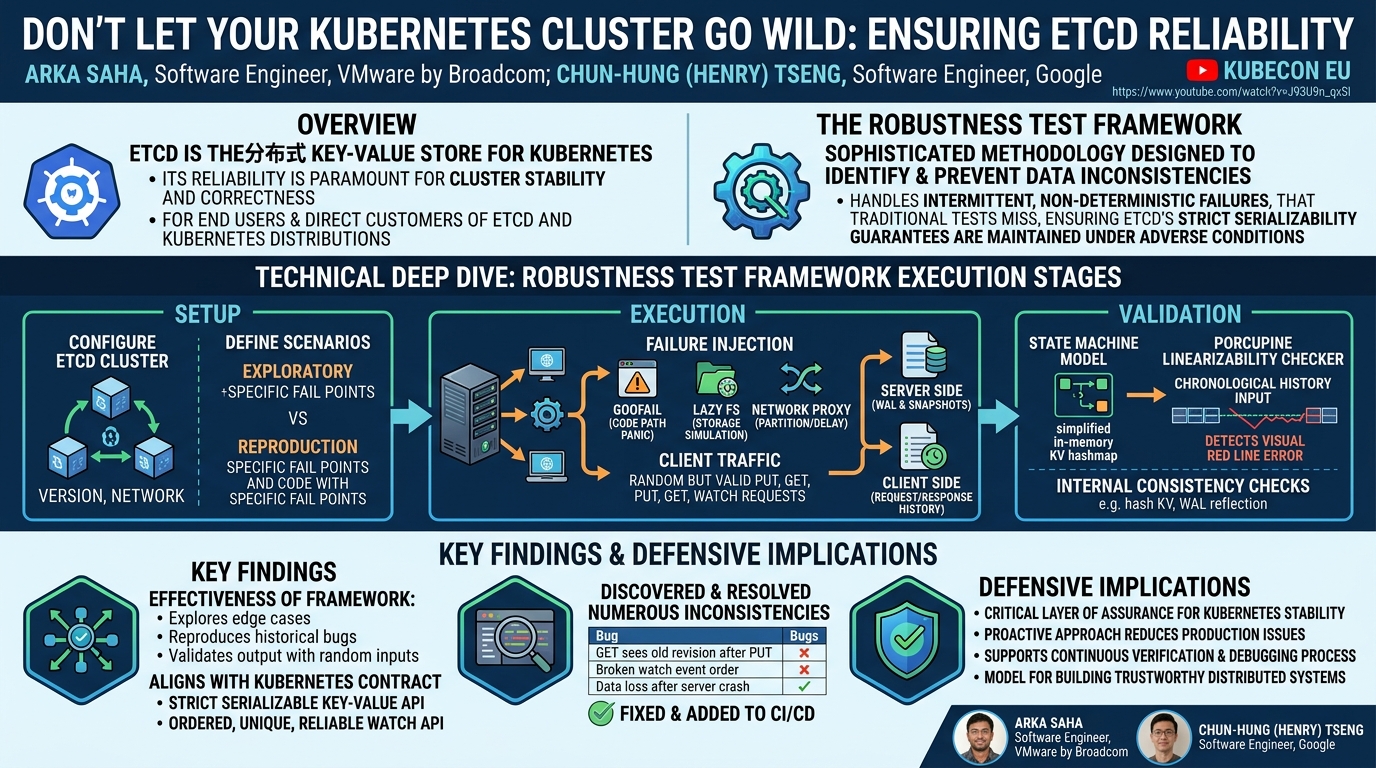
The core of the presentation introduces and technically dissects the robustness test framework, a sophisticated testing methodology designed to identify and prevent data inconsistencies within Etcd. This framework is essential because traditional testing methods often fall short in catching intermittent, non-deterministic failures that plague distributed systems. By offering a deep dive into its design principles, execution stages, and the tools it employs, the talk provides invaluable insights into how Etcd's strict serializability guarantees are maintained under adverse conditions, ultimately safeguarding the integrity of Kubernetes clusters.
The significance of this work cannot be overstated. Data inconsistencies in a critical component like Etcd can lead to severe operational issues, including stale data being served, incorrect cluster states, and even data loss, all of which compromise the reliability and security of applications running on Kubernetes. By detailing a proactive approach to testing and validation, the speakers empower the community with knowledge about how Etcd developers ensure the system adheres to its stringent consistency model, thereby solidifying the foundational layer of modern container orchestration.
Background
▶ Watch: Introduction and talk agenda (0:00)
Etcd operates as a distributed key-value store, a fundamental component for many modern distributed systems, most notably Kubernetes. Its primary role in Kubernetes is to store all cluster data, including configurations, state information, and metadata, making its correctness and consistency absolutely vital. A cornerstone of Etcd's design is its commitment to strict serializability, a strong consistency model. This means that all operations appear to have occurred in some single, global order that is consistent with the real-time ordering of those operations. Conceptually, if operation A completes before operation B begins in real time, then A must appear to precede B in the global order. If operations overlap, the system must find a valid set of linearization points—specific moments in time when each operation logically takes effect—that preserves this global ordering.
The challenge in maintaining strict serializability in a distributed environment stems from the inherent complexities and potential for intermittent failures. As highlighted by the speakers, real-world scenarios frequently introduce disruptions such as network connection errors (partitions, packet loss), disk problems (slowness, corruption), clock drift, and issues during upgrades or downgrades. These failures are often random and non-deterministic, making them exceedingly difficult to reproduce and debug using conventional unit or integration tests. A particularly problematic symptom of such failures is when Etcd responds with "stale data" or a "previous revision," effectively causing clients to "travel back in time." For instance, if a client performs a put operation, then another client performs a get operation shortly after, the get should always reflect the latest committed value and an incremented revision. Receiving an older revision signifies a critical consistency violation.
Recognizing these profound challenges, the robustness test framework was initially conceived and implemented by Benjamin Marik approximately two years prior to this talk. Its purpose was to provide a reliable mechanism to reproduce these elusive, intermittent failure scenarios consistently. The framework aimed to go beyond the limitations of traditional testing, where inputs are often fixed (unit/integration tests) or purely random garbage (fuzzing). Instead, the robustness tests generate random but valid inputs and target the entire Etcd binary and infrastructure stack, including containers and virtual machines, rather than just isolated functions. This holistic approach ensures that issues discovered in the past are not only fixed but also prevented from regressing in future releases, forming a crucial part of Etcd's data inconsistency prevention efforts. The speakers also referenced a prior talk from OSS Japan, which offered a more beginner-friendly introduction to the framework.
Key Findings
▶ Watch: Demonstrating a broken consistency scenario (5:30)
The central contribution and key finding presented in this talk is the profound effectiveness and necessity of the robustness test framework in maintaining Etcd's stringent consistency guarantees. The framework was specifically designed with several critical goals in mind:
- Exploration: To uncover edge cases and race conditions that are difficult to trigger through typical usage patterns. It aims to explore code paths not covered by existing unit or end-to-end tests, pushing the system to its limits under various failure conditions.
- Reproduction: To reliably reproduce historical issues and previously reported bugs. This ensures that fixes are robust and that regressions are caught before they impact users. The ability to consistently reproduce bugs is vital for effective debugging and validation.
- Validation: To verify the correctness of Etcd's output, even with random, valid inputs. Unlike tests with predictable outputs, robustness tests must validate intermediate states, not just final states, to uphold Etcd's promise of strict serializability.
The framework's design is heavily influenced by the Kubernetes contract for Etcd, meaning it specifically tests Etcd in ways that Kubernetes expects it to behave. This includes ensuring the key-value API remains strict serializable, atomic, and durable. Furthermore, it rigorously checks the watch API to guarantee that events are ordered, unique, and reliable, preventing any missing watch events which could have severe consequences for Kubernetes controllers. This targeted approach ensures that Etcd development does not inadvertently break the foundational assumptions Kubernetes makes about its data store.
Over the past two years, the robustness test framework has proven instrumental in discovering and resolving numerous data inconsistency issues. The speakers presented a table illustrating various bugs, many of which were initially reported by users or uncovered by the framework itself. These issues, ranging from subtle race conditions to more apparent data corruption scenarios, have been reliably reproduced, fixed, and integrated into the continuous integration (CI) pipeline. This continuous testing against every commit that goes into a release has become a significant part of the Etcd team's commitment to delivering a stable and reliable distributed key-value store, directly benefiting the stability of Kubernetes. The framework's ability to simulate complex, real-world failure scenarios makes it an indispensable tool for ensuring Etcd's robustness in production environments.
Technical Deep Dive
▶ Watch: Real-world failures causing data inconsistency (6:20)
The robustness test framework operates through three main execution stages: Setup, Execution, and Validation. Each stage is meticulously designed to create, challenge, and verify the consistency of an Etcd cluster under duress.
Setup
The setup phase begins by configuring a clean Etcd cluster. This involves starting the etcd binary from an empty database state, specifying the number of nodes (typically a quorum-based cluster like three members), their versions, and network addresses to enable communication. Critically, the setup defines the scenarios for the test, which can be either exploratory or aimed at reproduction. Exploratory scenarios might configure varying traffic profiles, different leader election timeouts, or specific snapshot counts to probe for unknown edge cases. Reproduction scenarios are tailored to re-trigger known bugs, often requiring precise configurations such as a specific fail point (e.g., ref panic fail point) combined with a particular traffic profile to reliably manifest a previously identified issue. This targeted reproduction is key to verifying bug fixes and preventing regressions.
Execution
The execution stage is where the Etcd cluster is subjected to a combination of client traffic and injected failures.
- Client Traffic Generation: Clients generate a stream of requests (put, get, watch, delete, etc.) that are random but valid, mimicking real-world application usage. The specific mix of operations and their frequency is defined by traffic profiles configured during the setup phase, allowing for diverse load patterns.
- Failure Injection: This is the most distinctive and powerful aspect of the framework. It deliberately introduces faults into the running Etcd cluster using three primary tools:
- Goofail: A project under the Etcd organization, Goofail enables runtime injection of failures into specific Go code paths. Developers can embed special comments (
go:fail) within their code, which are then processed by Goofail to generate corresponding Go code. When this compiled binary is run, failures can be triggered via HTTP endpoints or environment variables. For instance, the talk mentions using Goofail to inject a panic into the raft part of the codebase, preventing the leader from sending messages and causing a node crash. The test then verifies if the cluster remains consistent despite such an event. - Lazy FS: This tool is used to simulate storage-related problems. It can mimic scenarios like data loss, unsynced writes, or disk slowness, testing Etcd's resilience to underlying storage system failures.
- Network Proxy: A reverse proxy sits between Etcd nodes and clients, allowing the framework to dynamically block or delay traffic. This simulates various network conditions, such as network partitions (where nodes cannot communicate with each other) or partial disconnections, challenging Etcd's ability to maintain quorum and consistency.
- Output Collection: During execution, data is meticulously collected from both the server and client sides:
- Server Side: The server's Write-Ahead Log (WAL) and snapshots are recorded. The WAL is crucial for recovery and understanding the sequence of changes, while snapshots represent point-in-time states.
- Client Side: For each client, the framework records detailed information about every request and response, including the client ID, input (request payload), request time, response (response payload), response time, and any errors encountered. This data also includes continuous streams of watch responses, which are critical for verifying event ordering and reliability. The collected client data forms a chronological history of interactions, which is then used for validation.
Validation
Validating the output of a system under random, valid inputs is significantly more complex than checking against fixed expected values. The robustness test framework addresses this challenge using a state machine model and the Porcupine linearizability checker.
- State Machine Modeling: The core idea is to create a simplified, in-memory implementation of Etcd's key-value store. This model, essentially a hashmap, doesn't involve complex aspects like WAL or disk writes, but accurately reflects the expected state transitions based on operations. By applying the same sequence of client operations to this model, an expected correct state can be derived at any point in time.
- Porcupine Linearizability Checker: This tool takes the recorded client-side operation history (requests and responses with their timestamps) and assigns linearization points to each operation. It then walks through the history, applying operations to the in-memory state machine model. Porcupine visually represents the system's state evolution over time. If it detects any violation of strict serializability—such as a client observing a state that logically predates a completed earlier operation (i.e., "traveling back in time")—it flags this as an error, often depicted as a "red line" in its visualization.
- Internal Consistency Checks: Beyond linearizability, the framework performs other Etcd-specific internal consistency checks. For example, at the end of a test run, it can verify the hash KV (a hash of the key-value store's state) across all nodes to ensure they are identical. It also checks if all successful operations observed on the client side are correctly reflected in the server's WAL, guarding against data loss or discrepancies.
Debugging Process
When the robustness test detects an anomaly, a structured debugging process is followed:
- Verify Bug Origin: First, it's crucial to determine if the detected issue is a genuine bug in Etcd or a flaw in the robustness framework's model itself.
- Local Reproduction: If confirmed as an Etcd bug, efforts are made to reproduce it locally, often by re-running the specific test scenario multiple times (e.g.,
count=100or200due to race conditions). - Fix and Test: Once reproduced and understood, the bug is fixed, and new end-to-end tests are written to cover the specific scenario.
- Integrate into Robustness Suite: For bugs that require race conditions or specific failure injections to manifest, the scenario is added to the permanent robustness test suite. This ensures that the issue is continuously monitored and prevented from recurring in future releases.
Demo / Proof of Concept
▶ Watch: Introducing the robustness test framework (7:25)
The speakers provided a concise yet impactful demonstration of the robustness test framework in action, specifically showcasing how it reproduces a critical bug where a revision "travels back in time"—a direct violation of Etcd's strict serializability.
The demo began by illustrating the simplicity of reproducing a known issue. Instead of complex setup, the user can simply run a make command followed by the specific issue number. This command triggers the framework to recreate the exact conditions that led to the bug.
During the execution, the demo highlighted the various outputs collected by the framework:
- Client-side logs: These logs captured both operation details (put, delete requests with their payloads, request/response times, and any errors) and watch events observed by clients. The structural logging of these events was shown, providing a clear timeline of client interactions.
- Server-side logs: The demo also briefly touched upon the collected snapshot and Write-Ahead Log (WAL) data from the Etcd servers, which are vital for post-mortem analysis.
The most compelling part of the demonstration was the visualization of the generated report when a failure occurs. The robustness test framework automatically generates a web-based report. Navigating to this report, users can see a graphical representation of the operation history, similar to the timeline graphs shown in the slides. The report features a "jump to first error" button, which instantly highlights the exact point in the timeline where consistency was violated. In the demonstrated bug, this was visually represented by a "red line" indicating that a future get request observed a revision (e.g., revision 164) that was older than a previously committed revision (e.g., revision 165). This clear visualization, powered by Porcupine, makes it straightforward for developers to pinpoint and understand the nature of the data inconsistency. The demo effectively solidified the framework's ability to not only detect but also visually explain complex distributed system bugs.
Defensive Implications
▶ Watch: Robustness tests compared to traditional tests (8:20)
For anyone operating or relying on Kubernetes, understanding the robustness test framework for Etcd has significant defensive implications. Firstly, the existence and continuous development of this framework provide a crucial layer of assurance regarding the foundational stability of their clusters. It means that the Etcd component, which stores all critical cluster state, is being rigorously tested against a wide array of intermittent and hard-to-reproduce failure scenarios, far beyond what typical unit or integration tests can achieve. This proactive approach significantly reduces the likelihood of encountering severe data inconsistency issues in production.
For platform engineers and SREs, the talk underscores the inherent fragility of distributed systems and the necessity for sophisticated testing methodologies. While they might not directly run these specific Etcd robustness tests, the principles demonstrated are broadly applicable. It highlights that relying solely on basic health checks is insufficient; true resilience requires actively simulating failures and verifying consistency under stress. Operators should be aware of the types of failures that can impact Etcd (network partitions, disk issues, clock drift) and understand that even with such advanced testing, vigilance, robust monitoring, and well-practiced disaster recovery plans remain essential.
Furthermore, the talk implicitly encourages a mindset of continuous verification. The bi-weekly robustness test meetings, where developers review dashboards for new failures, illustrate that maintaining distributed system reliability is an ongoing process, not a one-time achievement. For organizations building their own distributed systems or critical components, the framework serves as an exemplary model for designing comprehensive testing suites that incorporate failure injection (using tools like Goofail, Lazy FS, and Network Proxy) and formal verification of consistency models (using techniques like state machine modeling and linearizability checkers like Porcupine). Adopting similar rigorous testing practices can significantly enhance the robustness and trustworthiness of their own software, ultimately bolstering the overall security and reliability posture of their infrastructure.
Key Takeaways
- Etcd's Strict Serializability is Paramount: Etcd's role as the Kubernetes backend necessitates strict serializability to ensure data consistency, which is crucial for cluster stability and preventing issues like "traveling back in time" (seeing stale data).
- Intermittent Failures Demand Advanced Testing: Traditional unit and integration tests are insufficient for catching non-deterministic, intermittent failures (network partitions, disk errors, clock drift) that are common in distributed systems.
- The Robustness Test Framework is a Game Changer: This framework is specifically designed to explore edge cases, reproduce historical bugs, and validate Etcd's consistency under adverse, real-world conditions.
- Failure Injection is Key to Discovering Bugs: Tools like Goofail (runtime code path injection), Lazy FS (storage simulation), and a Network Proxy (network partition simulation) are critical for deliberately introducing faults and stress-testing Etcd.
- State Machine Modeling and Linearizability Checking Ensure Correctness: The framework uses a simplified in-memory state machine model of Etcd combined with Porcupine, a linearizability checker, to verify that all operations maintain strict serializability, even with random inputs.
- Continuous Verification and Debugging are Essential: The framework is integrated into the CI pipeline, running against every commit, and supported by dedicated bi-weekly meetings to review results, identify new failures, and ensure ongoing reliability.
About the Speaker(s)
Arka Saha is a Software Engineer at VMware by Broadcom. He is an active contributor to the Etcd project and holds responsibilities for the downstream releases of both Etcd and Kubernetes. His work focuses on ensuring the stability and reliability of these critical cloud-native components.
Chun-Hung (Henry) Tseng is a Software Engineer at Google. He is also a significant contributor to the Etcd project, bringing his expertise to the development and maintenance of this foundational distributed key-value store.
Reviews
Dr. Zero (Offensive Security Researcher) — STRONG ACCEPT
This talk dives deep into the Etcd robustness test framework, a critical piece of engineering ensuring the stability of every Kubernetes cluster. It's a no-nonsense look at how serious distributed systems maintain strict serializability under duress, detailing the specific tools and methodologies. For anyone building or running Kubernetes at scale, this isn't just theory; it's a foundational insight into why your control plane (mostly) doesn't fall apart, offering actionable understanding for robust system design.
Heather Calloway (CISO) — STRONG ACCEPT
This talk provides a critical deep dive into the Etcd robustness test framework, which is essential for ensuring data consistency in Kubernetes clusters. While highly technical, the session effectively demonstrates how sophisticated testing methodologies, including failure injection and formal verification, are used to prevent severe operational issues like data loss and incorrect cluster states. For any organization relying on Kubernetes, this work offers crucial assurance about the foundational integrity of their infrastructure and serves as an exemplary model for building resilience into critical systems.