Data Gravity and Kubernetes: Managing Large-Scale Data Ingest... Abhishek Bhattacharjee & Arya Soni
Abhishek Bhattacharjee, Arya Soni
KubeCon + CloudNativeCon Europe 2025 · Session
Overview
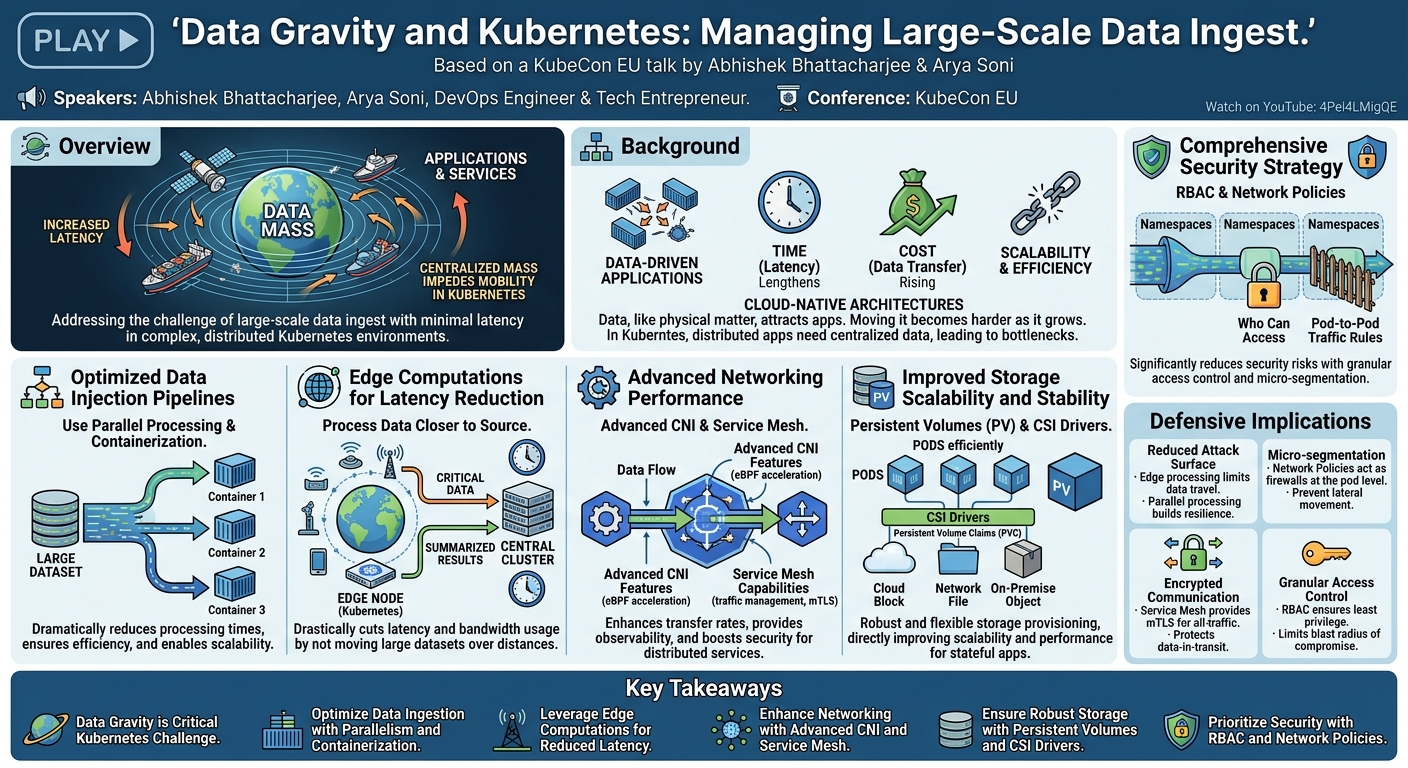
In an era defined by ever-increasing data volumes, the concept of data gravity has emerged as a critical consideration for organizations managing complex, distributed systems. This talk, presented by Arya Soni and Abhishek Bhattacharjee at KubeCon EU, delves into the intricacies of data gravity, particularly its profound implications within Kubernetes environments. Data gravity, as defined by the speakers, refers to the phenomenon where accumulated data attracts more applications and services, leading to a centralized mass that paradoxically increases latency and complicates data mobility, especially when containerized.
Key moments
- 0:00 Introduction and defining data gravity
- 1:00 Challenges: Latency, cost, scalability in Kubernetes
- 2:00 Optimizing data injection and edge computations
- 3:00 Improving networking with CNI and Service Mesh
- 4:00 Storage solutions: PV volumes and CSI drivers
- 5:00 Security strategy with RBAC and network policies
- 6:00 Comprehensive strategy for data gravity efficiency
Data Gravity and Kubernetes: Managing Large-Scale Data Ingest... Abhishek Bhattacharjee & Arya Soni
Speakers: Abhishek Bhattacharjee, Arya Soni, DevOps Engineer & Tech Entrepreneur
Conference: KubeCon EU
YouTube: https://www.youtube.com/watch?v=4Pei4LMigQE
Overview
In an era defined by ever-increasing data volumes, the concept of data gravity has emerged as a critical consideration for organizations managing complex, distributed systems. This talk, presented by Arya Soni and Abhishek Bhattacharjee at KubeCon EU, delves into the intricacies of data gravity, particularly its profound implications within Kubernetes environments. Data gravity, as defined by the speakers, refers to the phenomenon where accumulated data attracts more applications and services, leading to a centralized mass that paradoxically increases latency and complicates data mobility, especially when containerized.
The core challenge addressed by the speakers is how this gravitational pull of data can significantly impede the performance, scalability, and efficiency of Kubernetes clusters. As data grows, the costs associated with data transfer escalate, and the inherent latency introduced by moving data across a distributed system becomes a major bottleneck. The talk outlines a comprehensive strategy to mitigate these effects, focusing on optimizing data ingestion pipelines, leveraging edge computing, enhancing networking and storage solutions, and bolstering security postures.
This article provides a detailed technical exploration of the strategies proposed by Bhattacharjee and Soni, dissecting their recommendations for managing large-scale data ingest with minimal latency in Kubernetes. It highlights how a multi-faceted approach, integrating advancements in computation, networking, and storage, can transform data-intensive operations within containerized infrastructures, ensuring both efficiency and stability in the face of growing data demands.
Background
▶ Watch: Introduction and defining data gravity (0:00)
The proliferation of data-driven applications and the widespread adoption of cloud-native architectures have brought the concept of data gravity to the forefront of enterprise IT discussions. Data gravity posits that data, much like physical matter, attracts applications and services, making it increasingly difficult and costly to move as its volume grows. In traditional monolithic architectures, this might manifest as a large database becoming a central bottleneck, but in the context of Kubernetes and containerized environments, the problem takes on new dimensions.
Kubernetes, designed for distributed and ephemeral workloads, often involves applications and services that are geographically dispersed or dynamically scheduled across various nodes. When large datasets are involved, the need for these distributed applications to access centralized data stores introduces significant challenges. The speakers emphasize that as data accumulates and more applications attach to it, the resulting centralization increases latency and complicates data mobility. This is particularly problematic for large-scale data ingest, where vast amounts of data must be efficiently processed and stored, often under stringent latency requirements.
The inherent distributed nature of Kubernetes, while offering tremendous benefits in terms of scalability and resilience, can exacerbate the issues of data gravity. Data transfer costs between clusters or even between nodes within a single cluster can become prohibitive. Furthermore, the performance of applications heavily reliant on data access can degrade significantly if the data is not strategically located or efficiently managed. The speakers identify these challenges—increased latency, higher data transfer costs, and impacts on scalability and efficiency—as the primary motivators for developing optimized strategies to counter data gravity in Kubernetes. Prior work in distributed systems has often focused on data locality, but the containerization paradigm introduces unique considerations regarding persistent storage, dynamic networking, and security in a highly orchestrated environment.
Key Findings
▶ Watch: Optimizing data injection and edge computations (2:00)
The core findings presented by Abhishek Bhattacharjee and Arya Soni revolve around a series of strategic optimizations designed to counter the adverse effects of data gravity within Kubernetes environments. Their talk distills these into a comprehensive framework for managing large-scale data ingestion with enhanced efficiency, reduced latency, and improved scalability.
The primary discovery is that a multi-pronged approach, encompassing various layers of the Kubernetes stack, is essential. The speakers identify several key areas for intervention:
- Optimized Data Injection Pipelines: They highlight that implementing technologies such as parallel processing and containerization within data injection pipelines significantly cuts data processing times. This approach ensures greater efficiency and scalability in handling large datasets by distributing the workload and leveraging the isolated, portable nature of containers.
- Edge Computations for Latency Reduction: A crucial finding is the effectiveness of processing data closer to its source, at the edge. By integrating edge computation strategies with Kubernetes, organizations can drastically reduce latency and decrease bandwidth usage, as data does not need to traverse long distances to a central processing unit.
- Advanced Networking Performance: The speakers emphasize that utilizing advanced CNI (Container Network Interface) solutions and service mesh technologies can substantially enhance data transfer rates and reduce network-induced latency. These tools are critical for managing complex network communications within Kubernetes, ensuring data flows efficiently between services.
- Improved Storage Scalability and Stability: Addressing storage challenges is paramount. The talk identifies Persistent Volumes (PV) and CSI (Container Storage Interface) drivers as fundamental solutions for improving storage scalability and stability in Kubernetes. These technologies enable robust and flexible storage provisioning, directly contributing to reduced latency and enhanced application performance.
- Comprehensive Security Strategy: Finally, the speakers stress the importance of a robust security posture. Implementing RBAC (Role-Based Access Control) and defining stringent network policies are presented as essential measures to significantly reduce security risks associated with data gravity and complex data ingestion processes, enhancing overall data security.
These findings collectively form a comprehensive strategy that, when implemented, leads to a more efficient, scalable, and secure Kubernetes environment capable of effectively managing the challenges posed by large-scale data gravity.
Technical Deep Dive
▶ Watch: Improving networking with CNI and Service Mesh (3:00)
Mitigating data gravity in Kubernetes necessitates a nuanced understanding of its underlying technical components and how they interact with large data volumes. The speakers outlined several key technical strategies, each designed to optimize specific aspects of data handling within a containerized, orchestrated environment.
Optimized Data Injection Pipelines: Parallel Processing and Containerization
The foundational step in addressing data gravity is to optimize the initial data ingestion process. The speakers advocate for parallel processing, a technique where large datasets are broken down into smaller chunks and processed concurrently across multiple computational units. Within Kubernetes, this is naturally facilitated by its distributed architecture. Applications designed for parallel processing can be deployed as multiple pods, each responsible for a segment of the data. This significantly reduces the total processing time compared to sequential processing.
Containerization, the very essence of Kubernetes, plays a critical role here. By encapsulating applications and their dependencies into lightweight, portable containers, organizations can ensure consistent execution environments across different nodes. This consistency is vital for parallel processing, as it guarantees that each processing unit operates under the same conditions, minimizing discrepancies and errors. Furthermore, container images can be optimized for specific data processing tasks, including pre-installed libraries and configurations, streamlining the deployment and execution of data ingestion pipelines. The isolation provided by containers also prevents resource contention, ensuring that one processing task does not negatively impact another, thereby enhancing overall efficiency and stability.
Edge Computations for Latency Reduction
A significant technical strategy for combating data gravity is the adoption of edge computations. The principle is simple yet powerful: process data as close to its source as possible, rather than sending it all to a centralized cloud or datacenter. This approach directly tackles latency and bandwidth consumption, two major pain points identified by the speakers.
In a Kubernetes context, edge computing involves extending the Kubernetes control plane to remote locations, or deploying lightweight Kubernetes distributions at the network edge. This allows for the deployment of application pods directly on edge devices or local servers. For example, sensor data from an IoT device could be processed on a nearby edge gateway running a Kubernetes node, performing initial filtering, aggregation, or anomaly detection before sending only critical or summarized data to a central cluster. This drastically reduces the volume of data transmitted over potentially high-latency wide area networks (WANs) and minimizes the round-trip time for critical real-time applications. The integration of Kubernetes at the edge enables consistent deployment, management, and scaling of applications, extending the benefits of container orchestration to distributed edge environments.
Advanced Networking Performance: CNI and Service Mesh
Networking is a critical layer in any distributed system, and its optimization is paramount for mitigating data gravity. The speakers highlight the importance of advanced CNI (Container Network Interface) plugins and service mesh technologies.
CNI plugins are responsible for configuring network interfaces for Linux containers. While basic CNI provides fundamental connectivity, advanced CNI solutions (e.g., Calico, Cilium, Weave Net) offer enhanced features that directly impact data transfer performance and latency. These include:
- High-performance data planes: Some CNIs use eBPF (extended Berkeley Packet Filter) to accelerate network operations, bypassing traditional kernel network stack overheads.
- Network policies: Beyond basic connectivity, advanced CNIs enforce network segmentation and security policies at the pod level, which can optimize traffic flow by preventing unnecessary or unauthorized communication.
- Load balancing and traffic management: Integrated load balancing capabilities can distribute data ingress and egress efficiently across multiple pods, preventing hot spots and ensuring even data flow.
A service mesh (e.g., Istio, Linkerd) operates at a higher level, providing a dedicated infrastructure layer for handling service-to-service communication. For data-intensive applications, a service mesh offers several advantages:
- Traffic management: It enables fine-grained control over traffic routing, allowing for intelligent load balancing, retries, and circuit breaking, which can improve data transfer reliability and performance.
- Observability: Service meshes provide deep insights into network traffic, including latency, error rates, and throughput, allowing operators to identify and resolve networking bottlenecks quickly.
- Security: Features like mutual TLS (mTLS) encrypt all service-to-service communication, protecting sensitive data as it moves within the cluster. This is crucial for maintaining data integrity during large-scale transfers.
By combining advanced CNI for efficient low-level networking with a service mesh for sophisticated traffic management and observability, organizations can significantly reduce network-related latency and enhance data transfer rates within their Kubernetes clusters.
Improved Storage Scalability and Stability: PV and CSI Drivers
For stateful applications handling large datasets, robust and scalable storage is non-negotiable. The speakers identify Persistent Volumes (PV) and CSI (Container Storage Interface) drivers as key technologies for addressing storage challenges in Kubernetes.
Persistent Volumes (PVs) provide an API that abstracts the details of how storage is provided from how it is consumed. A PV represents a piece of storage in the cluster that has been provisioned by an administrator or dynamically provisioned. It is independent of the lifecycle of a pod, meaning data persists even if the pod that was using it is terminated or rescheduled. This is crucial for data gravity scenarios where data needs to remain available and consistent. Persistent Volume Claims (PVCs) are requests for storage by users, allowing developers to consume storage without knowing the underlying infrastructure specifics.
CSI drivers are a standardized interface that allows Kubernetes to expose arbitrary block and file storage systems to containerized workloads. Before CSI, storage integration often required in-tree plugins, which were tightly coupled with Kubernetes releases. CSI decouples storage vendors from the Kubernetes core, enabling them to develop and deploy their own drivers independently. This offers several benefits:
- Flexibility: Kubernetes can integrate with a vast array of storage solutions, from cloud provider-specific storage (AWS EBS, GCP Persistent Disk, Azure Disk) to on-premises solutions (NFS, iSCSI, Ceph, NetApp).
- Scalability: CSI drivers often expose advanced features of the underlying storage system, such as snapshotting, cloning, and resizing, which are vital for managing large, dynamic datasets.
- Performance: By leveraging optimized, vendor-specific drivers, Kubernetes can achieve better I/O performance for persistent storage, directly impacting the speed of data ingestion and processing.
Together, PVs and CSI drivers provide a resilient, scalable, and high-performance storage layer for Kubernetes applications, ensuring that data gravity does not lead to storage bottlenecks or data loss.
Comprehensive Security Strategy: RBAC and Network Policies
The security implications of data gravity, especially with large-scale data ingestion, are significant. The speakers emphasize the implementation of RBAC (Role-Based Access Control) and network policies as fundamental security measures.
RBAC in Kubernetes allows administrators to define granular permissions based on roles. Instead of granting blanket access, RBAC ensures that users and service accounts only have the minimum necessary permissions to perform their tasks. For data ingestion pipelines, this means:
- Least privilege: Data processing pods or users interacting with data sources only have access to the specific secrets, ConfigMaps, or API objects required for their operation.
- Separation of duties: Different teams or components can be assigned distinct roles, preventing a single point of compromise from affecting the entire data pipeline.
- Auditing: RBAC policies make it easier to audit access patterns and identify unauthorized attempts to interact with sensitive data.
Network policies are Kubernetes resources that control traffic flow between pods/namespaces. They act as firewalls at the pod level, specifying which pods can communicate with each other and on which ports. In the context of data gravity and ingestion:
- Network segmentation: Policies can isolate data ingestion pipelines into dedicated namespaces, restricting inbound and outbound traffic to only necessary components.
- Data exfiltration prevention: By explicitly denying outbound connections to unauthorized external endpoints, network policies can help prevent sensitive data from leaving the cluster.
- Minimizing attack surface: Limiting network connectivity between services reduces the potential pathways for attackers to move laterally within the cluster if one component is compromised.
By rigorously implementing RBAC and network policies, organizations can significantly enhance the security posture of their Kubernetes environments, protecting large datasets from unauthorized access, modification, or exfiltration, thereby reducing the security risks introduced by data gravity.
Demo / Proof of Concept
▶ Watch: Security strategy with RBAC and network policies (5:00)
The provided transcript for this KubeCon EU talk does not mention or describe any specific live demonstration or proof-of-concept. The presentation focuses on theoretical concepts and strategic recommendations for addressing data gravity in Kubernetes environments.
Defensive Implications
▶ Watch: Comprehensive strategy for data gravity efficiency (6:00)
The strategies outlined by Abhishek Bhattacharjee and Arya Soni have profound defensive implications for organizations operating Kubernetes clusters, particularly those dealing with significant data volumes. The core defensive posture derived from their recommendations is one of proactive mitigation against the performance, cost, and security risks associated with data gravity.
Firstly, by adopting parallel processing and edge computations, defenders can inherently reduce the attack surface and improve resilience. Processing data closer to the source means less sensitive data needs to traverse potentially insecure networks, thus minimizing opportunities for interception or tampering. Furthermore, distributing processing across multiple containers and nodes via parallel processing makes the entire system more robust against single points of failure or targeted attacks; if one processing unit is compromised, others can continue operations.
The emphasis on advanced CNI and service mesh provides critical defensive layers. Advanced CNIs, with their network policy enforcement capabilities, allow security teams to implement micro-segmentation within the cluster. This means defining granular firewall rules at the pod level, preventing unauthorized lateral movement by attackers even if they manage to breach an initial container. A service mesh further enhances this by providing mutual TLS (mTLS) for all service-to-service communication by default. This encrypts data in transit within the cluster, protecting it from eavesdropping and ensuring that only authenticated and authorized services can communicate. The observability features of a service mesh also empower defenders to detect anomalous traffic patterns that might indicate a compromise or data exfiltration attempt.
From a storage perspective, the use of Persistent Volumes (PVs) and CSI drivers allows for more secure and manageable data persistence. PVs ensure that sensitive data is not inadvertently lost or exposed when pods are terminated. CSI drivers, by integrating with enterprise-grade storage solutions, bring their inherent security features (e.g., encryption at rest, access controls) directly into the Kubernetes ecosystem, providing a consistent security posture for data storage. Defenders can leverage these capabilities to ensure data integrity and confidentiality.
Finally, the explicit mention of RBAC (Role-Based Access Control) and network policies forms the bedrock of a secure Kubernetes defense strategy against data gravity. RBAC ensures that the principle of least privilege is enforced, meaning users and service accounts only have the minimum permissions necessary to perform their functions. This significantly limits the blast radius of a compromised account. Network policies are direct defensive controls, acting as internal firewalls that restrict pod-to-pod and pod-to-external network communication. By defining strict ingress and egress rules, defenders can prevent unauthorized access to data ingestion pipelines, block attempts to exfiltrate data to unknown external destinations, and isolate compromised workloads. For instance, a network policy could ensure that a data processing pod can only communicate with the designated data source and the final storage sink, blocking all other connections.
In summary, the defensive implications of the talk's strategies are about building a resilient, segmented, and tightly controlled Kubernetes environment. By implementing these technical solutions, organizations can significantly reduce the risks associated with large-scale data gravity, protecting their critical data assets from both performance degradation and security breaches.
Key Takeaways
- Data Gravity is a Critical Kubernetes Challenge: The accumulation of data attracts applications, leading to increased latency, higher transfer costs, and scalability issues within containerized Kubernetes environments.
- Optimize Data Ingestion with Parallelism and Containerization: Employing parallel processing and leveraging containerization significantly reduces data processing times, enhancing the efficiency and scalability of data ingestion pipelines.
- Leverage Edge Computations for Reduced Latency: Processing data closer to its source at the edge drastically minimizes latency and bandwidth consumption, particularly beneficial for real-time applications and distributed data sources.
- Enhance Networking with Advanced CNI and Service Mesh: Utilizing advanced CNI (Container Network Interface) solutions and service mesh technologies improves data transfer rates, reduces network latency, and enables sophisticated traffic management and security within the cluster.
- Ensure Robust Storage with Persistent Volumes and CSI Drivers: Implementing Persistent Volumes (PV) and CSI (Container Storage Interface) drivers is crucial for providing scalable, stable, and high-performance storage solutions for stateful applications in Kubernetes, ensuring data persistence and integrity.
- Prioritize Security with RBAC and Network Policies: A comprehensive security strategy involving RBAC (Role-Based Access Control) and stringent network policies is essential to mitigate security risks associated with data gravity, protecting sensitive data and controlling access within the Kubernetes environment.
About the Speaker(s)
Arya Soni is a DevOps engineer with three years of experience, primarily in the gaming and healthcare industries. He is also a tech entrepreneur currently focused on building SaaS-based applications. His insights in this talk are drawn from his practical experience in managing complex distributed systems and optimizing data pipelines.
Abhishek Bhattacharjee is also listed as a speaker for this talk. While the provided transcript focuses on Arya Soni's delivery, Abhishek's collaboration is integral to the comprehensive strategies presented regarding data gravity and Kubernetes.
Reviews
Dr. Zero (Offensive Security Researcher) — STRONG ACCEPT
This talk presents a robust, multi-faceted architectural strategy for mitigating 'data gravity' in Kubernetes environments. While it doesn't unveil novel technologies, it offers a pragmatic and comprehensive integration of established, high-impact solutions—parallel processing, edge computing, advanced CNI/service mesh, and robust storage with CSI drivers—all underpinned by critical security measures like RBAC and network policies. The speakers clearly articulate how these components, when strategically combined, can address the very real challenges of latency, cost, and scalability in large-scale data ingestion. It's an actionable blueprint for any organization grappling with…
Heather Calloway (CISO) — STRONG ACCEPT
This KubeCon talk by Bhattacharjee and Soni effectively addresses the critical challenge of data gravity within Kubernetes environments, offering a robust set of technical strategies for managing large-scale data ingest. While deeply technical, the proposed solutions—spanning optimized pipelines, edge computing, advanced networking, scalable storage, and critical security controls like RBAC and network policies—directly translate into tangible improvements in performance, cost efficiency, and, crucially, the defensive posture of an organization. It provides concrete, actionable guidance for technical teams, empowering them to build more resilient and secure data infrastructures.