Lightning Talk: Scheduling Success: Precision Updates for Continuous Manufacturing Op... J.C. Orozco
J.C. Orozco
KubeCon + CloudNativeCon Europe 2025 · Lightning Talk
Overview
In this insightful lightning talk at KubeCon EU, J.C. Orozco, a DevOps Manager at Bosch Connected Industry, illuminated a critical operational challenge faced by large-scale manufacturers leveraging cloud-native technologies. The presentation, titled "Scheduling Success: Precision Updates for Continuous Manufacturing Operations," detailed how Bosch developed a robust, automated system to manage and precisely control Kubernetes cluster and node updates in a public cloud environment. This solution directly addresses the inherent limitations of cloud provider "best effort" maintenance windows, which can lead to significant disruptions in continuous manufacturing operations.
Key moments
- 0:00 Introduction and the core problem of uncontrolled updates
- 2:00 Impact: Application downtime, financial losses, stressed teams
- 2:28 Solution overview: CronJobs, pipelines, promotion flows
- 2:50 Automated update promotion through integration and quality
- 3:55 Crucial manual review before production deployment
- 4:25 Summary of outcomes: Control, traceability, confidence, happy customers
Scheduling Success: Precision Updates for Continuous Manufacturing Operations
Speakers: J.C. Orozco, DevOps Manager, Bosch Connected Industry
Conference: KubeCon EU
YouTube: https://www.youtube.com/watch?v=QJ8MHzSRkbo
Overview
In this insightful lightning talk at KubeCon EU, J.C. Orozco, a DevOps Manager at Bosch Connected Industry, illuminated a critical operational challenge faced by large-scale manufacturers leveraging cloud-native technologies. The presentation, titled "Scheduling Success: Precision Updates for Continuous Manufacturing Operations," detailed how Bosch developed a robust, automated system to manage and precisely control Kubernetes cluster and node updates in a public cloud environment. This solution directly addresses the inherent limitations of cloud provider "best effort" maintenance windows, which can lead to significant disruptions in continuous manufacturing operations.
The core of Orozco's discussion centered on the imperative for precision and predictability in infrastructure management when dealing with sensitive, legacy manufacturing systems. For organizations like Bosch, where application downtime directly translates to halted production lines and substantial financial losses, uncontrolled updates pose an unacceptable risk. The talk outlined a pragmatic approach, combining common DevOps tools like cron jobs, pipelines, and Git-based promotion flows, to transform a reactive, disruptive update process into a proactive, controlled, and traceable operation.
The significance of this talk extends beyond Bosch's specific use case. It provides a valuable blueprint for any enterprise operating critical production systems on managed Kubernetes services, particularly those with applications sensitive to transient disruptions. By demonstrating how to reclaim control over fundamental infrastructure update schedules, Bosch's solution offers a compelling model for enhancing operational resilience, ensuring business continuity, and ultimately, fostering greater confidence and satisfaction among customers and operational teams alike.
Background
▶ Watch: Introduction and the core problem of uncontrolled updates (0:00)
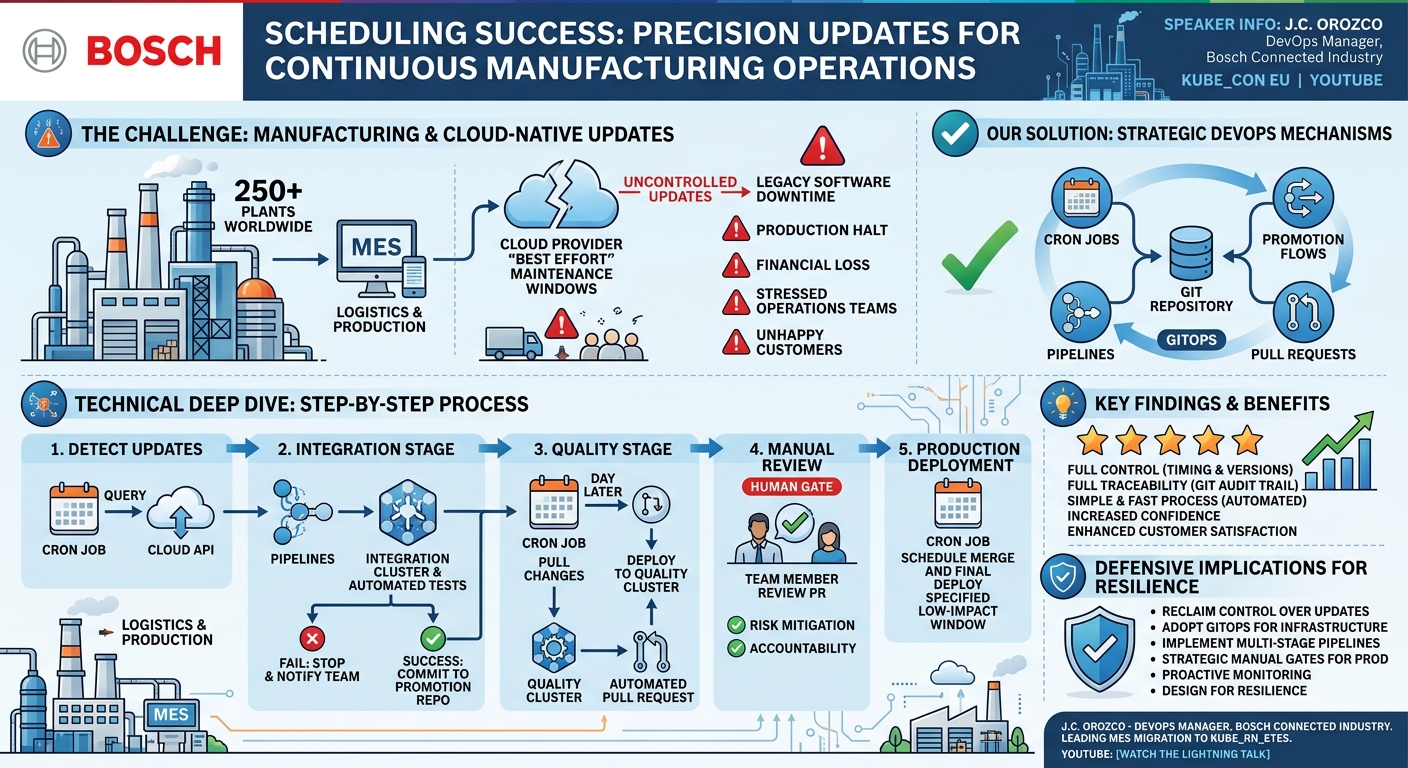
Bosch, a global leader in automotive components, electronics, power tools, and home appliances, operates an expansive manufacturing network comprising over 250 plants worldwide. To support these vast and complex operations, Bosch has developed its own Manufacturing Execution System (MES). The MES is a critical software suite responsible for orchestrating and driving all manufacturing and logistics processes within a plant. Bosch's MES is particularly complex, integrating over 30 distinct software modules, including vital functions like shuffler management, line control, part traceability, and intralogistics.
The modern SaaS version of Bosch's MES is deployed on Kubernetes clusters, hosted by a public cloud provider. While leveraging public cloud services offers numerous benefits in terms of scalability, elasticity, and reduced operational overhead, it also introduces specific challenges, particularly concerning infrastructure maintenance. A key issue arises from the public cloud provider's management of Kubernetes cluster and node updates. Although cloud providers typically allow customers to specify maintenance windows for these updates, Orozco highlighted a critical caveat: these windows are often not guaranteed. Instead, they operate on a "best effort" basis. This means an update intended for a low-impact period, such as the middle of the night, could potentially be executed during peak operational hours the following day, when the MES software is under maximum utilization.
This lack of guaranteed precision in update scheduling becomes problematic for Bosch due to the nature of its plant-level software. Many of these systems incorporate legacy software components that exhibit a fundamental limitation: they cannot seamlessly handle request redirection between replicas during a rolling update or node restart. This architectural constraint means that even brief periods of unavailability or service disruption during a cluster or node update can directly lead to application downtime at the plant. Such disruptions are not merely inconveniences; they halt production lines, leading to immediate and tangible financial losses. Beyond the direct financial impact, unplanned downtime results in unhappy customers, whose operations are directly tied to the MES's continuous availability. Furthermore, unexpected incidents stemming from uncontrolled updates place immense stress on the operational teams, who are then forced to react to unscheduled outages rather than proactively manage their systems. An additional layer of complexity identified by Bosch was the difficulty in expressing and controlling promotion flows for these updates, making it challenging to ensure that tested and validated updates progressed predictably from development to staging and finally to production environments.
Key Findings
▶ Watch: Solution overview: CronJobs, pipelines, promotion flows (2:28)
The central finding presented by J.C. Orozco is that it is entirely possible, and indeed crucial, for organizations operating critical manufacturing systems on public cloud Kubernetes to reclaim precise control over infrastructure updates. Bosch's experience demonstrates that by implementing a well-structured, automated, and Git-driven process, the inherent unpredictability of cloud provider "best effort" maintenance windows can be effectively mitigated.
The solution, characterized by Orozco as "simple yet effective," hinges on the strategic integration of widely available and familiar DevOps mechanisms: cron jobs, pipelines, promotion flows, and pull requests, all orchestrated around a Git repository. This approach allowed Bosch to achieve several critical outcomes:
- Full Control over Updates: Bosch gained complete dominion over when cluster and node updates are applied, precisely controlling the timing of execution to align with minimal disruption windows. They also achieved full visibility and control over the specific versions of Kubernetes and underlying nodes being used.
- Full Traceability: By storing all configurations and changes within a Git repository, Bosch established a robust audit trail, providing complete traceability for every update. This adherence to GitOps principles ensures transparency and accountability.
- Simple and Fast Process: The implemented process is largely automated, requiring only minimal manual intervention. This automation significantly reduces the time and effort involved in managing updates, making the process efficient and repeatable.
- Increased Confidence and Reliability: By eliminating unexpected application downtime directly attributable to cluster updates, Bosch's operational teams developed significantly higher confidence in the stability and predictability of their infrastructure.
- Enhanced Customer Satisfaction: The ultimate measure of success, according to Orozco, was the marked improvement in customer satisfaction. With manufacturing operations no longer suffering from unscheduled outages caused by infrastructure updates, the MES consistently performs as expected, directly benefiting Bosch's plant operations.
These findings collectively underscore that operational resilience in cloud-native manufacturing environments is not solely dependent on robust application design but equally on a disciplined, automated, and controlled approach to underlying infrastructure management.
Technical Deep Dive
▶ Watch: Automated update promotion through integration and quality (2:50)
Bosch's solution for achieving precision updates is a testament to the power of combining standard DevOps tools in an intelligent, opinionated workflow. The approach is fundamentally a GitOps-driven promotion model for infrastructure changes, extending beyond application code to the Kubernetes platform itself.
The process begins with a cron job – a scheduled task – that runs periodically. This cron job's primary responsibility is to query the public cloud provider's API to detect the availability of any new Kubernetes cluster or node updates. This proactive checking mechanism is crucial for identifying updates as soon as they are released, rather than passively waiting for the cloud provider to enforce them.
Upon detection of an available update, the cron job triggers an automated pipeline. This pipeline is the engine of the promotion process. Its first action is to deploy the newly identified cluster and node versions to Bosch's integration environment. This environment serves as the initial testing ground, where the stability and compatibility of the updates with Bosch's MES and its numerous modules can be verified without impacting production.
The pipeline incorporates a critical conditional branch:
- If the update fails in the integration environment: The process is immediately halted. The relevant operational team is automatically notified, allowing them to investigate the cause of the failure. This early detection prevents problematic updates from progressing further.
- If the update is successful in the integration environment: The pipeline proceeds to commit the validated cluster and node versions to a dedicated promotion repository. This Git repository acts as the single source of truth for approved infrastructure versions. By committing to this repository, the updates are effectively "promoted" from the integration environment to the quality environment. This step is a key aspect of the GitOps philosophy, where changes to the desired state are represented as Git commits.
On the following day (or another pre-defined schedule), another cron job monitors the promotion repository for new commits. If changes are detected, this cron job triggers a subsequent deployment, pushing the previously validated versions to the quality stage. This environment is designed for more comprehensive testing, often mirroring production conditions more closely.
Again, the pipeline evaluates the outcome:
- If the update fails in the quality stage: The process is stopped, and the team is notified for intervention and root cause analysis.
- If the update is successful in the quality stage: The pipeline automatically creates a pull request (PR). This PR is specifically engineered to propose the promotion of these thoroughly tested versions from the quality stage to the production environment.
This is where Bosch introduces its sole manual step in the entire update workflow. A designated team member is required to review the automatically generated pull request. This manual gate is critical for several reasons:
- Human Oversight: It provides a crucial opportunity for a human operator to review all the changes, examine the test results from both the integration and quality stages, and ensure that all prerequisites and operational considerations are met before a production-impacting change is merged.
- Risk Mitigation: For systems as critical as a manufacturing execution system, a final human check adds an essential layer of risk mitigation, especially given the legacy components that are sensitive to disruptions.
- Accountability: The approval of the PR signifies an explicit human decision to proceed, fostering accountability within the team.
Once the team member confirms that "everything looks good" and approves the pull request, the PR is completed. This merge event triggers the final promotion of the validated versions from the quality stage to the production stage within the Git repository.
The final piece of the puzzle is another cron job dedicated to the production environment. This cron job is configured to deploy the newly promoted versions to production, but crucially, it does so at a precisely specified time. This allows Bosch to schedule the actual production update during periods of minimal plant operations, such as planned maintenance windows or off-peak hours, thereby ensuring no interruptions to continuous manufacturing. This mechanism directly addresses the initial problem of the cloud provider's "best effort" maintenance windows.
In summary, Bosch's technical solution is an elegant blend of automation and strategic manual oversight. It leverages Git as the central control plane, pipelines for automated execution and testing across environments, and cron jobs for both proactive update detection and precise scheduling. This GitOps-centric approach provides full traceability – every configuration change, every version, and every deployment is recorded in Git, offering an auditable history. The process is designed to be simple and fast, with automation handling the bulk of the work, while the single manual pull request review ensures high confidence before critical production deployments.
Demo / Proof of Concept
▶ Watch: Crucial manual review before production deployment (3:55)
While J.C. Orozco's presentation was a lightning talk format, precluding a live demonstration of the system in action, the detailed explanation of Bosch's implemented workflow serves as a comprehensive conceptual proof of concept. The speaker meticulously walked through the architectural design, the sequence of automated and manual steps, and the decision points within their update pipeline.
The entire talk, in essence, functions as a narrative demonstration of how their "simple yet effective" solution addresses a complex operational challenge. Orozco described the logical flow from update detection, through multiple testing environments, to the final controlled deployment in production. This verbal and diagrammatic explanation provided sufficient detail to understand the mechanics and benefits of their system, illustrating how cron jobs, pipelines, Git-based promotion, and pull requests are integrated to achieve precise, controlled, and traceable updates for Kubernetes clusters and nodes. The outcome—zero application downtime due to cluster updates and happier customers—is the ultimate validation of this conceptual proof.
Defensive Implications
▶ Watch: Summary of outcomes: Control, traceability, confidence, happy customers (4:25)
The Bosch case study offers profound defensive implications, not against traditional cyber threats, but against operational vulnerabilities stemming from uncontrolled infrastructure changes. For any organization running critical applications on managed Kubernetes services, particularly those with sensitive or legacy components, the lessons learned are directly applicable to building more resilient and predictable operations.
- Reclaim Control over Infrastructure Updates: The primary defensive strategy is to actively manage and schedule infrastructure updates rather than passively accepting cloud provider defaults. Organizations should implement their own mechanisms to detect, validate, and deploy updates on their terms, aligning with business-critical windows. This means moving beyond "best effort" maintenance windows offered by providers.
- Adopt GitOps for Infrastructure: Treat all infrastructure configurations, including Kubernetes cluster versions, node images, and related settings, as code. Store these in a Git repository. This enables version control, auditability, and traceability for every change, making it easier to revert to a previous state if issues arise and providing a clear history for compliance and troubleshooting.
- Implement Multi-Stage Promotion Pipelines: Establish a robust promotion pipeline with distinct environments (e.g., integration, quality, production) for infrastructure updates. Each stage should have automated testing and validation steps. This ensures that any potential compatibility issues or regressions are caught in lower environments, preventing them from impacting production.
- Strategic Manual Gates for Production: While automation is key for efficiency, critical production deployments benefit from a carefully placed manual gate, such as a pull request review. This allows experienced operators to perform a final sanity check, review test results from preceding stages, and assess the broader operational impact before a change goes live. This human oversight is a crucial defense against unforeseen consequences.
- Proactive Monitoring and Notification: Integrate continuous monitoring for available updates from cloud providers. Automate notifications to operational teams when updates fail in any environment, ensuring rapid response and intervention. This proactive stance minimizes the duration and impact of potential issues.
- Design for Resilience (if possible): While Bosch's legacy software presented limitations, modern applications should ideally be designed with resilience to rolling updates and transient disruptions in mind. This includes robust health checks, graceful shutdown mechanisms, and the ability to handle temporary network partitions or replica restarts without service interruption. For legacy systems, the defensive posture shifts to controlling the environment around the application more tightly.
- Understand Cloud Provider SLAs: Clearly understand the service level agreements (SLAs) and "best effort" clauses of your cloud provider regarding maintenance. Do not assume guaranteed precision where it isn't explicitly promised. Build your operational strategies to account for these limitations, as Bosch did.
By adopting these defensive postures, organizations can transform infrastructure updates from a source of anxiety and unplanned downtime into a predictable, controlled, and confidence-inspiring operational routine, safeguarding continuous operations and enhancing overall system reliability.
Key Takeaways
- Cloud provider "best effort" maintenance windows are insufficient for critical manufacturing operations. Organizations must implement their own control mechanisms for Kubernetes cluster and node updates.
- A GitOps-driven approach provides full control and traceability for infrastructure updates. Storing configurations in Git ensures version control, auditability, and a clear history of changes.
- Automated multi-stage promotion pipelines are essential for validating updates. Testing in integration and quality environments prevents problematic updates from reaching production.
- Strategic manual gates (e.g., pull request reviews) are crucial for high-confidence production deployments. Human oversight adds a vital layer of risk mitigation for critical systems.
- Precise scheduling of production updates via cron jobs minimizes disruption. Aligning deployments with off-peak hours or planned maintenance windows safeguards continuous operations.
- Investing in controlled update processes leads to increased operational confidence and happier customers. Eliminating unplanned downtime directly impacts business continuity and financial performance.
About the Speaker(s)
J.C. Orozco is a DevOps Manager at Bosch Connected Industry. In this role, he is responsible for leading initiatives that enhance the operational efficiency and reliability of Bosch's critical manufacturing systems. His expertise lies in leveraging cloud-native technologies and modern DevOps practices to solve complex industrial challenges. As highlighted in his talk, Orozco and his team are actively involved in the significant undertaking of migrating Bosch's Manufacturing Execution Systems (MES) to Kubernetes, demonstrating a deep understanding of both legacy industrial software and cutting-edge cloud infrastructure.
Reviews
Dr. Zero (Offensive Security Researcher) — STRONG ACCEPT
This talk from Bosch delivers a brutally honest look at the reality of 'best effort' cloud provider maintenance windows when applied to critical manufacturing operations. Orozco presents a clear, well-engineered GitOps-driven pipeline that reclaims precise control over Kubernetes cluster and node updates. While the individual components aren't novel, the integration, robust testing stages, and strategic manual gate for production demonstrate a highly effective and repeatable solution to a pervasive operational vulnerability. This isn't theoretical; it's proven engineering that directly addresses a critical business continuity challenge.
Heather Calloway (CISO) — STRONG ACCEPT
This talk from Bosch provides a compelling blueprint for how an organization can reclaim control over critical infrastructure updates, moving beyond cloud provider 'best effort' promises. It demonstrates a disciplined, engineering-led approach to operational resilience, directly mitigating significant business risk and enhancing institutional accountability for continuous manufacturing operations. The solution's focus on GitOps, automated pipelines, and a strategic human gate offers clear, actionable guidance for any CISO concerned with the stability and predictability of their core systems.