The European Way To Resilience: CRA(ck), SBOM(b) & AdviSor®y
Dina Truxius
S4x24 - ICS Security Conference · Day 2 · Stage 3
Overview
This talk, delivered by Dina Truxius at the S4 conference, provides a compelling and high-level introduction to the European Union's Cyber Resilience Act (CRA). While the talk title suggests a broader discussion encompassing SBOMs and advisories, the speaker's focus in the provided transcript is exclusively on the CRA. Truxius frames the discussion around humanity's "legal addiction" to laws and an inescapable reliance on "digitization," highlighting the critical need for security-by-design in an increasingly interconnected world. The core message revolves around the EU's proactive stance on product security in response to significant cyber incidents.
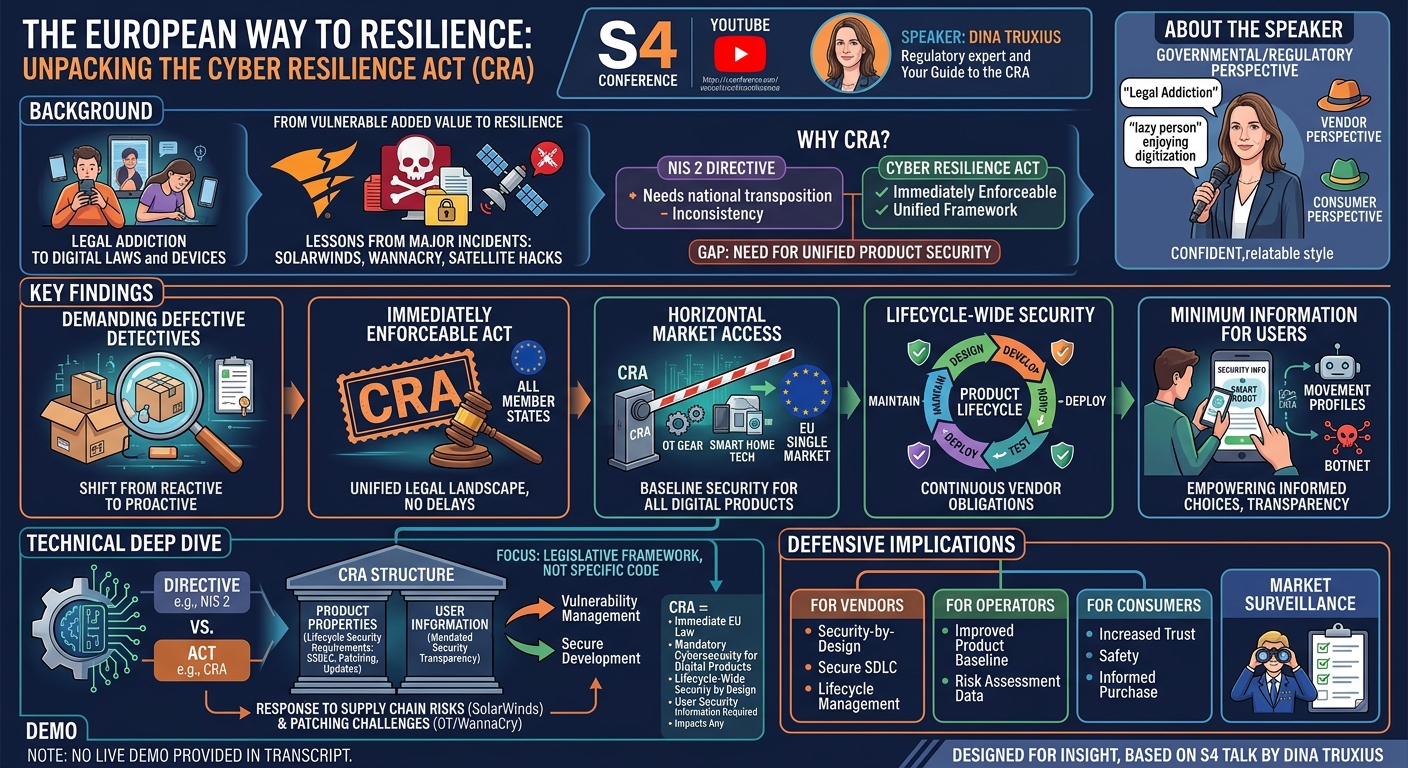
Key moments
- 0:00 Introduction: The 'legal addiction' to laws
- 2:00 EU questions product security after major hacks
- 3:00 Introducing the immediately enforceable Cyber Resilience Act (CRA)
- 4:00 CRA's goal: horizontal market access regulation for security
- 4:40 Vendor obligations: CRA's product lifecycle requirements
- 5:20 Consumer perspective: CRA demands minimum user information
The European Way To Resilience: CRA(ck), SBOM(b) & AdviSor®y
Speakers: Dina Truxius
Conference: S4
YouTube: https://www.youtube.com/watch?v=lV2h9OKFrBI
Overview
This talk, delivered by Dina Truxius at the S4 conference, provides a compelling and high-level introduction to the European Union's Cyber Resilience Act (CRA). While the talk title suggests a broader discussion encompassing SBOMs and advisories, the speaker's focus in the provided transcript is exclusively on the CRA. Truxius frames the discussion around humanity's "legal addiction" to laws and an inescapable reliance on "digitization," highlighting the critical need for security-by-design in an increasingly interconnected world. The core message revolves around the EU's proactive stance on product security in response to significant cyber incidents.
The presentation serves as a crucial heads-up for any entity – be it a vendor, operator, or consumer – engaged in business within the European Union. It underscores that the CRA is not merely another regulatory hurdle but a fundamental shift towards mandating security across the entire lifecycle of products. Truxius emphasizes the immediate enforceability and horizontal market access implications of the CRA, positioning it as a pivotal piece of legislation designed to elevate the baseline security posture of digital products available to EU citizens and businesses.
Background
▶ Watch: Introduction: The 'legal addiction' to laws (0:00)
The impetus for the Cyber Resilience Act stems from a recognition that while societies are "addicted" to legal frameworks and increasingly reliant on "digitization" for comfort and automation, the security of the underlying digital products has often been an afterthought. The speaker challenges the audience to consider whether everything currently in use, from OT field equipment to consumer smart devices, is genuinely "designed with security in mind." This fundamental question forms the bedrock of the EU's legislative response.
Major cybersecurity incidents, explicitly cited as catalysts, include SolarWinds, WannaCry, and various satellite hacks. These events exposed systemic vulnerabilities, demonstrating that a lack of inherent product security could have far-reaching economic, social, and even geopolitical consequences. The EU's introspection following these incidents led to critical inquiries: Is there sufficient security by design in products? Are patches and updates adequately managed, particularly in challenging environments like Operational Technology (OT)? And is there sufficient market surveillance to ensure product security? The existing NIS 2 Directive, while significant, requires transposition into national law, which can lead to inconsistencies and delays. The EU identified a gap: a need for a unified, immediately enforceable framework specifically targeting the security of products themselves, rather than just the security of services or networks. This identified gap is precisely what the CRA aims to fill, providing a horizontal market access regulation focused squarely on product security.
Key Findings
▶ Watch: Introducing the immediately enforceable Cyber Resilience Act (CRA) (3:00)
The talk highlights several key findings regarding the EU's approach to cybersecurity resilience, particularly through the lens of the Cyber Resilience Act:
- EU Demands "Defective Detectives": The European Union is shifting from a reactive stance to a proactive one, demanding an inherent focus on security. The term "defective detectives" implies a requirement for products to be designed and maintained with security in mind, and for mechanisms to identify and address vulnerabilities throughout their lifecycle, rather than waiting for incidents to occur.
- CRA: An Immediately Enforceable Legislation: The Cyber Resilience Act (CRA) is presented as a new, potent piece of EU legislation. Unlike directives such as NIS 2, which require individual member states to transpose them into national law, the CRA is an "Act" and therefore immediately enforceable across all EU member states. This eliminates variations and delays, creating a unified legal landscape.
- Horizontal Market Access Regulation: The CRA's primary function is as a horizontal market access regulation. This means it sets a baseline for cybersecurity requirements that all products must meet to be placed on the market within the European Union, regardless of their specific sector or application. It's a foundational requirement for doing business in the EU.
- Lifecycle-Wide Security Requirements: A central tenet of the CRA is the imposition of requirements across the whole life cycle of every product. This extends beyond initial design and manufacturing to encompass development, testing, deployment, maintenance, and end-of-life considerations. Vendors are explicitly tasked with fulfilling these continuous security obligations.
- Minimum Information for Users: From a consumer perspective, the CRA mandates that users receive minimum information about the security properties of products. This reflects a growing awareness of how smart devices, such as "smart robots scanning your house," can collect sensitive data (e.g., "movement profiles") or be co-opted for malicious purposes (e.g., "function as part of a botnet"). Empowering users with security-relevant information is seen as crucial for informed decision-making and overall resilience.
Technical Deep Dive
▶ Watch: CRA's goal: horizontal market access regulation for security (4:00)
The technical deep dive into the Cyber Resilience Act, as outlined by Dina Truxius, primarily focuses on its legislative structure, scope, and the nature of its requirements, rather than specific code or protocol implementations. The power of the CRA lies in its legal framework and the broad implications it carries for product development and market access.
The most significant technical distinction highlighted is the CRA's legal status as an Act rather than a Directive. The speaker explicitly contrasts this with the NIS 2 Directive. While NIS 2 requires individual EU member states to "transpose" its provisions into their respective national laws, a process that can lead to varying interpretations and implementation timelines, the CRA, as an Act, is immediately enforceable across all member states. This means there is "no way out" for entities operating within the EU market; the requirements apply directly and uniformly from the moment the Act enters into force. This legislative mechanism ensures a consistent and swift application of cybersecurity standards across the entire single market.
The scope of the CRA is exceptionally broad: it applies to "any vendor, anyone who is or who puts any product in the European Union on the market." This comprehensive coverage means that from consumer electronics to industrial control systems, medical devices, and software components, any "product with digital elements" (as the CRA is formally known) must comply. This "horizontal" approach differs from sector-specific regulations by establishing a baseline for all products.
The CRA's requirements are structured into two main parts:
- Requirements related to the properties of the products: This is the core technical demand placed on vendors. The Act mandates security requirements "across the whole life cycle" of every product. While the talk doesn't detail specific technical controls (e.g., cryptographic algorithms, secure boot mechanisms, vulnerability disclosure policies), it implies a holistic approach to security. This would necessitate secure by design and by default principles, secure development lifecycles (SDLCs), robust vulnerability management processes, and mechanisms for providing timely security updates. The speaker emphasizes that vendors must "stick to it and has to fulfill these requirements," indicating a shift from optional best practices to mandatory compliance. This could involve adhering to specific standards, conducting security assessments, and demonstrating due diligence in mitigating known risks.
- Minimum information for users: This aspect addresses the transparency and usability of security information. The EU has recognized that consumers and operators often lack sufficient insight into the security posture of the products they use. The example of a "smart robot that is scanning your house" and potentially collecting "movement profiles" or functioning "as part of a botnet" illustrates the tangible risks that users face. The CRA aims to mitigate this by requiring vendors to provide clear, accessible information regarding a product's security features, known vulnerabilities, update policies, and data handling practices. This empowers users to make informed decisions and potentially configure products more securely. While not a technical control in itself, it drives technical documentation and communication requirements for manufacturers.
The talk implicitly links these requirements to past incidents like SolarWinds, WannaCry, and satellite hacks. These events underscore the need for robust supply chain security (as seen in SolarWinds), effective vulnerability patching (WannaCry exploited unpatched systems), and the protection of critical infrastructure (satellite hacks). The CRA's lifecycle approach and emphasis on updates are direct responses to these types of widespread security failures, aiming to prevent similar incidents by raising the bar for product security at the foundational level.
No specific code, protocols, or architectures were detailed in the transcript, as the talk focused on the legislative framework and its implications rather than granular technical implementations. The "deep dive" here is into the structure and intent of the legislation itself and its broad technical impact on product development.
Demo / Proof of Concept
▶ Watch: Vendor obligations: CRA's product lifecycle requirements (4:40)
The provided transcript for Dina Truxius's talk, "The European Way To Resilience: CRA(ck), SBOM(b) & AdviSor®y," does not include any mention of a live demonstration or a proof of concept. The presentation was focused on the legislative framework and its implications rather than a technical showcase.
Defensive Implications
▶ Watch: Consumer perspective: CRA demands minimum user information (5:20)
The Cyber Resilience Act, as presented by Dina Truxius, carries profound defensive implications for a wide range of stakeholders, fundamentally altering the landscape of product security within the European Union.
For Vendors and Manufacturers:
The most direct and significant impact is on vendors who design, develop, and place products on the EU market. The CRA mandates a security-by-design and by-default approach across the entire product lifecycle. This means:
- Proactive Security Integration: Security can no longer be an afterthought or an add-on. It must be embedded from the initial design phase, through development, testing, deployment, and ongoing maintenance. This necessitates a robust Secure Software Development Lifecycle (SSDLC), including threat modeling, secure coding practices, and regular security testing (e.g., penetration testing, vulnerability scanning).
- Continuous Vulnerability Management: Vendors must establish and maintain processes for identifying, assessing, and remediating vulnerabilities throughout the product's expected lifespan. This includes providing timely security updates and patches, even for products that may be considered "end-of-life" under previous, less stringent regulations. The challenge of patching in OT environments, explicitly mentioned by the speaker, will require innovative and robust update mechanisms.
- Transparency and Information Disclosure: Vendors are now legally obliged to provide "minimum information" to users regarding the security aspects of their products. This could involve clear documentation on security features, known vulnerabilities, data handling practices, and instructions for secure configuration. This increased transparency aims to empower users to make informed decisions and better protect themselves.
- Compliance and Market Access: Non-compliance with CRA requirements will directly impact market access in the EU. This means vendors must invest in understanding the specific technical requirements and demonstrating adherence, potentially through conformity assessments or certifications. Failure to comply could result in products being barred from the EU market, significant fines, and reputational damage.
For Operators (especially in OT/Critical Infrastructure):
Operators who deploy and manage digital products, particularly in sensitive sectors like industrial control systems, will benefit from the CRA's mandate for higher baseline security:
- Improved Product Security: Operators can expect products entering the EU market to have a significantly improved security posture, reducing the inherent risk posed by insecure components. This should translate to fewer vulnerabilities to manage and a more resilient operational environment.
- Better Information for Risk Management: The requirement for vendors to provide "minimum information" will aid operators in conducting more accurate risk assessments and making more informed decisions about product selection, deployment, and configuration. Understanding a product's security features, update cadence, and known limitations is crucial for effective risk management.
- Empowered Demands on Vendors: The CRA provides a legal framework for operators to demand compliance from their vendors. If a product does not meet the necessary security standards, operators have a stronger basis to seek redress or choose compliant alternatives.
For Consumers:
Individual consumers will also experience defensive benefits, particularly concerning smart devices:
- Increased Trust and Safety: The CRA aims to instill greater trust in digital products by ensuring a baseline level of security. Consumers should be less exposed to devices that could easily be compromised, used for surveillance (e.g., "scanning movement profiles"), or co-opted into botnets.
- Informed Choices: With mandated "minimum information," consumers will have better visibility into the security characteristics of products, enabling them to make more secure purchasing and usage decisions.
Overall Market Surveillance:
The EU's intention to demand "defective detectives" and engage in "market surveillance" signifies a more active regulatory environment. This suggests that authorities will proactively monitor products on the market for compliance, investigate security incidents, and enforce the Act's provisions. This overarching enforcement mechanism acts as a deterrent against non-compliance and drives a continuous improvement cycle for product security.
In essence, the CRA is a defensive strategy applied at the legislative level, forcing security into the foundational DNA of products rather than leaving it as an optional feature. It shifts the burden of initial security from the end-user or operator back to the manufacturer, aiming to create a more resilient digital ecosystem from the ground up.
Key Takeaways
- The Cyber Resilience Act (CRA) is a new, immediately enforceable EU legislation that sets mandatory cybersecurity requirements for products with digital elements.
- It functions as a horizontal market access regulation, meaning any product placed on the EU market must comply with its security provisions.
- The CRA mandates security by design across the entire product lifecycle, from conception through development, deployment, and maintenance, requiring continuous vigilance from vendors.
- Vendors must provide minimum security information to users, empowering consumers and operators to make informed decisions about product security and data privacy.
- The Act is a direct response to major cyber incidents like SolarWinds and WannaCry, aiming to raise the baseline security posture of all digital products in the EU.
- Non-compliance with the CRA will result in products being unable to enter or remain on the EU market, impacting any vendor doing business within the European Union.
About the Speaker(s)
Dina Truxius, the speaker for this insightful talk, presents herself as a "federal person," implying a role within a governmental or regulatory body, likely associated with the European Union or one of its member states. This background provides her with a unique perspective on the intricate details and implications of EU legislation, such as the NIS 2 Directive and the Cyber Resilience Act. She demonstrates a deep understanding of the regulatory landscape and the challenges faced by various stakeholders, from vendors to operators and consumers.
Truxius possesses a confident and engaging presentation style, using relatable analogies like "legal addiction" and acting as a "tour guide" to simplify complex legal and technical concepts. She emphasizes the pervasive nature of digitization and the critical need for security, even humorously admitting to being a "lazy person" who appreciates comfort and automation. Her ability to articulate the perspectives of both vendors (wearing "fake glasses, the basically vendor glasses") and consumers ("from a consumer perspective") highlights her comprehensive grasp of the CRA's multi-faceted impact.
Reviews
Dr. Zero (Offensive Security Researcher) — STRONG ACCEPT
Truxius delivers a critical briefing on the EU's Cyber Resilience Act (CRA), a legislative hammer that will fundamentally reshape product security for anyone doing business in the European Union. While not a technical deep-dive into an exploit, it's a crucial deep-dive into a regulatory framework that mandates security by design across the entire product lifecycle. The speaker clearly articulates the CRA's nature as an immediately enforceable 'Act' versus a 'Directive,' providing essential signal on its broad, horizontal market access implications. This is not a fluffy awareness session; it's a sober, direct explanation of a significant defensive shift.
Heather Calloway (CISO) — MUST SEE
Dina Truxius delivers a critical and timely overview of the EU's Cyber Resilience Act. This isn't just another regulation; it's a foundational shift in accountability for product security, demanding security by design across the entire lifecycle for any entity operating within the EU market. The talk effectively communicates the immediate, horizontal implications of the CRA, making it essential viewing for any CISO or executive with EU market exposure. It clearly lays out the institutional demands and business consequences, which is precisely the clarity leaders need.