BeeBox: Hardening BPF against Transient Execution Attacks
Di Jin
33rd USENIX Security Symposium · Day 1 · USENIX Security '24 · USENIX Security '24
Overview
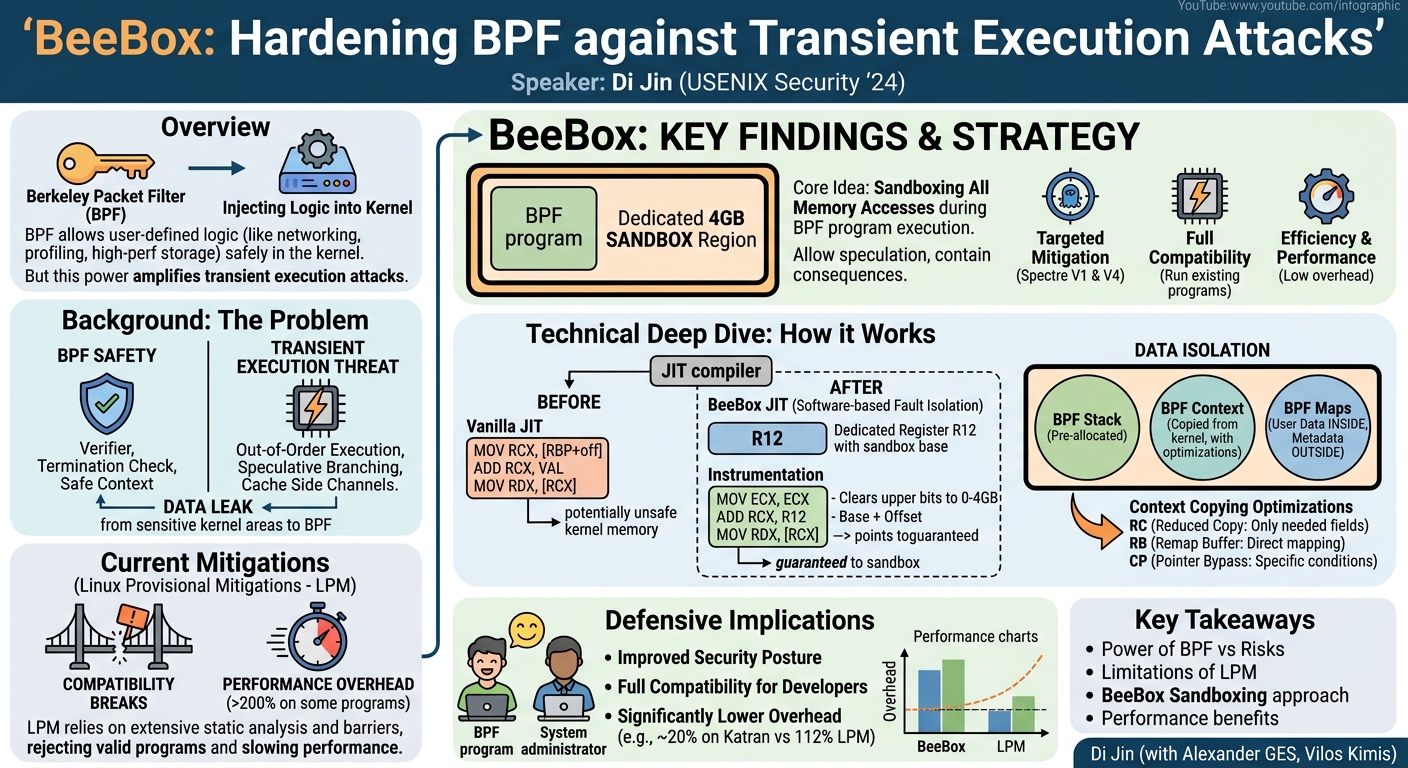
The talk "BeeBox: Hardening BPF against Transient Execution Attacks" by Di Jin introduces a novel framework designed to protect the Berkeley Packet Filter (BPF) from the insidious threat of transient execution attacks. BPF has emerged as a critical kernel feature, allowing user applications to safely delegate complex computations, such as networking, profiling, and high-performance storage, directly into the operating system kernel. While BPF itself is designed with strong safety guarantees, its ability to execute user-defined logic within the kernel context creates a unique amplification vector for existing kernel vulnerabilities, particularly those related to speculative execution.
Key moments
- 0:00 Introduction to BeeBox, BPF, and transient execution problem
- 2:00 Understanding transient execution attacks and their danger with BPF
- 3:30 Limitations of current Linux BPF transient execution mitigations (LPM)
- 4:30 BeeBox's three core goals: defense, compatibility, efficiency
- 5:00 BeeBox's core idea: sandboxing all BPF memory accesses
- 5:50 Detailed example of BeeBox's JIT compilation and pointer instrumentation
- 7:00 How BPF stack, maps, and context are managed within the sandbox
BeeBox: Hardening BPF against Transient Execution Attacks
Speakers: Di Jin
Conference: USENIX Security '24
YouTube: https://www.youtube.com/watch?v=rZ47dOX2snI
Overview
The talk "BeeBox: Hardening BPF against Transient Execution Attacks" by Di Jin introduces a novel framework designed to protect the Berkeley Packet Filter (BPF) from the insidious threat of transient execution attacks. BPF has emerged as a critical kernel feature, allowing user applications to safely delegate complex computations, such as networking, profiling, and high-performance storage, directly into the operating system kernel. While BPF itself is designed with strong safety guarantees, its ability to execute user-defined logic within the kernel context creates a unique amplification vector for existing kernel vulnerabilities, particularly those related to speculative execution.
This presentation details BeeBox, a new approach that rethinks how BPF programs interact with memory during speculative execution. Instead of attempting to prevent all speculative misbehavior, BeeBox focuses on sandboxing all memory accesses made by BPF programs. This ensures that even if speculative execution goes awry, no sensitive kernel data can be inadvertently exposed through side channels. The framework aims to provide robust security against specific Spectre variants, maintain full compatibility with existing BPF programs, and achieve this with significantly lower performance overhead compared to current Linux provisional mitigations.
Background
▶ Watch: Introduction to BeeBox, BPF, and transient execution problem (0:00)
For decades, the operating system kernel and user applications have adhered to a model of strong separation, a cornerstone of system security. However, the relentless demand for higher performance has challenged this paradigm, leading to innovations like BPF. BPF effectively blurs this traditional line by enabling users to inject custom application logic directly into the kernel, acting as a "JavaScript for the kernel" – albeit with enhanced safety features. BPF programs are defined by a small, RISC-like virtual architecture and are statistically verified by an in-kernel verifier upon loading to ensure termination and prevent unintended memory access. For runtime efficiency, BPF programs are typically Just-In-Time (JIT) compiled into native machine code. They interact with the kernel through BPF helpers (predefined kernel functions), access data via the BPF context (data passed from kernel to BPF), utilize a BPF stack for local variables, and store persistent data in BPF maps.
Despite its inherent safety mechanisms, BPF's privileged position within the kernel makes it particularly susceptible to transient execution attacks. These attacks exploit optimizations in modern CPUs, such as out-of-order execution and speculative execution, where instructions are executed ahead of time, often before their control flow dependencies are fully resolved. If a speculative execution path is later determined to be incorrect, the transient instructions are "squashed" and their architectural effects discarded. However, these transient instructions are not entirely ephemeral; they leave behind detectable traces in microarchitectural states, most notably in CPU caches. Attackers can then recover this information via side channels, effectively leaking sensitive data that was never intended to be accessed by the architecturally correct program path.
The combination of BPF and transient execution attacks is particularly dangerous. BPF allows attackers to inject native code patterns directly into the kernel, giving them fine-grained control over execution traces. This proximity to sensitive kernel data and the ability to craft specific speculative execution scenarios often lead to less noisy side-channel signals, potentially bypassing defenses designed for cross-domain attacks. The implications are severe: even a perfectly correct BPF program, verified and deemed safe, can be coerced by the CPU's speculative engine into leaking secret information.
Linux has recognized this threat and implemented Linux Provisional Mitigations (LPM) within its BPF implementation. LPM primarily relies on two strategies: extensive static analysis by the verifier to check all branch and value combinations, aiming to prevent unsafe speculative behavior, and the insertion of speculation barriers to mitigate issues like speculative store bypass (Spectre-V4/STL). While LPM provides a degree of protection, it suffers from significant limitations. Its rigorous static analysis often leads to compatibility breaks, rejecting otherwise legal BPF programs due to the additional constraints imposed by speculative behavior analysis. Furthermore, the insertion of numerous speculation barriers, especially in complex or stack-heavy BPF programs, introduces substantial performance overhead, sometimes exceeding 200%. These drawbacks highlight the need for a more efficient and compatible mitigation strategy, which BeeBox aims to provide.
Key Findings
▶ Watch: Limitations of current Linux BPF transient execution mitigations (LPM) (3:30)
BeeBox presents a fundamentally different approach to hardening BPF against transient execution attacks, addressing the shortcomings of existing Linux Provisional Mitigations (LPM). The framework sets out three primary goals:
- Targeted Mitigation: BeeBox specifically focuses on defending against Spectre-PHT (Spectre V1), which exploits speculative branch prediction, and Spectre-STL (Spectre V4), which targets speculative store bypass. Other transient execution attack instances are left to be handled by generic, system-wide kernel defenses. This focused approach allows for specialized and efficient mitigations where BPF is most vulnerable.
- Full Compatibility: Crucially, BeeBox aims to maintain full compatibility with existing BPF programs. Unlike LPM, it does not impose additional constraints or require changes to BPF program logic, ensuring that valid BPF code is not rejected due to speculative analysis overheads.
- Efficiency and Performance: BeeBox is designed to be efficient and performant, minimizing the runtime overhead introduced by its security mechanisms. This is a significant improvement over LPM, which can incur substantial performance penalties.
The core idea behind BeeBox is elegantly simple: instead of attempting to prevent or meticulously verify every possible speculative execution path, BeeBox allows any speculation or mis-speculation to occur. However, it sandboxes all memory accesses made by BPF programs during their execution. This means that regardless of how speculatively an instruction might behave or where it might attempt to access memory, the actual memory read or written will always be confined to a designated, non-sensitive region. By doing so, BeeBox ensures that no sensitive kernel data can be exposed through side channels, even if speculative execution attempts to access out-of-bounds or privileged memory locations. The strategy is to contain the potential damage of mis-speculation within a safe, isolated environment.
Technical Deep Dive
▶ Watch: BeeBox's three core goals: defense, compatibility, efficiency (4:30)
BeeBox implements its sandboxing strategy using techniques derived from software-based fault isolation (SFI). The fundamental principle is to ensure that all memory accesses within the BPF runtime are constrained to a predefined, secure region.
For each BPF program execution, BeeBox establishes a dedicated 4-gigabyte sandbox region for the user. This region serves as the isolated environment where BPF programs operate. A key component of this architecture is a dedicated register, specifically R12 in the presented x86-64 examples, which is always loaded with the base address of this sandbox region at the beginning of BPF program execution.
The critical innovation lies in the JIT compilation process. When a BPF program is compiled into native machine code, BeeBox instruments all BPF pointers and their dereferences. This instrumentation transforms memory access instructions to ensure they always target the sandbox.
Consider a hypothetical BPF snippet that loads a pointer, adds an offset, and then dereferences it:
In a vanilla JIT compilation, this might translate to instructions like:
If, during speculative execution, the value of RCX (after translation from R3) becomes out-of-bounds or points to a sensitive kernel memory location, the speculative MOV RDX, [RCX] instruction could load sensitive data into RDX, potentially leaving traces in the cache that can be exploited.
BeeBox's JIT compilation process profoundly alters this. The instrumentation ensures that the dereferenced address remains within the sandbox:
The MOV ECX, ECX instruction is crucial here. It effectively clears the upper 32 bits of the 64-bit register RCX, ensuring that the offset value (e.g., 0x1000) remains within the 0 to 4 GB range. When this 32-bit offset is then added to the SANDBOX_BASE_ADDRESS stored in R12, the resulting memory address for the dereference (MOV RDX, [RCX]) is guaranteed to fall strictly within the allocated 4 GB sandbox region. This mechanism ensures that regardless of any speculative miscalculation of RCX, the actual memory access will always be safe.
Beyond instruction instrumentation, BeeBox also ensures that all data required by BPF programs at runtime is placed within the sandbox:
- BPF Stack: The BPF stack, used for local variables, is entirely confined to the sandbox. BeeBox utilizes a pre-allocated region within the sandbox to serve as the stack, simplifying stack management to mere stack pointer changes upon BPF program invocation and termination.
- BPF Maps: BPF maps, which can store user data but may also contain kernel metadata (like raw kernel pointers), are split. The kernel-internal metadata required for map management remains outside the sandbox, accessible only by the kernel. However, the actual data visible and accessible to the BPF program is placed inside the sandbox. This segregation prevents BPF programs from speculatively leaking kernel metadata.
- BPF Context: The BPF context, which encapsulates data passed from the kernel to the BPF program, also needs to reside within the sandbox. Since the context is generated by the kernel, it must be copied into the sandbox for each BPF invocation. The memory management for this context copying can reuse the pre-allocated region designated for the BPF stack.
Copying the BPF context can be a costly operation, especially for performance-sensitive BPF workloads. To mitigate this overhead, BeeBox introduces domain-specific optimizations that leverage BPF's simplicity and analyzability:
- BeeBox RC (Reduced Copy): This optimization employs static analysis to identify precisely which context fields are actually needed by a specific BPF program. Instead of copying the entire context, only the identified, necessary fields are copied into the sandbox, significantly reducing the copy overhead.
- BeeBox RB (Remap Buffer): For BPF program types where the entire context page is semantically accessible and safe for BPF, BeeBox RB avoids copying altogether. Instead, it directly maps the context page into the sandbox whenever the page is allocated, providing a zero-copy solution.
- BeeBox CP (Context Pointer Bypass): In scenarios where the context pointer cannot be speculatively hijacked (e.g., BPF program types with very simple and predictable context usages), BeeBox CP completely avoids transforming the context pointer. This optimization is the most aggressive in reducing overhead but is applicable only under specific, verifiable conditions.
The talk mentions that further interesting details and specifics of these implementations are available in the accompanying paper, indicating the depth of the engineering effort behind BeeBox.
Demo / Proof of Concept
▶ Watch: Detailed example of BeeBox's JIT compilation and pointer instrumentation (5:50)
The presentation did not include a live demonstration or a detailed walkthrough of a proof-of-concept exploit mitigated by BeeBox. Instead, the efficacy and performance of BeeBox were validated through comprehensive evaluation results using synthetic microbenchmarks and real-world workloads. These evaluations serve as empirical evidence of BeeBox's capabilities rather than a direct demonstration.
Defensive Implications
▶ Watch: How BPF stack, maps, and context are managed within the sandbox (7:00)
BeeBox offers significant defensive implications for system administrators, kernel developers, and security practitioners dealing with BPF-enabled systems. The primary benefit is a robust and compatible mitigation against specific, high-impact transient execution attacks like Spectre V1 and Spectre V4, which are particularly dangerous in the kernel context due to BPF's capabilities.
For kernel developers and BPF program authors, BeeBox ensures full compatibility. Unlike LPM, which can reject valid BPF programs due to its strict static analysis of speculative paths, BeeBox's sandboxing approach allows existing BPF code to run without modification or additional constraints. This removes a significant barrier to BPF adoption and development, as developers no longer need to consider speculative execution behavior when writing their programs.
For system administrators and security teams, BeeBox provides an improved security posture for BPF workloads with a much lower performance overhead. The presented evaluation results highlight a stark contrast: BeeBox's most optimized version incurred an average overhead of 0-23% on synthetic benchmarks and approximately 20% on the Katran load balancer benchmark. In contrast, LPM showed over 200% overhead in stack-heavy BPF programs and 112% on Katran. This efficiency means that organizations can deploy BPF programs securely without sacrificing critical performance, which is often a trade-off in security mitigations. For simple cbpf workloads, the overhead was even less than 1%.
The sandboxing approach also simplifies the mental model of BPF security. Instead of relying on complex, potentially incomplete static analysis to prevent speculative misbehavior, BeeBox guarantees that even if mis-speculation occurs, the consequences are contained within a safe region, preventing data leakage. This containment strategy is inherently more resilient to unforeseen speculative execution side channels. While BeeBox focuses on specific Spectre variants, its underlying sandboxing mechanism provides a strong foundation that could potentially be extended or adapted for future transient execution attack vectors, though this would require further research. Overall, BeeBox represents a significant step forward in securing BPF, making this powerful kernel feature more reliable and trustworthy in the face of sophisticated CPU vulnerabilities.
Key Takeaways
- BPF's Dual Nature: BPF is a powerful kernel feature for high-performance computation but also amplifies the risk of transient execution attacks due to its privileged execution context.
- Transient Execution Threat: Modern CPU optimizations like speculative execution can leak sensitive kernel data via side channels (e.g., cache) even from architecturally correct BPF programs.
- Limitations of Existing Mitigations: Linux Provisional Mitigations (LPM) provide some defense but suffer from poor compatibility (rejecting legal programs) and significant performance overhead (over 200% in some cases) due to extensive static analysis and speculation barriers.
- BeeBox's Sandboxing Approach: BeeBox mitigates Spectre V1 (PHT) and Spectre V4 (STL) by allowing speculation but sandboxing all BPF memory accesses within a dedicated 4GB region using software-based fault isolation (SFI) and JIT instrumentation.
- Enhanced Compatibility and Efficiency: BeeBox maintains full BPF program compatibility and achieves significantly lower performance overhead (0-23% on microbenchmarks, ~20% on Katran) compared to LPM, making it a practical and performant security solution.
- Data Isolation: BeeBox ensures BPF stack, context, and map data are either fully within the sandbox or carefully split, preventing sensitive kernel metadata exposure during speculative execution.
About the Speaker(s)
The talk "BeeBox: Hardening BPF against Transient Execution Attacks" was presented by Di Jin. The work was a joint effort with his labmate Alexander GES and his adviser Vilos Kimis. The transcript does not provide specific titles or affiliations for the speakers beyond their academic relationship.
Reviews
Dr. Zero (Offensive Security Researcher) — MUST SEE
BeeBox presents a truly novel and effective sandboxing framework for BPF, directly addressing transient execution attacks like Spectre V1/V4. Its SFI-based JIT instrumentation and smart context optimizations offer robust protection with superior compatibility and significantly lower overhead than current Linux mitigations. This is a critical advancement for kernel security and BPF adoption.
Heather Calloway (CISO) — STRONG ACCEPT
BeeBox addresses a critical and persistent risk in kernel-level BPF operations by offering a robust, performance-efficient mitigation against transient execution attacks. Its focus on full compatibility and significantly lower overhead compared to existing Linux mitigations makes it a crucial development for organizations relying on high-performance kernel features. This work provides clear, actionable guidance for securing a powerful technology without compromising business velocity.